Hestia vs. Vesta
What is the Roman name of Hestia? The Roman name of Hestia is Vesta.
Cicero says the name Vesta comes from the Greek Hestia, and both are virgin goddesses of the hearth. The cults differ in form. Hestia has a place in the middle of every house and a civic hearth in each city's prytaneion, while Rome built a single public cult around Vesta, with priestesses on a state stipend and a temple that held a fire and no statue.
Sections on this page

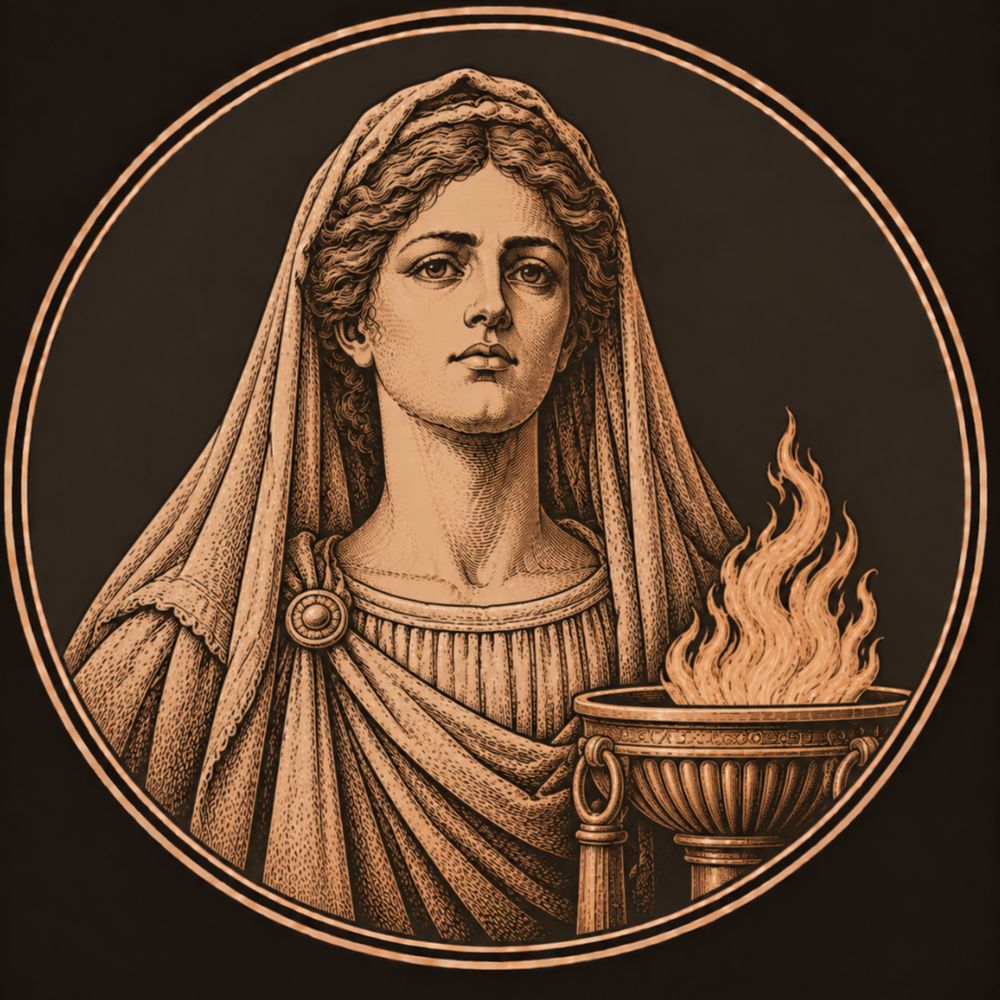
How They Compare
Vesta is the clearest case in the pantheon of a household goddess turned public institution. Greek cities also kept a public hearth for Hestia, but it belonged to each city. The Roman Vesta has one temple, one college of priestesses, and a role in the tale of Rome's own origins.
Side by Side
| Aspect | Hestia | Vesta |
|---|---|---|
| Public role | A place in the middle of every house and a share of honor in all the temples of the gods (Homeric Hymn to Aphrodite 29-32); each city kept her hearth in its prytaneion. | One state fire tended by priestesses chosen by King Numa, paid from public funds and made sacred by a vow of chastity (Livy 1.20.3). |
| Birth order | The first-born of Kronos and Rhea, swallowed first and disgorged last (Hesiod, Theogony 453-458). | The third of Saturn and Ops's daughters, after Juno and Ceres, in Ovid's Fasti. |
| Why she is a virgin | She refuses Poseidon and Apollo and swears an oath by the head of Zeus (Homeric Hymn to Aphrodite 21-32). | Ovid says she alone of the three sisters refused marriage, and that a flame bears no bodies. |
| Cult image | Pausanias saw a figure of Hestia beside one of Peace in the Athenian prytaneion (Description of Greece 1.18.3). | Ovid says the round temple held an unquenched fire and no likeness of her (Fasti 6.295-298). |
| Link to Troy | Her own myths are few: the swallowing by Kronos and her refusal of two suitors. | Virgil has Hector hand Aeneas Vesta and her eternal fire as Troy falls (Aeneid 2.293-297). |
Shared between both
- goddess of the hearth and its fire
- remains a virgin
- child of the Titan king of the golden age (Kronos or Saturn)
- honored at the start or end of prayers
How do Hestia and Vesta differ?
Cicero says the name Vesta comes from the Greek Hestia and that her province is altars and hearths (De Natura Deorum 2.67). The main difference is the form of the public cult. The Homeric hymn gives Hestia a place in the middle of every house and a share in all sacrifices (Homeric Hymn to Aphrodite 29-32). Livy has Numa appoint virgin priestesses to Vesta and pay them from public funds (Ab Urbe Condita 1.20.3).
Cicero, De Natura Deorum 2.67
Are Hestia and Vesta the same goddess?
Romans treated them as one, and Cicero says the name Vesta is the Greek Hestia carried into Latin (De Natura Deorum 2.67). The genealogy is not identical. Hesiod makes Hestia the first child of Kronos and Rhea (Theogony 453-458), while Ovid makes Vesta the third daughter of Saturn and Ops after Juno and Ceres (Fasti 6.285-286).
Hesiod, Theogony 453-458
Which is older, Hestia or Vesta?
Within the myths, Hestia is the eldest of the six children of Kronos, since Hesiod lists her first and she is disgorged last by her father (Theogony 453-458). Ovid gives Vesta a different rank, naming her the third of three sisters (Fasti 6.285-286). The sources therefore disagree about which sister comes first. This concerns story rank, and does not date the two cults.
Hesiod, Theogony 453-458
Did Hestia have a public cult like Vesta's?
In a civic form, yes. Each Greek city kept a hearth-hall, and Pausanias saw figures of Peace and Hestia in Athens's prytaneion beside Solon's laws (Description of Greece 1.18.3). Rome instead built one state cult with a college of priestesses whom Numa paid from public funds (Livy, Ab Urbe Condita 1.20.3). See the prytaneion and the Vestal Virgins.
Pausanias, Description of Greece 1.18.3
How is Vesta tied to the founding of Rome?
Livy has the Vestal Rhea Silvia bear twins and name Mars as their father, and the king imprisons her (Ab Urbe Condita 1.4.2). Virgil has the ghost of Hector hand Aeneas Vesta and her eternal fire as Troy falls (Aeneid 2.293-297). The site's Hestia page ties her instead to the family of the gods and to the household (Theogony 453-458).
Livy, Ab Urbe Condita 1.4.2
Where Accounts Differ
- whether Vesta or Hestia is the elder sister
- whether Vesta had a statue
- Birth order differs. Hesiod makes Hestia the first-born of Kronos and Rhea (Theogony 453-458). Ovid makes Vesta the third daughter of Saturn and Ops (Fasti 6.285-286).
- Ovid contradicts himself on whether Vesta had a statue. In Fasti 3 the statues of Vesta cover their eyes at Rhea Silvia's labour (Fasti 3.45-46), but in Fasti 6 he says no image stands under the dome (Fasti 6.295-298).
The Two Figures
Related Terms
Sources
- Hesiod, Theogony 453-458
- Homeric Hymn to Aphrodite 21-32
- Homeric Hymn to Aphrodite 29-32
- Pausanias, Description of Greece 1.18.3
- Livy, Ab Urbe Condita 1.20.3
- Livy, Ab Urbe Condita 1.4.2
- Virgil, Aeneid 2.293-297
- Ovid, Fasti 6.285-286
- Ovid, Fasti 6.295-298
- Cicero, De Natura Deorum 2.67