Vesta
Vesta is the Roman goddess of the hearth and its sacred fire, kept alight in Rome by the Vestal Virgins. Ovid makes her a daughter of Saturn and Ops and says her temple held no statue, only the flame (Fasti 6.285-286, 6.295-298). The Romans matched her to the Greek Hestia. Livy credits King Numa with founding her priestesses (Ab Urbe Condita 1.20.3).
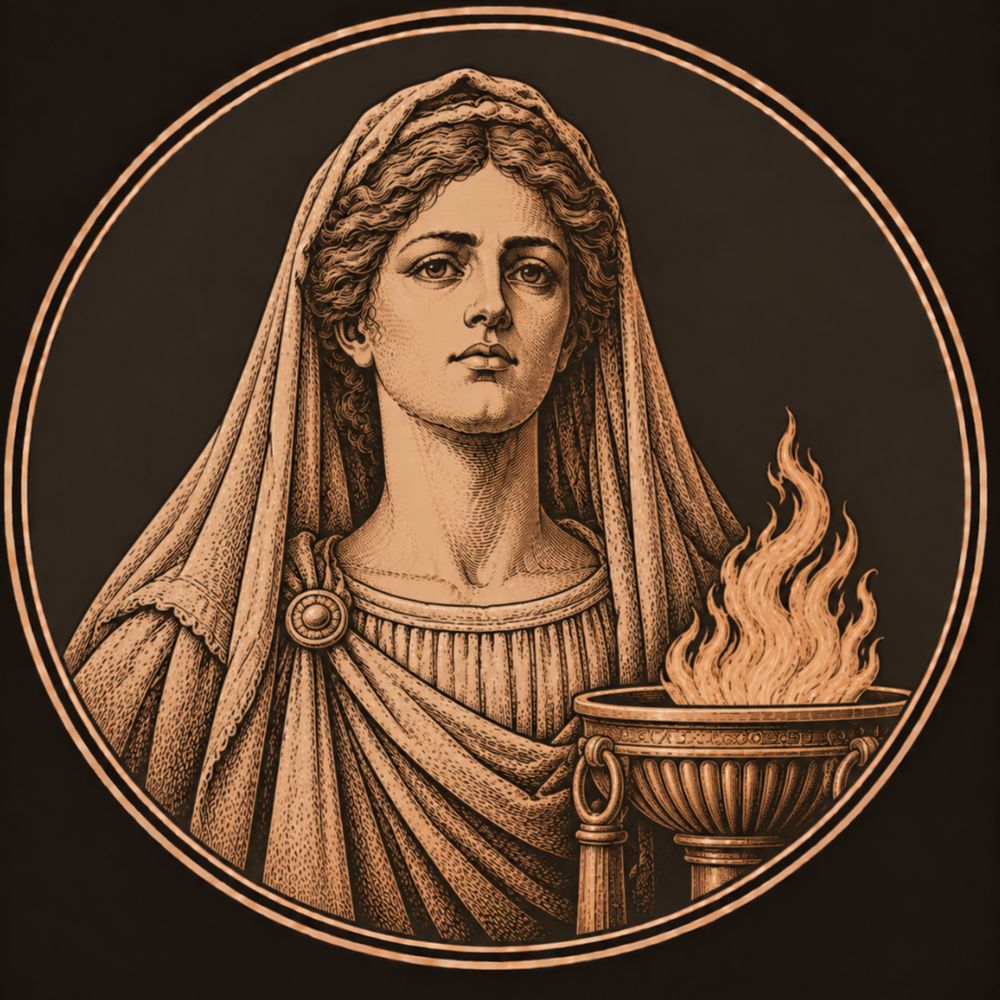
Vesta, bronze medallion illustration
Generated by AI from this page's own facts, not an ancient image or evidence of anything. How this site uses generated images
Sections on this page
Greek vs Roman: Hestia vs. Vesta → See how Hestia differs.
Core Myth
Vesta is the Roman goddess of the hearth. Ovid, the poet of the Roman calendar, gives her the longest treatment we have, in the sixth book of the Fasti. He calls her a daughter of Saturn and Ops, the third of three sisters with Juno and Ceres (Fasti 6.285-286). Of the three, only Vesta refused marriage (Fasti 6.287-288). Ovid adds a second reason for her virginity: she is the living flame, and fire bears no bodies (Fasti 6.291-294).
Her temple in Rome was small, round and old. Ovid says Rome had kept forty Parilia when the goddess was received into her shrine, the work of a peaceful king (Fasti 6.257-260). That king is Numa. The site of her Atrium was once Numa's great house (Fasti 6.263-264). The first building had a thatched roof and walls of woven wicker (Fasti 6.261-262). Ovid gives the temple's round shape an earthly cause. Vesta and the earth are the same, and the earth is a globe (Fasti 6.267-282).
Ovid also tells that no image stood inside. He says he long believed there were statues of Vesta, then learned that nothing sat under the curved dome. An unquenched fire is hidden in the temple, and neither Vesta nor the fire has a likeness (Fasti 6.295-298). The poet stresses that he never saw her, and that no man was meant to (Fasti 6.253-254).
The one story Ovid tells about Vesta herself is comic. Cybele invited the gods to a feast on Mount Ida, and Vesta fell asleep on the grass (Fasti 6.321-332). The garden god Priapus saw her and crept closer, though he claims he thought she was a nymph (Fasti 6.333-336). Silenus had left his donkey by a stream, and it brayed at the wrong moment. The goddess woke, the gods came running, and Priapus ran off (Fasti 6.339-344). Ovid says this is why Roman bakers hang loaves on donkeys at her festival (Fasti 6.311-312; 6.347).
Vesta also stands behind the origin of Rome. King Amulius made his niece Rhea Silvia a Vestal, so that she would have no children (Livy, Ab Urbe Condita 1.3.11). She bore twins and named Mars as their father, and Amulius imprisoned her (Livy, Ab Urbe Condita 1.4.2). Ovid sets the scene at a riverbank, where Silvia the Vestal came at dawn to fetch water for the rites (Fasti 3.11-24). When she gave birth, the statues of Vesta were said to cover their eyes, and the altar shook (Fasti 3.45-48). The infants were Romulus and Remus.
Are Hestia and Vesta the same?
Roman writers treated them as the same goddess under two names. Cicero says the name Vesta comes from the Greek Hestia and that her province is altars and hearths (De Natura Deorum 2.67). The cults differed. Hesiod makes Hestia the first child of Cronus and Rhea (Theogony 453-458), while Ovid makes Vesta the third daughter of Saturn and Ops (Fasti 6.285-286). Rome also gave Vesta a state priesthood of virgins, while Plutarch says Greek perpetual fires at Delphi and Athens were tended by widows (Life of Numa 9.5).
Cicero, De Natura Deorum 2.67
Is the flame of Vesta still burning?
No. The fire in Rome's temple went out when the cult ended. Zosimus tells of the last Vestal cursing Serena, but he does not date the fire's end (New History 5.38). Modern historians place the closing of the temple in the early 390s under Theodosius I, and usually give 394. Plutarch says the fire could be relit only from the sun's rays, using concave mirrors (Life of Numa 9.6-7). No ancient source I found describes any flame that has burned since. The ruins of the Atrium Vestae stand in the Roman Forum.
Ovid, Fasti 3.135-144
Why is Vesta so important?
Vesta was the goddess of the hearth, and Rome treated its public hearth as the pledge of the city's safety. Her flame stood for the household of the whole state. Virgil has Hector hand Aeneas Vesta and her eternal fire as Troy falls (Aeneid 2.296-297). Ovid says her worship has a place in every prayer and that the pledges of fate were kept under her watch (Fasti 6.303-304; 6.435-436). Livy says King Numa paid her priestesses from public funds so they could give their whole time to the temple (Ab Urbe Condita 1.20.3).
Virgil, Aeneid 2.296-297
What did Vestal Virgins do?
The Vestal Virgins kept Vesta's fire burning and lived under a vow of chastity. Livy says Numa gave them a public stipend and made their persons sacred (Ab Urbe Condita 1.20.3). Plutarch says they served for thirty years, learning for ten, serving for ten and teaching for ten (Life of Numa 10.1). They could also spare a condemned criminal they met on the road (Life of Numa 10.3). A Vestal who broke her vow was buried alive (Life of Numa 10.4-7). Some held that they guarded hidden sacred objects as well as the fire (Life of Numa 9.8).
Livy, Ab Urbe Condita 1.20.3
What does Vesta mean?
The ancient sources give two answers. Cicero says the name is the Greek Hestia carried into Latin (De Natura Deorum 2.67). Ovid offers a word play. The earth stands by its own force (vi stat), and Vesta is named from standing by force, perhaps for the same reason as the Greek name (Fasti 6.299-300). Ovid also links focus, the hearth, to fire that warms everything, and suggests vestibulum is named for her (Fasti 6.301-304). These are ancient guesses, and the sources do not settle the word's origin.
Ovid, Fasti 6.299-300
Later Traditions
Roman writers disagree on who founded the Vestal Virgins order. Livy says Numa chose virgins as priestesses of Vesta, and that the order had begun in Alba (Livy, Ab Urbe Condita 1.20.3). Plutarch, in the Life of Numa, says the consecration of the Vestals is ascribed to Numa (Life of Numa 9.5). In the Life of Romulus he records that some say Romulus first introduced the sacred fire and its virgin guards (Plutarch, Life of Romulus 22.1).
The Vestals kept the fire and were bound by strict rules. Plutarch says they vowed chastity for thirty years: ten to learn, ten to serve, ten to teach (Life of Numa 10.1). They had privileges. They could make wills and manage property without a guardian, and a criminal they met on the way to execution was spared (Life of Numa 10.3). A Vestal who broke her vow was buried alive near the Colline gate (Life of Numa 10.4-7). If the fire ever went out, Plutarch says, it had to be made new from the rays of the sun with concave mirrors (Life of Numa 9.6-7). Ovid adds that a new fire was lit in the shrine in March (Fasti 3.143-144).
What the Vestals guarded is disputed. Plutarch reports that some hold that they tend only the fire, while others think they also hide sacred objects that no one else may see (Life of Numa 9.8). Ovid says the temple guarded the pledges of Roman fate that Vesta watches over. He does not say who carried the Palladium from Troy: Diomedes, Ulysses and Aeneas are all named (Fasti 6.433-436). When fire broke out in the temple, the pontifex Metellus rushed in and carried the pledges out himself, though no man was supposed to enter (Fasti 6.437-454).
Virgil links Vesta to Troy. In the night of the city's fall, the ghost of Hector commends Troy's Penates to Aeneas and hands him the fillets, Vesta's power and her eternal fire from the inner shrine (Aeneid 2.293-297). This is why Ovid calls Vesta's hearth Trojan (Fasti 3.142; 6.456).
Greek and Roman religion differed in who kept the fire. Plutarch says that in Greece, perpetual fires such as those at Delphi and Athens were tended by widows past marriage, not virgins (Life of Numa 9.5). Cicero says her name comes from the Greek Hestia and that she rules altars and hearths, and that prayers and sacrifices end in her name (De Natura Deorum 2.67).
The cult ended in late antiquity. Zosimus tells that when the noblewoman Serena took a necklace from a statue and wore it, the only remaining Vestal cursed her (Zosimus, New History 5.38). Zosimus does not date the end of the fire. Modern historians place the closing of the temple in the early 390s under Theodosius I, and 394 is the year usually given.
The Roman and Greek hearth goddesses are set side by side in Hestia vs Vesta.
Lineage
See the full family tree4 recorded relations, each with the ancient line behind it.
Parents
-

disputed
Ovid names Ops as mother of Juno, Ceres and Vesta by Saturn's seed.
-
Ovid says Juno and Ceres were born of Ops by Saturn's seed, and that Vesta was the third.
Siblings
-

Ovid lists Juno, Ceres and Vesta as the three daughters of Ops and Saturn.
-

Ovid lists Juno, Ceres and Vesta as the three daughters of Ops and Saturn.
Also Connected
3 recorded connections, each with the ancient line behind it.
Connected
-
Hector's ghost gives Aeneas the fillets, Vesta and her eternal fire from the inner shrine as Troy falls.
-
Livy says Numa chose the priestesses of Vesta, gave them a public stipend and made them sacred by a vow of chastity.
-

Romulus's mother Rhea Silvia was a Vestal, made so by Amulius, and she named Mars as the father of her twins.
Where Accounts Differ
- who founded the Vestal cult
- whether Vesta had a statue
- why the temple is round
- whether Vesta or Hestia is the elder sister
- why the Vestals were virgins
- whether prayers begin or end with Vesta
- who carried the Palladium from Troy
- when the Vestal fire went out
- The sources disagree on who founded the Vestal cult. Livy gives Numa credit and says the order began in Alba (Ab Urbe Condita 1.20.3). His own account of Rhea Silvia, made a Vestal by Amulius before Numa, already assumes the order existed (Ab Urbe Condita 1.3.11). Plutarch ascribes the consecration of the Vestals to Numa in one Life (Numa 9.5) and reports in another that some say Romulus first appointed them (Romulus 22.1).
- Ovid contradicts himself on whether Vesta had statues. In Book 3 the statues of Vesta cover their eyes at Silvia's labour (Fasti 3.45-46). In Book 6 he says he long believed in images of Vesta, then learned that no image stands under the dome (Fasti 6.295-298). Zosimus writes of a statue of Vesta whose necklace Serena took (New History 5.38). Translations differ on which goddess the statue shows, so this passage is not used here to settle the question.
- The temple's round shape has two explanations. Ovid says it copies the globe of the earth, which he equates with Vesta (Fasti 6.267-282). Plutarch says Numa did not mean the shape of the earth but of the whole universe, with fire at the Pythagorean centre (Life of Numa 11.1).
- Vesta's birth order differs between Greek and Roman accounts. Hesiod makes Hestia the first of Cronus's children (Theogony 453-458). Ovid makes Vesta the third, after Juno and Ceres, all children of Saturn and Ops (Fasti 6.285-286).
- Why the Vestals were virgins has three ancient answers. Ovid says Vesta alone of the three sisters refused marriage (Fasti 6.287-290), and that a flame bears no bodies (Fasti 6.291-294). Plutarch says Numa thought fire pure and uncorrupted, or barren and so akin to virginity (Life of Numa 9.5).
- Cicero says prayers and sacrifices end in Vesta's name (De Natura Deorum 2.67). Ovid says prayers begin with her, because she holds the first places (Fasti 6.303-304).
- Ovid does not say who took the Palladium from Troy. He lists Adrastus's son-in-law Diomedes, Ulysses and Aeneas as the candidates, and says only that Vesta now guards it (Fasti 6.433-436).
- The end of the flame is not recorded in the sources checked here. Zosimus tells only of the last Vestal's curse on Serena (New History 5.38). The closing under Theodosius I, usually dated to 394, comes from modern reconstruction, not from a passage I could check.
Read the full source verification →
Mythology
Equivalent Figures
Referenced By
Sources
- Ovid, Fasti 3.11-48
- Ovid, Fasti 3.135-144
- Ovid, Fasti 6.249-304
- Ovid, Fasti 6.311-348
- Ovid, Fasti 6.421-460
- Livy, Ab Urbe Condita 1.3.11
- Livy, Ab Urbe Condita 1.4.2
- Livy, Ab Urbe Condita 1.20.3
- Virgil, Aeneid 2.293-297
- Plutarch, Life of Romulus 22.1
- Cicero, De Natura Deorum 2.67
- Hesiod, Theogony 453-458