Numa Pompilius
Numa Pompilius is the legendary second king of Rome, chosen from the Sabine town of Cures after Romulus. Livy says he shut the temple of Janus in peace, founded the Vestals, Salii and pontiffs, and claimed the advice of the nymph Egeria. He reigned 43 years in the tradition. Ovid has him draw a sacred shield from Jupiter. Whether he was a pupil of Pythagoras is disputed.
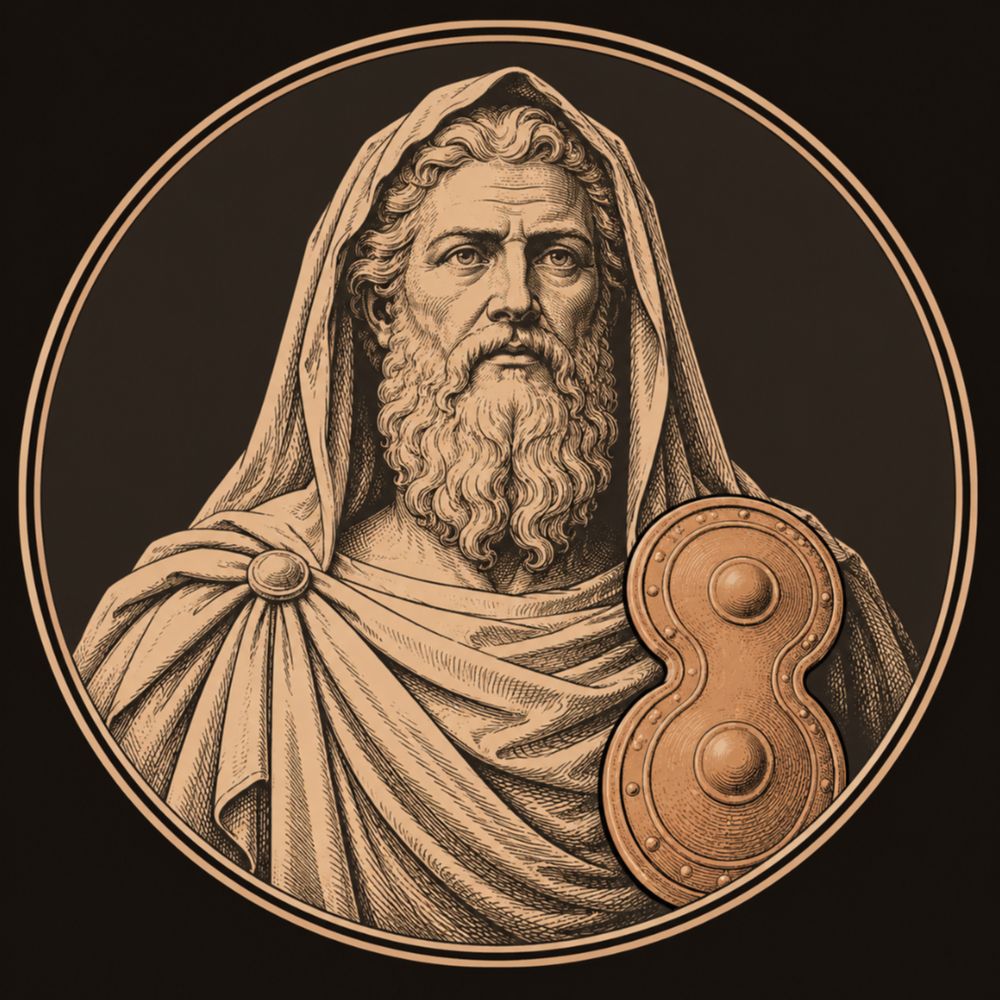
Numa Pompilius, bronze medallion illustration
Generated by AI from this page's own facts, not an ancient image or evidence of anything. How this site uses generated images
Sections on this page
Core Myth
Numa Pompilius is a figure of Roman legend, and no source cited here is close to his time. Livy, Plutarch and Dionysius of Halicarnassus write centuries after the dates they give him. In their story he follows Romulus as the second king of Rome. Livy gives him a reign of 43 years, against 37 for Romulus (Ab Urbe Condita 1.21). Where Romulus founded the city by war, Numa is the king who is said to have founded it anew by law and worship (Ab Urbe Condita 1.19).
He came from Cures, a Sabine town. Plutarch calls him the youngest son of an illustrious man named Pompon. He was born, Plutarch says, on the very day Romulus founded Rome, 21 April (Life of Numa 3). His wife was Tatia, daughter of Titus Tatius, who had ruled beside Romulus. She died in the thirteenth year of their marriage (Life of Numa 3). Livy calls him a man famed for justice and piety, and as learned in divine and human law as anyone of his age could be (Ab Urbe Condita 1.18.1).
The Roman senators, Livy says, saw that a Sabine king would tip the balance of power toward the Sabines. Yet none dared propose anyone else, and they decreed the crown to Numa (Ab Urbe Condita 1.18). Plutarch adds that he was nearly forty when envoys reached him. He refused at first, and his father and a relative had to persuade him (Life of Numa 5; Life of Numa 6). Dionysius also puts him near forty at his selection (Roman Antiquities 2.58).
Numa then asked that the gods be consulted, as they had been for Romulus. An augur led him to the citadel and seated him on a stone facing south. Holding the augur's crooked staff, the lituus, the augur prayed to Father Jupiter that if Numa were to be king, he should show it by sure signs. The signs came, and Numa came down from the sacred space as king (Ab Urbe Condita 1.18).
Livy says Numa saw that a city just founded by arms could not be settled while war lasted. Believing that disuse of arms would soften his subjects, he made the shrine of Janus a sign of peace and war. Open, it showed Rome under arms. Shut, it showed every neighbour at peace (Ab Urbe Condita 1.19.2). Livy notes it had been shut only twice since, once after the First Punic War and once after Actium under Augustus (Ab Urbe Condita 1.19.3). Numa also made treaties with all his neighbours (Ab Urbe Condita 1.19.4).
Peace alone would breed idleness, so Numa set out to teach fear of the gods. Livy says he pretended to hold night meetings with the nymph Egeria, and to institute the rites on her advice (Ab Urbe Condita 1.19.5). He divided the year into twelve months, added intercalary months, and marked days when legal business could and could not be done (Ab Urbe Condita 1.19.6-1.19.7).
Livy then lists his priesthoods. Numa performed many rites himself, especially those later given to the Flamen of Jupiter. He named a permanent flamen for Jupiter, and two more for Mars and Quirinus (Ab Urbe Condita 1.20.1-1.20.2). He also chose the priestesses of Vesta, the Vestal Virgins. They were given a public stipend and made sacred by a vow of chastity and other rules (Ab Urbe Condita 1.20.3). Plutarch gives the same king the temple of Vesta with its round shape and perpetual fire (Life of Numa 11).
He chose twelve Salii for Mars Gradivus. They wore an embroidered tunic and a bronze breastplate, and carried the twelve heavenly shields called ancilia through the city, singing and dancing (Ab Urbe Condita 1.20.4). He made Numa Marcius the first pontifex and put every sacred rule, written and sealed, in his charge. The pontifex also taught funeral rites and how to expiate lightning and other prodigies (Ab Urbe Condita 1.20.5-1.20.6). To draw such signs from the gods, Numa dedicated an altar to Jupiter Elicius on the Aventine (Ab Urbe Condita 1.20.7).
Livy says the neighbouring peoples came to think it wrong to harm a state so devoted to the gods. Numa often withdrew to a grove with a stream flowing from a dark cave, and dedicated it to the Camenae, because he met his wife Egeria there. He also began a yearly sacrifice to Fides, Faith (Ab Urbe Condita 1.21). Livy names the peace and security of his whole reign as his greatest work (Ab Urbe Condita 1.21).
Ovid tells the origin of the ancilia differently. In the Fasti the nymph Egeria, wife and councillor to Numa, tells of a thunderstorm that terrified the Romans. She told the king to catch the woodland gods Picus and Faunus and force them to teach the expiation (Fasti 3.259-322). They in turn drew Jupiter down from the sky, which is why he is called Elicius (Fasti 3.323-358). Jupiter answered in riddles, and Numa answered them with an onion, hair and a fish. The god laughed, and promised proof of empire at sunrise (Fasti 3.323-358).
At dawn the god thundered three times. A shield fell from the clear sky, and Numa sacrificed a heifer and called it the ancile. He then had many copies made so a traitor could not tell the true one, and the smith Mamurius made them. As his reward, Mamurius asked that his name be sung at the end of the Salii's song (Fasti 3.359-392). Plutarch has a similar story with the shield falling during a plague in Numa's eighth year, and the Salii guarding twelve shields (Life of Numa 13).
What was Numa Pompilius known for?
Numa was known as the king who gave Rome its religion. Livy says he built up the priesthoods of Jupiter, Mars and Quirinus, chose the Vestals and the twelve Salii, and appointed the first pontifex (Ab Urbe Condita 1.20.1-1.20.7). He is also credited with the Janus shrine as a sign of war and peace, and with a calendar of twelve months (Ab Urbe Condita 1.19.2; Ab Urbe Condita 1.19.6).
Livy, Ab Urbe Condita 1.20.1-1.20.7
What happened to Numa Pompilius?
He died of old age after a reign Livy puts at 43 years (Ab Urbe Condita 1.21). Dionysius says he lived past eighty, died the gentlest of deaths, and was buried on the Janiculum (Roman Antiquities 2.76). In Livy, two stone chests were found there long afterward. The one marked as his tomb was empty, and the other held books, which the senate ordered burned (Ab Urbe Condita 40.29).
Dionysius of Halicarnassus, Roman Antiquities 2.76
Was Numa a good king?
The sources judge him an excellent king, though they differ on his methods. Livy names the preservation of peace and security through his whole reign as his greatest work (Ab Urbe Condita 1.21). He also says Numa pretended to consult Egeria to make people fear the gods (Ab Urbe Condita 1.19.5). Plutarch says his fame shone brighter after death, because the kings after him met violent or unhappy ends (Life of Numa 22).
Livy, Ab Urbe Condita 1.21
Later Traditions
The tradition that Numa studied under Pythagoras is old, and the best sources reject it. Livy says the story that Pythagoras was his teacher is erroneous, since Pythagoras taught in southern Italy more than a century later, in the reign of Servius Tullius. He asks how such fame could have reached the Sabines, and prefers to credit Numa's own character and the austere Sabine discipline (Ab Urbe Condita 1.18.2). Dionysius agrees. He notes that Pythagoras lived about four generations later, and that Croton did not yet exist when Numa was called to rule (Roman Antiquities 2.59). Plutarch reports the dispute without settling it, and notes some say a different Pythagoras, a Spartan runner, is meant (Life of Numa 1).
Ovid ignores the objection. In Book 15 of the Metamorphoses, Fame picks Numa as Romulus's successor. His heart is not content with Sabine rites, and he travels to the Greek city of Croton (Metamorphoses 15.1-8). There he hears the Samian exile who taught there, a figure the tradition names Pythagoras (Metamorphoses 15.60-72). Ovid returns him to Italy "well taught" by such precepts, blessed with a nymph as wife and the Muses as guides. He taught rites of sacrifice and trained a people used to war in the arts of peace (Metamorphoses 15.479-484).
Ovid also gives Egeria an ending. When Numa died, the Latin matrons, the senators and all the people wept. The nymph withdrew to the grove of Aricia and mourned so loudly that she disturbed the rites of Diana. The exile Hippolytus, living there as Virbius, tried to console her with his own story. She lay at the foot of a mountain dissolved in tears until Diana turned her body into a spring (Metamorphoses 15.479-551).
Egeria's role is contested. Livy says outright that Numa pretended to meet her (Ab Urbe Condita 1.19.5). Plutarch compares the tale to other legends of mortals loved by gods. He allows that a god might befriend a very good man, but doubts that a god took bodily pleasure in a mortal. He also records the view that lawgivers like Numa and Lycurgus claimed divine sanction to manage unruly people (Life of Numa 4). Dionysius records both a nymph and one of the Muses, and adds that sceptics said Numa invented her to make the people fear the gods (Roman Antiquities 2.60; Roman Antiquities 2.61).
Also Connected
5 recorded connections, each with the ancient line behind it.
Connected
-
Livy credits Numa with the shrine of Janus, open in war and shut in peace, as a sign of the peace he wanted for Rome.
-

Livy says Numa gave Jupiter a permanent flamen and dedicated an altar to Jupiter Elicius; Ovid has Numa draw the god down and receive the sacred shield.
-

Livy says Numa chose a flamen for Mars and twelve Salii for Mars Gradivus to carry the heavenly shields called ancilia.
-
Livy sets Numa after Romulus as the second king, and contrasts the greatness Romulus won by war with the greatness Numa won by peace.
-
Livy says Numa chose the priestesses of Vesta, gave them a public stipend and made them sacred by a vow of chastity.
Where Accounts Differ
- whether Numa was a pupil of Pythagoras
- whether Egeria is real
- where the sacred shield comes from
- the books found on the Janiculum
- Numa is legendary or at best semi-legendary. Livy, Plutarch, Dionysius and Ovid write centuries after the reign they describe, and the 43-year reign is the tradition's figure, not a documented one.
- Whether Numa studied under Pythagoras is disputed. Livy and Dionysius reject it on chronology (Ab Urbe Condita 1.18.2; Roman Antiquities 2.59), Plutarch leaves the question open (Life of Numa 1), and Ovid tells it as fact (Metamorphoses 15.1-8; Metamorphoses 15.479-484).
- Who Egeria is, and whether she is real, differs. Livy says Numa pretended to meet her (Ab Urbe Condita 1.19.5). Plutarch weighs a divine marriage against a lawgiver's pretence (Life of Numa 4). Dionysius says some called her a nymph and others one of the Muses (Roman Antiquities 2.60). Ovid treats her as Numa's real wife and counsellor (Fasti 3.259-322; Metamorphoses 15.479-551).
- The origin of the sacred shields differs. Livy credits Numa with the twelve Salii and the shields but gives no origin (Ab Urbe Condita 1.20.4). Ovid has one shield fall from the sky after Jupiter Elicius is summoned (Fasti 3.359-392). Plutarch has it fall during a plague in Numa's eighth year (Life of Numa 13).
- The number and content of the books found on the Janiculum differs. Livy has seven Latin books on pontifical law and seven Greek books on philosophy in the chest (Ab Urbe Condita 40.29). Plutarch says Numa himself had them buried with him, and gives twelve pontifical and twelve Greek books only on the authority of Antias (Life of Numa 22).
- The site of the Janus shrine is left out because the Perseus English of Livy 1.19.2 says the foot of the Aventine, where the Latin has the foot of the Argiletum. Livy 40.29 is cited from the Latin text on The Latin Library, because the Perseus English edition stops at book 10. The Ovid Fasti lines are checked against the Theoi English text, which marks lines at intervals; ranges given here are cut at those markers. Plutarch's and Dionysius's chapters are checked on LacusCurtius, which does not number every section.
Read the full source verification →
Mythology
Related Terms
Sources
- Livy, Ab Urbe Condita 1.18.1
- Livy, Ab Urbe Condita 1.18.2
- Livy, Ab Urbe Condita 1.18
- Livy, Ab Urbe Condita 1.19
- Livy, Ab Urbe Condita 1.19.2
- Livy, Ab Urbe Condita 1.19.3
- Livy, Ab Urbe Condita 1.19.4
- Livy, Ab Urbe Condita 1.19.5
- Livy, Ab Urbe Condita 1.19.6
- Livy, Ab Urbe Condita 1.19.6-1.19.7
- Livy, Ab Urbe Condita 1.20.1-1.20.2
- Livy, Ab Urbe Condita 1.20.1-1.20.7
- Livy, Ab Urbe Condita 1.20.3
- Livy, Ab Urbe Condita 1.20.4
- Livy, Ab Urbe Condita 1.20.5-1.20.6
- Livy, Ab Urbe Condita 1.20.7
- Livy, Ab Urbe Condita 1.21
- Plutarch, Life of Numa 1
- Plutarch, Life of Numa 3
- Plutarch, Life of Numa 4
- Plutarch, Life of Numa 5
- Plutarch, Life of Numa 6
- Plutarch, Life of Numa 11
- Plutarch, Life of Numa 13
- Plutarch, Life of Numa 21
- Plutarch, Life of Numa 22
- Ovid, Fasti 3.259-322
- Ovid, Fasti 3.323-358
- Ovid, Fasti 3.359-392
- Ovid, Metamorphoses 15.1-8
- Ovid, Metamorphoses 15.60-72
- Ovid, Metamorphoses 15.479-484
- Ovid, Metamorphoses 15.479-551
- Dionysius of Halicarnassus, Roman Antiquities 2.58
- Dionysius of Halicarnassus, Roman Antiquities 2.59
- Dionysius of Halicarnassus, Roman Antiquities 2.60
- Dionysius of Halicarnassus, Roman Antiquities 2.61
- Dionysius of Halicarnassus, Roman Antiquities 2.76