Roman Mythology
Roman mythology is the body of stories Rome told about its gods and its own founding. A great deal of it was absorbed from Greek myth and given Latin names, but not all of it was: Rome kept indigenous Italic gods with no Greek counterpart, and it built a set of foundation legends, from Aeneas to Romulus, that the Greeks never told.
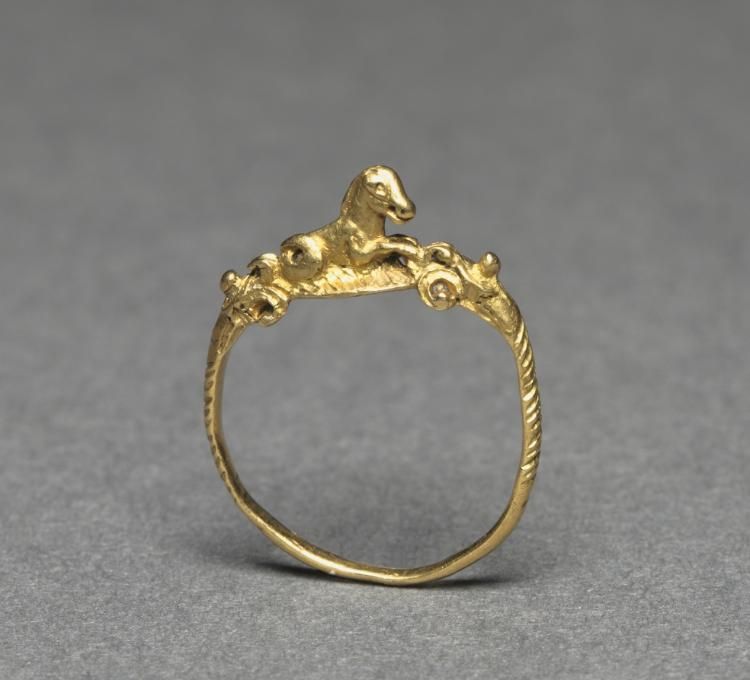
Ring with Hippocampus - Italy, Roman, 100–200 CE, gold
The Cleveland Museum of Art, Cleveland, OH, 1916.101. CC0
Sections on this page
Cosmology
Roman religion was organised around cult and calendar more than around a cosmology. Where Greek writers set out a genealogy of the universe beginning with Chaos, Roman practice concentrated on which god received which rite, on which day, and at which altar. Livy, for instance, records the year a temple was dedicated to Saturn and the Saturnalia was made a festival day. The cosmological material that survives in Latin is largely borrowed: Ovid opens the Metamorphoses with a creation drawn from Greek and Hellenistic models, and Virgil's account of the ages of the world follows Hesiod. What was distinctly Roman lay elsewhere, in a dense map of divine functions. There were gods of doorways, boundaries, granaries, and the household hearth, many of them without myths at all. A Roman god could be fully real to worship and yet have no story, which is a shape of religion that Greek myth does not prepare a reader for.
Mythological Timeline
Almost every Latin text a modern reader meets is late. Rome had been worshipping Jupiter for centuries before anyone wrote the surviving accounts of him. The great literary sources belong to a single generation under Augustus: Virgil died in 19 BCE, Ovid was exiled in 8 CE, and Livy finished his history in the same decades. That timing matters for reading them. These writers worked when Rome had already absorbed Greek literature wholesale. Several of them wrote with an emperor's programme in view. A Roman myth as we have it is often a Greek story retold by a poet with a political present in mind. Earlier Italic religion has to be reconstructed from ritual calendars, inscriptions, and the antiquarian remarks these same late authors make in passing.
Are the Roman gods just the Greek gods with different names?
Partly, and the exception matters. Romans systematically identified foreign gods with their own, a habit modern scholars call interpretatio romana, and by the late Republic Jupiter was routinely equated with Zeus and Minerva with Athena. What travelled across in that equation was mostly the stories, not the cult. Roman Jupiter kept his own priesthood, his own temple on the Capitol, and his own festivals, none of which came from Greece. And some Roman gods have no Greek counterpart at all: Janus, the two-faced god of doorways and beginnings, is the standard example, invoked first in Roman prayer and absent from Greek religion entirely.
Ovid, Metamorphoses 14.805-851
Which Roman myths have no Greek original?
The foundation legends. Rome's own myths concern the making of the city rather than the making of the world: Aeneas escaping Troy and reaching Italy, the twins Romulus and Remus suckled by a she-wolf, the seizure of the Sabine women, and the reign of Numa, who was said to have received Rome's religious law from the nymph Egeria. These stories are Roman in a way the Olympian material is not, and they carry a political charge the Greek stories lack, because each of them explains why Rome ought to hold the position it holds.
Ovid, Metamorphoses 14.581-608
Why do Roman writers matter for Greek myth?
Because they often preserve the fullest version that survives. Ovid's Metamorphoses gathers hundreds of Greek stories into a single poem, and for a number of them his is the earliest complete account we still have; the Greek originals he worked from are lost. This puts a reader in an awkward position. The best surviving telling of a Greek myth may be a Latin poem written centuries later by an author with his own literary purposes, so a story cited as Greek is frequently being read through Ovid without that being said.
Ovid, Metamorphoses 1.5-88
Why does Rome have two different founding stories?
Rome tells both the story of Aeneas, a Trojan prince who escapes the fall of Troy and eventually settles in Italy, and the story of Romulus and Remus, twins suckled by a she-wolf who found the city itself centuries later. Roman authors did not treat these as competing accounts to choose between; they linked them into one sequence, making Romulus a distant descendant of Aeneas, so that Rome's founding carried both a prestigious link to the fall of Troy and a home-grown origin for the city's actual walls and institutions.
Virgil, Aeneid 1.1-33
Did the Romans think their myths were literally history?
Educated Romans held a more complicated view than a flat yes or no. Livy opens his history of Rome by saying that events before the city's founding belong to poetic legend rather than sound historical record, and he includes the traditional stories anyway because they were part of how Rome understood its own identity, not because he vouches for every detail. Roman religious practice, meanwhile, treated the gods themselves as fully real regardless of how literally any individual story about them was taken.
Livy, Ab Urbe Condita 1.1-16
Where Accounts Differ
- extent of Greek borrowing
- date of the foundation legends
- Indigenous Italic religion is reconstructed largely from ritual calendars and from antiquarian remarks in authors who were already writing in a Hellenised literary culture.
- Where a Roman god is equated with a Greek one, the equation is treated here as a historical practice rather than as evidence that the two were the same god.
Major Figures
Comparisons
- Comparison Zeus vs. Jupiter
- Comparison Hera vs. Juno
- Comparison Poseidon vs. Neptune
- Comparison Athena vs. Minerva
- Comparison Ares vs. Mars
- Comparison Aphrodite vs. Venus
- Comparison Hermes vs. Mercury
- Comparison Artemis vs. Diana
- Comparison Hephaestus vs. Vulcan
- Comparison Demeter vs. Ceres
- Comparison Dionysus vs. Bacchus
- Comparison Hades vs. Pluto
Key Terms
Referenced By
- Term Acheron
- Term Aegis
- Story Aeneas and Turnus
- Character Apollo in Rome
- Term Apotheosis
- Term Bident
- Term Bow and Arrow
- Term Caduceus
- Character Camilla
- Term Cassandra
- Term Catabasis
- Term Cocytus
- Term Cornucopia
- Term Cumaean Sibyl
- Character Cupid
- Character Cybele
- Term Delphi
- Term Dove
- Term Elysium
- Term Epithet
- Character Fortuna
- Term Golden Age
- Term Graeae
- Term Hecatomb
- Character Hercules
- Character Janus
- Term Kleos
- Term Lares and Penates
- Character Latinus
- Term Laurel Wreath
- Term Lethe
- Character Lucretia
- Term Lupercalia
- Term Maenads
- Term Nemesis (Concept)
- Term Nostos
- Character Numa Pompilius
- Character Ops
- Term Owl
- Term Peacock
- Term Phoenix
- Character Proserpina
- Term Pythia
- Character Remus
- Topic Roman Heroes: Founders, Kings, Rivals and Lucretia
- Character Romulus
- Character Saturn
- Term Saturnalia
- Term Satyrs
- Term Scallop Shell
- Story The Founding of Rome
- Story The Rape of the Sabine Women
- Topic The Roman Gods: The Capitoline Triad, the Twelve and the Older Cults
- Term Thunderbolt
- Term Thyrsus
- Term Trident
- Term Trojan Horse
- Character Turnus
- Character Ulysses
- Character Vesta
- Term Vestal Virgins
- Term Winged Sandals
Sources
- Ovid, Metamorphoses 1.5-88
- Ovid, Metamorphoses 14.581-608
- Virgil, Aeneid 1.1-33
- Livy, Ab Urbe Condita 1.1-16
- Ovid, Fasti 1.1-44
- Livy, Ab Urbe Condita 2.21