Proserpina
Proserpina is the Roman goddess of the underworld, the daughter of Ceres whom Pluto carries off in Sicily. Ovid adds a Roman motive: Venus sends Cupid to wound Pluto with desire (Metamorphoses 5.363-384). Jupiter lets her return to Ceres for half the year (Metamorphoses 5.533-571). Romans identified her with the Greek Persephone, and Virgil makes the golden bough sacred to her (Aeneid 6.136-148).
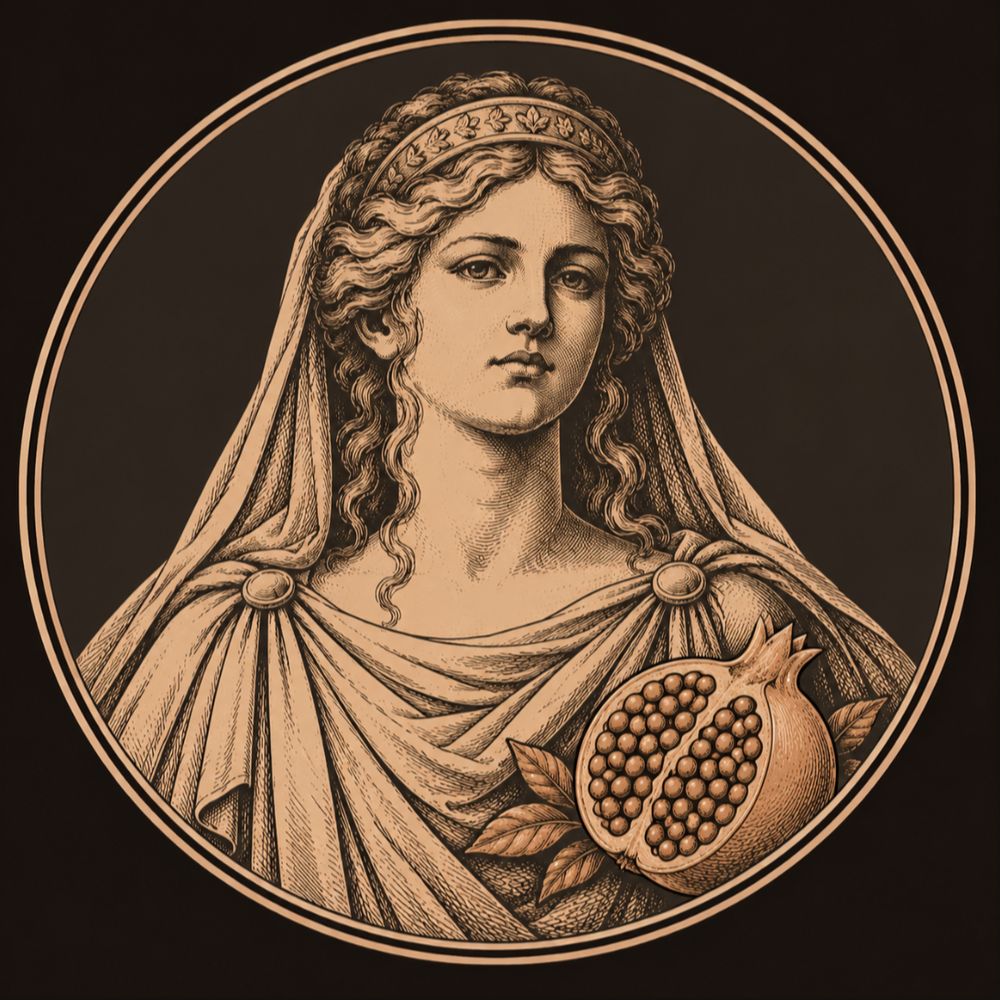
Proserpina, bronze medallion illustration
Generated by AI from this page's own facts, not an ancient image or evidence of anything. How this site uses generated images
Sections on this page
Greek vs Roman: Persephone vs. Proserpina → See how Persephone differs.
Core Myth
Ovid tells the fullest Roman version in Book 5 of the Metamorphoses. Proserpina is the daughter of Ceres, and she is picking flowers by a lake near Enna in Sicily when the story begins (Metamorphoses 5.385-395). Venus has watched Pluto, the king of the dead, and complains that he alone among the great gods has escaped her power. She orders Cupid to shoot him, and he does (Metamorphoses 5.363-384). Pluto sees the girl, seizes her, and drives down through the earth as she calls out to her mother (Metamorphoses 5.385-408).
Ceres searches the earth with torches lit from Etna and finds only the girdle of Proserpina floating on the nymph Cyane's pool (Metamorphoses 5.438-470). The nymph Arethusa later tells her that Proserpina is alive, and queen of the underworld (Metamorphoses 5.489-508). Ceres then appeals to Jupiter, who replies that the abduction is a deed of love and no injury, but agrees that the girl may return if she has tasted no food there (Metamorphoses 5.512-532).
The condition fails. Ascalaphus reports that he saw her pick a pomegranate and eat seven seeds in the garden of the dead (Metamorphoses 5.533-538). Jupiter settles the dispute between his brother and his sister by dividing the year between them (Metamorphoses 5.533-571). After the settlement she divides her time between the underworld and her mother.
Are Persephone and Proserpina the same goddess?
Romans treated them as one goddess. Cicero writes that Dis forced away Proserpine, whom the Greeks call Persephone, and that the poets mean the seed of corn by her (De Natura Deorum 2.66). The stories differ in detail. In the Homeric hymn she spends a third of the year below (Homeric Hymn to Demeter 398-403), and in Ovid half of it (Metamorphoses 5.533-571). The two are compared in Persephone vs Proserpina.
Cicero, De Natura Deorum 2.66
Who is Proserpina in Roman mythology?
She is the daughter of Ceres and, in Ovid, of Jupiter, and the queen of the underworld through her marriage to Pluto (Metamorphoses 5.489-508). Ovid's Jupiter calls her a pledge that he shares with Ceres (Metamorphoses 5.512-532). Virgil adds a role at the threshold: the golden bough that lets a living man enter the underworld is sacred to her (Aeneid 6.136-148).
Ovid, Metamorphoses 5.489-508
Why was Proserpina taken by Pluto?
In Ovid's account, Venus wants to bring the king of the dead under her power and sends Cupid to shoot him with desire (Metamorphoses 5.363-384). He then seizes Proserpina in Sicily and drives away (Metamorphoses 5.385-408). Jupiter later describes the act as love, not injury (Metamorphoses 5.512-532).
Ovid, Metamorphoses 5.363-384
Why did Proserpina eat the pomegranate seeds?
Ovid gives no motive beyond an idle moment. Ascalaphus says she picked a pomegranate from a bent branch and put seven seeds in her mouth (Metamorphoses 5.533-538). Since Jupiter had allowed her return only if she had eaten nothing (Metamorphoses 5.530-532), the seeds keep her tied to the underworld for part of each year.
Ovid, Metamorphoses 5.533-538
How long does Proserpina stay in the underworld?
Half the year in Ovid's account: Jupiter divides the year equally between Pluto and Ceres (Metamorphoses 5.533-571). The Greek Homeric Hymn to Demeter gives a third of the year below and two thirds above (Homeric Hymn to Demeter 398-403). The sources therefore disagree, and the site's Persephone page follows the hymn.
Ovid, Metamorphoses 5.533-571
Later Traditions
Virgil ties her to the road into the underworld. The Sibyl tells Aeneas that he can enter the realm of the dead only if he carries a golden bough sacred to Proserpina, which the goddess has ordained as her gift (Aeneid 6.136-148).
Cicero reads the myth as an allegory of grain. In his account of Roman religion he says the king who rules the earth, Dis, is called Pluton in Greek, that he forced away Proserpine, and that the poets mean by her the seed of corn (De Natura Deorum 2.66). Rome also honored her mother in a cult of Ceres with Liber and Libera. Livy records that goods of anyone who harmed a plebeian magistrate were given to the temple of Ceres, Liber and Libera (Ab Urbe Condita 3.55). Cicero says the ancestors consecrated Liber and Libera in state with Ceres (De Natura Deorum 2.62). These passages do not identify Libera with Proserpina, so the link is not asserted here.
Lineage
See the full family tree2 recorded relations, each with the ancient line behind it.
Parents
-

Ovid's Ceres searches the whole earth for her daughter Proserpina after the abduction.
-

disputed
Ovid's Jupiter tells Ceres that the girl is a care and a pledge to him as well as to her.
Also Connected
3 recorded connections, each with the ancient line behind it.
Connected
-
The golden bough that lets Aeneas enter the underworld is sacred to Proserpina.
-

Ovid makes Cupid's arrow the first cause of Proserpina's abduction.
-

Ovid has Pluto seize Proserpina in Sicily and carry her to the underworld, where she becomes his queen.
Where Accounts Differ
- how long Proserpina stays below
- why Pluto took Proserpina
- The length of Proserpina's stay below differs. The Homeric Hymn to Demeter gives a third of the year (Homeric Hymn to Demeter 398-403). Ovid divides the year equally (Metamorphoses 5.533-571).
- The reason for the abduction differs. In Ovid, Venus sends Cupid to wound Pluto (Metamorphoses 5.363-384). In the Homeric hymn, Zeus has given the girl to Hades (Homeric Hymn to Demeter 1-3).
- Cicero reads Proserpina as the seed of corn (De Natura Deorum 2.66). This is a Stoic allegory reported by Cicero, and Ovid's story does not depend on it.
Read the full source verification →
Mythology
Equivalent Figures
Related Terms
Referenced By
Sources
- Ovid, Metamorphoses 5.363-384
- Ovid, Metamorphoses 5.385-395
- Ovid, Metamorphoses 5.385-408
- Ovid, Metamorphoses 5.438-470
- Ovid, Metamorphoses 5.489-508
- Ovid, Metamorphoses 5.512-532
- Ovid, Metamorphoses 5.533-538
- Ovid, Metamorphoses 5.533-571
- Virgil, Aeneid 6.136-148
- Cicero, De Natura Deorum 2.62
- Cicero, De Natura Deorum 2.66
- Livy, Ab Urbe Condita 3.55
- Homeric Hymn to Demeter 1-3
- Homeric Hymn to Demeter 398-403