Aeneas
Aeneas is a Trojan hero, son of the goddess Aphrodite and the mortal Anchises. In Homer's Iliad he is a leading Trojan fighter whom the gods twice rescue, and Poseidon foretells that his line will rule the Trojans. Later writers have him carry his father out of burning Troy, and Roman tradition makes him the founder of the Latin people in Italy.
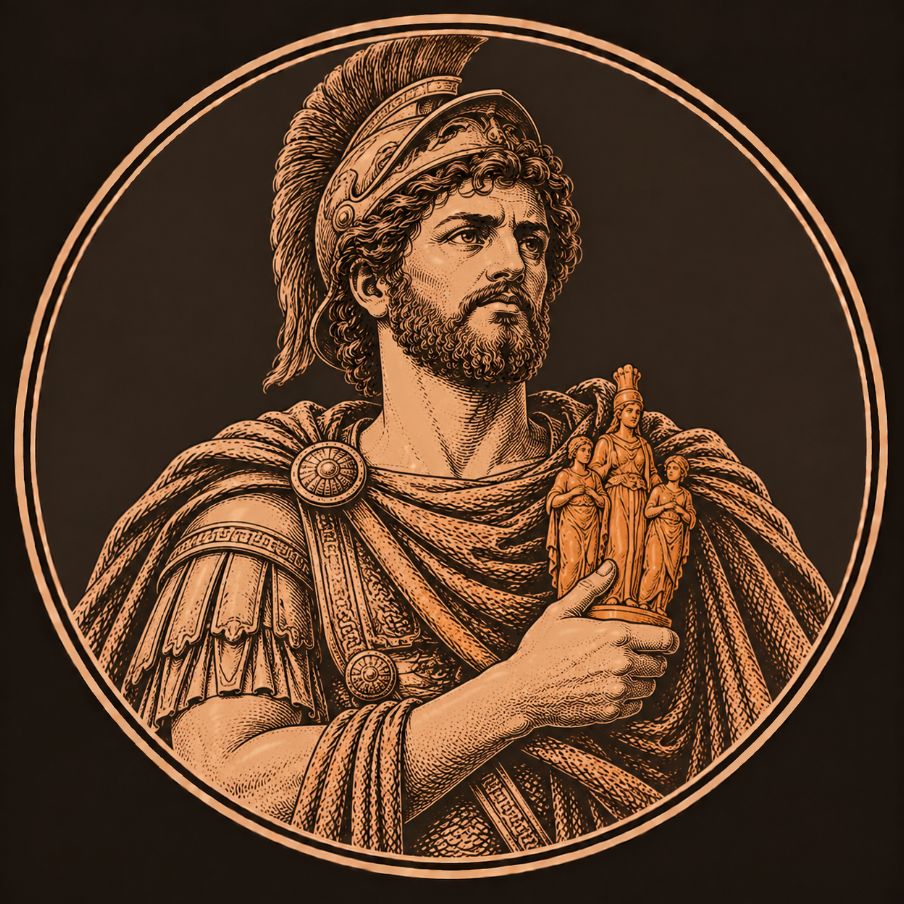
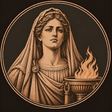
Aeneas, bronze medallion illustration
Generated by AI from this page's own facts, not an ancient image or evidence of anything. How this site uses generated images
Sections on this page
See Aeneas in the Greek family tree.
Core Myth
Aeneas is the son of Aphrodite and the Trojan prince Anchises. The Iliad says the goddess conceived him while Anchises tended his cattle on the slopes of Mount Ida, and Hesiod's Theogony also sets the birth on the peaks of Ida. The Homeric Hymn to Aphrodite tells the affair from her side. After their night together she promises Anchises a son who will reign among the Trojans, with children's children after him. She names the boy Aeneas from the awful grief she felt at sharing a mortal's bed. Mountain nymphs will rear him, and she warns Anchises never to boast of her, or Zeus will strike him with a thunderbolt.
Aeneas belongs to the younger branch of Troy's royal house. Facing Achilles in Iliad Book 20, he recites his descent from Dardanus, son of Zeus. Tros had three sons: Ilus, Assaracus and Ganymede. Ilus's line runs to Priam and Hector, Assaracus's to Capys, Anchises and Aeneas himself. In the Iliad he leads the Dardanians. The seer Helenus tells Aeneas and Hector that the war-toil of the Trojans rests on them above all others. Yet in Book 13 Aeneas hangs back at the rear, angry at Priam, who never honoured him for all his bravery.
The gods save him twice in the Iliad. In Book 5, Diomedes crushes his hip with a boulder, and Aphrodite wraps her son in her robe to carry him from the fighting. Diomedes wounds her wrist and she drops him. Apollo then hides Aeneas in a dark cloud and beats Diomedes back three times before warning him off. He carries Aeneas to his temple on Pergamus, where Leto and Artemis heal him, and leaves a phantom of Aeneas for the armies to fight over. The episode belongs to the larger Trojan War.
In Book 20, Apollo urges Aeneas to face Achilles. Achilles taunts him with hoping for Priam's throne and reminds him how he once fled from his cattle on Ida. Aeneas's spear stops in the gold layer of Achilles's divine shield, and Achilles's spear drives through Aeneas's shield. Poseidon then tells the gods that Aeneas is fated to escape, so that the race of Dardanus will not die out. Zeus has come to hate Priam's line, he says, and Aeneas and his sons' sons will be kings among the Trojans. Poseidon pours mist over Achilles's eyes and flings Aeneas to the far edge of the battle.
The accounts of his escape from Troy differ. Apollodorus says he took up his father Anchises and fled, and the Greeks let him alone because of his piety. Livy says the Greeks spared Aeneas and Antenor, from old ties of hospitality and because both had always urged peace and the return of Helen. In Virgil's Aeneid, Hector's ghost tells him to flee with Troy's household gods and Vesta's undying fire. He carries Anchises on his shoulders, Anchises holds the sacred images, and his small son Iulus walks at his side. His wife Creusa falls behind in the dark and is lost. Her ghost tells him that the Great Mother of the gods keeps her in that land. Ovid's Metamorphoses also has him carry the holy images and his father, with his son Ascanius.
The Aeneid makes him the hero of Rome's national epic. Juno's anger drives storms against his fleet, which lands at Carthage. There he becomes the lover of Queen Dido, until Jupiter sends Mercury to order him on. He tells Dido it is not his own free choice that seeks Italy, and she curses him. At Cumae he vows a marble temple to Phoebus and his sister (Aeneid 6.69-74). In the underworld he meets her shade and weeps, but she turns away from him in anger. He also finds Anchises in the blessed groves, where his father shows him the souls of his future descendants. In Italy he wins Lavinia and ends the poem by killing Turnus in single combat, after seeing the belt Turnus stripped from the young Pallas.
Livy tells the Italian story as history, and admits two versions of its start. Aeneas sails by way of Macedonia and Sicily to the Laurentine coast. In one tradition King Latinus is beaten in battle and then makes peace; in the other he offers friendship before any fighting. Either way Aeneas marries Latinus's daughter and founds Lavinium, naming it after her. Turnus, king of the Rutulians, had been betrothed to her and goes to war. Latinus dies in the fighting. Aeneas then names Trojans and natives alike Latins and wins a last battle against Turnus's Etruscan ally Mezentius.
What is Aeneas famous for?
Aeneas is famous for surviving the fall of Troy and, in Roman tradition, for leading its survivors to Italy. In Homer's Iliad he is one of the strongest Trojans, rescued first by Aphrodite and Apollo and then by Poseidon, who foretells that his line will rule the Trojans. Later writers add the image he is best known by: carrying his old father Anchises out of the burning city. Virgil's Aeneid then makes him the ancestor of Rome.
Homer, Iliad 20.293-308
Who were Aeneas' parents?
His mother was the goddess Aphrodite, Venus to the Romans, and his father was Anchises, a Trojan prince of the royal house. The Iliad says Aphrodite conceived him while Anchises was tending cattle on Mount Ida. The Homeric Hymn to Aphrodite tells the full story. After lying with Anchises, the goddess promises him a son who will reign among the Trojans. She warns him never to reveal that she is the mother, on pain of Zeus's thunderbolt.
Homeric Hymn to Aphrodite 192-199
Why was Aeneas important to the Romans?
The Romans traced their origins through him. Livy says Aeneas founded Lavinium and united Trojans and natives under the name of Latins, and that his son Ascanius founded Alba Longa. In Virgil's Aeneid, Jupiter promises Venus a line running from Aeneas through Alba Longa to Romulus and an empire without end. Jupiter also names Julius Caesar as a descendant of Iulus, Aeneas's son. That gave the Julian family a claim to descent from Venus herself.
Virgil, Aeneid 1.257-296
What did Aeneas do after the Trojan War?
He fled Troy and wandered before settling in Italy, but the sources give different routes. Livy takes him through Macedonia and Sicily to the Laurentine coast, where he marries King Latinus's daughter and founds Lavinium. Ovid has him stop at Delos, where King Anius receives him. Virgil sends him to Carthage and Queen Dido, then down to the underworld, and finally to war in Latium against Turnus. All agree that he ended his days in Italy.
Livy, Ab Urbe Condita 1.1
Was Aeneas the founder of Rome?
No. The ancient sources make him the ancestor of the Romans, not the founder of the city. Livy says Aeneas founded Lavinium, named after his wife, and that his son Ascanius later founded Alba Longa. In Virgil's Aeneid, Jupiter foretells three centuries of rule from Alba Longa before Romulus, nursed by the wolf, founds Rome and gives it his name. Aeneas himself is promised a war in Italy, a city wall and three summers of rule in Latium.
Livy, Ab Urbe Condita 1.3
Whom did Aeneas marry?
Aeneas had two wives. At Troy he was married to Creusa, who in Virgil's Aeneid falls behind in the dark as the family escapes the burning city and is lost. In Italy he married Lavinia, daughter of King Latinus. Livy says he named his new town Lavinium after her. Turnus, king of the Rutulians, had been promised Lavinia first and went to war over her. Dido, queen of Carthage, called their union a marriage, but Aeneas denies in the Aeneid that he ever made her a marriage vow.
Virgil, Aeneid 2.735-795
Later Traditions
His end is told as a disappearance more than a death. Livy says the victory over the Etruscans was his last mortal act, and that his tomb stands on the bank of the Numicius, where he is addressed as Jupiter Indiges. Livy hedges even there, calling him whatever it is right to call him. Ovid makes the change explicit. Venus asks Jupiter to give her son a godhead, the river Numicius washes away every mortal part of him, and she anoints him with nectar and ambrosia. The people then name him Indiges. This is an apotheosis, and Virgil's Jupiter promises it in Aeneid Book 1: Venus will bear Aeneas up to the stars.
The sources also disagree about his son. In Virgil, Ascanius is the boy from Troy, renamed Iulus, and Jupiter traces from him a line through Alba Longa and Romulus to Julius Caesar. Livy says Lavinia bore Aeneas a son named Ascanius in Italy. He then declines to decide whether the Iulus claimed by the Julian family was that boy or an older son born to Creusa at Troy. Livy agrees that Ascanius founded Alba Longa, thirty years after Lavinium.
The Greek and Roman pictures of Aeneas do not fully match. The Iliad promises that he and his descendants will rule among the Trojans, and says nothing about Italy. The Homeric Hymn to Aphrodite makes the same promise of a son and descendants reigning among the Trojans. Italy, Lavinium and Rome come from later writers, above all Virgil and Livy. The fuller Roman story is traced across the Trojan Cycle and its aftermath.
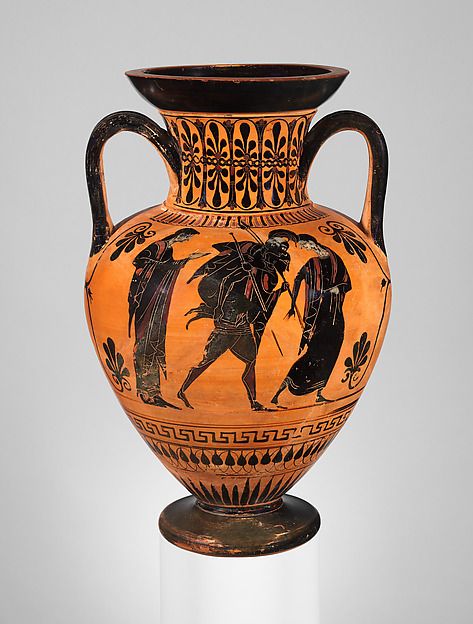
Terracotta neck-amphora (jar) - Greek, Attic, last quarter of 6th century BCE, Terracotta
Metropolitan Museum of Art, New York, NY, 41.162.171. CC0
Lineage
See the full family tree2 recorded relations, each with the ancient line behind it.
Parents
-

Aphrodite bore Aeneas to the Trojan prince Anchises and named him for the grief she felt at sharing a mortal's bed.
-

Livy introduces Aeneas to King Latinus as the son of Anchises and Venus; Roman tradition built the Julian family's descent from Venus on this.
Also Connected
20 recorded connections, each with the ancient line behind it.
Allies
-

Apollo hides the wounded Aeneas from Diomedes, carries him to his temple on Pergamus to be healed, and leaves a phantom in his place.
-

The seer Helenus tells Aeneas and Hector that the war-toil of the Trojans rests on them above all others; both descend from Tros, through Assaracus and Ilus.
-
Latinus makes a treaty with Aeneas and gives him his daughter Lavinia. Livy records two traditions: a defeat in battle followed by peace, or friendship offered before any fighting. In Virgil's Aeneid he welcomes the Trojans at once and swears the treaty in Book 12.
-

Poseidon rescues Aeneas from Achilles because he is fated to survive and carry on the line of Dardanus as king among the Trojans.
Enemies
-

Aeneas faces Achilles in single combat in Iliad Book 20 and is saved only by Poseidon.
-
Camilla fights for the Latin side against the Trojans and their Etruscan allies. She never meets Aeneas in the poem.
-
Diomedes crushes Aeneas's hip with a boulder and would have killed him had Aphrodite not carried him away.
-

In Virgil's Aeneid, Juno's anger at the Trojan race drives the storms and hardships that keep Aeneas from Italy.
Connected
-

In the Aeneid, Aeneas finds Andromache in Epirus pouring offerings at an empty tomb of Hector, and she tells him how she came to be Helenus's wife.
-
In Virgil, Aeneas vows a marble temple and festal days to Phoebus and Trivia at Cumae (Aeneid 6.69-70) and celebrates games on the Actian shore (Aeneid 3.274-280). Augustus's Actian Apollo later repeats both places.
-

Venus calls Aeneas Cupid's brother and sends Cupid, disguised as Ascanius, to make Dido love him.
-

Aeneas builds his fleet from Cybele's sacred pines on Ida, and she turns the ships into sea nymphs when Turnus tries to burn them. Aeneas later prays to her before battle (Aeneid 10.252-255).
-

Aeneas names Ganymede among the three sons of Tros when he recites his Trojan lineage to Achilles.
-
Evander tells Aeneas the story of Hercules and Cacus and the feast in the hero's honor.
-

Jupiter promises Venus that Aeneas will wage war in Italy, rule three summers in Latium and be raised to the stars, and that his line will lead to Rome.
-

Homer says Aeneas bore a grudge against Priam, who did not honour him for all his bravery.
-

The golden bough that lets Aeneas enter the underworld is sacred to Proserpina.
-
A minority tradition reported by Dionysius makes Romulus and Remus sons or grandsons of Aeneas, with Remus founding a Rome named after himself. The standard account makes them Alban descendants of Aeneas's line through Numitor.
-

King Evander tells Aeneas how the exiled Saturn gave laws to Latium and ruled its Golden Age, while guiding him over the future site of Rome.
-
Hector's ghost gives Aeneas the fillets, Vesta and her eternal fire from the inner shrine as Troy falls.
Where Accounts Differ
- why the Greeks let Aeneas escape
- where the prophecy of his rule points
- how Aeneas met Latinus
- which Ascanius was Iulus
- death or deification of Aeneas
- Why Aeneas survived the sack differs by source. Apollodorus (Epitome 5.21) says the Greeks let him go because of his piety as he carried Anchises. Livy (1.1) says the Greeks spared Aeneas and Antenor for old ties of hospitality and because both had urged peace and the return of Helen. Virgil (Aeneid 2) has him flee through the burning city on Hector's ghostly warning, with no Greek consent at all.
- The prophecy of his rule differs in scope. Poseidon in the Iliad (20.293-308) and Aphrodite in the Homeric Hymn (192-199) promise only that he and his descendants will reign among the Trojans. The move to Italy, Lavinium and Rome comes from Virgil and Livy.
- Livy (1.1) gives two versions of how Aeneas met Latinus: a defeat in battle followed by peace, or a pact of friendship offered before any fighting.
- The identity of Ascanius is disputed. Virgil (Aeneid 1.257-296) makes Ascanius the Trojan-born Iulus, ancestor of the Julian family. Livy (1.1, 1.3) has Lavinia bear a son named Ascanius in Italy and declines to say whether the Iulus claimed by the Julii was that son or an older one born to Creusa.
- His end is told differently. Livy (1.2) says his last battle was his last mortal act and that he is worshipped at the Numicius as Jupiter Indiges. Ovid (Metamorphoses 14.581-608) describes Venus making him a god after the Numicius washes away his mortal parts. Virgil's Jupiter (Aeneid 1.257-296) promises he will be borne up to the stars and gives him three summers of rule in Latium.
- The death of Turnus is cited to Aeneid Book 12 without a line range because the Perseus passage service returned server errors for ranges running to the end of the book; the scene was read at the passage beginning 12.919.
Read the full source verification →
Mythology
Appears In
Related Terms
Referenced By
Sources
- Homer, Iliad 2.819-823
- Homer, Iliad 5.297-318
- Homer, Iliad 5.431-453
- Homer, Iliad 6.75-79
- Homer, Iliad 13.459-461
- Homer, Iliad 20.178-241
- Homer, Iliad 20.293-308
- Homeric Hymn to Aphrodite 192-199
- Homeric Hymn to Aphrodite 256-290
- Hesiod, Theogony 1008-1010
- Apollodorus, Library 3.12.2
- Apollodorus, Epitome 5.21
- Virgil, Aeneid 1.1-33
- Virgil, Aeneid 1.257-296
- Virgil, Aeneid 2.268-297
- Virgil, Aeneid 2.707-729
- Virgil, Aeneid 2.735-795
- Virgil, Aeneid 4.160-172
- Virgil, Aeneid 4.333-361
- Virgil, Aeneid 6.450-476
- Virgil, Aeneid 6.679-702
- Virgil, Aeneid, Book 12
- Livy, Ab Urbe Condita 1.1
- Livy, Ab Urbe Condita 1.2
- Livy, Ab Urbe Condita 1.3
- Ovid, Metamorphoses 13.623-631
- Ovid, Metamorphoses 14.581-608
- Virgil, Aeneid 6.69-74