Lares and Penates
The Lares and Penates were the Roman household gods.
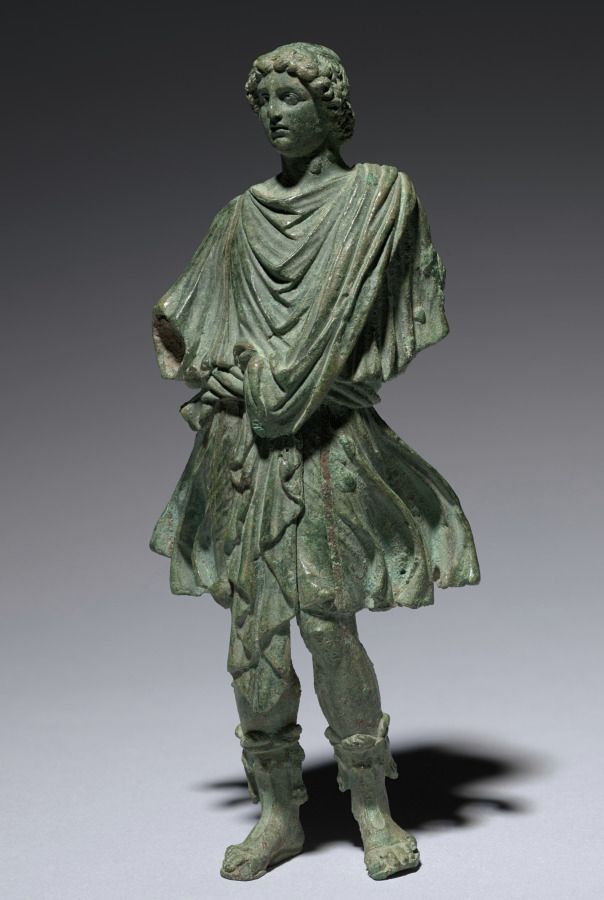
Lar - Italy, Rome, Early Imperial period, 1–25 CE, bronze with copper inlays
The Cleveland Museum of Art, Cleveland, OH, 1987.3. CC0
Sections on this page
In Practice
The Lares guarded a family, its house and its land, and were also honoured at crossroads and for the city. The Penates guarded the household's store and the family's continuity. Ancient writers also gave the Penates a public role, as the sacred objects Aeneas carried from Troy. The Romans did not treat them as one pair. Sources use "Lar" and "Penates" for different jobs, and they sometimes disagree about who the Penates were.
The clearest picture of a Lar is comic. In Plautus's Aulularia a Lar familiaris opens the play. He says he has held and tended the house for the grandfather and father of its present owner (Plautus, Aulularia 2-5). The grandfather buried a treasure in the middle of the hearth and asked the Lar to guard it (Aulularia 6-8). The owner's daughter prays to him every day with incense, wine or something else, and gives him garlands (Aulularia 23-25). In gratitude he lets her father find the gold, so that he can marry her off (Aulularia 25-27). The joke is Plautus's, but the shape of the cult is plain. A Lar belongs to a house, and the household feeds him.
Cato shows the same cult on a farm. The bailiff's wife must sweep the hearth clean each evening. On the Kalends, Ides and Nones, and on any festival, she puts a garland on the hearth and makes an offering to the Lar familiaris as her means allow (Cato, De Agri Cultura 143). Cato adds that the master sees to the devotions for the whole household, so she may not worship without his leave (De Agri Cultura 143). The Lar sits at the hearth, and the calendar sets the days.
Lares also stood outside the house. Ovid makes the Lares twin sons of a nymph, and says they watch over the crossroads and keep guard in the city (Ovid, Fasti 2.615-616). Dionysius of Halicarnassus says King Servius Tullius ordered chapels built in every street, with an annual sacrifice at which each household gave a honey-cake and slaves served. He notes the festival, the Compitalia, was still kept in his day a few days after the Saturnalia (Roman Antiquities 4.14.3-4). Ovid's Lares Praestites, a name he derives from their standing guard, protect the city, and a stone dog stood at their feet (Fasti 5.129-142). Archaeology adds the domestic side. Pompeii has countless small household shrines, called lararia, some with traces of burning on the altar and the last offerings (Ostia-Antica.org, Private religion: introduction).
The Penates are harder to pin down. Dionysius says Romans call them Penates, and that Greek writers rendered the name in five ways: Patrooi (ancestral), Genethlioi (of the family line), Ktesioi (of property), Mychioi (of the inner room) and Herkeioi (of the courtyard) (Roman Antiquities 1.67.3). Macrobius reports a philosophical reading. The deeper inquirers said the Penates are the gods through whom we breathe and have bodies and minds (Macrobius, Saturnalia 3.4.8). That reading is not the Roman cult itself.
Their best-known role is Trojan. In Virgil the ghost of Hector tells Aeneas that Troy entrusts her sacred things and her Penates to him, to be taken as companions of his fate (Aeneid 2.293-295). On Crete the Phrygian Penates appear to him in a dream, the images he had carried from the burning city. They say Apollo has sent them and tell him to seek Italy (Aeneid 3.147-150; 3.154-171). Macrobius adds that Varro made Dardanus carry them from Samothrace to Phrygia, and Aeneas on to Italy, while Cassius Hemina identified them with the Samothracian gods (Saturnalia 3.4.7; 3.4.9). Dionysius says the Trojan sacred images at Lavinium moved home overnight when carried to Alba and had to be returned (Roman Antiquities 1.67.1-2). He describes a small shrine of the Penates on the Velia in Rome, holding statues of two seated youths with spears (Roman Antiquities 1.68.1-2).
So the Lares and Penates overlap and differ. Both were domestic, both were honoured at the hearth, and both had public counterparts. The Lares are tied to place: the house, the farm and the street. The Penates are tied to lineage and stores, and, in the epic tradition, to Rome's Trojan descent. Compare the public hearth kept by Vesta and her Vestal Virgins, and the god at every threshold, Janus, for the wider Roman pattern of gods tied to doorways and fires.
What is the difference between Lares and Penates?
Lares are tied to a place, and Penates to a household's store and line. Plautus and Cato show a Lar familiaris at one house's hearth (Aulularia 2-8; De Agri Cultura 143). Ovid also has Lares at crossroads and for the city (Fasti 2.615-616). Dionysius says the Greeks translated "Penates" as ancestral, family, property, inner-room and courtyard gods (Roman Antiquities 1.67.3). Virgil makes them Troy's gods, carried by Aeneas (Aeneid 2.293-295).
Dionysius of Halicarnassus, Roman Antiquities 1.67.3
What is a penate?
A penate is one of the Di Penates, Roman gods of the household and its store. Dionysius says the Romans use the name for what Greeks called ancestral, family, property, inner-room and courtyard gods (Roman Antiquities 1.67.3). Epic tradition made them the images Aeneas carried from Troy, and Virgil has them speak to him (Aeneid 3.147-150; 3.154-171). Macrobius quotes a philosophical reading of them as the gods through whom we breathe (Saturnalia 3.4.8).
Virgil, Aeneid 3.147-150
What is Lares the god of?
The Lares had no single domain. A Lar familiaris guarded one family and its house, as in Plautus, where he says he has tended it for three generations (Aulularia 2-5). Other Lares watched the crossroads, and Ovid's Lares Praestites protect the city (Fasti 2.615-616; 5.129-142). The word is plural because there were many, one for each household and street.
Plautus, Aulularia 2-5
How did Romans worship their Lares?
They gave them small, regular offerings at the hearth. Cato has the bailiff's wife hang a garland on the hearth and make an offering to the Lar on the Kalends, Ides, Nones and festivals (De Agri Cultura 143). Plautus's Lar receives incense, wine and garlands daily (Aulularia 23-25). Ovid tells families to give incense and set a dish of food before the girded Lares at the Caristia (Fasti 2.630; 2.632-633).
Cato, De Agri Cultura 143
Where Accounts Differ
- who the Penates were
- Penates of the state and of the house
- Lares of the house and of the crossroads
- Who the Penates were: Virgil has Hector hand Aeneas Troy's sacred things and Penates, and has the Phrygian Penates speak to him as household images (Aeneid 2.293-295; 3.147-150). Macrobius gives rival accounts. Varro has Dardanus carry them from Samothrace to Phrygia, Cassius Hemina identifies them with the Samothracian gods, and others call them the gods through whom we breathe and have bodies (Saturnalia 3.4.7-3.4.9). Dionysius gives five Greek renderings of the name and declines to describe the hidden objects at Lavinium (Roman Antiquities 1.67.3). The sources do not agree on one identity.
- The Penates of Rome and of a house: Dionysius describes the Trojan images as belonging to Lavinium and Alba and a small shrine of the Penates on the Velia (Roman Antiquities 1.67.1-2; 1.68.1-2). Plautus and Cato speak only of the Lar familiaris at a single hearth (Aulularia 2-8; De Agri Cultura 143). This page does not claim the private and public cults were one, and the sources checked here do not say so.
- Lares at the crossroads and in the house: Ovid treats the Lares as twins who guard the crossroads and the city (Fasti 2.615-616), and the Lares Praestites as guardians of the city (Fasti 5.129-142). Plautus and Cato treat the Lar familiaris as belonging to a household. Dionysius describes the Compitalia chapels as shrines to "heroes" whose statues stood before the houses, and his editor identifies them with the Lares Compitales (Roman Antiquities 4.14.3). Whether Roman writers saw one kind of Lar or several is left open here.
- Verification: Plautus Aulularia (Latin, Latin Library, standard line numbers; Perseus numbers one higher because it counts the speaker heading), Cato 143 (Thayer, LacusCurtius, English; Latin phrase Lari familiari confirmed in a scholarly quotation), Dionysius 1.67-68 and 4.14 (Cary, Loeb, LacusCurtius), Ovid Fasti 2 and 5 (Latin Library), Macrobius Saturnalia 3.4.6-9 (Latin, LacusCurtius) and Aeneid 2 and 3 (Perseus and Latin Library) were read. Plautus, Cato and Ovid's Fasti have no machine-checkable English text. The date of the Caristia is not stated in the lines cited and is not asserted.
Where This Appears
Sources
- Plautus, Aulularia 2-5
- Plautus, Aulularia 6-8
- Plautus, Aulularia 23-25
- Plautus, Aulularia 25-27
- Cato, De Agri Cultura 143
- Ovid, Fasti 2.615-616
- Ovid, Fasti 2.630
- Ovid, Fasti 2.632-633
- Ovid, Fasti 5.129-142
- Dionysius of Halicarnassus, Roman Antiquities 1.67.1-2
- Dionysius of Halicarnassus, Roman Antiquities 1.67.3
- Dionysius of Halicarnassus, Roman Antiquities 1.68.1-2
- Dionysius of Halicarnassus, Roman Antiquities 4.14.3-4
- Virgil, Aeneid 2.293-295
- Virgil, Aeneid 3.147-150
- Virgil, Aeneid 3.154-171
- Macrobius, Saturnalia 3.4.7
- Macrobius, Saturnalia 3.4.8
- Macrobius, Saturnalia 3.4.9
- Ostia-Antica.org, Private religion: introduction (lararia at Pompeii; cites G. K. Boyce, Corpus of the Lararia of Pompeii, 1937, and D. G. Orr, Roman Domestic Religion: A Study of the Roman Lararia, 1972)