Hercules
Hercules is the Roman form of the Greek hero Heracles and a god of Roman cult. Livy and Virgil tell how he drove Geryon's cattle to the Tiber, killed the thief Cacus, and was honored by King Evander with an altar that later became the Ara Maxima (Livy 1.7.3-15; Aeneid 8.184-279). The Romans identified him with Heracles, but this Italian episode belongs to Rome.
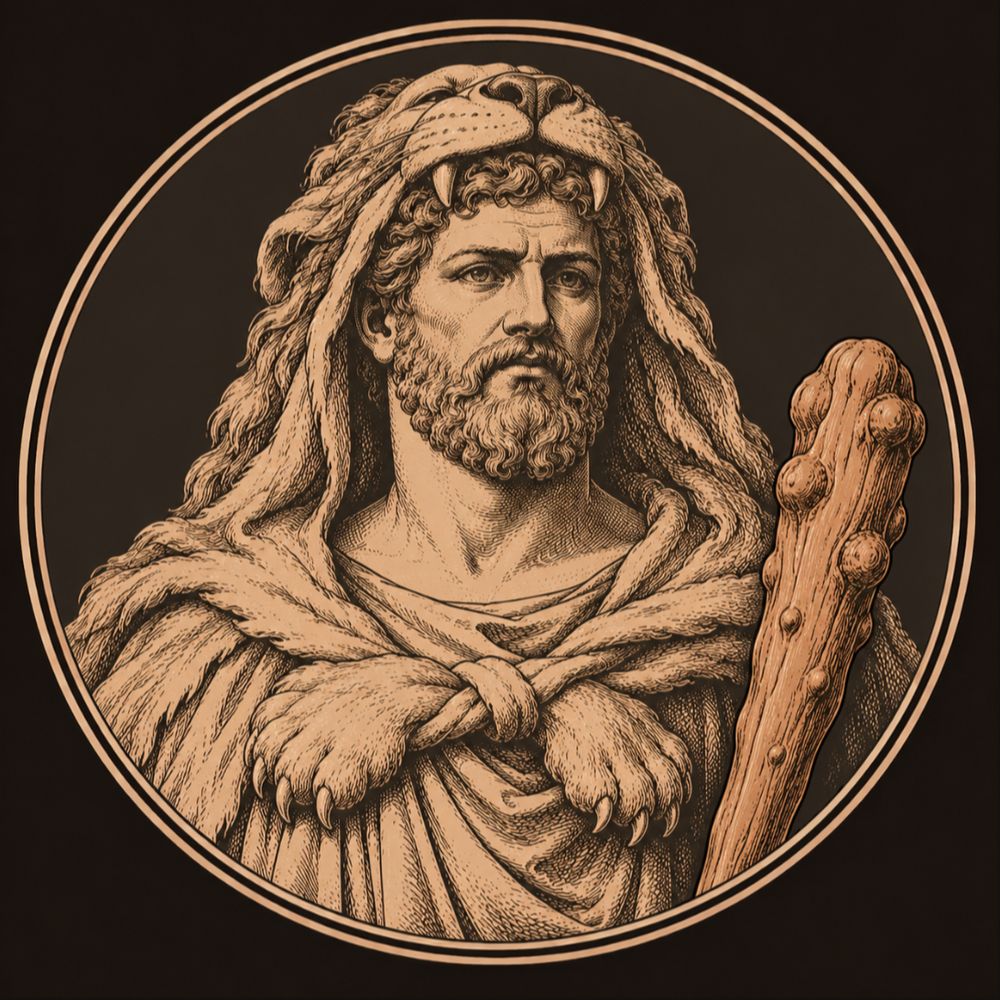
Hercules, bronze medallion illustration
Generated by AI from this page's own facts, not an ancient image or evidence of anything. How this site uses generated images
Sections on this page
Greek vs Roman: Heracles vs. Hercules → See how Heracles differs.
Core Myth
The Roman story of Hercules is set after his tenth labor, the seizure of Geryon's cattle. Livy says he swam the Tiber with the herd and lay down to rest near the river (Livy, Ab Urbe Condita 1.7.3-7). A shepherd named Cacus stole the finest cattle and dragged them backwards by the tails into his cave, so that the hoofprints pointed away from it (Livy, Ab Urbe Condita 1.7.3-7). When the cattle lowed, Hercules found the cave and killed Cacus with his club (Livy, Ab Urbe Condita 1.7.3-7).
Virgil tells the same episode more darkly through King Evander, who is welcoming Aeneas on the site of the future Rome. In the Aeneid, Cacus is a half-human monster, the son of Vulcan, who spews smoke and flame from his mouth (Aeneid 8.190-199). Hercules comes from killing Geryon and Cacus steals four bulls and four heifers (Aeneid 8.200-212). Hercules tears open the cave and kills the monster, and the villagers celebrate (Aeneid 8.219-267).
In Livy's telling, Evander recognizes the stranger as Hercules, son of Jupiter, and says his mother's prophecy foretold that Hercules would join the gods and receive an altar that the most powerful nation would call the Ara Maxima (Livy, Ab Urbe Condita 1.7.9-10). Hercules accepts the omen, and the first sacrifice is made at once. The two leading local families, the Potitii and the Pinarii, are invited to the feast, and the Potitii conduct the rite for many ages (Livy, Ab Urbe Condita 1.7.11-14). Livy adds that Romulus adopted this cult alone of all foreign rites (Livy, Ab Urbe Condita 1.7.15).
Are Heracles and Hercules the same hero?
Romans treated them as one hero, and Virgil's Salian hymn to Hercules lists the Greek labors: the serpents, the centaurs, the Nemean lion and Cerberus (Aeneid 8.285-302). What Rome added is the episode in Italy. Livy sets the Cacus story on the future site of the city (Ab Urbe Condita 1.7.3-15). The two are compared in Heracles vs Hercules.
Virgil, Aeneid 8.285-302
Who was Cacus and why did Hercules kill him?
Cacus stole some of the cattle Hercules had taken from Geryon and hid them in a cave, dragging them backwards by the tails to hide their tracks (Livy, Ab Urbe Condita 1.7.3-7). Livy calls him a shepherd, and Virgil a half-human monster, son of Vulcan, who breathes smoke and flame (Aeneid 8.190-199). Hercules found the cave when the stolen cattle answered the herd and killed him.
Livy, Ab Urbe Condita 1.7.3-15
What is the Ara Maxima of Hercules?
It is the altar that Hercules consecrated after killing Cacus. Livy has Evander prophesy that the most powerful nation in the world would one day call it the Ara Maxima and honor it with Hercules's special worship (Ab Urbe Condita 1.7.10). Two families, the Potitii and the Pinarii, conducted the sacrifice, and Romulus adopted this rite from all foreign ones (Ab Urbe Condita 1.7.12-15).
Livy, Ab Urbe Condita 1.7.10
Was Hercules a god or a hero in Rome?
Both. Virgil's Salii sing to him as a god who should bless his altars and people, calling him Jove's true son (Aeneid 8.285-302). Cicero, though, lists Hercules among the men raised to heaven for public service (De Natura Deorum 2.62). The distinction is old: Homer's Odysseus sees Heracles's phantom in Hades while the hero himself feasts among the gods (Odyssey 11.601-604).
Cicero, De Natura Deorum 2.62
How did Hercules become a god?
In Ovid, Hercules is tormented by the poisoned robe and builds his own pyre on Mount Oeta. Jupiter then tells the gods that only Hercules's mortal part will burn, and takes the rest to the stars (Metamorphoses 9.172-272). Hesiod ends the story differently and simply records that Heracles took Hebe as his wife on Olympus (Theogony 950-955).
Ovid, Metamorphoses 9.172-272
Later Traditions
Virgil shows the cult in action. At Evander's feast the Salian priests sing a hymn to Hercules that lists his labors, ending with a plea that he bless his altars and his people, calling him Jove's true son (Aeneid 8.285-302). Evander also tells Aeneas that Hercules once entered his humble home, and that Aeneas too should dare to scorn wealth (Aeneid 8.320-369).
Roman writers were less certain about how a hero became a god. Cicero says men who did important service to the public were raised to heaven by fame, and he names Hercules first among them (De Natura Deorum 2.62). Elsewhere Cicero lists several different Herculeses in the older histories, which shows that the name covered more than one tradition (De Natura Deorum 3.42). Ovid gives the apotheosis in the Metamorphoses. Hercules is burned on Mount Oeta, and Jupiter tells the gods that only the mortal part will be consumed (Metamorphoses 9.172-272). The site's Heracles page covers the labors and the Greek versions.
Lineage
See the full family tree1 recorded relation, each with the ancient line behind it.
Parents
-

In Livy, Evander greets the stranger as Hercules and foretells his place among the gods.
Also Connected
3 recorded connections, each with the ancient line behind it.
Enemies
-

In Ovid's account of his death, Hercules calls on Juno to feast on the suffering her enmity has caused.
Connected
-
Evander tells Aeneas the story of Hercules and Cacus and the feast in the hero's honor.
-
Livy says Romulus adopted the cult of Hercules, alone of all foreign rites, and kept it according to the rites Evander instituted.
Where Accounts Differ
- what Cacus was
- whether Hercules was born a god or became one
- Livy and Virgil describe Cacus differently. Livy calls him a shepherd who presumed on his strength and was killed with a club (Ab Urbe Condita 1.7.3-7). Virgil makes him a half-human, fire-breathing son of Vulcan (Aeneid 8.190-199).
- Whether Hercules was a god from the start or became one is also not settled. Livy has Evander prophesy his place among the gods (Ab Urbe Condita 1.7.10), Cicero counts him among deified men (De Natura Deorum 2.62), and Homer's Odysseus sees only a phantom in Hades while the hero feasts among the gods (Odyssey 11.601-604).
Read the full source verification →
Mythology
Appears In
Equivalent Figures
Related Terms
Referenced By
Sources
- Livy, Ab Urbe Condita 1.7.3-15
- Virgil, Aeneid 8.184-279
- Virgil, Aeneid 8.285-302
- Virgil, Aeneid 8.320-369
- Cicero, De Natura Deorum 2.62
- Cicero, De Natura Deorum 3.42
- Ovid, Metamorphoses 9.172-272
- Homer, Odyssey 11.601-604
- Hesiod, Theogony 950-955