Vulcan
Vulcan is Rome's god of fire, both the forge-fire that makes tools and weapons and the destructive fire Rome feared above almost any other disaster in a city built largely of wood. Romans identified him with Hephaestus, but his cult was shaped by a specifically Roman anxiety: his temples were deliberately built outside the city walls, to keep his own dangerous power at a distance.

Vulcan, Roman god of the forge
Generated by AI from this page's own facts, not an ancient image or evidence of anything. How this site uses generated images
Sections on this page
Greek vs Roman: Hephaestus vs. Vulcan → See how Hephaestus differs.
What does the name "Vulcan" mean? →
Looking for a name of your own? Try the mythological name generator.
Core Myth
Vulcan's mythology - the lame smith-god, husband of Venus, maker of weapons for gods and heroes - comes directly from Hephaestus through interpretatio romana. What is distinctly Roman is the anxiety behind his cult. Rome, a city of densely packed wooden buildings, treated fire as one of its most feared recurring disasters, and Vulcan's worship was oriented toward keeping that danger away rather than toward celebrating his craft. The architect Vitruvius states the logic outright: shrines to Vulcan belong outside a city's walls, so that his own power over fire is drawn off and kept at a distance from the buildings it could destroy.
Rome's oldest shrine to the god, the Vulcanal, sat at the foot of the Capitoline Hill in the Forum and was traditionally attributed to Titus Tatius, the Sabine co-king said to have ruled alongside Romulus in the earliest years of the city. A larger temple stood on the Campus Martius, also outside the sacred city boundary, the pomerium, by 214 BCE.
Is Vulcan the same god as Hephaestus?
Romans identified Vulcan with Hephaestus and inherited his myths - the lameness, the forge, the marriage to Venus - but Vulcan's Roman cult was shaped by a concern Hephaestus's Greek worship did not center on: Rome's practical fear of urban fire, which determined where and how the god was actually worshipped.
Why were Vulcan's temples built outside Rome's walls?
The logic, stated directly by the architect Vitruvius, was to keep the god's own dangerous power over fire physically separated from the city he might otherwise damage - inviting his cult too close to densely built wooden neighborhoods was considered a risk rather than a comfort.
Vitruvius, De Architectura 1.7
What happened during the Volcanalia festival?
Held on August 23, deep in Rome's hot late summer when fire risk peaked, the Volcanalia's central recorded rite, per Varro, had households throw living creatures into an open fire on the god's behalf. The specific detail of fish comes from a separate custom Festus records, a June fishing festival whose catch went to Vulcan rather than to market - the two are often merged in retellings, but ancient sources keep them distinct.
Varro, De Lingua Latina 6.20
Where was Vulcan's oldest shrine in Rome?
The Vulcanal stood at the foot of the Capitoline Hill in the Roman Forum and was traditionally said to have been established by Titus Tatius, the Sabine king who ruled jointly with Romulus in the city's earliest legendary period, long before the larger Campus Martius temple was ever built.
Livy, Ab Urbe Condita 1.13
Did Romans worship Vulcan out of gratitude or fear?
Largely fear, or at least caution. Rather than a cult celebrating the forge-fire's usefulness the way Hephaestus's craftsmanship was sometimes honored in Greece, Vulcan's Roman worship was oriented mainly toward keeping his destructive potential away from the city - placation more than praise.
Vitruvius, De Architectura 1.7
Later Traditions
The Volcanalia, Vulcan's festival, fell on August 23, deep in Rome's hot, dry late summer when the risk of fire was highest. Varro records its central rite plainly: households threw living creatures into an open fire on the god's behalf, without specifying what kind. Fish specifically appear in a separate custom Festus describes, a June fishing festival whose catch went to Vulcan's precinct rather than to market - a rite ancient sources connect to the god but not explicitly to the Volcanalia itself, though the two customs are often blended in modern retellings. Other reported customs included suspending normal work and hanging clothing out to be aired, both understood as ways of appeasing the god before the season's fire risk peaked. For the god's own myth - his lameness, his marriage to Venus, and his forge beneath Mount Etna - see the Hephaestus entry, since that material is inherited Greek content rather than a distinctly Roman addition. Ovid also makes Vulcan the father of King Servius Tullius, the mortal whom Fortuna is said to have loved (Fasti 6.569-576, 6.627-628). Virgil makes Vulcan the father of Cacus, the fire-breathing monster that Hercules kills on the future site of Rome (Aeneid 8.190-199).

Denarius Serratus (Coin) Depicting the God Vulcan - Italy, 105 BCE, Silver
The Art Institute of Chicago, Chicago, IL, 1923.1239. CC0
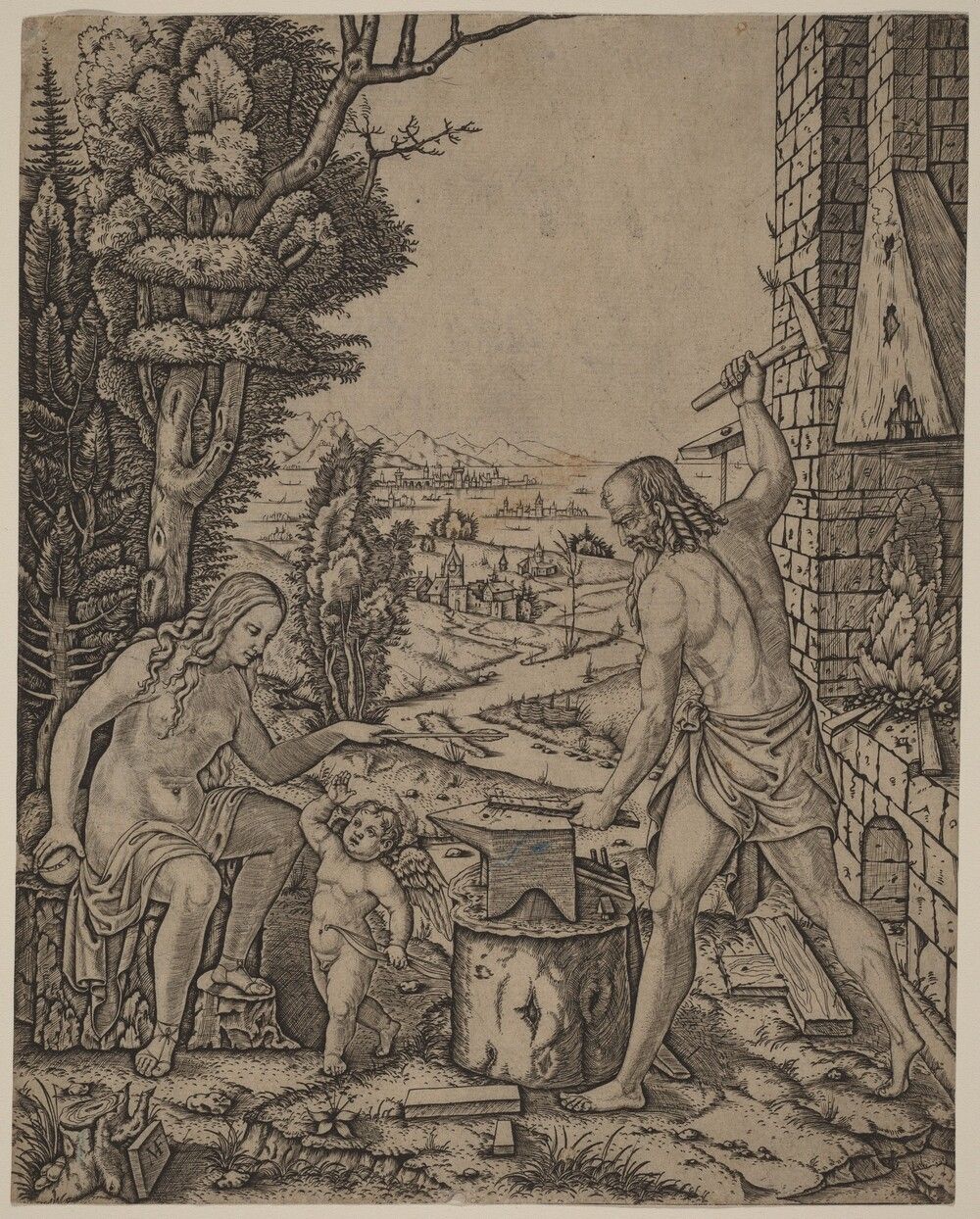
Vulcan, Venus, and Eros - Marcantonio Raimondi, 1508, engraving
National Gallery of Art, Washington, DC, 1941.1.67. CC0
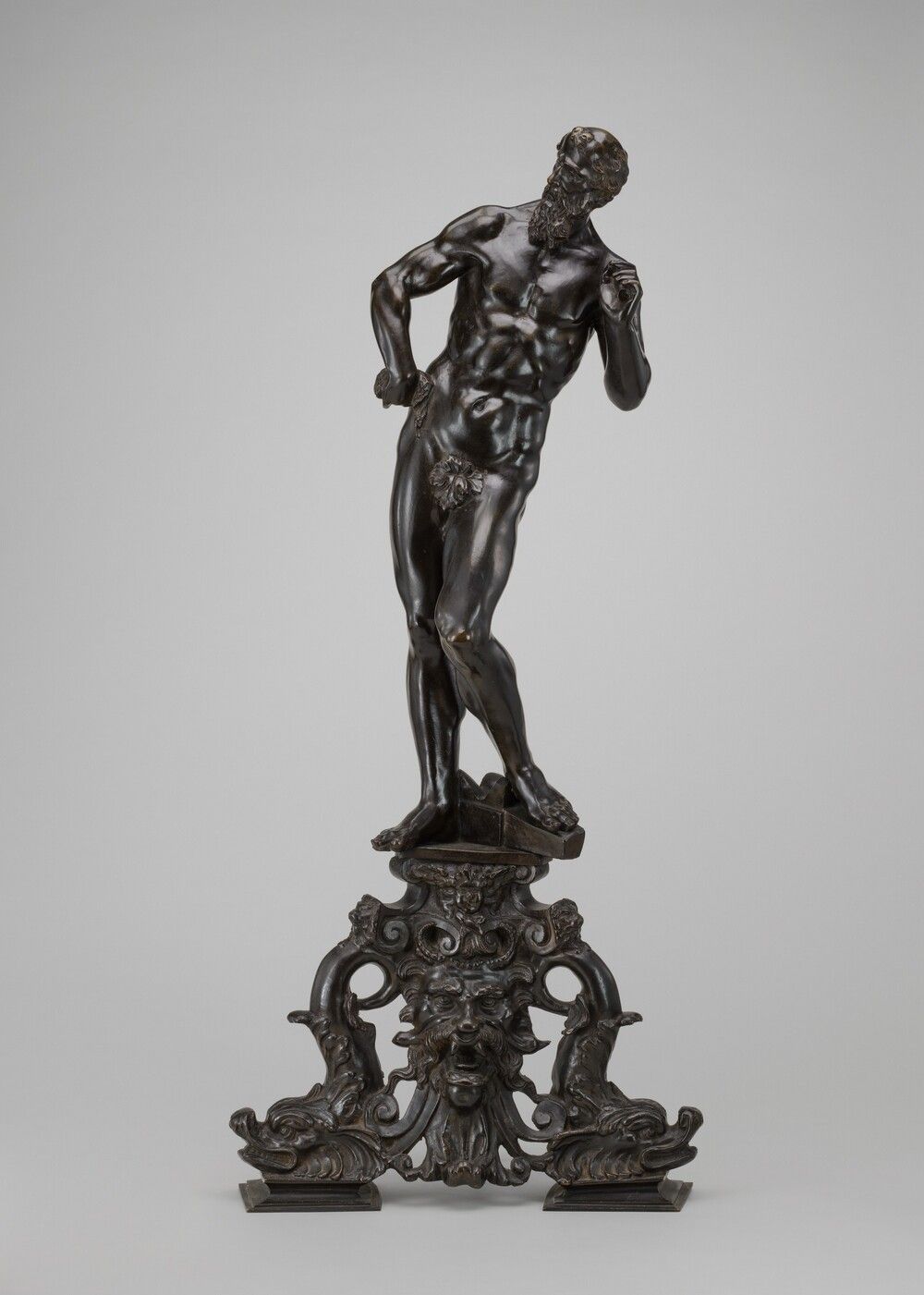
Andiron: Vulcan with His Anvil - Italian 18th Century, 18th century, bronze
National Gallery of Art, Washington, DC, 1942.9.2521. CC0
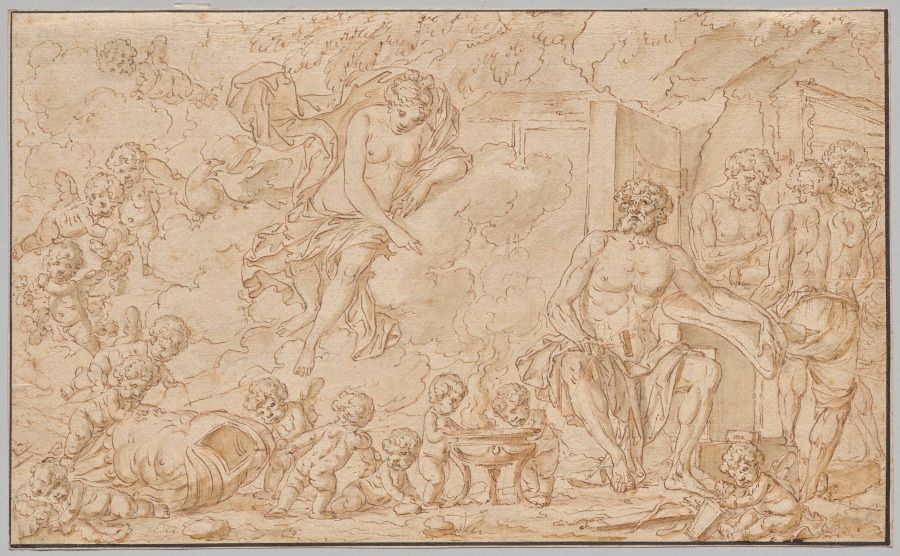
Venus at the Forge of Vulcan - France, 18th century, Pen and brown ink, and brown wash (bistre) with red chalk and traces of graphite
The Cleveland Museum of Art, Cleveland, OH, 2017.212. CC0
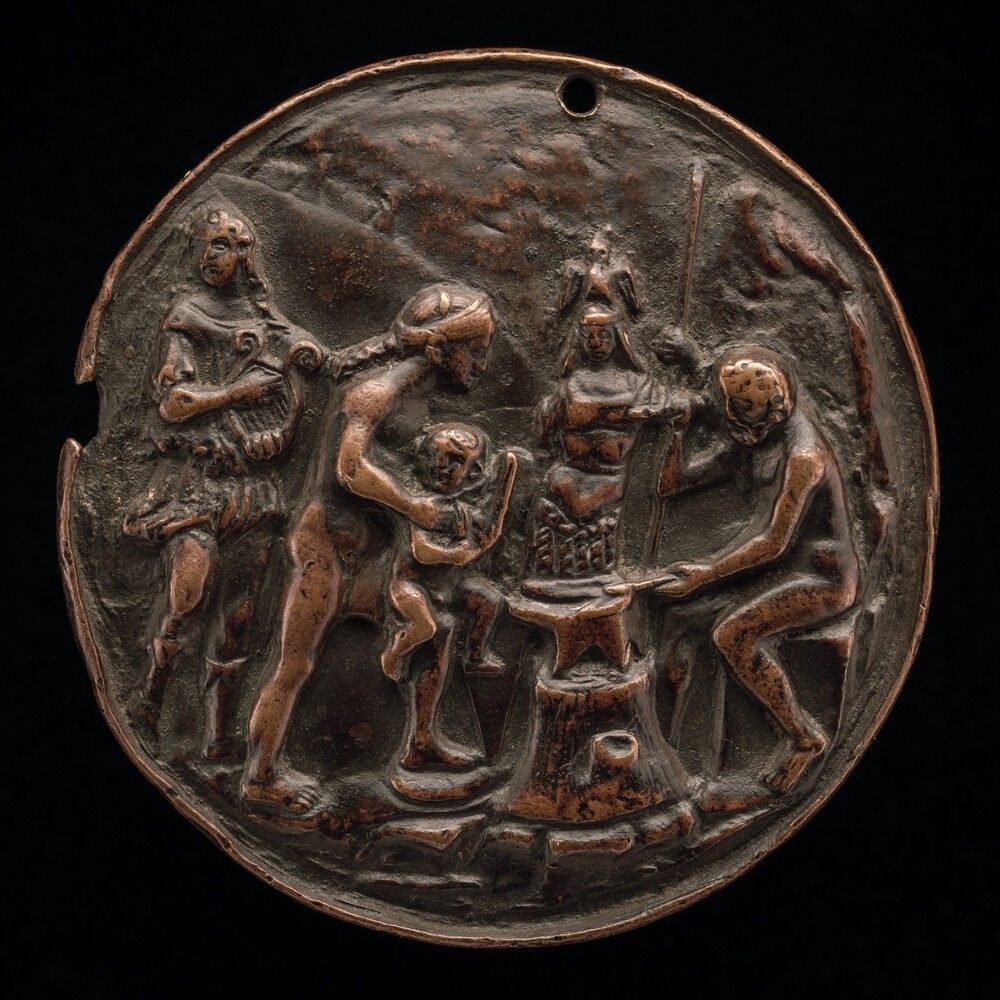
Apollo, Venus, Mars and Vulcan - Master M.C., bronze//Medium brown patina
National Gallery of Art, Washington, DC, 1957.14.191. CC0
Lineage
See the full family tree1 recorded relation, each with the ancient line behind it.
Parents
-

disputed
An alternate tradition holds that Juno conceived Vulcan without a father, jealous after Jupiter bore Minerva alone - the same parthenogenesis motif Greek myth assigns to Hera and Hephaestus.
Also Connected
4 recorded connections, each with the ancient line behind it.
Connected
-
In Ovid's account, Servius Tullius, the king Fortuna loved, was fathered by Vulcan, and Vulcan saved the statue in her temple from a fire (Fasti 6.569-636). Plutarch says some named the household Lar instead (On the Fortune of the Romans 322f-323a).
-

Vulcan caught his wife Venus and her lover Mars together in a net of his own forging and summoned the other gods to see them exposed.
-
Plutarch has Romulus dedicate a bronze four-horse chariot taken from Cameria in the temple of Vulcan (Romulus 24), and names the same temple as the place where, in one conjecture, the senators killed him (Romulus 27).
-

Venus was Vulcan's wife in Roman tradition; the marriage is best attested through its most famous rupture, her affair with Mars.
Where Accounts Differ
- meaning of the Volcanalia fish rite
- Varro records living creatures thrown into fire at the Volcanalia without naming fish; the popular "fish" detail traces to a separate June rite Festus describes, and modern retellings often merge the two.
Read the full source verification →
Mythology
Equivalent Figures
Related Terms
Referenced By
Sources
- Livy, Ab Urbe Condita 1.13
- Vitruvius, De Architectura 1.7
- Varro, De Lingua Latina 6.20
- Ovid, Fasti 6.569-576
- Ovid, Fasti 6.627-628