Hephaestus
Hephaestus is the divine smith of Olympus, born to Hera alone according to Hesiod, and responsible for forging the weapons and armor of the gods, from Zeus's thunderbolts to Achilles' shield. He is the only Olympian depicted as physically imperfect, cast from heaven and left lame, and he works his forge on the island of Lemnos.

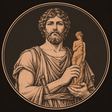
Hephaestus, Olympian god of the forge
Generated by AI from this page's own facts, not an ancient image or evidence of anything. How this site uses generated images
Sections on this page
Greek vs Roman: Hephaestus vs. Vulcan → See how Vulcan differs.
What does the name "Hephaestus" mean? →
See Hephaestus in the Greek family tree. Looking for a name of your own? Try the mythological name generator.
Core Myth
Hesiod says Hera bore him without union with Zeus, angry at her husband for producing Athena from his own head. Calling him the son of Zeus and Hera is common in later retelling and is not what the Theogony says, which is the source this page's genealogy rests on. He was born lame or became so after being hurled from Olympus - in one version by Zeus for defending Hera, in another by Hera herself who was ashamed of his appearance. He landed on the island of Lemnos, where he established his forge. Hephaestus became the master craftsman of the gods, creating Zeus's thunderbolts, Athena's aegis, Achilles' armor, and the golden net that trapped Ares and Aphrodite. Despite his lameness, he was married to Aphrodite, though she was unfaithful with Ares.
Who are Hephaestus's parents?
Hesiod's Theogony says Hera bore Hephaestus alone, without union with Zeus, in anger at Zeus for producing Athena from his own head without her. This is the parentage this page records as a graph edge. The widespread claim that Homer instead makes Zeus his father does not hold up: the Iliad passages usually cited only have Hephaestus address Hera as his mother and use the standard vocative "Father Zeus" that every god and mortal uses of the king of Olympus.
Hesiod, Theogony 927-929
Why is Hephaestus lame?
Sources disagree on both the cause and the moment. One account has Zeus hurl him from Olympus for taking Hera's side in a quarrel, and the fall itself cripples him after a day spent falling to Lemnos. Another has Hera herself throw him from Olympus at birth, ashamed of an already-deformed child. Either way, Hephaestus is the one Olympian marked by physical imperfection rather than divine perfection.
Homer, Iliad 1.590-594
What did Hephaestus make for the gods?
As the gods' craftsman, Hephaestus forged Zeus's thunderbolts, Athena's aegis, Achilles' new set of armor and shield at Thetis's request, Hermes' winged sandals, Heracles's bronze rattle used against the Stymphalian Birds, and the invisible, unbreakable net he used to trap his wife Aphrodite with Ares. He also built automated servants of gold to help him work, and mechanical golden and silver dogs to guard the palace of Alcinous.
Homer, Iliad 18.478-617
How did Hephaestus catch Aphrodite and Ares?
Warned by Helios, who sees everything from the sky, that his wife Aphrodite was sleeping with Ares, Hephaestus forged a net of chains too fine to see and too strong to break, and rigged it over their marriage bed. He caught the pair in the act, then summoned the other gods to laugh at their public humiliation rather than taking violent revenge, a scene told as a song within Homer's Odyssey.
Homer, Odyssey 8.266-366
How was Athena born from Hephaestus's actions?
When Zeus suffered an unbearable headache from carrying the unborn Athena in his own skull, Hephaestus (in some versions, Prometheus) split it open with an axe, and Athena sprang out fully grown and armed. Hephaestus's role is purely as the one who delivers her, not as any kind of parent, and the story is often read as balancing Hera's unilateral birth of Hephaestus with Zeus's unilateral birth of Athena.
Pindar, Olympian Ode 7
Later Traditions
In Roman religion, Hephaestus was identified with Vulcan, who was similarly associated with fire and the forge. His craft was increasingly allegorized as a symbol of civilization and technological progress. His golden handmaidens, given voice and intelligence to help him work, place Hephaestus alongside a wider Greek fascination with bodies made rather than born, a theme Pygmalion's ivory bride, warmed to life by Aphrodite rather than built by a craftsman-god, shares from the opposite direction.
Lineage
See the full family tree1 recorded relation, each with the ancient line behind it.
Parents
-

Hesiod has Hera bear Hephaestus alone, without Zeus, in answer to the birth of Athena. Later sources instead make him the son of both.
Also Connected
5 recorded connections, each with the ancient line behind it.
Connected
-

Helios, having seen Aphrodite and Ares together from the sky, told Hephaestus, prompting him to trap the pair in a net of his own forging.
-

Hephaestus shaped her body out of earth and water at Zeus's command, the same craftsman's role he plays in several other origin stories.
-
Both bring an artificial body to life: Pygmalion's ivory statue through Aphrodite's answered prayer, Hephaestus's own golden handmaidens and creations through his own craft as a god.
-

An alternate tradition credits the smith-god Hephaestus with forging Talos and giving him to Minos, rather than Zeus giving him to Europa.
-

Thetis and the Oceanid Eurynome sheltered the infant Hephaestus in the sea for nine years after Hera cast him from Olympus; Hephaestus later forges Achilles's armor at Thetis's request in gratitude.
Where Accounts Differ
- expulsion variant
- parentage of Hephaestus
- Expulsion variant: sources differ on whether Zeus or Hera cast Hephaestus from Olympus, and on whether his lameness was congenital or caused by the fall.
- Hesiod (Theogony 927-929) has Hera bear Hephaestus alone, without union with Zeus, and that is the only parentage this site records as an edge. The widespread claim that Homer makes Zeus his father is not carried here: the passages usually cited have Hephaestus address Hera as his mother and use the formulaic vocative "Father Zeus", which every god and mortal uses.
Read the full source verification →
Mythology
Appears In
Equivalent Figures
Related Terms
Referenced By
Sources
- Homer, Iliad 18.417-420
- Homer, Iliad 18.478-617
- Homer, Odyssey 8.266-366
- Hesiod, Theogony 927-929
- Timothy Gantz, Early Greek Myth (1993)