The Death of Achilles
The death of Achilles happens after Homer's Iliad ends, with Hector's funeral. Later sources say Paris shot him in the ankle at the Scaean gate while Apollo guided the arrow. Ajax carried out his body, Thetis, the Nereids and the Muses mourned him, and the arms went to Odysseus. The heel is a still later detail.
Sections on this page
What Led To It
Achilles dies in the tenth year of the Trojan War, after the events of Homer's Iliad. He had killed Hector and dragged the body, and Priam had come to beg for it. The Aethiopis, Proclus's summary of it, and Apollodorus's Epitome carry the story on from Hector's funeral.
The Myth
Homer's Iliad ends with Hector's burial, so the death of Achilles falls outside it. The poem still foretells that death again and again. Thetis warns her son in Book 18 that his own death is ready straight after Hector's. Later epic and the mythographers supply the rest: Paris, a god's help and an arrow at the Scaean gate.
The prophecies name the killers but not the wound. Before the fighting, the horse Xanthus, given speech by Hera, tells Achilles that he is fated to be slain by a god and a mortal. Achilles answers that he already knows he will die far from his father and mother, and drives on regardless. In Book 21, pinned by the river, he blames his mother for telling him he would fall beneath the Trojan wall to the swift missiles of Apollo. The three passages do not match word for word, and none of them mentions a heel.
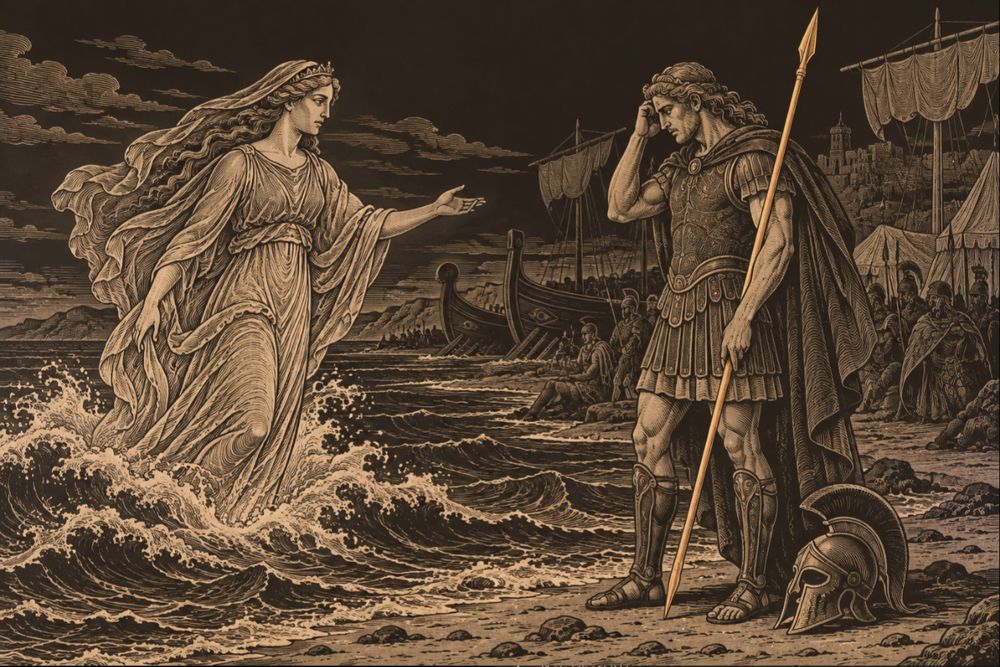
Thetis warns Achilles
Generated by AI from this page's own facts, not an ancient image or evidence of anything. How this site uses generated images
The clearest prophecy comes from the man Achilles has just killed. Dying, Hector begs him to give the body back for burial. Achilles refuses. He says he wishes rage would let him carve and eat the flesh raw, and that no ransom will save it from the dogs. Hector answers that he knew Achilles's heart was iron. He warns that the gods' wrath will fall on Achilles on the day when Paris and Phoebus Apollo destroy him at the Scaean gate. Then Hector dies.
Achilles replies in one line. Let him lie dead, he says, and he will accept his own fate whenever Zeus and the other gods choose to bring it. That gives the killers and the place. It gives no method, and the Iliad closes before it can. Its last scene is Hector's funeral.
Between the two deaths the Iliad keeps Achilles in grief. When he hears that Patroclus is dead, he pours dust over his head and lies stretched in it. Antilochus holds his hands for fear he will cut his own throat. Thetis and her sisters wail in the sea while he is still alive. In a dream, Patroclus's ghost asks that their bones lie together in one golden coffer, the gift of Thetis. It also tells him he is doomed to fall beneath the Trojan wall.
The next stretch of the story lives outside Homer. It belongs to the Aethiopis, a lost epic ascribed to Arctinus of Miletus, which begins where the Iliad stops.
Proclus's summary of the Aethiopis survives, and Apollodorus's Epitome keeps the same order. First an Amazon arrives. Penthesileia, daughter of Ares, comes to help the Trojans and is killed by Achilles. Apollodorus adds that Achilles fell in love with her after her death and killed Thersites for jeering at him.
Then comes Memnon, son of Eos, the Dawn. In Proclus he wears armour made by Hephaestus, and Thetis tells her son about him beforehand. Memnon kills Antilochus, and Achilles kills Memnon. Eos then asks Zeus for immortality for her son and gets it. Achilles routs the Trojans, rushes into the city among them, and there, Proclus says, Paris and Apollo kill him.
Apollodorus gives the death in one sentence. Chasing the Trojans, Achilles was shot in the ankle by Alexander, that is Paris, and by Apollo at the Scaean gate. Ovid supplies the motive in the Metamorphoses. Poseidon, called Neptune there, still grieves for a son whom Achilles killed and whom he had turned into a swan. He tells Apollo that they built Troy's walls in vain. He cannot meet Achilles face to face, he says, so Apollo must kill him with a sudden arrow.
Apollo agrees. Veiled in cloud, he finds Paris shooting at the common Greek soldiers, shows himself and tells him to aim at Achilles instead. Then Apollo turns the Trojan's bow on the hero and guides the fatal shaft with his own hand. Ovid adds that it was the first joy Priam had known since Hector's death, and he scorns the hero's end. Achilles was beaten by a coward who seduced a Greek wife.
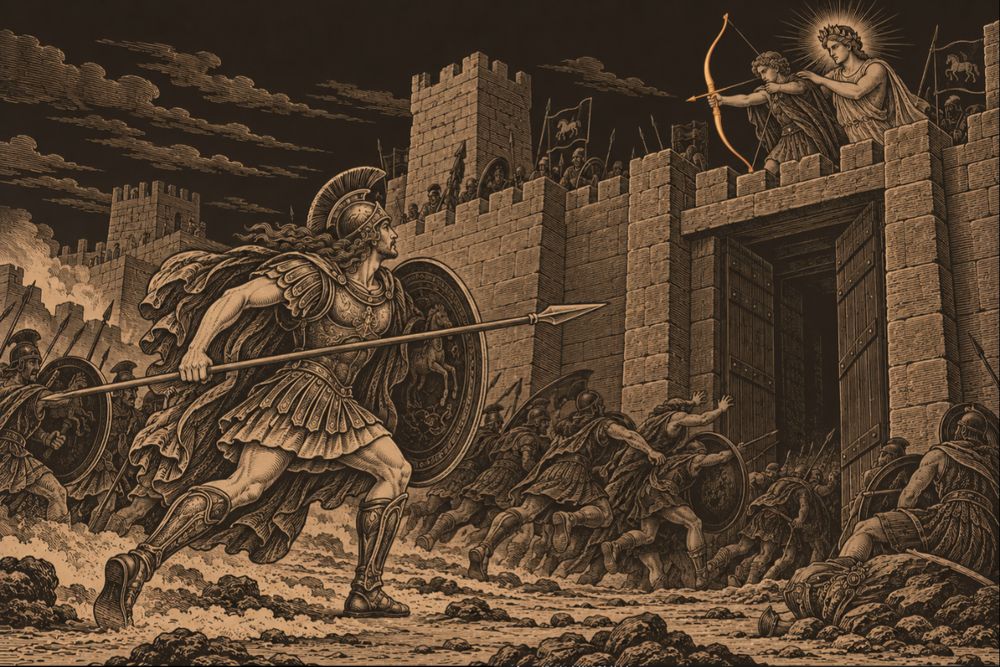
Paris and Apollo at the Scaean gate
Generated by AI from this page's own facts, not an ancient image or evidence of anything. How this site uses generated images
The famous heel is a later addition. Apollodorus, in the Library, tells a different story of Achilles as a child. Thetis hid the baby in the fire by night to burn away his mortal part. By day she anointed him with ambrosia. Peleus saw, cried out, and she left. Frazer's note to that passage adds a variant from later writers in which only an anklebone was burnt, and Peleus replaced it with a giant's.
The dip in the Styx comes from the Roman poet Statius. In the Achilleid, Thetis tells Chiron of her fears and says that she carries her son to the Stygian springs to dip him. Later, pleading with Achilles, she says she armed him in the stern stream of the Styx and wishes it had been all of him. Statius names no heel in either passage. Frazer's note to Apollodorus's death scene says the dry heel appears in commentators on Virgil and Statius and in Fulgentius. Apollodorus himself says only ankle.
Once Achilles falls, the fight is over his body. Apollodorus has Ajax kill Glaucus and send the arms on to the ships. Ajax carries the body out through a shower of darts while Odysseus holds off the pursuers. Proclus gives the same division of labour.
In the Odyssey, Agamemnon's shade describes it to Achilles in the underworld. The best of the Trojans and Achaeans fell around him as he lay in the whirl of dust, forgetful of his horsemanship. The Greeks would have fought all day and never stopped, Agamemnon says, had Zeus not stopped them with a storm. Then the army bore Achilles to the ships, and the sea answered.
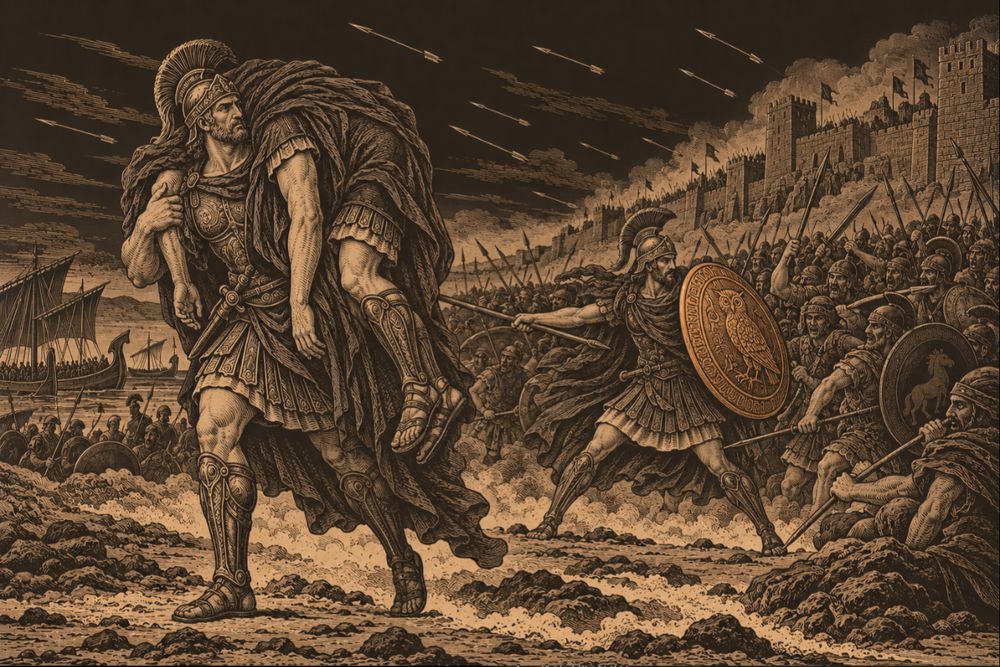
Ajax carries Achilles from the field
Generated by AI from this page's own facts, not an ancient image or evidence of anything. How this site uses generated images
Then around thee stood the daughters of the old man of the sea wailing piteously, and they clothed thee about with immortal raiment. And the Muses, nine in all, replying to one another with sweet voices, led the dirge. There couldst thou not have seen an Argive but was in tears, so deeply did the clear-toned Muse move their hearts.
Before that, Agamemnon says, the Greeks washed the body with warm water and ointment and cut their hair. When Thetis rose from the sea with the sea-nymphs, a great cry went over the water and the army panicked. They would have run for the ships, but Nestor told them it was only his mother coming to see her dead son. For seventeen days gods and men wept for Achilles. On the eighteenth they gave him to the fire, with sheep and cattle killed around the pyre and armed men circling it. The daughters of the old man of the sea in the quote are the Nereids, Thetis's sisters.
In the morning the Greeks gathered his bones and laid them in wine and unguents, in the golden urn his mother had given. Agamemnon calls it the gift of Dionysus and the work of Hephaestus. Patroclus's bones were mixed with his, as the ghost had asked, and those of Antilochus lay apart. The army heaped a great tomb on a headland by the Hellespont, and Thetis set out prizes for games. Not even in death, Agamemnon tells him, did he lose his name. His renown, his kleos, will last among all men.
The Odyssey ends with a tomb, but the Aethiopis differs. In Proclus's summary, Thetis arrives with the Muses and her sisters and mourns her son. Then she snatches him from the pyre and carries him to the White Island. Only after that do the Achaeans pile a cairn and hold games. Apollodorus has the mourning too, and then says the army buried Achilles on the White Isle with Patroclus, mixing their bones. Frazer's note calls that a slip, since the tomb stood in the Troad. Apollodorus also lists the winners of the games: Eumelus in the chariot-race, Diomedes in the footrace, Ajax with the quoit and Teucer in archery.
The last contest is over his armour. Apollodorus says the arms were offered as a prize to the bravest, and Ajax and Ulysses stepped forward. The judges were the Trojans or, as some say, the allies, and Ulysses won. Homer agrees on the result. In the Odyssey, Odysseus meets the shade of Ajax in the underworld, still angry about that contest. He names the judges as the sons of the Trojans and Pallas Athena. Ovid instead has Agamemnon, unwilling to be blamed, leave the decision to the Greek chiefs.
Ajax, in Apollodorus, is driven mad by Athena. He slaughters cattle, thinking them Achaeans, and then kills himself. Proclus says the Little Iliad goes on from there. Odysseus fetches Neoptolemus from Scyros and gives him his father's arms. In the Iliad, Achilles has already spoken of that son growing up on Scyros.
What Followed
The war went on without him. In Proclus's summary of the Little Iliad, the judging of his arms opens the poem, Ajax goes mad and kills himself, and Odysseus later brings Neoptolemus from Scyros to fight in his father's armour.
How did Achilles die?
In the sequel to the Iliad, Achilles chases the Trojans into their city and is killed by Paris and Apollo. Apollodorus says an arrow struck him in the ankle at the Scaean gate. Ovid adds that Apollo guided Paris's aim. Homer never narrates the death, but the dying Hector names Paris and Apollo as the killers in Iliad 22.
Apollodorus, Epitome 5.3
Who killed Achilles in Troy?
Paris fired the arrow, and most sources say Apollo guided it. Hector names both in Iliad 22, and Apollodorus and Ovid follow. Not every source agrees. In Iliad 21 Achilles says his mother foretold Apollo's missiles alone, and Frazer's note lists writers who name Paris alone. A late tale has Paris and Deiphobus ambush him at a temple of Apollo.
Homer, Iliad 22.337-366
Did Achilles go crazy after Patroclus died?
The Iliad shows grief and fury, not madness. Achilles pours dust over his head, and Antilochus fears he will cut his own throat. He will not eat, cannot sleep and drags Hector's body round Patroclus's barrow each dawn. Apollo tells the gods that his mind is not right and that he has lost pity. Later he weeps with Priam.
Homer, Iliad 24.33-54
Why did Achilles cry when he killed Hector?
In Homer he does not. He refuses Hector's plea for burial and says he will accept his own fate when the gods choose. His tears come later. In Iliad 24 he weeps with Priam for his own father and for Patroclus, while Priam weeps for Hector. His grief is for Patroclus, whom Hector had killed.
Homer, Iliad 24.507-512
Where Accounts Differ
- who-killed-achilles
- polyxena-version-of-the-death
- origin-of-the-heel
- what-became-of-achilles-body
- judges-of-the-arms
- Who killed him varies. Homer, Iliad 22.337-366, has Hector name Paris and Apollo together, and Apollodorus, Epitome 5.3, and Ovid, Metamorphoses 12.580-619, agree, Ovid making Paris the archer and Apollo the guide. In Iliad 21.275-278 Achilles says his mother foretold Apollo's arrows alone. Frazer's note to Epitome 5.3 adds writers who name Paris alone and Hyginus, Fabulae 107, who has Apollo in Paris's shape. The Hyginus text was not read here, only Frazer's report of it.
- The Polyxena version is only reported here. Frazer's note to Epitome 5.3 says later writers, including Tzetzes, Philostratus and Dictys Cretensis, have Achilles lured to a temple of Apollo by an offer of Polyxena and killed by Paris and Deiphobus. None of those texts was read for this page.
- The heel is late. The Iliad prophecies, 18.95-96, 19.404-423 and 22.337-366, name killers and a place but no wound. Apollodorus, Library 3.13.6, gives fire, not water, and Epitome 5.3 says ankle. Statius, Achilleid 1.133-134 and 1.269-270, has the Styx but names no heel in either passage. Frazer's note to Epitome 5.3 places the dry heel in Servius on Aeneid 6.57, Lactantius Placidus on Statius and Fulgentius, none read here.
- The Statius lines were read in the Latin text at thelatinlibrary.com, and the English paraphrase on this page is the site's own. No translation was quoted.
- The body's fate varies. Homer, Odyssey 24.36-94, has a pyre, an urn with Patroclus's bones and a tomb on the Hellespont. Proclus's summary of the Aethiopis has Thetis snatch him from the pyre to the White Island. Apollodorus, Epitome 5.5, puts the burial on the White Isle, which Frazer's note calls an error, since the Greeks' tomb was in the Troad.
- The judges of the arms vary. Homer, Odyssey 11.543-547, names the sons of the Trojans and Athena. Apollodorus, Epitome 5.6, says the Trojans or, according to some, the allies. Ovid, Metamorphoses 12.620-628, leaves it to the Greek chiefs.
- Proclus is outside this site's source registry. His summaries of the Aethiopis and the Little Iliad were read in H. G. Evelyn-White's translation on theoi.com, and none of the epics themselves survives. No line numbers exist for them, so none is given.
Read the full source verification →
Mythology
Figures In This Myth
Also Connected
Related Terms
Referenced By
Sources
- Homer, Iliad 18.22-64
- Homer, Iliad 18.95-96
- Homer, Iliad 19.312-333
- Homer, Iliad 19.404-423
- Homer, Iliad 21.275-278
- Homer, Iliad 22.337-366
- Homer, Iliad 23.69-92
- Homer, Iliad 24.10-18
- Homer, Iliad 24.33-54
- Homer, Iliad 24.507-512
- Homer, Iliad 24.802-804
- Homer, Odyssey 11.543-547
- Homer, Odyssey 24.36-94
- Homer, Odyssey 24.58-62
- Apollodorus, Library 3.13.6
- Apollodorus, Epitome 5.1
- Apollodorus, Epitome 5.3
- Apollodorus, Epitome 5.4
- Apollodorus, Epitome 5.5
- Apollodorus, Epitome 5.6
- Ovid, Metamorphoses 12.580-619
- Ovid, Metamorphoses 12.620-628
- Statius, Achilleid 1.133-134
- Statius, Achilleid 1.269-270
- Proclus, Chrestomathia
- J. G. Frazer, Apollodorus: The Library (Loeb, 1921), notes to Library 3.13.6 and Epitome 5.1-5.6
- H. G. Evelyn-White, Hesiod, the Homeric Hymns and Homerica (Loeb, 1914), the Aethiopis and Little Iliad, with Proclus's summaries