Nestor
Nestor was the aged king of Pylos and the oldest Greek leader at Troy. Homer's Iliad says two generations of men had passed in his lifetime and he ruled among the third. He is the army's counsellor, quick to recall the battles of his youth. In the Odyssey he is home in Pylos, where he hosts Telemachus. Heracles had killed all his brothers when Nestor was young.
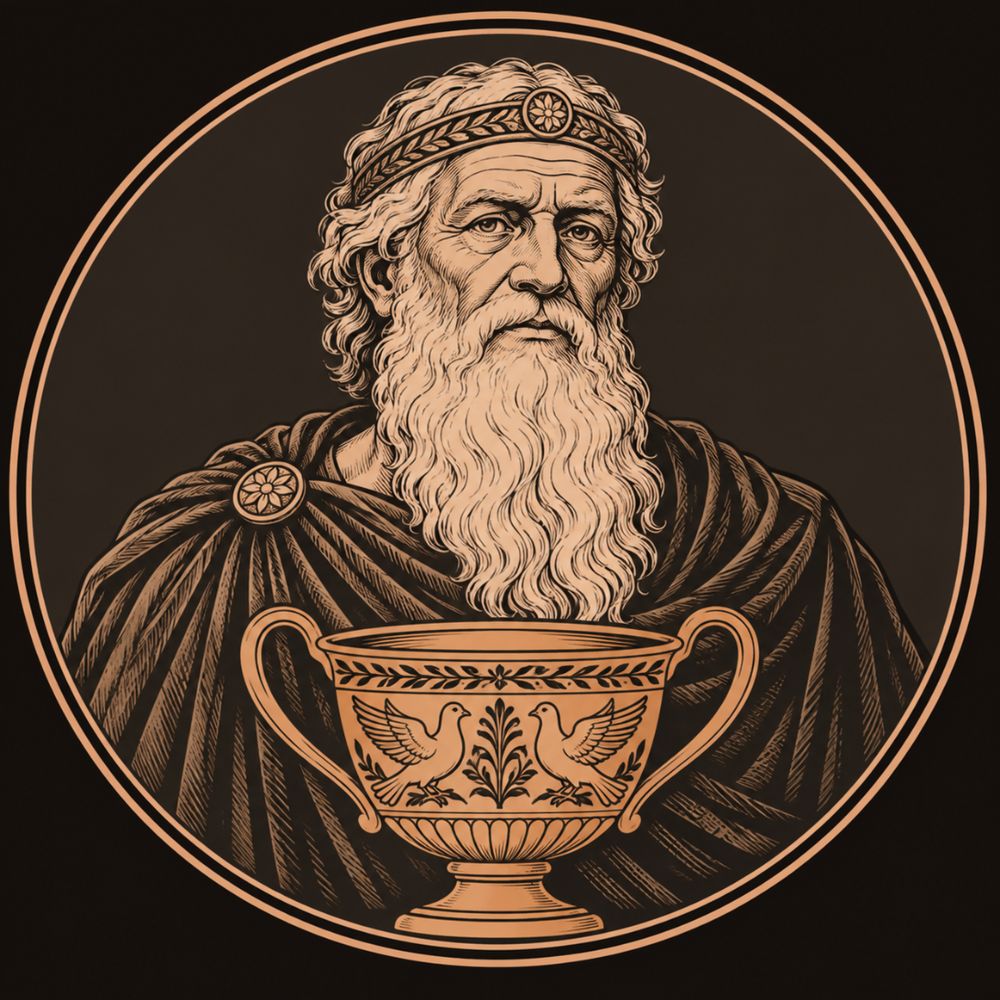
Nestor, bronze medallion illustration
Generated by AI from this page's own facts, not an ancient image or evidence of anything. How this site uses generated images
Sections on this page
Core Myth
Nestor was a son of Neleus, king of Pylos. In the Odyssey, Odysseus sees Nestor's mother Chloris among the dead, and Homer names her children: Nestor, Chromius, Periclymenus and a daughter, Pero. Apollodorus gives Neleus twelve sons by Chloris. When Heracles sacked Pylos, he killed Neleus's sons, Periclymenus among them, though Poseidon had given that brother the power to change his shape. Apollodorus says Nestor alone was saved, because he was being brought up among the Gerenians.
Nestor tells his own youth at length in the Iliad. In Book 11 he recalls a cattle raid on Elis, where he killed Itymoneus and drove fifty herds of cattle home to Pylos. When the Epeians struck back, his father hid his horses, thinking the boy knew nothing yet of war. The boy fought on foot anyway. He killed Mulius, took his chariot, and captured fifty chariots. He would have killed the two Moliones, he says, had their father, the Earth-Shaker, not hidden them in mist.
Other speeches add more. In Book 7 he says he killed the giant Ereuthalion when he was the youngest of all who might have faced him. In Book 1 he claims he fought beside Peirithous and Theseus against the mountain-dwelling centaurs. In Book 23 he recalls the funeral games for Amarynceus at Buprasium. He won the boxing, the wrestling, the foot race and the spear throw, and lost only the chariot race, to the twin sons of Actor.
At Troy, the old king leads the men of Pylos, with ninety ships in Homer's catalogue. Book 1 introduces him as the clear-voiced speaker of the Pylians, whose words flowed sweeter than honey. He tries to settle the quarrel between Agamemnon and Achilles. He tells Agamemnon to leave Briseis alone and Achilles not to strive with a king. In Book 8 Paris shoots one of his horses, and Diomedes takes the old man onto his own chariot to save him from Hector.
His advice moves the plot. In Book 9 he reminds Agamemnon that he tried to stop him taking Briseis, and urges him to win Achilles back with gifts and gentle words. In Book 11 he tells Patroclus to ask Achilles for his armor, so the Trojans might take him for Achilles and draw back. That is the plan that sends Patroclus into battle. In Book 23 Nestor coaches his son Antilochus for the chariot race, telling him to wheel close around the turning post.
Who was Nestor to Agamemnon?
He was an allied king and Agamemnon's most valued counsellor. Nestor ruled Pylos and brought his own ships to Troy under Agamemnon's command. In Iliad Book 2, Agamemnon tells him he excels the Greeks in the assembly, and wishes he had ten such counsellors, for then Troy would soon fall. Nestor also stands up to him. In Book 9 he reminds Agamemnon that he tried to stop him taking Briseis from Achilles. In the Odyssey, Nestor tells Telemachus how Agamemnon was murdered on his return.
Homer, Iliad 2.370-374
Who is Nestor in the Odyssey?
He is the old king of Pylos whom Telemachus visits first in search of news of his father. In Book 3, Athena, disguised as Mentor, sends the young man to him. Nestor cannot say what became of Odysseus, but he tells how the Greeks sailed home from Troy and how Agamemnon was killed. He recognizes Athena when she leaves as a sea-eagle and sacrifices a heifer to her. Then he sends Telemachus to Menelaus in Sparta, with his son Peisistratus as driver.
Homer, Odyssey 3.371-384
Who was Nestor's wife?
In Homer's Odyssey his wife is Eurydice, the eldest daughter of Clymenus. She appears in Book 3, raising the women's cry when Nestor's sons sacrifice a heifer to Athena. Apollodorus names her differently: Nestor married Anaxibia, daughter of Cratieus. He lists two daughters, Pisidice and Polycaste, and seven sons, Perseus, Stratichus, Aretus, Echephron, Pisistratus, Antilochus and Thrasymedes. The children largely match Homer's. Only the mother's name and one son's spelling differ.
Homer, Odyssey 3.451-452
How old was Nestor in the Iliad?
Homer gives no number of years. He says instead that two generations of mortal men had passed away in Nestor's lifetime, men born and raised with him in Pylos, and that he was king among the third. The Odyssey repeats the idea when Telemachus says men claim Nestor has been king for three generations. Ovid's Nestor is more exact. In Metamorphoses Book 12 he says he has lived two hundred years and is now living his third century.
Homer, Iliad 1.250-252
How did Nestor's son Antilochus die?
He died saving his father. Pindar's sixth Pythian ode tells the story. Paris had wounded one of the horses, so Nestor's chariot could not move, and Memnon, commander of the Ethiopians, was aiming his spear. The old man shouted to his son. Antilochus stayed and paid for his father's rescue with his own life. The Odyssey calls the killer the son of the bright Dawn, and Apollodorus's Epitome names Memnon, who was then killed by Achilles.
Pindar, Pythian Ode 6.28-42
Who killed Nestor's brothers?
Heracles did. In Iliad Book 11, Nestor says Heracles came to Pylos in earlier years and killed its best men. Neleus had twelve sons, and Nestor alone was left. Apollodorus adds that Heracles killed Neleus too, and that Nestor survived because he was being raised among the Gerenians. Among the dead was Periclymenus, whom Poseidon had given the power to change shape. Ovid's Nestor says Heracles shot Periclymenus with an arrow while he flew as an eagle.
Homer, Iliad 11.690-693
Later Traditions
In the Odyssey the war is over and the king is home. Telemachus finds him on the shore at Pylos with his sons, sacrificing black bulls to Poseidon. The old man has no news of Odysseus. He tells how the Greeks split after Troy, how he sailed straight home, and how Aegisthus murdered Agamemnon. His own is one of the quick, safe homecomings. He sends Telemachus on to Menelaus at Sparta, with his son Peisistratus driving the chariot.
When Athena, disguised as Mentor, leaves in the form of a sea-eagle, the king recognizes her and vows her a heifer with gilded horns. The next morning his six sons gather around him: Echephron, Stratius, Perseus, Aretus, Thrasymedes and Peisistratus. At the sacrifice his wife Eurydice, eldest daughter of Clymenus, raises the women's cry. His youngest daughter Polycaste bathes Telemachus.
One son is missing. In Odyssey Book 3 Nestor names Antilochus among the dead at Troy, and in Book 4 Peisistratus weeps for him at Menelaus's table, slain by the son of the Dawn. Apollodorus's Epitome names that killer as Memnon. Pindar's sixth Pythian ode tells how it happened. Paris had wounded a horse of Nestor's chariot, and Memnon came on with his spear. Antilochus stood his ground and died so that his father could live.
Ovid gives Nestor a precise age and a long grudge. In Metamorphoses Book 12 he tells the Greek chiefs he has lived two hundred years and is now in his third century. Asked why he never praises Heracles, he says Heracles ruined Pylos and killed eleven of the twelve sons of Neleus. Pausanias, visiting Pylos, saw a house called the house of Nestor with a painting of him inside, and says his tomb was in the city.
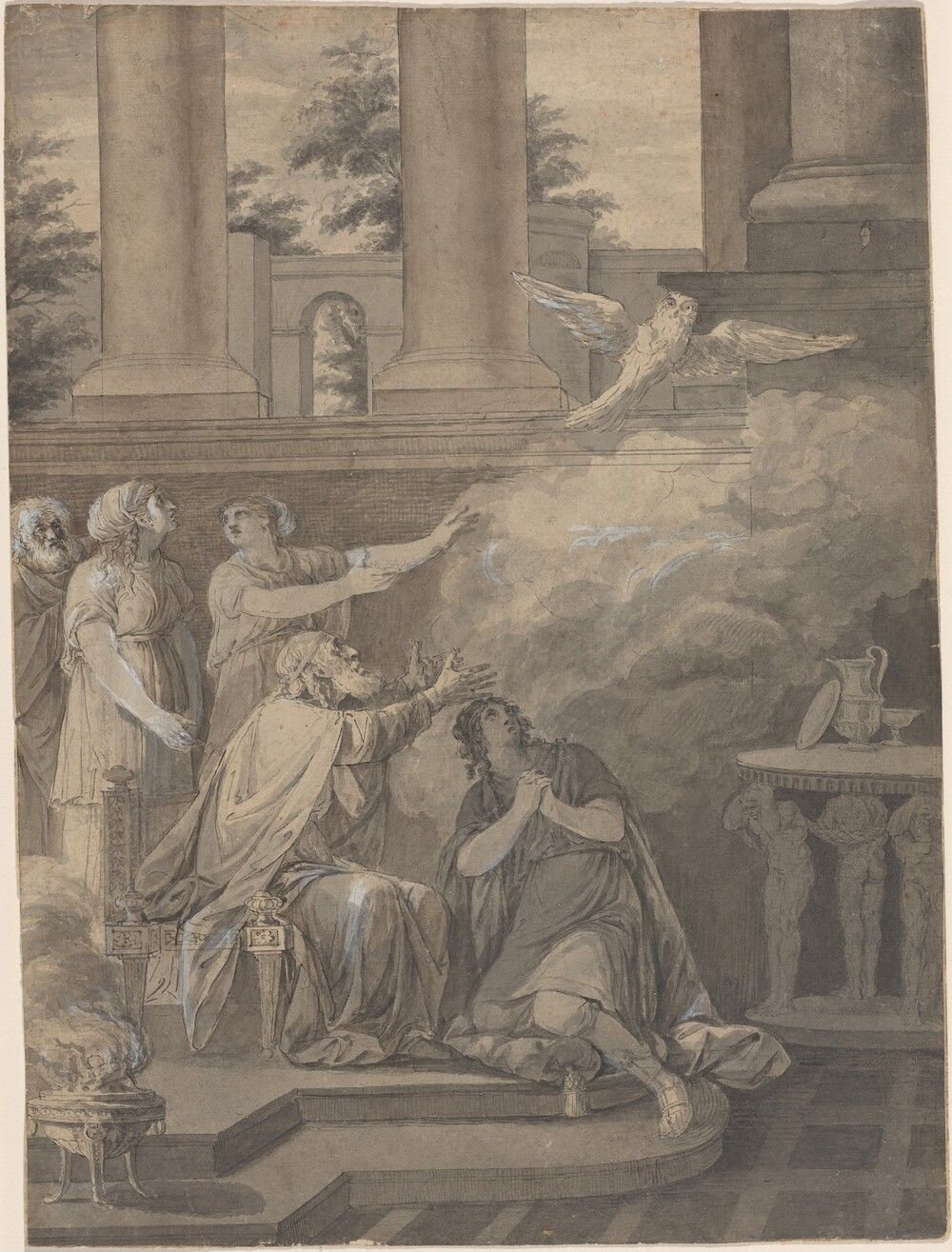
Pallas Athene in the Form of a Bird Leaving Nestor and Telemachus - Jean-Jacques-François Le Barbier I, c. 1780, pen and black ink with gray and brown washes over graphite, heightened with white, on laid paper
National Gallery of Art, Washington, DC, 1992.61.2. CC0
Also Connected
11 recorded connections, each with the ancient line behind it.
Allies
-
Nestor is Agamemnon's senior counsellor at Troy. In Iliad Book 9 he reminds the king that he tried to stop him taking Briseis and urges him to make amends to Achilles.
-

Nestor recognizes Athena when she leaves as a sea-eagle and vows her a heifer with gilded horns. In Iliad Book 11 he says she roused the Pylians for battle against the Epeians.
-
When Paris shoots one of Nestor's horses, Diomedes takes the old man onto his own chariot and drives at Hector.
-

Nestor tells Telemachus that he and Odysseus never spoke at variance in assembly or council at Troy.
-
Nestor hosts Telemachus at Pylos, tells him of the Greek homecomings, and sends him to Sparta with his son Peisistratus.
Enemies
-

Heracles sacked Pylos and killed the sons of Neleus. Nestor alone survived, being brought up among the Gerenians.
Connected
-

In Iliad Book 1 Nestor tries to settle the quarrel, telling Achilles not to strive with a sceptred king. In Book 23 Achilles gives him a prize at Patroclus's funeral games.
-

Nestor reminds Agamemnon that he tried to stop him taking Briseis, and urges him to make amends to Achilles.
-
Nestor sends Telemachus on to Menelaus at Sparta. There Menelaus praises Nestor's good fortune in old age and in his sons.
-
Nestor tells Patroclus to ask Achilles for his armor, so the Trojans might take him for Achilles and draw back.
-

Apollodorus makes Poseidon the father of Neleus by Tyro. In the Odyssey, Telemachus finds Nestor and the Pylians sacrificing black bulls to Poseidon.
Where Accounts Differ
- who was Nestor's wife
- whether Heracles killed Neleus
- how old Nestor was
- how many ships Nestor brought to Troy
- how many brothers Nestor had
- Nestor's wife is named two ways. The Odyssey (3.451-452) calls her Eurydice, eldest daughter of Clymenus. Apollodorus (Library 1.9.9) names her Anaxibia, daughter of Cratieus. The sons also differ slightly: the Odyssey (3.412-415) names Stratius where Apollodorus has Stratichus, and Apollodorus adds a daughter, Pisidice, whom Homer does not mention.
- Whether Heracles killed Neleus differs by source. In the Iliad (11.690-693) Heracles kills the sons of Neleus, and Neleus is still alive to share out the spoil of Nestor's cattle raid and to hide his horses from him. Apollodorus (Library 2.7.3) says Heracles slew Neleus and his sons except Nestor. The Odyssey (3.409-410) says only that Neleus had died before Telemachus's visit.
- Nestor's age is given two ways. Homer counts generations: two had passed in his lifetime and he ruled among the third (Iliad 1.250-252), and Telemachus says he has been king for three generations of men (Odyssey 3.245). Ovid (Metamorphoses 12.187-188) has him say he has lived two hundred years and is in his third century.
- Homer's catalogue (Iliad 2.601-602) gives Nestor ninety ships. Apollodorus (Epitome 3.12) gives him forty.
- Nestor's brothers are counted differently. The Iliad (11.692) and Ovid (Metamorphoses 12.536-579) give Neleus twelve sons. The Odyssey (11.281-286) names only three sons of Chloris, Nestor, Chromius and Periclymenus. Apollodorus (Library 1.9.9) lists twelve sons and has no Chromius among them. Apollodorus says Periclymenus turned into a lion, a snake and a bee before Heracles killed him, while Ovid has him shot down as an eagle.
Read the full source verification →
Mythology
Appears In
Related Terms
Referenced By
Sources
- Homer, Iliad 1.247-284
- Homer, Iliad 1.250-252
- Homer, Iliad 2.370-374
- Homer, Iliad 2.591-602
- Homer, Iliad 7.132-160
- Homer, Iliad 8.80-117
- Homer, Iliad 9.96-113
- Homer, Iliad 11.670-761
- Homer, Iliad 11.690-693
- Homer, Iliad 11.765-803
- Homer, Iliad 23.306-348
- Homer, Iliad 23.626-650
- Homer, Odyssey 3.1-66
- Homer, Odyssey 3.102-200
- Homer, Odyssey 3.111-112
- Homer, Odyssey 3.245
- Homer, Odyssey 3.254-312
- Homer, Odyssey 3.371-384
- Homer, Odyssey 3.404-415
- Homer, Odyssey 3.451-452
- Homer, Odyssey 3.464-465
- Homer, Odyssey 4.186-202
- Homer, Odyssey 11.281-286
- Apollodorus, Library 1.9.8
- Apollodorus, Library 1.9.9
- Apollodorus, Library 2.7.3
- Apollodorus, Epitome 3.12
- Apollodorus, Epitome 5.3
- Pindar, Pythian Ode 6.28-42
- Ovid, Metamorphoses 12.187-188
- Ovid, Metamorphoses 12.536-579
- Pausanias, Description of Greece 4.36.2