Menelaus
Menelaus, king of Sparta and younger brother of Agamemnon, loses his wife Helen when the Trojan prince Paris takes her to Troy, giving the Greeks their pretext for a ten-year siege. He fights through the war, including a single combat against Paris, and survives to sail home. Homer's Odyssey even has a god promise him he will never die an ordinary death at all.
Menelaus, king of Sparta
Generated by AI from this page's own facts, not an ancient image or evidence of anything. How this site uses generated images
Sections on this page
Core Myth
Menelaus, a son of Atreus and younger brother of Agamemnon, ruled Sparta as king after marrying Helen, said to be the most beautiful woman alive and a daughter of Zeus. When the Trojan prince Paris, guided there by the outcome of the Judgement of Paris, arrived in Sparta as a guest, Menelaus welcomed him for nine days before leaving for Crete to attend his grandfather Catreus's funeral. In his absence, Paris persuaded Helen to leave with him for Troy, taking a share of the household's wealth and abandoning her nine-year-old daughter Hermione. Menelaus returned to an empty palace, and the loss became the occasion for a vast Greek coalition, led by Agamemnon, to sail against Troy and reclaim her. In Euripides's Iphigenia at Aulis, Agamemnon says his brother Menelaus persuaded him to sacrifice Iphigenia when the fleet lay weatherbound at Aulis.
In Homer's Iliad, Menelaus fights among the Greek champions throughout the war's tenth year and very nearly ends the whole conflict himself in Book 3, when he and Paris agree to settle the war by single combat for Helen's sake. Menelaus overpowers Paris quickly, breaking his sword on his opponent's helmet and dragging him by the helmet strap toward the Greek lines, only for Aphrodite to snap the strap and spirit Paris away in a mist before the killing blow can land. The truce collapses soon after, when the Trojan archer Pandarus wounds Menelaus with an arrow and restarts the war in earnest.
Did Menelaus and Paris ever fight each other directly?
Yes, in Homer's Iliad Book 3, the two agree to settle the entire war by single combat for Helen's sake. Menelaus quickly gets the better of Paris, breaking his sword and dragging him toward the Greek lines by his helmet, but Aphrodite snaps the helmet strap and carries Paris off in a mist before Menelaus can finish him, leaving the duel technically won but the war unresolved.
Homer, Iliad 3.340-382
How did Menelaus lose Helen to Paris?
According to Apollodorus's Epitome, Menelaus hosted Paris as a guest in Sparta for nine days, then left for Crete to attend his grandfather Catreus's funeral. With Menelaus away, Paris persuaded Helen to leave with him for Troy, taking a share of the household's wealth and abandoning her young daughter Hermione, and the two sailed off by night.
Apollodorus, Epitome 3.3
Did Menelaus die in the Trojan War, or afterward?
No. Menelaus is one of the few major Greek leaders who survives both the siege and the journey home. Homer's Odyssey has the sea god Proteus tell him directly that he will not die an ordinary death: because he is married to Helen and counted Zeus's son-in-law, the gods will carry him living to the Elysian plain instead.
Homer, Odyssey 4.561-569
Why does Homer say Menelaus will never really die?
Proteus explains the reason as a direct consequence of Menelaus's marriage: because he has Helen for a wife, he counts in the gods' eyes as a son-in-law of Zeus, and that connection alone earns him a place in the Elysian plain rather than an ordinary death and a place among the shades in the underworld like other men.
Homer, Odyssey 4.561-569
What happened to Menelaus after the war ended?
His voyage home took eight years rather than a direct sail, driven off course through Egypt and Cyprus. Homer's Odyssey shows him telling this story to Telemachus, Odysseus's son, years later, safely back in Sparta and reunited with Helen, living out the household life the war had interrupted.
Homer, Odyssey 4.121-146
Later Traditions
Menelaus is one of the few prominent Greek commanders who survives the war outright and eventually gets home. Homer's Odyssey has him tell Telemachus, Odysseus's son, about his own eight-year detour through Egypt and Cyprus on the long nostos back to Sparta, including a wrestling match with the shape-shifting sea god Proteus to learn his fate. Proteus tells him he will not die an ordinary death at all: because he is married to Helen and counted a son-in-law of Zeus, the gods will carry him living to the Elysian plain at the ends of the earth, where life is easiest for mortals. Later tragedy, especially Euripides's Helen, keeps the couple together at Sparta in old age; this entry follows Homer's own account of the couple's return and the Elysium prophecy rather than the later dramatic elaborations, since no ancient source actually narrates Menelaus dying.
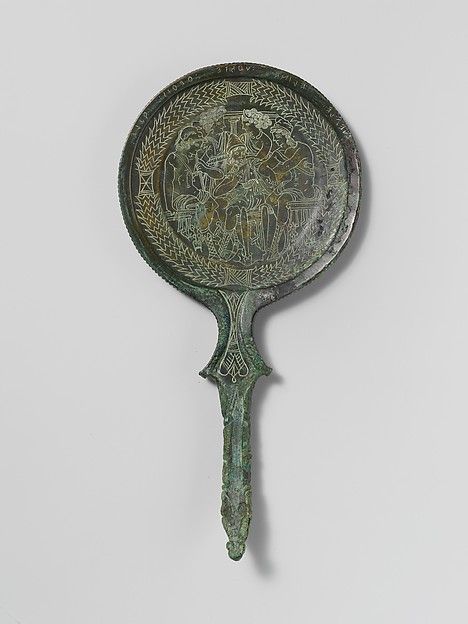
Bronze mirror - Etruscan, 3rd century BCE, Bronze
Metropolitan Museum of Art, New York, NY, 21.88.28. CC0
Lineage
See the full family tree1 recorded relation, each with the ancient line behind it.
Siblings
-

Sons of Atreus and joint leaders of the Greek expedition against Troy: Agamemnon commands the largest contingent, and Menelaus leads the Spartans as his own brother.
Also Connected
10 recorded connections, each with the ancient line behind it.
Allies
-

Menelaus is the first to stand over Patroclus's body and defend it from the Trojans at the start of Iliad Book 17.
Enemies
-

In Euripides's Andromache, Menelaus seizes her son and forces her to leave the shrine of Thetis by threatening to kill the child in her place.
-

Paris's abduction of Menelaus's wife Helen makes the two archenemies for the whole war; they meet in single combat in Iliad Book 3, and only Aphrodite's rescue of Paris keeps Menelaus from killing him on the spot.
-

In Euripides's Andromache the aged Peleus stops Menelaus from killing Andromache and her child and denounces him as a coward.
Connected
-

Menelaus and Helen are already married when Paris takes her to Troy, and Homer's Odyssey shows the couple reunited and ruling together in Sparta years after the war ends.
-

In Homer's Odyssey, Menelaus sends his daughter Hermione to marry Achilles's son, keeping a promise made at Troy. Euripides's Andromache says he had first betrothed her to Orestes.
-

Nestor sends Telemachus on to Menelaus at Sparta. There Menelaus praises Nestor's good fortune in old age and in his sons.
-

At the close of Euripides's Orestes, Apollo stops Orestes holding a sword to Hermione, tells Menelaus to leave him to rule Argos, and foretells that Orestes will marry her.
-

Tantalus is Menelaus's great-grandfather. In Euripides's Orestes, Electra traces the line from Tantalus through Pelops and Atreus to Agamemnon and Menelaus.
-

Menelaus hosts Telemachus in Sparta, tells him Proteus saw Odysseus held by Calypso, and sends him home with gifts.
Where Accounts Differ
- menelaus-fate-elysium-vs-later-tragedy
- No ancient source narrates an ordinary death for Menelaus; Homer's Odyssey has the sea god Proteus prophesy that he will be carried alive to the Elysian plain instead, a fate tied explicitly to his marriage to Helen and standing as Zeus's son-in-law rather than to any personal heroism of his own.
- Later tragedy, especially Euripides's Helen, keeps Menelaus and Helen together at Sparta in old age with its own plot complications; this entry follows Homer's own account of the couple's reunion and the Elysium prophecy rather than the later dramatic elaborations.
Read the full source verification →
Mythology
Appears In
Related Terms
Referenced By
Sources
- Apollodorus, Epitome 3.3
- Homer, Iliad 2.581-590
- Homer, Iliad 3.340-382
- Homer, Odyssey 4.121-146
- Homer, Odyssey 4.561-569
- Euripides, Iphigenia at Aulis 87-110
- Timothy Gantz, Early Greek Myth (1993)