Agamemnon
Agamemnon, king of Mycenae, commands the largest Greek contingent at Troy and leads the whole allied army in Homer's Iliad. His seizure of Achilles's war prize Briseis, forced by his own loss of a captive to end a plague, drives Achilles from the fighting and frames the entire poem. Agamemnon survives the war only to be murdered at home by Aegisthus, aided by his wife Clytemnestra.
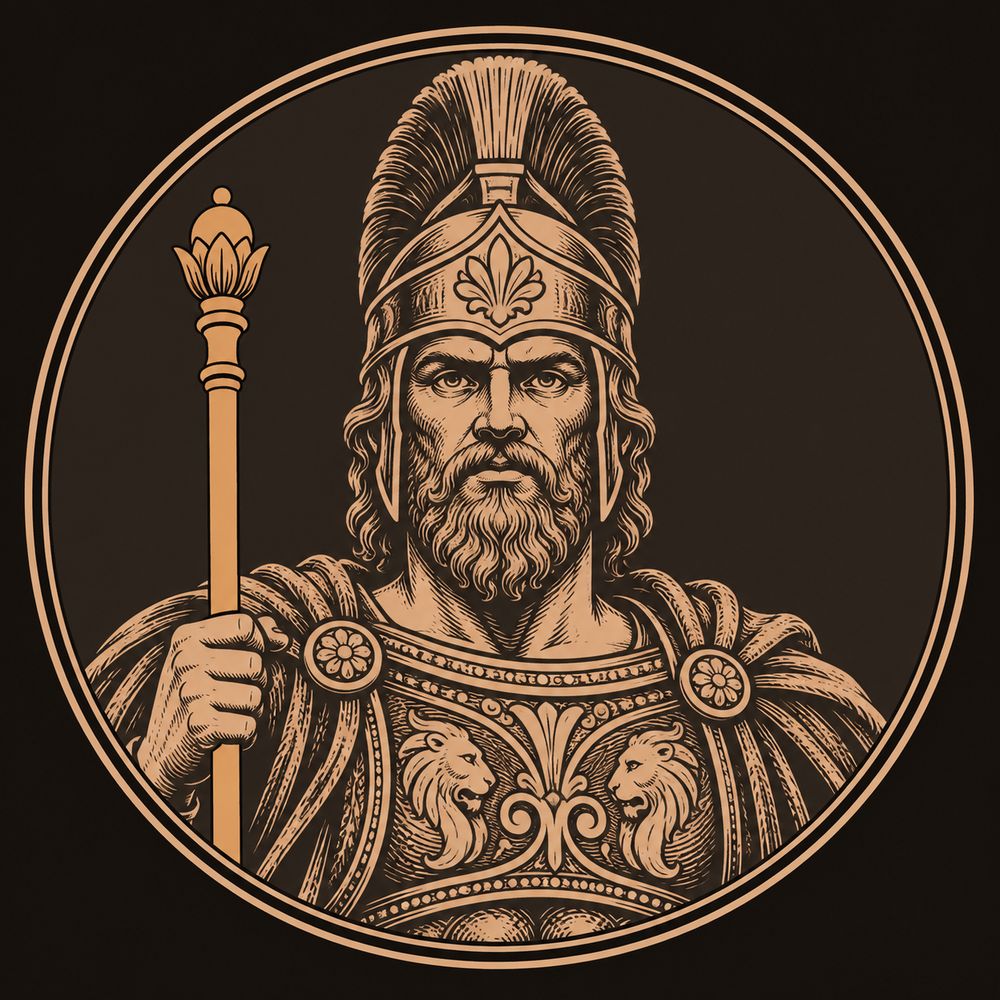
Agamemnon, Bronze Medallion Illustration
Generated by AI from this page's own facts, not an ancient image or evidence of anything. How this site uses generated images
Sections on this page
See Agamemnon in the Greek family tree.
Core Myth
Agamemnon, son of Atreus, ruled Mycenae and commanded the combined Greek army that sailed against Troy with a hundred ships, more than any other contingent. In Euripides's Iphigenia at Aulis, he admits that Menelaus talked him into sacrificing his daughter, whom he lured with a sham wedding. In the tenth year of the siege, a plague sent by Apollo forces him to return the captive Chryseis to her father, and Agamemnon compensates himself by seizing Achilles's own prize, Briseis - a public insult that drives Achilles from the fighting and very nearly loses the Greeks the war. After a disastrous night battle, Agamemnon loses heart and proposes abandoning the siege altogether, only to be rebuked by Diomedes, who refuses to leave. Agamemnon survives the war and returns to Mycenae with the captive Cassandra, but is killed there by Aegisthus, his wife Clytemnestra's lover, who cuts him down at a feast with Clytemnestra's help; Homer has Agamemnon's own shade describe the murder, and Cassandra's death cry beside him, to Odysseus in the underworld.
Why did Agamemnon take Achilles's war prize Briseis?
A plague sent by Apollo forces Agamemnon to give up his own captive, Chryseis, to end it, and he compensates himself by seizing Briseis, the woman awarded to Achilles as a prize of war. The insult is public and deliberate, and it drives Achilles to withdraw from the fighting entirely, setting the whole plot of the Iliad in motion.
Homer, Iliad, Book 1
What did Agamemnon propose after a disastrous night of fighting, and how did Diomedes respond?
Convinced that Zeus has doomed the expedition, Agamemnon tells the assembled Greeks to load the ships and sail home, giving up on ever taking Troy. Diomedes answers first and refuses outright, reminding Agamemnon that he once mocked Diomedes's courage and telling him to leave alone if he wishes: Diomedes and his companion Sthenelus will stay and fight until the city falls.
Homer, Iliad 9.32-49
How large was Agamemnon's own contingent at Troy?
Homer's catalogue of the Greek forces gives Agamemnon a hundred ships from Mycenae and the surrounding towns of the Argolid, more than any other leader brings, and names him as the noblest and most numerous of all the contingents gathered against Troy.
Homer, Iliad 2.559-568
How did Agamemnon actually die?
According to his own shade, speaking to Odysseus in the underworld, Agamemnon was invited to a feast at the house of Aegisthus, his wife Clytemnestra's lover, and was cut down there like an ox at a stall, with Clytemnestra's aid. Cassandra, the Trojan captive he had brought home with him, was killed at his side in the same attack.
Homer, Odyssey 11.409-434
Does Apollodorus tell Agamemnon's murder the same way Homer does?
Mostly, but with an added detail and a shift in emphasis. Apollodorus's Epitome credits the killing jointly to Aegisthus and Clytemnestra, rather than naming Aegisthus as the one who struck the blow, and adds that Clytemnestra gave Agamemnon a shirt with no opening for the head or arms, cutting him down while he struggled to put it on.
Apollodorus, Epitome 6.23
Was anyone else killed alongside Agamemnon when he returned home?
Yes. Cassandra, the captive Trojan princess Agamemnon had brought back from Troy as part of his spoils, was murdered in the same attack that killed him, cut down by Clytemnestra according to Apollodorus's account of the episode, though other ancient writers split the blame between Clytemnestra and Aegisthus together.
Apollodorus, Epitome 6.23
Later Traditions
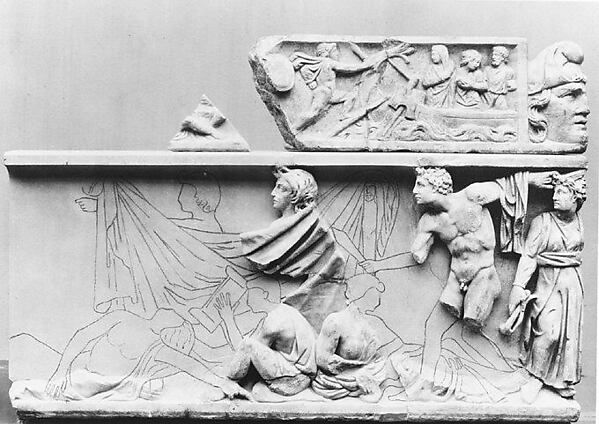
Fragmentary marble sarcophagus with scenes from the Oresteia - Roman, mid-2nd century CE, Marble-Luni
Metropolitan Museum of Art, New York, NY, 28.57.8a–d. CC0
Homer and Apollodorus differ slightly on the murder's mechanics. Homer's Odyssey has Agamemnon's own shade name Aegisthus as the one who struck the blow, with Clytemnestra's help, at a feast staged as a homecoming celebration. Apollodorus's Epitome, writing centuries later, credits the killing to Aegisthus and Clytemnestra jointly and adds a specific method: Clytemnestra gave her husband a robe sewn shut at the neck and sleeves, cutting him down as he struggled to put it on. The Epitome then follows the revenge: his daughter Electra smuggled her young brother Orestes away to Strophius in Phocis, and Orestes, once grown, went secretly to Mycenae with Pylades and killed both Aegisthus and his mother.
Agamemnon's grudges outlasted the men who earned them. After Ajax killed himself in shame over losing Achilles's armor, Agamemnon, still resentful, denied him the cremation given to every other Greek dead at Troy, so that Ajax alone was buried whole, in a coffin.
4 recorded relations, each with the ancient line behind it.
Siblings
-
Sons of Atreus and joint leaders of the Greek expedition against Troy: Agamemnon commands the largest contingent, and Menelaus leads the Spartans as his own brother.
Children
-
Electra names her father and her siblings in the prologue of Euripides's Orestes. Homer's Iliad lists Agamemnon's daughters without her name.
-

Iphigenia traces her own line from Tantalus through Pelops and Atreus in the prologue of Euripides's Iphigenia in Tauris. Homer's Iliad lists Agamemnon's daughters without her name.
-
Zeus opens Homer's Odyssey by recalling that Orestes took vengeance for his father on Aegisthus once he came to manhood.
Also Connected
6 recorded connections, each with the ancient line behind it.
Allies
-

Nestor is Agamemnon's senior counsellor at Troy. In Iliad Book 9 he reminds the king that he tried to stop him taking Briseis and urges him to make amends to Achilles.
Enemies
-

Agamemnon seizes Achilles's war prize Briseis to replace a captive he was forced to give up, a public insult that drives Achilles to withdraw from the fighting and frames the whole Iliad.
Connected
-

Agamemnon takes Briseis from Achilles to replace his own captive, then returns her and swears he never touched her.
-
When Agamemnon proposes abandoning the siege after a disastrous night of fighting, Diomedes rebukes him publicly and vows to fight on even without him.
-

In the underworld, Agamemnon's shade describes his own murder to Odysseus, and the two commiserate over the suffering Helen's abduction brought on the sons of Atreus.
-

Tantalus is Agamemnon's great-grandfather. In Euripides's Orestes, Electra traces the line from Tantalus to Pelops, Pelops to Atreus, and Atreus to Agamemnon.
Where Accounts Differ
- agamemnon-murder-aegisthus-vs-clytemnestra
- Homer's Odyssey has Agamemnon's own shade name Aegisthus as the one who struck the fatal blow, with Clytemnestra's help; Apollodorus's later Epitome instead credits the killing to both jointly and adds the detail of a robe sewn shut at the neck and sleeves. This entry records both versions rather than picking one.
Read the full source verification →
Mythology
Appears In
Related Terms
Referenced By
Sources
- Homer, Iliad, Book 1
- Homer, Iliad 2.559-568
- Homer, Iliad 9.32-49
- Homer, Odyssey 11.409-434
- Apollodorus, Epitome 6.23-6.25
- Apollodorus, Epitome 5.7
- Euripides, Iphigenia at Aulis 87-110
- Timothy Gantz, Early Greek Myth (1993)