Tantalus
Tantalus was a king at Mount Sipylus whom the gods admitted to their own table, then punished forever. Homer's Odyssey shows him in Hades, standing in water he cannot drink, under fruit he cannot reach. The ancient sources disagree on his crime: stolen nectar and ambrosia, a tongue he could not hold, or serving his son Pelops to the gods.
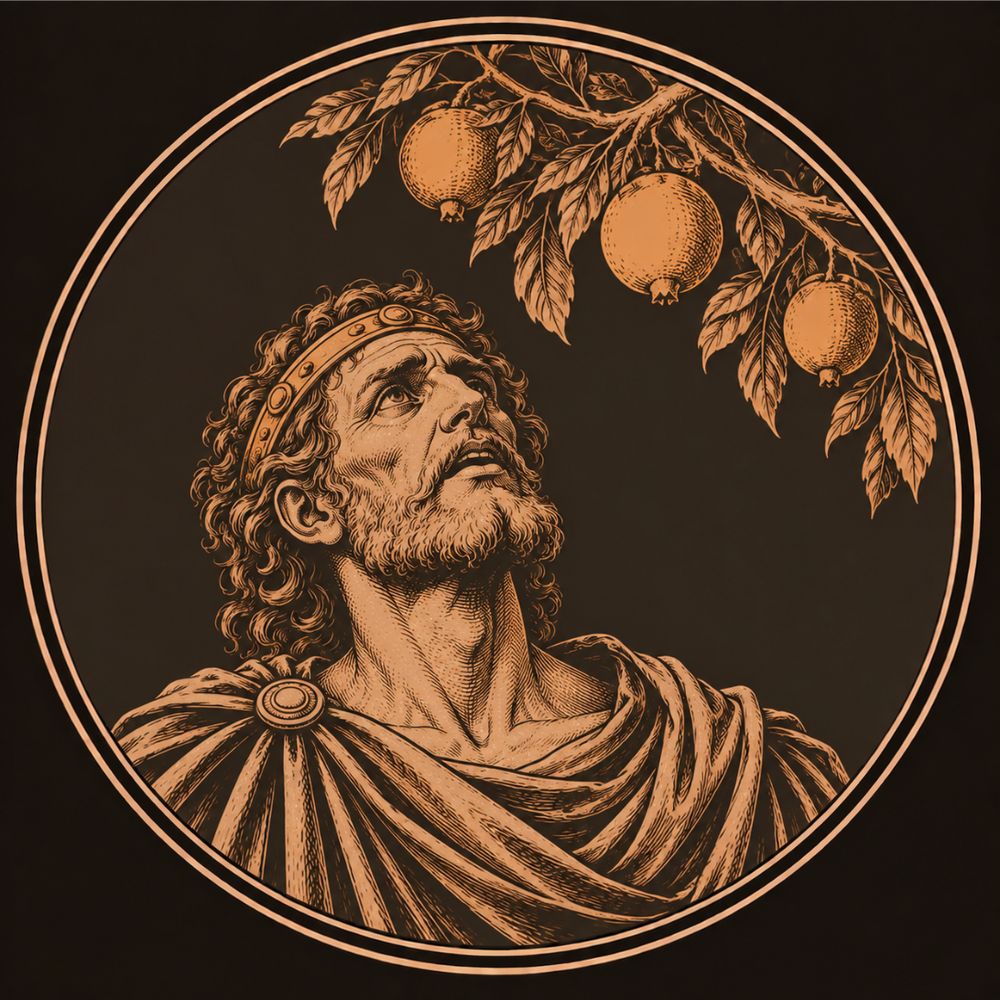
Tantalus, bronze medallion illustration
Generated by AI from this page's own facts, not an ancient image or evidence of anything. How this site uses generated images
Sections on this page
See Tantalus in the Greek family tree.
Core Myth
Tantalus is the mortal the gods honored most and punished longest. Pausanias calls him the son of Zeus and Pluto, and says he saw his grave on Mount Sipylus in Lydia. In Euripides's Orestes he is the reputed son of Zeus. Pindar's first Olympian Ode says that if the watchers of Olympus ever honored a mortal man, that man was Tantalus.
The oldest account of his punishment is in Homer's Odyssey. In Book 11, Odysseus sees him among the dead, standing in a pool with the water at his chin. Whenever the old man stoops to drink, the water vanishes and black earth shows at his feet. Pears, pomegranates, apples, figs and olives hang over his head. Whenever he reaches for them, the wind tosses them toward the clouds. Homer gives no reason for any of it.
Pindar tells a different story in his first Olympian Ode. Tantalus invited the gods to a banquet at Sipylus. Poseidon, overcome with desire for his son Pelops, carried the boy off to the house of Zeus. When Pelops could not be found, Pindar says, an envious neighbor whispered that the gods had cut him up, boiled him and eaten him. Pindar refuses to call any god a glutton.
Pindar's Tantalus falls through greed instead. He could not digest his great prosperity. He stole from the gods the nectar and ambrosia with which they had made him immortal, and gave them to his drinking companions. For that, the Father hung a mighty stone over his head, and he wanders far from all festivity. Because of his crime, the gods sent Pelops back to the race of mortal men.
Other writers kept the story Pindar rejected. Apollodorus's Epitome says Pelops was slaughtered and boiled at the banquet of the gods and came back to life fairer than before. It does not say who killed him. Ovid's Metamorphoses names his father's hands. The gods rejoined the boy's limbs, Ovid says, but part of one shoulder was missing, so they set ivory in its place. Pindar knows the ivory shoulder too, but gives it no such cause.
Euripides and Apollodorus add other charges. In the Orestes, Electra says Tantalus hangs in the air, cowering under a rock, because he could not bridle his tongue after sharing the gods' feasts. Apollodorus reports that some say he blabbed the gods' mysteries to men and tried to share ambrosia with his fellows. His punishment in Apollodorus joins both traditions: a stone over him, a lake that dries when he drinks, and fruit trees the winds lift away.
Tantalus stands at the head of a family that kept killing its own. Euripides's Electra traces it from Tantalus to Pelops, from Pelops to Atreus, and from Atreus to Agamemnon and Menelaus. Later in the play she longs to reach the rock that swings on golden chains between earth and heaven, to lament to Tantalus, forefather of her house.
His daughter Niobe carries the family flaw to Thebes. Apollodorus makes her the daughter of Tantalus and the wife of Amphion. In Ovid, she boasts that her father alone was allowed to touch the tables of the gods. Leto complains that Niobe has her father's tongue. In Apollodorus, Artemis shoots down Niobe's daughters and Apollo kills her sons, and Niobe goes back to her father at Sipylus.
What did Tantalus do and why did he do it?
The ancient sources name different crimes. Pindar's first Olympian Ode says Tantalus stole nectar and ambrosia from the gods and gave them to his drinking companions, because he could not digest his great prosperity. Euripides's Orestes blames a tongue he could not bridle after dining with the gods. Apollodorus reports that he revealed the gods' mysteries to men. The best-known crime, serving his son Pelops at a banquet of the gods, is one Pindar explicitly rejects as a neighbor's slander.
Pindar, Olympian Ode 1.52-66
Why can't Tantalus eat or drink?
Because the gods made his punishment in Hades out of food and water kept just beyond him. In Homer's Odyssey he stands in a pool with the water at his chin. When he stoops to drink, the water drains away. Fruit trees hang over him, but when he reaches up, the wind tosses the fruit toward the clouds. Pindar and Euripides describe a different torment: a great stone hanging over his head. Apollodorus's Epitome combines the two.
Homer, Odyssey 11.582-592
Which fate is worse: the fate of Sisyphus or the fate of Tantalus?
No ancient source ranks them, but Homer sets them side by side. In Odyssey Book 11, Odysseus sees Tantalus in violent torment, thirsty in a pool that drains whenever he stoops. Right after, he sees Sisyphus in violent torment too, pushing a monstrous stone uphill only to watch it roll back down. Homer uses the same phrase for both. Tantalus suffers want in the middle of plenty; Sisyphus suffers labor that never finishes. Pindar calls Tantalus's fate a helpless life of never-ending labor.
Homer, Odyssey 11.582-600
Is Tantalus good or bad?
Neither simply: the poets show a favored mortal who went wrong. Pindar says the gods honored him above all men, but he could not digest his great prosperity and stole their nectar and ambrosia. Euripides's Orestes opens by calling him blessed, then says he paid for an unbridled tongue after sharing the gods' table. In Homer's Odyssey he is one of the great sinners Odysseus sees punished in Hades.
Euripides, Orestes 4-10
What does Tantalus symbolize?
In the ancient sources, Tantalus stands for a mortal who could not bear the favor of the gods. Pindar says the gods honored him above all men, but he could not digest his prosperity. His stone became a figure of speech: in the eighth Isthmian Ode, Pindar calls a danger just lifted from Greece the stone of Tantalus above our heads. Plato's Cratylus reads the name as fitting his fate, a play on the balancing of the stone and on the word for most wretched.
Plato, Cratylus 395e
Who is Tantalus in Greek mythology?
Tantalus is a king of Mount Sipylus in Lydia, a mortal the gods let eat at their own table. Pausanias calls him the son of Zeus and Pluto and says he saw his grave on Sipylus. He is the father of Pelops and of Niobe, and through Pelops the ancestor of Atreus, Agamemnon and Menelaus. He is best known for his punishment in Hades, which Homer's Odyssey describes: water and fruit that always move out of reach.
Pausanias, Description of Greece 2.22.3
Later Traditions
A further crime appears in later writers. Pausanias says the Cretan Pandareos was implicated in the theft of Tantalus and in the trick of the oath, but does not say what was stolen. The mythographer Antoninus Liberalis tells the fuller story in his Metamorphoses. Pandareos stole the golden dog that guarded Zeus's sacred place in Crete and gave it to Tantalus to keep. When Pandareos asked for it back, Tantalus swore he had never received it. Zeus struck Tantalus with a thunderbolt and set Mount Sipylus on his head.
Pausanias thought the hanging stone came from the poet Archilochus. Describing Polygnotus's painting of the underworld at Delphi, he says Tantalus suffers all the pains Homer describes, and also the terror of a stone above him. Polygnotus followed Archilochus, Pausanias says, though he could not tell whether Archilochus invented the stone. Plato's Cratylus reads the name itself as a pun on the balancing of that stone.
The stone became a figure of speech. In his eighth Isthmian Ode, Pindar says a god has turned aside the stone of Tantalus above our heads, an unbearable hardship for Greece. The pool and the fruit lasted too. When Juno goes down to the underworld in Ovid's Metamorphoses, she sees Tantalus unable to catch the water. When Orpheus sings to the dead in Ovid's Book 10, Tantalus stops reaching for the wave, the moment retold in Orpheus in the Underworld.
The name belongs to more than one figure. Pausanias saw a grave at Argos said to hold a Tantalus who was the son of Thyestes or Broteas and married Clytemnestra before Agamemnon did. He insists this is not the son of Zeus, whose grave is on Sipylus. Near that mountain, Pausanias says, there is still a lake called after Tantalus and a famous grave.
Lineage
See the full family tree1 recorded relation, each with the ancient line behind it.
Parents
-

disputed
Pausanias reports the parentage as legend and says he saw this Tantalus's grave on Mount Sipylus, apart from a later Tantalus buried at Argos.
Also Connected
4 recorded connections, each with the ancient line behind it.
Connected
-
Tantalus is Agamemnon's great-grandfather. In Euripides's Orestes, Electra traces the line from Tantalus to Pelops, Pelops to Atreus, and Atreus to Agamemnon.
-
Tantalus is Menelaus's great-grandfather. In Euripides's Orestes, Electra traces the line from Tantalus through Pelops and Atreus to Agamemnon and Menelaus.
-

In Pindar's first Olympian Ode, Poseidon falls in love with Tantalus's son Pelops and carries him off from the banquet Tantalus gave the gods at Sipylus.
-
In Homer's Odyssey, Odysseus sees Tantalus and then Sisyphus among the dead, and Homer describes both as in violent torment: Tantalus reaching for water and fruit, Sisyphus pushing a stone that rolls back.
Where Accounts Differ
- what crime Tantalus committed
- whether Tantalus served Pelops to the gods
- water and fruit or a hanging stone
- where Pelops's ivory shoulder came from
- whether Tantalus was a son of Zeus
- two figures named Tantalus
- The sources name different crimes. Pindar (Olympian 1.52-66) says Tantalus stole nectar and ambrosia and gave them to his drinking companions. Euripides (Orestes 4-10) blames his unbridled tongue at the gods' table. Apollodorus (Epitome 2.1) reports that some say he revealed the gods' mysteries to men and tried to share ambrosia. Pausanias (10.30.2) links him to a theft and a false oath with Pandareos, which Antoninus Liberalis (Metamorphoses 36) explains as the golden dog of Zeus.
- Pindar (Olympian 1.35-52) explicitly rejects the story that Pelops was cut up and eaten at a banquet of the gods, calling it the whisper of an envious neighbor; in his version Poseidon carried Pelops off. Apollodorus (Epitome 2.3) says Pelops was slaughtered and boiled at the gods' banquet without naming the killer, and Ovid (Metamorphoses 6.403-411) says it was his father's hands.
- The punishment differs by source. Homer (Odyssey 11.582-592) describes only the receding water and fruit and gives no crime. Pindar (Olympian 1.52-66) and Euripides (Orestes 4-10, 982-994) describe a stone hanging over him. Apollodorus (Epitome 2.1) combines stone, lake and fruit. Pausanias (10.31.12) credits the stone to Archilochus, and Antoninus Liberalis (Metamorphoses 36) has Zeus strike him with a thunderbolt and set Mount Sipylus on his head.
- Pindar (Olympian 1.23-27) gives Pelops an ivory shoulder as he comes out of Clotho's cauldron, with no mention of anyone eating it. Ovid (Metamorphoses 6.403-411) explains the ivory as a patch for flesh missing after his father cut him up.
- His parentage is reported with hedging. Pausanias (2.22.3) calls him the son of Zeus and Pluto as a matter of legend, and Euripides (Orestes 4-10) calls him the reputed son of Zeus.
- Two figures share the name. Pausanias (2.22.3) separates this Tantalus, buried on Sipylus, from a later Tantalus, son of Thyestes or Broteas, who was Clytemnestra's first husband and was said to be buried at Argos.
Read the full source verification →
Mythology
Appears In
Related Terms
Referenced By
Sources
- Homer, Odyssey 11.582-592
- Homer, Odyssey 11.582-600
- Pindar, Olympian Ode 1.23-27
- Pindar, Olympian Ode 1.23-45
- Pindar, Olympian Ode 1.35-52
- Pindar, Olympian Ode 1.52-66
- Pindar, Isthmian Ode 8.10
- Euripides, Orestes 4-10
- Euripides, Orestes 4-17
- Euripides, Orestes 982-994
- Apollodorus, Epitome 2.1
- Apollodorus, Epitome 2.3
- Apollodorus, Library 3.5.6
- Ovid, Metamorphoses 4.458-459
- Ovid, Metamorphoses 6.172-173
- Ovid, Metamorphoses 6.403-411
- Ovid, Metamorphoses 10.41-42
- Pausanias, Description of Greece 2.22.3
- Pausanias, Description of Greece 5.13.7
- Pausanias, Description of Greece 10.30.2
- Pausanias, Description of Greece 10.31.12
- Plato, Cratylus 395e