Clytemnestra
Clytemnestra, daughter of Tyndareus and Leda and sister of Helen, is the wife of Agamemnon. While he fights at Troy she takes his cousin Aegisthus as her lover. When Agamemnon comes home, the two of them kill him, and Cassandra with him. Years later their son Orestes kills her. The sources disagree on who struck the blow and why she did it.
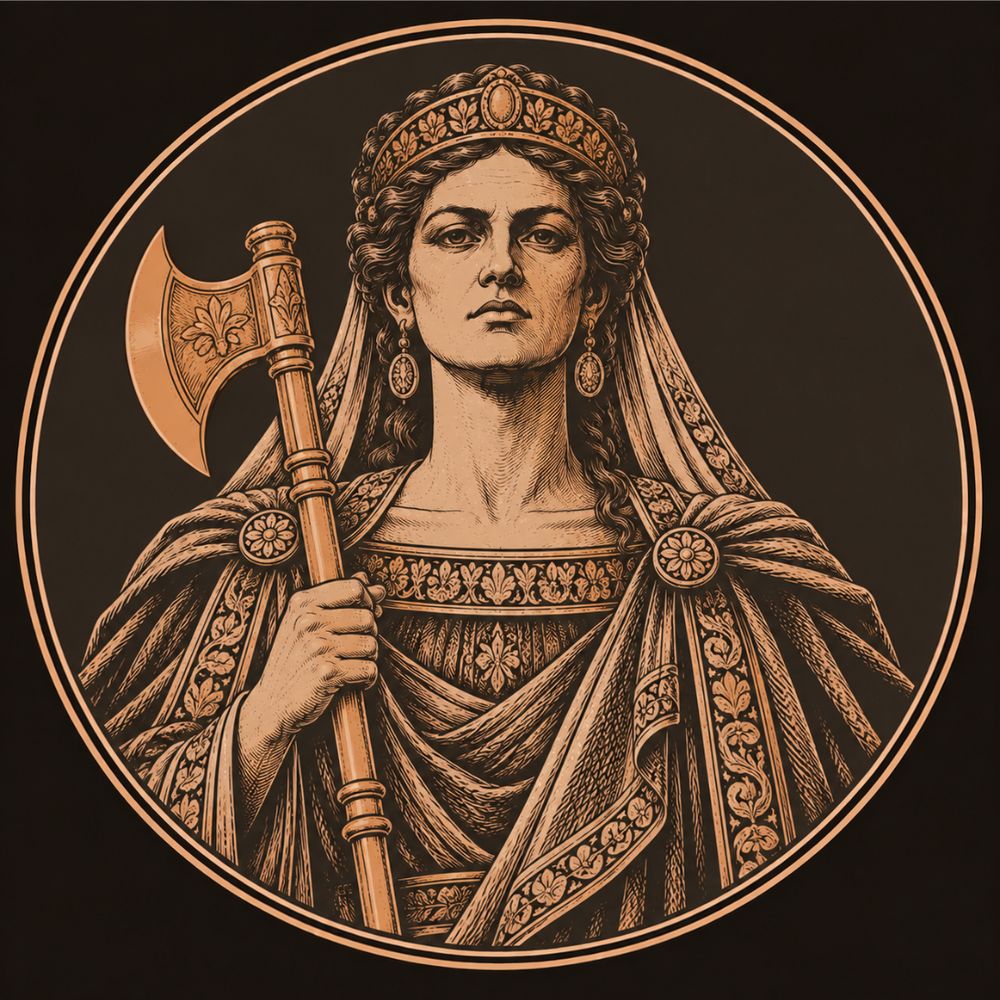
Clytemnestra, bronze medallion illustration
Generated by AI from this page's own facts, not an ancient image or evidence of anything. How this site uses generated images
Sections on this page
See Clytemnestra in the Greek family tree.
Core Myth
Clytemnestra was a daughter of Leda, queen of Sparta. Apollodorus's Library says that Zeus, in the form of a swan, lay with Leda on the same night as her husband Tyndareus. She bore Pollux and Helen to Zeus, and Castor and Clytemnestra to Tyndareus. Homer's Odyssey calls her simply the daughter of Tyndareus. Apollodorus's Epitome adds a harsher start to her marriage. Agamemnon won her only after killing her first husband, Tantalus son of Thyestes, together with his child. Euripides's Iphigenia at Aulis gives Clytemnestra the same charge in her own voice: he tore her baby from her breast and dashed it to the ground.
When the fleet was held at Aulis, Agamemnon sent for their daughter Iphigenia. Apollodorus's Epitome says he asked Clytemnestra for the girl on the pretext of marrying her to Achilles, and that Artemis snatched her from the altar and left a deer in her place. In the tragedians the girl dies, and her death is the wound Clytemnestra never forgives.
While Agamemnon fought at Troy, his cousin Aegisthus courted her. Nestor tells the story in Homer's Odyssey. At first she refused, and a bard left to guard her kept her faithful. Then Aegisthus marooned the bard on a desert island and took her willingly to his house.
Aeschylus's Agamemnon gives her the leading role in what followed. She has the king walk into the palace over purple tapestries. Inside, she casts a robe around him like a fishing net, strikes him twice, and deals a third blow after he falls. She kills Cassandra, the captive he brought home, beside him. Then she defends the deed to the elders of Argos as justice for Iphigenia. She also says the ancient evil spirit of Atreus, avenging slain children, worked through her. That curse runs through the house of Atreus.
She and Aegisthus ruled for seven years, Homer's Odyssey says, until her son Orestes came home. In Aeschylus's Libation Bearers she dreams she has given birth to a serpent that draws blood from her breast. Orestes takes the dream as a prophecy of himself, kills Aegisthus, and then kills her. In Eumenides her ghost rouses the sleeping Furies to hunt him down. At his trial in Athens, Apollo argues that a mother is not the true parent of her child, and Athena casts her vote for Orestes. The votes are equal, and he is acquitted.
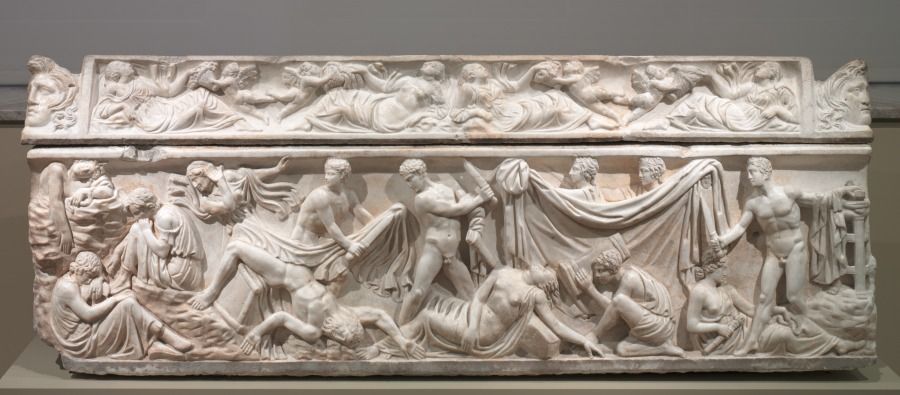
Sarcophagus - Italy, Rome, Roman Empire, c. 100–125 CE, Greek marble
The Cleveland Museum of Art, Cleveland, OH, 1928.856. CC0
What is Clytemnestra famous for?
She is famous for killing her husband Agamemnon, the commander of the Greeks at Troy, on the day he came home. Aeschylus's Agamemnon shows her standing over his body and the body of Cassandra. She says she cast a robe around him like a fishing net and struck him three times. She glories in the deed before the elders of Argos rather than denying it.
Aeschylus, Agamemnon 1380-1395
Why was Agamemnon killed by his wife?
The sources give three answers. In Aeschylus, Clytemnestra says she did it for Iphigenia, the daughter Agamemnon sacrificed at Aulis to calm the winds from Thrace. Homer's Odyssey puts the blame on Aegisthus, who seduced her while the king was away. Pindar leaves the question open, asking whether it was Iphigenia's slaughter or another man's bed that drove her. Euripides's Electra adds her anger at Cassandra.
Aeschylus, Agamemnon 1412-1425
How did Clytemnestra kill Agamemnon?
Aeschylus's Agamemnon has her throw a robe around him like a net so that he could not escape, then strike him twice and a third time after he fell. Cassandra foresees the murder in a bath. Other sources differ. Homer has Aegisthus strike him down at a feast. Sophocles has the pair use an axe. Apollodorus says she gave him a shirt with no sleeves and no neck and he was cut down while putting it on.
Aeschylus, Agamemnon 1380-1395
Why did Clytemnestra kill Cassandra?
Aeschylus gives her own answer. Over the bodies she calls Cassandra her husband's captive and concubine, and says her death brought an added relish of delight to her own bed. Cassandra foresees it herself, saying the queen will pay her back for being brought home. In Homer's Odyssey Agamemnon's ghost hears Cassandra's cry as Clytemnestra kills her beside him. Pindar says Clytemnestra sent both of them to the Acheron with a bronze blade.
Aeschylus, Agamemnon 1431-1445
What happened to Clytemnestra after she killed Agamemnon?
She ruled with Aegisthus, whom Homer's Odyssey says reigned seven years over Mycenae. In the eighth year her son Orestes came home and killed them both. Apollodorus says Orestes had been raised in Phocis and went to Mycenae with Delphi's leave. In Aeschylus she begs him by the breast that nursed him and warns him of a mother's avenging hounds. Her ghost then rouses the Furies against him.
Aeschylus, Libation Bearers 908-930
Who was Clytemnestra in Greek mythology?
She was a daughter of Leda and Tyndareus of Sparta and the sister of Helen. Apollodorus says Leda lay with Zeus and with Tyndareus on the same night, so that Helen and Pollux were children of Zeus and Clytemnestra and Castor were children of Tyndareus. She married Agamemnon, king of Mycenae, and bore him Orestes, Electra, Chrysothemis and Iphigenia.
Apollodorus, Library 3.10.7
Later Traditions
The ancient sources agree that Agamemnon died on his return and that Clytemnestra shared the guilt. They disagree on nearly everything else. Homer's Odyssey makes Aegisthus the killer. Agamemnon's own ghost says Aegisthus invited him to a feast in his house and killed him with the aid of his wife, like an ox at the stall. Aeschylus makes her the one who strikes. Sophocles's Electra has the pair split his head with an axe, and Euripides's Electra says he died by his wife's guile and the hand of Aegisthus. Apollodorus's Epitome names them both and adds the trick of a shirt with no sleeves and no neck, which trapped him as he put it on.
Her motive is just as unsettled. In Pindar's eleventh Pythian ode the poet asks the question himself: was it Iphigenia, slaughtered at the Euripus, or was she led astray by another man's bed? Pindar also sets the murder at Amyclae, not at Mycenae or Argos. In Sophocles, Clytemnestra claims justice for her daughter, and Electra answers that Aegisthus persuaded her to it. In Euripides's Electra she adds Cassandra. She says she could have forgiven the sacrifice, but not a husband who brought home a second bride.
Her death is told differently too. The Odyssey only hints at it: Orestes gave a funeral feast over his hateful mother and Aegisthus. Aeschylus has Orestes kill Aegisthus first and then his mother. In Sophocles, Clytemnestra dies first, crying out while Electra urges her brother to strike again, and Aegisthus comes home to find her body under a veil. In Euripides, Electra lures her to her own poor house with a false report of a newborn child. Orestes covers his eyes with his cloak and drives the sword into his mother's throat, and Electra puts her hand to it with him.
Modern Influence
Clytemnestra remains the central figure of every modern Oresteia. Richard Strauss's opera Elektra, first performed at Dresden in 1909 with a libretto by Hugo von Hofmannsthal, gives her a principal role as Agamemnon's widow and killer. Martha Graham's full-length dance Clytemnestra, first performed in New York in 1958, retells the trilogy from the queen's own point of view.
Sarcophagus - Italy, Rome, Roman Empire, c. 100–125 CE, Greek marble
The Cleveland Museum of Art, Cleveland, OH, 1928.856. CC0
Lineage
See the full family tree4 recorded relations, each with the ancient line behind it.
Siblings
-
Daughters of Leda, queen of Sparta. Apollodorus gives the two sisters different fathers, conceived on the same night.
Children
-
In the tragedians Electra helps Orestes kill Clytemnestra. Euripides's Electra has her put her hand to the sword.
-
In the prologue of Euripides's Iphigenia in Tauris, Iphigenia says Calchas claimed her as the fairest thing born that year in Agamemnon's house, and that Odysseus took her from Clytemnestra with a false promise of marriage.
-
Electra lists the children in the prologue of Euripides's Orestes, three daughters and one son, all from the one mother who killed her husband.
Also Connected
1 recorded connection, each with the ancient line behind it.
Connected
-

Artemis demands the sacrifice of Clytemnestra's daughter Iphigenia at Aulis. Apollodorus says the goddess carried the girl off and left a deer at the altar.
Where Accounts Differ
- who struck Agamemnon down
- Clytemnestra's motive
- the robe, the bath and the weapon
- whether Iphigenia died at Aulis
- how Orestes killed Clytemnestra
- Who struck Agamemnon down differs by source. Homer's Odyssey names Aegisthus as the killer, with Clytemnestra's aid, at a feast in his house. Aeschylus's Agamemnon makes Clytemnestra the one who strikes. Sophocles's Electra has the pair split his head with an axe. Euripides's Electra credits her guile and the hand of Aegisthus. Apollodorus's Epitome names both.
- Her motive is disputed in the ancient sources themselves. Aeschylus and Sophocles give her the sacrifice of Iphigenia. Homer's Odyssey blames Aegisthus's seduction. Pindar's eleventh Pythian ode asks whether it was Iphigenia or an adulterous bed. Euripides's Electra adds her anger at Cassandra. Aeschylus also has her claim the old avenging spirit of Atreus's house acted through her.
- The means of the murder vary. Aeschylus describes a net-like robe cast around him, and Cassandra's vision places the death in a bath. Apollodorus describes a shirt without sleeves or neck. Euripides's Orestes speaks of an inextricable robe. The weapon is a sword in Aeschylus, a bronze blade in Pindar and an axe in Sophocles.
- Iphigenia's fate is told two ways. Aeschylus, Sophocles and Euripides's Electra treat her as killed at Aulis. Apollodorus's Epitome says Artemis carried her off and left a deer at the altar in her place.
- The order of the killings by Orestes differs. Aeschylus's Libation Bearers has Aegisthus die first, Sophocles's Electra has Clytemnestra die first, and Euripides's Electra has Electra lure her mother to her death with a false report of a birth. Homer's Odyssey only hints at her death.
- The passage of Apollodorus's Epitome naming Tantalus as her first husband at 2.15 is restored from Tzetzes, as Frazer notes. The same fact appears in the transmitted text at Epitome 2.16 and in Euripides's Iphigenia at Aulis, which this page cites instead.
Read the full source verification →
Mythology
Appears In
Related Terms
Referenced By
Sources
- Homer, Odyssey 3.262-275
- Homer, Odyssey 3.303-310
- Homer, Odyssey 11.405-434
- Homer, Odyssey 24.192-202
- Pindar, Pythian Ode 11.17-11.35
- Aeschylus, Agamemnon 905-910
- Aeschylus, Agamemnon 1107-1125
- Aeschylus, Agamemnon 1256-1260
- Aeschylus, Agamemnon 1380-1395
- Aeschylus, Agamemnon 1412-1425
- Aeschylus, Agamemnon 1431-1445
- Aeschylus, Agamemnon 1497-1505
- Aeschylus, Libation Bearers 523-535
- Aeschylus, Libation Bearers 885-900
- Aeschylus, Libation Bearers 908-930
- Aeschylus, Eumenides 94-115
- Aeschylus, Eumenides 117-135
- Aeschylus, Eumenides 657-665
- Aeschylus, Eumenides 734-740
- Aeschylus, Eumenides 752
- Sophocles, Electra 90-100
- Sophocles, Electra 516-530
- Sophocles, Electra 530-550
- Sophocles, Electra 560-575
- Sophocles, Electra 1404-1416
- Sophocles, Electra 1466-1480
- Euripides, Electra 5-10
- Euripides, Electra 1011-1030
- Euripides, Electra 1030-1050
- Euripides, Electra 1102-1110
- Euripides, Electra 1123-1132
- Euripides, Electra 1139-1145
- Euripides, Electra 1206-1226
- Euripides, Orestes 20-30
- Euripides, Iphigenia at Aulis 1146-1155
- Apollodorus, Library 3.10.6
- Apollodorus, Library 3.10.7
- Apollodorus, Epitome 2.16
- Apollodorus, Epitome 3.22
- Apollodorus, Epitome 6.23
- Apollodorus, Epitome 6.24
- Apollodorus, Epitome 6.25
- J. G. Frazer, Apollodorus: The Library, notes to Epitome 6.23 (Loeb, 1921)