Electra
Electra is the daughter of Agamemnon and Clytemnestra. After her mother and Aegisthus murder her father, she mourns him for years and waits for her exiled brother Orestes. When he comes home, she helps him kill their mother and Aegisthus. Aeschylus, Sophocles and Euripides each give her a different share in the killing, and only Euripides marries her off.
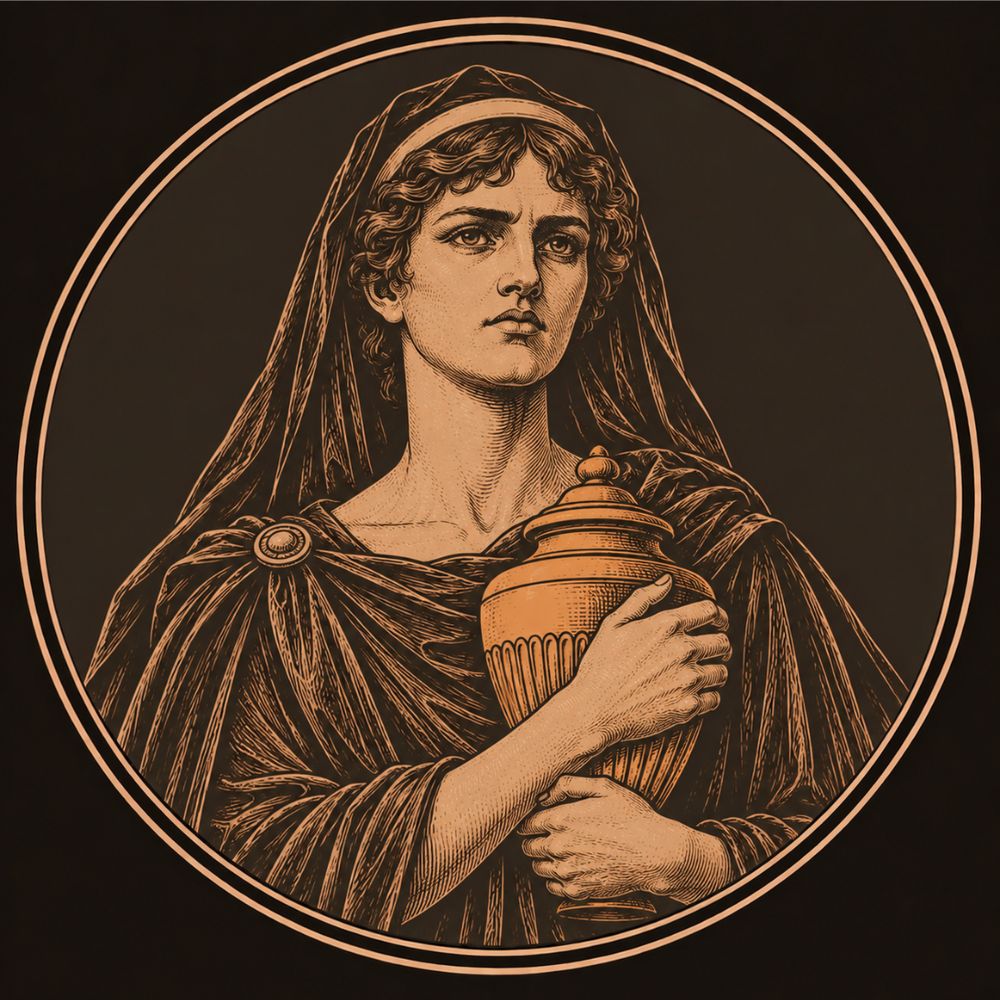
Electra, bronze medallion illustration
Generated by AI from this page's own facts, not an ancient image or evidence of anything. How this site uses generated images
Sections on this page
See Electra in the Greek family tree.
Core Myth
Electra is a daughter of Agamemnon, king of Mycenae, and Clytemnestra. In Euripides's Orestes she names her own family: her sisters Chrysothemis and Iphigenia, and her brother Orestes. Homer never names her. When Agamemnon lists his daughters in Homer's Iliad, they are Chrysothemis, Laodice and Iphianassa. Aelian's Varia Historia reports how the early lyric poet Xanthus closed that gap. Electra, Xanthus said, was first called Laodice. The Argives renamed her after her father's death, because she stayed so long without a husband or a marriage bed.
The name belongs to other figures too. Hesiod's Theogony gives it to an Oceanid, the mother of Iris and the Harpies. Apollodorus's Library gives it to one of the Pleiades, the daughters of Atlas.
Her story begins with her father's murder on his return from Troy. Apollodorus's Epitome says Electra smuggled her young brother Orestes away to Strophius in Phocis, who raised him with his own son Pylades. In Sophocles's Electra she recalls stealing him away with her own hands to save him from death.
In Aeschylus's Libation Bearers, Electra brings libations to her father's grave on her mother's orders. Instead of her mother's prayer, she asks Hermes and her dead father for an avenger. Then she finds a lock of hair on the tomb that looks like her own, and footprints that match hers. Orestes steps forward, and a piece of her own weaving convinces her. Together they call on Agamemnon's spirit for help. Orestes then sends her into the house to keep watch, and she does not appear in the play again.
Sophocles makes her the centre of his Electra. A messenger brings a false report that Orestes died in a chariot race at the Pythian games at Delphi. Electra then resolves to kill Aegisthus herself. When her sister Chrysothemis refuses to help, she declares that the deed must be done by her hand alone. She weeps over an urn she believes holds her brother's ashes, until Orestes proves himself with their father's signet. When Clytemnestra cries out inside the palace, Electra calls to him: "Stab her doubly, if you can!" When Aegisthus begs to speak, she urges her brother to kill him at once.
Euripides moves her out of the palace. In his Electra, Aegisthus fears she will bear a son who will avenge Agamemnon. So he gives her to a poor farmer, who tells the audience he has never touched her. Orestes comes to their cottage, and an old servant knows him by a scar on his brow. Electra plans her mother's death herself. She sends word that she has given birth, knowing Clytemnestra will come. Afterwards Orestes says he covered his eyes and drove the sword into his mother's throat. Electra answers that she urged him on and put her hand to the sword with him.
The sequel belongs to Euripides's Orestes. Six days after the killing, Electra nurses her brother while the Furies drive him mad, and Argos votes on whether both of them must die. It is Electra who devises the plan to seize Hermione, the daughter of Helen, as a hostage against Menelaus. At the close, Apollo orders Orestes to give his sister to Pylades, to whom she had already been promised.
Euripides's Electra ends the same way, with Castor and Polydeuces, her mother's brothers, ordering the marriage. Apollodorus's Epitome agrees that Orestes married her to Pylades. Pausanias saw her tomb at Mycenae and cites Hellanicus for her two sons by Pylades, Medon and Strophius.
Who is Electra?
She is a daughter of Agamemnon and Clytemnestra and the sister of Orestes, Chrysothemis and Iphigenia, as she says herself in Euripides's Orestes. After her mother and Aegisthus murder her father, she waits years for Orestes to return and avenge him. She is the heroine of Sophocles's Electra and Euripides's Electra, and a leading figure in Aeschylus's Libation Bearers. Homer never names her.
Euripides, Orestes 20-34
Did Electra have any siblings?
Yes, though the sources name them differently. In Euripides's Orestes, Electra lists Chrysothemis, Iphigenia and herself as the three daughters, with Orestes as the only son. Homer's Iliad names Agamemnon's daughters as Chrysothemis, Laodice and Iphianassa, and Xanthus, quoted by Aelian, made Laodice Electra's original name. Sophocles's Electra names Chrysothemis and Iphianassa as sisters still living in the palace. In Aeschylus's Libation Bearers, Electra also mourns the sister who was sacrificed.
Homer, Iliad 9.144-145
Did Electra love Agamemnon?
Yes, and all three tragedians build her around that love. In Aeschylus's Libation Bearers she prays at his tomb that his killers be killed in return. Her grief is also a grievance: she lives like a slave while Orestes is shut out of his inheritance. In Sophocles she tells Chrysothemis that Aegisthus will never let them marry or bear children, for fear of an avenger. Euripides's Electra gives the same fear as the reason Aegisthus married her to a poor farmer.
Aeschylus, Libation Bearers 124-151
Who does Electra marry?
Euripides gives her two husbands. At the start of his Electra, Aegisthus has married her to a poor farmer, who respects her and never touches her. At the end, Castor and Polydeuces order Orestes to give her to Pylades, his closest friend. In Euripides's Orestes, Apollo gives the same order. Apollodorus's Epitome says Orestes married her to Pylades, and Pausanias records two sons, Medon and Strophius. Aeschylus and Sophocles leave her unmarried.
Euripides, Electra 1245-1252
What is the Electra complex in Greek mythology?
It is not from Greek mythology at all. The Electra complex is a modern psychological term, which Carl Jung coined in 1913 for a girl's attachment to her father and rivalry with her mother. Freud himself rejected the name in 1931, arguing that girls do not develop as a mirror image of boys. Mainstream psychology gives the theory little weight today. The tragedians' Electra is driven by her father's murder, not by rivalry.
Later Traditions
The three tragedians agree that Orestes strikes the fatal blow. They disagree on nearly everything Electra does. In Aeschylus's Libation Bearers she prays for vengeance and recognises her brother, then leaves the stage before the killing. In Sophocles's Electra the murder happens offstage, but Electra stands at the door and cries encouragement as her mother dies. In Euripides's Electra she plans the trap herself and holds the sword with her brother. His Orestes goes further and has her say she shared in the murder as far as a woman could.
The recognition changes too. Aeschylus uses a lock of hair, matching footprints and a piece of weaving. Euripides seems to answer him directly. His Electra dismisses all three tokens: a man's hair differs from a woman's, rocky ground holds no footprint, and a child's cloak would no longer fit a grown man. The scar settles it instead. Sophocles uses neither and has Orestes show their father's signet.
Who saved the boy Orestes is also disputed. Sophocles and Apollodorus give the rescue to Electra. Euripides's Electra gives it to their father's old servant, and Pindar's eleventh Pythian ode to his nurse Arsinoe.
Her marriage is the last disagreement. Sophocles keeps her unmarried, and she complains that Aegisthus will never let her bear children. Only Euripides gives her a husband before the revenge, the poor farmer. Her marriage to Pylades comes from Euripides's two plays, Apollodorus's Epitome and Pausanias.
Modern Influence
Electra is one of the most retold figures of Greek tragedy. Richard Strauss's opera Elektra was first performed at Dresden in 1909, to a libretto Hugo von Hofmannsthal adapted from his own 1903 play. Eugene O'Neill's trilogy Mourning Becomes Electra (1931) moves the Oresteia to New England after the American Civil War.
Her name is best known today through psychology. Carl Jung coined the term "Electra complex" in 1913, in The Theory of Psychoanalysis, as a female counterpart to Freud's Oedipus complex, named after Oedipus. Freud rejected the term in his 1931 essay Female Sexuality, because it implied the two sexes develop in parallel. The idea has nothing to do with the ancient plays beyond the name.
Lineage
See the full family tree3 recorded relations, each with the ancient line behind it.
Parents
-
Electra names her father and her siblings in the prologue of Euripides's Orestes. Homer's Iliad lists Agamemnon's daughters without her name.
-
In the tragedians Electra helps Orestes kill Clytemnestra. Euripides's Electra has her put her hand to the sword.
Siblings
-
Electra says she shared in the killing of their mother as far as a woman could, and nurses Orestes through the madness that followed.
Where Accounts Differ
- Electra's share in the matricide
- Electra and Laodice
- the recognition tokens
- who saved the young Orestes
- Electra's marriage
- Electra's share in the matricide differs in each tragedy. Aeschylus's Libation Bearers sends her indoors before the killing. Sophocles's Electra has her cry encouragement outside while the murder happens offstage. Euripides's Electra has her plan the trap and put her hand to the sword with Orestes.
- Homer never names Electra. Homer's Iliad lists Agamemnon's daughters as Chrysothemis, Laodice and Iphianassa. Aelian's Varia Historia reports the lyric poet Xanthus's claim that Electra was first called Laodice. Sophocles's Electra treats Iphianassa as a living sister, separate from both Electra and the sacrificed daughter.
- The recognition tokens differ. Aeschylus uses a lock of hair, footprints and a woven cloth. Euripides's Electra rejects each of those tokens and uses a scar instead. Sophocles uses Agamemnon's signet.
- Who saved the young Orestes is disputed. Sophocles's Electra and Apollodorus's Epitome credit Electra. Euripides's Electra credits the old servant. Pindar's eleventh Pythian ode credits the nurse Arsinoe.
- Her marriage differs. Only Euripides's Electra marries her to a farmer. Euripides's Electra and Orestes, Apollodorus's Epitome and Pausanias give her to Pylades. Aeschylus and Sophocles do not marry her at all.
- The name Laodice rests on Aelian, who is not yet in this site's source registry, so the claim is named in prose without a checked line reference.
Read the full source verification →
Mythology
Appears In
Related Terms
Referenced By
Sources
- Homer, Iliad 9.144-145
- Hesiod, Theogony 265-269
- Pindar, Pythian Ode 11.17
- Aeschylus, Libation Bearers 124-151
- Aeschylus, Libation Bearers 164-211
- Aeschylus, Libation Bearers 212-245
- Aeschylus, Libation Bearers 479-509
- Aeschylus, Libation Bearers 554-584
- Sophocles, Electra 1-22
- Sophocles, Electra 154-163
- Sophocles, Electra 680-700
- Sophocles, Electra 740-763
- Sophocles, Electra 947-989
- Sophocles, Electra 1019-1027
- Sophocles, Electra 1126-1145
- Sophocles, Electra 1220-1226
- Sophocles, Electra 1398-1421
- Sophocles, Electra 1483-1490
- Euripides, Electra 1-53
- Euripides, Electra 508-546
- Euripides, Electra 572-582
- Euripides, Electra 647-663
- Euripides, Electra 1221-1226
- Euripides, Electra 1245-1252
- Euripides, Electra 1280-1285
- Euripides, Orestes 20-34
- Euripides, Orestes 1090-1100
- Euripides, Orestes 1177-1203
- Euripides, Orestes 1653-1665
- Apollodorus, Library 3.10.1
- Apollodorus, Epitome 6.24
- Apollodorus, Epitome 6.28
- Pausanias, Description of Greece 2.16.7
- Aelian, Varia Historia 4.26 (citing the lyric poet Xanthus on the name Laodice)
- C. G. Jung, The Theory of Psychoanalysis (1913)
- S. Freud, Female Sexuality (1931), Standard Edition vol. 21