Oedipus
Oedipus is the Theban king who killed his father Laius and married his mother without knowing either was his parent. Exposed as a baby and raised in Corinth, he fled a Delphic prophecy straight into its fulfillment, then won the throne by solving the Sphinx's riddle. The sources split on what followed: Homer has him keep ruling Thebes, while Sophocles has him blinded and exiled.
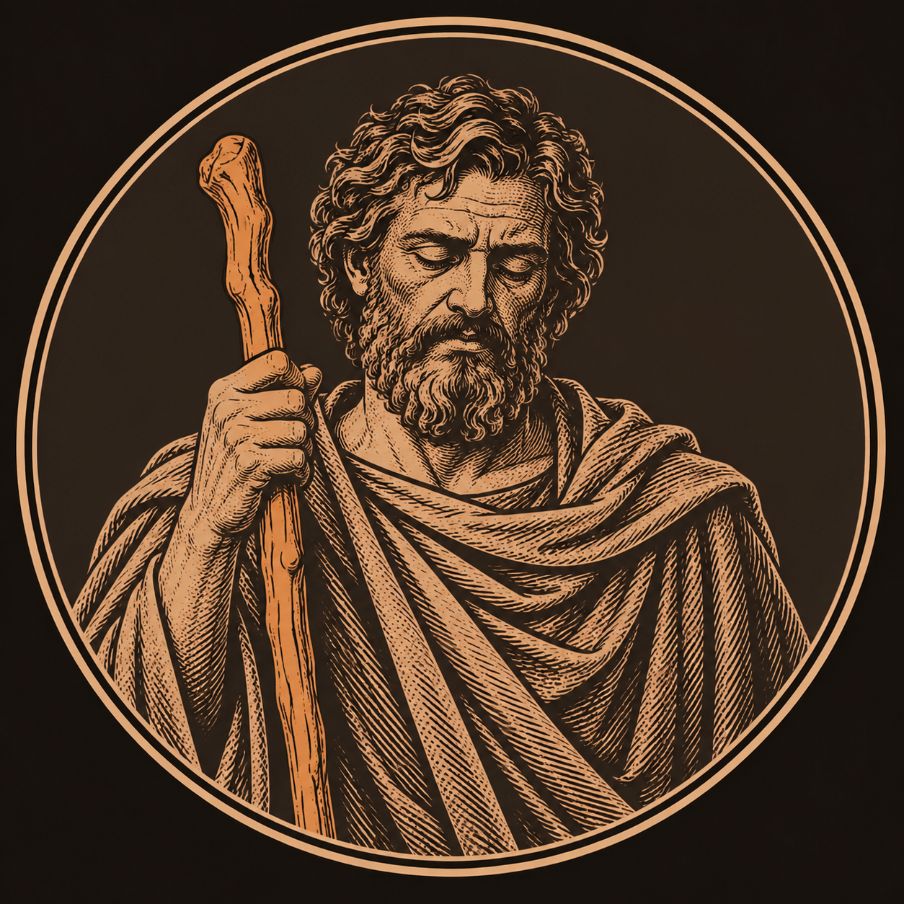
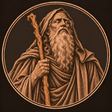
Oedipus, bronze medallion illustration
Generated by AI from this page's own facts, not an ancient image or evidence of anything. How this site uses generated images
Sections on this page
See Oedipus in the Greek family tree.
Core Myth
Oedipus was the son of Laius, king of Thebes, and a daughter of Menoeceus. Apollodorus's Library says some call her Jocasta and some Epicasta. An oracle had warned Laius not to father a son, because that son would kill him. Laius fathered one anyway, pierced the baby's ankles with brooches, and gave him to a herdsman to expose on Mount Cithaeron. Herdsmen of Polybus, king of Corinth, found the child. The queen of Corinth raised him as her own and named him Oedipus for his swollen feet. Apollodorus calls her Periboea, while in Sophocles she is Merope. Aeschylus's Seven Against Thebes frames the oracle differently. There Apollo told Laius three times at his Pythian seat that Thebes would be saved if he died childless, and Laius disobeyed.
In Sophocles's Oedipus Tyrannus, a drunken guest at a Corinthian banquet taunts the young man that he is not his father's true son. His parents deny it, but the rumor rankles, so he goes to Delphi without telling them. Apollo leaves his question unanswered. Instead the god foretells that he will share his mother's bed and kill the father who sired him. Believing Polybus and Merope to be his parents, he turns away from Corinth for good. Near a place where three roads meet, an old man in a carriage and his escort try to force him off the path. He strikes back and kills them all. Apollodorus adds that the herald Polyphontes had killed one of his horses. The old man was Laius.
He reached Thebes while the Sphinx was killing every Theban who failed to answer her riddle. Apollodorus says Creon, ruling after Laius's death, offered the kingdom and Laius's widow to whoever solved it. Oedipus answered that the riddle meant man, and the Sphinx threw herself from the citadel. The full episode is told in Oedipus and the Sphinx. His reward made him king and, unknowingly, his mother's husband. Apollodorus names their children as Polynices, Eteocles, Ismene and Antigone.
Sophocles's Oedipus Tyrannus stages the discovery years later. A plague lays waste to the city, and the king hunts for the man who killed Laius. A messenger from Corinth reveals that Polybus was not his father. An old Theban servant then admits that Jocasta herself handed him the baby to destroy, out of fear of the prophecies. Oedipus cries out that everything has come true. Jocasta hangs herself in the palace. He takes the golden brooches from her dress and strikes his own eyes with them again and again. The play ends with him begging Creon to cast him out, while Creon waits to consult the god first.
Did Oedipus know he was fulfilling the prophecy?
No. Every ancient account has him act without knowing. In Sophocles's Oedipus Tyrannus he flees Corinth precisely because he believes Polybus and Merope are his parents, then kills a stranger at a crossroads. Apollodorus agrees that he left Corinth believing himself the son of his nominal parents. The sources differ on when he found out. Homer's Odyssey says the gods revealed the truth straightway, while Sophocles delays the discovery until years into his reign. In Oedipus at Colonus he argues his own innocence: the oracle predates his birth, he killed a man who attacked him first, and he married his mother unknowingly.
Sophocles, Oedipus at Colonus 960-999
Why did Oedipus marry his mother?
Because he did not know she was his mother, and marrying her was the prize for saving Thebes. Apollodorus says Creon proclaimed that whoever solved the Sphinx's riddle would receive both the kingdom and the wife of Laius. Oedipus solved it, and so he unwittingly married his own mother. Sophocles gives the same picture. His Oedipus believes his mother is Merope of Corinth, the very woman he fled to avoid the prophecy. In Oedipus at Colonus he says that neither he nor she knew the truth, and that he did not marry her willingly.
Apollodorus, Library 3.5.8
Who was Oedipus in love with?
The ancient sources do not tell a love story about Oedipus. His marriage to his mother, called Jocasta by Sophocles and Epicaste by Homer, came as a political reward. Apollodorus says the kingdom and Laius's widow went together to whoever solved the Sphinx's riddle. The tradition even disputes who bore his children. Pausanias argues from Homer that the incest was revealed too quickly for any children. He names their mother as Euryganeia, a second wife. In the tragedies his closest bond is with his daughter Antigone, who guides him in exile.
Pausanias, Description of Greece 9.5.10-9.5.11
What is the moral of the Oedipus story?
The ancient sources draw different lessons from it. The closing lines of Sophocles's Oedipus Tyrannus warn that no mortal should be called happy until he dies free from pain, since even the man who solved the famous riddle fell. Aeschylus's Seven Against Thebes treats the story as an inherited curse: Laius disobeyed Apollo's oracle, and the ruin passed to his son and grandsons. Oedipus at Colonus stresses innocence, with Oedipus saying his deeds were suffered rather than done. Modern readers often name pride as his flaw, but that is interpretation rather than an ancient verdict.
Sophocles, Oedipus Tyrannus 1524-1530
Is Oedipus in the Odyssey?
Yes, briefly, and in a version that differs from the famous one. In Book 11, Odysseus sees the mother of Oedipus among the dead and names her Epicaste. Homer says the gods revealed the incest straightway, and that Oedipus went on ruling the Cadmeans in Thebes, suffering through the gods' designs. Epicaste hanged herself. Homer mentions no blinding and no exile. The Iliad also places his burial at Thebes. Pausanias later used Homer to reject Sophocles's account of a death at Colonus.
Homer, Odyssey 11.271-280
Later Traditions
The oldest surviving account is shorter and quite different. In Homer's Odyssey, Odysseus sees the mother of Oedipus among the dead and calls her Epicaste. She married her son in ignorance, and the gods made the truth known straightway. Homer then says Oedipus went on ruling the Cadmeans in Thebes, suffering through the gods' designs. Epicaste hanged herself and left him the woes that a mother's avengers, the Furies, bring about. The Iliad also places his end at Thebes, mentioning Mecisteus, who once came there for the burial of Oedipus. Neither poem mentions blinding or exile. Hesiod's Works and Days remembers the Theban war simply as a fight over the flocks of Oedipus.
The mother of his children is also disputed. Pausanias used Homer's line to argue that Oedipus had no children by his mother at all. If the gods revealed the marriage at once, he asked, how could she have borne four children? He names their mother as Euryganeia, daughter of Hyperphas, citing the lost epic Oedipodia and a painting by Onasias at Plataea. Apollodorus records the same alternative, spelling her Eurygania.
Sophocles's Oedipus at Colonus follows the blind exile, guided by Antigone, to a grove of the Awful Goddesses at Colonus near Athens. Apollo had promised him his last rest at such a shrine. There he curses his son Polynices to die by a brother's hand, the curse that plays out in the Seven Against Thebes. Aeschylus also has him curse both sons, praying they would divide his property with iron. In Sophocles his death is a mystery that only Theseus witnessed. Apollodorus likewise has him die at Colonus after Theseus received him kindly. Pausanias saw a monument to Oedipus in Athens and learned that his bones had been brought from Thebes. He says Homer's funeral at Thebes kept him from believing Sophocles's account of the death.
Modern Influence
Sigmund Freud drew on Sophocles's play for his theory of childhood desire. In The Interpretation of Dreams (1899) he argued that the play still moves audiences because the oracle's curse could have fallen on any of them. He introduced the term Oedipus complex itself in a paper of 1910. His collaborator Carl Jung later proposed an Electra complex as a counterpart for girls, which Freud rejected.
The ancient hero fits the theory awkwardly. In every ancient account he acts without knowing who Laius and Jocasta are. In Oedipus at Colonus he insists that he did not marry his mother willingly. Freud's reading turns an unwitting act into a hidden wish, a modern reinterpretation rather than anything the myth itself states.
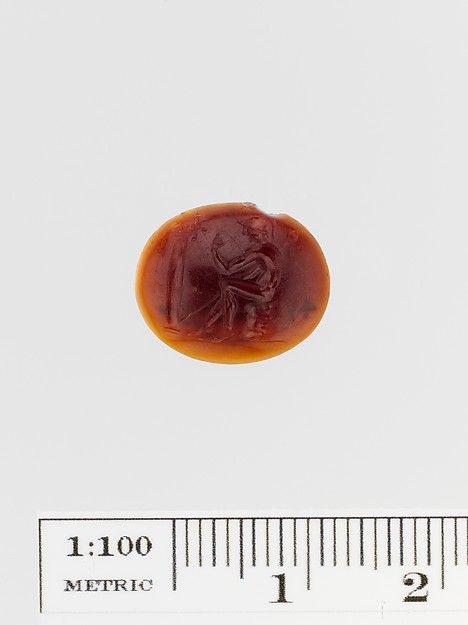
Sard ring stone - Roman, ca. 1st century BCE–3rd century CE, Sard
Metropolitan Museum of Art, New York, NY, 41.160.707. CC0
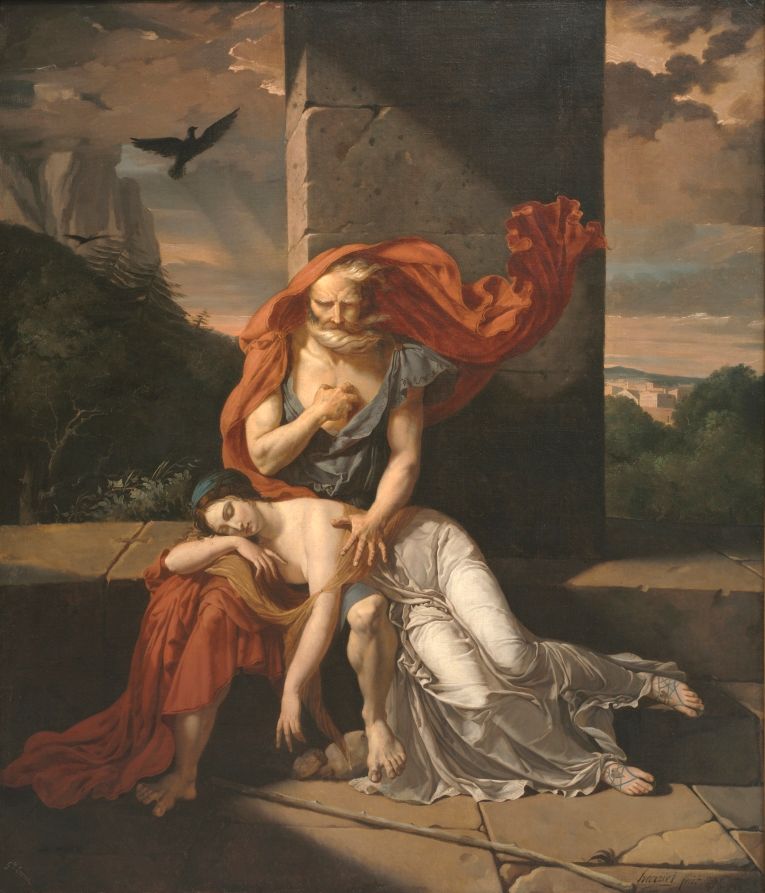
Oedipus at Colonus - France, 1798, oil on canvas
The Cleveland Museum of Art, Cleveland, OH, 2002.3. CC0
1 recorded relation, each with the ancient line behind it.
Children
-
Apollodorus names Antigone and Ismene as daughters of Oedipus; Pausanias gives their mother as Euryganeia rather than Jocasta.
Also Connected
3 recorded connections, each with the ancient line behind it.
Allies
-

Theseus received the exiled Oedipus at Colonus in Attica, where he died.
Connected
-

Oedipus answered the Sphinx's riddle, and she threw herself from the citadel.
-
Where Accounts Differ
- Jocasta or Epicaste
- who bore Oedipus's children
- whether Oedipus kept ruling after the revelation
- where and how Oedipus died
- the oracle to Laius: warning or advice
- Periboea or Merope
- Whether Oedipus stayed king after the truth came out depends on the source. Homer's Odyssey (11.271-280) has the gods reveal the incest straightway, after which Oedipus goes on ruling Thebes, and the Iliad (23.679-680) places his burial there. Sophocles (Oedipus Tyrannus 1182-1185, 1268-1279) and Apollodorus (Library 3.5.9) have him blind himself and leave the city.
- His mother's name varies. Homer calls her Epicaste, Sophocles and Pausanias Jocasta (Iocasta), and Apollodorus says some sources give one name and some the other.
- The mother of his four children is disputed. Apollodorus (Library 3.5.8) gives the standard account that Jocasta bore Polynices, Eteocles, Ismene and Antigone, but also records that some make Eurygania their mother. Pausanias (9.5.10-9.5.11) argues from Homer that Oedipus had no children by his mother, naming Euryganeia, daughter of Hyperphas, on the authority of the lost Oedipodia.
- The place and manner of his death differ. Sophocles's Oedipus at Colonus (1656-1666) has him pass away mysteriously at Colonus, seen only by Theseus, and Apollodorus (3.5.9) also has him die at Colonus. Homer's Iliad implies a death and burial at Thebes, and Pausanias (1.28.7) explicitly prefers Homer to Sophocles on this point.
- The oracle to Laius takes two forms. Apollodorus (3.5.7), Pausanias (9.5.10) and Sophocles's Oedipus Tyrannus (711-714) report it as a warning that his son would kill him. Aeschylus's Seven Against Thebes (742-757) frames it as Apollo's thrice-repeated advice that Laius should die childless to save the city, which he disobeyed.
- His knowledge of what he was doing is the cluster's contested question. No ancient source has him act knowingly. Sophocles's Oedipus Tyrannus (771-813) shows him fleeing Corinth to avoid the prophecy, and in Oedipus at Colonus (265-274, 960-999) he defends himself as unwitting and as having killed in self-defense.
- The foster mother is Periboea in Apollodorus (3.5.7) and Merope in Sophocles's Oedipus Tyrannus (775). Sophocles also has a Theban servant hand the baby to a Corinthian out of pity (1171-1178), where Apollodorus has him exposed on Cithaeron and found by Polybus's herdsmen.
Read the full source verification →
Mythology
Appears In
Related Terms
Referenced By
Sources
- Homer, Odyssey 11.271-280
- Homer, Iliad 23.679-680
- Hesiod, Works and Days 161-163
- Apollodorus, Library 3.5.7
- Apollodorus, Library 3.5.8
- Apollodorus, Library 3.5.9
- Pausanias, Description of Greece 9.5.10-9.5.11
- Pausanias, Description of Greece 1.28.7
- Pausanias, Description of Greece 1.30.4
- Sophocles, Oedipus Tyrannus 771-813
- Sophocles, Oedipus Tyrannus 1182-1185
- Sophocles, Oedipus Tyrannus 1263-1279
- Sophocles, Oedipus at Colonus 960-999
- Sophocles, Oedipus at Colonus 1656-1666
- Aeschylus, Seven Against Thebes 742-791
- Sophocles, Oedipus Tyrannus 452-456
- Timothy Gantz, Early Greek Myth (1993)
- Sigmund Freud, The Interpretation of Dreams (1899)