Creon
Creon is a mortal king of Thebes, son of Menoeceus and brother of Jocasta, not a god. He rules after Laius dies and again after the sons of Oedipus kill each other. Sophocles makes him the ruler who forbids Polynices's burial and loses his son and wife. A different Creon, king of Corinth, loses his daughter to Medea.
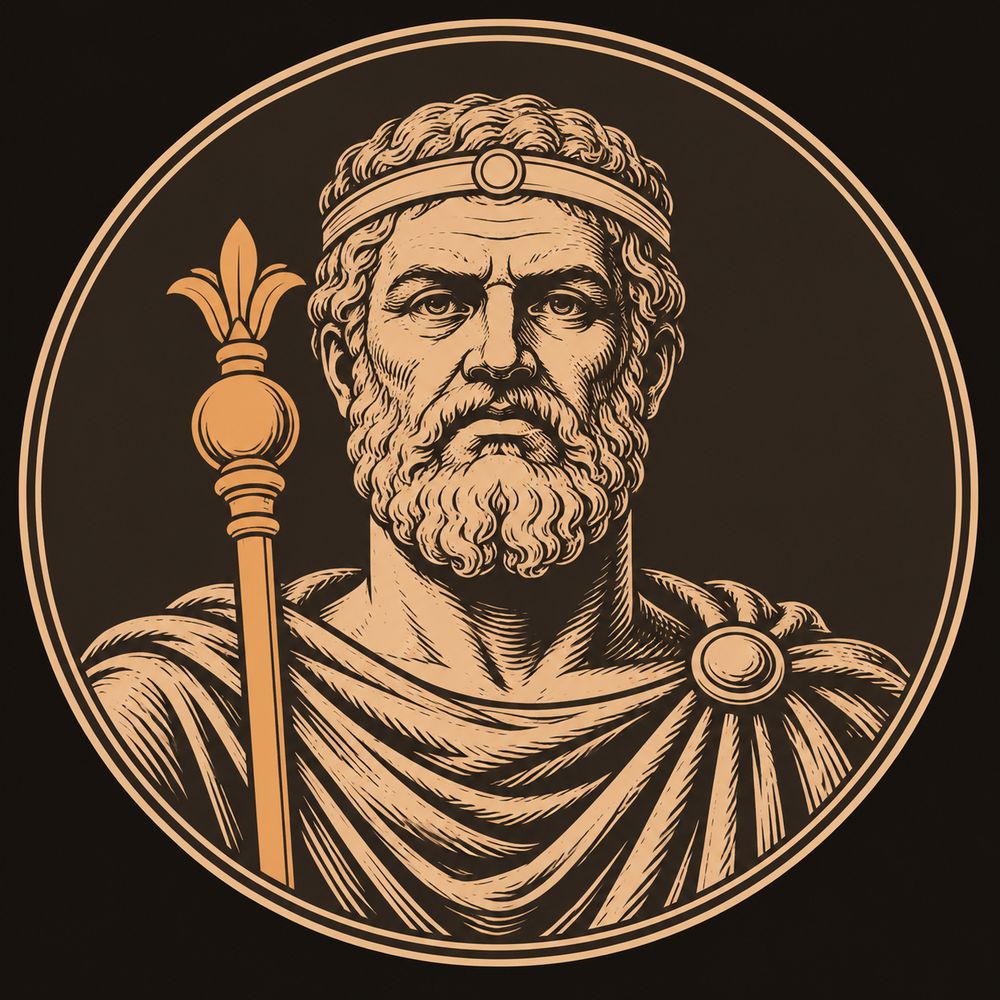
Creon, king of Thebes, holding his sceptre
Generated by AI from this page's own facts, not an ancient image or evidence of anything. How this site uses generated images
Sections on this page
Core Myth
Creon belongs to the royal house of Thebes. Apollodorus says Laius was buried by Damasistratus, king of Plataea, and that Creon, son of Menoeceus, then succeeded to the kingdom. The Sphinx came in his reign (Library 3.5.8). In Euripides's Phoenissae, Jocasta calls Creon her brother. She says that after her husband's death Creon proclaimed her hand as the prize for whoever guessed the Sphinx's riddle, and that her son Oedipus guessed it and became king (Phoenissae 45-50).
Creon returns to power after the war told in Seven Against Thebes. Apollodorus says that once he held the kingdom he cast out the Argive dead unburied. He proclaimed that nobody should bury them and set watchmen over the bodies (Library 3.7.1). Pausanias gives the same refusal a Theban date. He says Creon ruled as guardian of Laodamas, son of Eteocles, when he would not let the relatives bury their dead. Adrastus then appealed to Theseus, and the Athenians fought the Boeotians (Description of Greece 1.39.2).
Sophocles narrows the order to one corpse. Antigone tells her sister that Creon has granted honored burial to one brother and unburied shame to the other. No one may bury or mourn Polynices (Antigone 21-38). Creon answers her defiance by saying he will take her down a deserted path and entomb her alive in a rocky vault, with only a small ration of food (Antigone 773-780). The seer Tiresias comes to warn him, and the Furies are said to lie in wait for him (Antigone 988-1090; 1064-1076). A messenger tells how Antigone was found hanged and how Haemon died beside her (Antigone 1192-1240). Creon's wife Eurydice strikes herself down at the altar after mourning her son Megareus (Antigone 1301-1305). The play ends with the chorus saying that the great words of arrogant men are repaid with great blows (Antigone 1348-1353).
Creon has another son in the sources. Pausanias saw the tomb of Menoeceus, son of Creon, near the Neistan gate at Thebes. He says Menoeceus killed himself in obedience to an oracle from Delphi when Polynices and the Argive host arrived (Description of Greece 9.25.1). In Euripides's Phoenissae, Tiresias addresses Menoeceus, son of Creon, by name (Phoenissae 834-959).
What is the story of Creon?
Creon is the brother of Jocasta who holds the throne of Thebes at each crisis of the royal house. He succeeds Laius, offers Jocasta as the prize for solving the Sphinx's riddle, and rules again after Eteocles and Polynices die. In Sophocles he forbids burial for Polynices, condemns Antigone, and then loses Haemon and Eurydice. The same name belongs to a king of Corinth in the Medea story.
Apollodorus, Library 3.7.1
Who is Creon to Medea?
He is the king of Corinth who betrothed his daughter Glauce to Jason, which ended Jason's marriage to Medea. Euripides has him order Medea into exile with her children. Apollodorus says Glauce and her father both died in the fire from Medea's poisoned robe. This is a different man from the Theban Creon, whom no source checked here connects to Medea.
Apollodorus, Library 1.9.28
What did Creon do to Oedipus?
The passages checked here show Creon acting for Oedipus, not against him. In Euripides, Creon proclaims the marriage that goes to whoever solves the Sphinx's riddle, and Oedipus solves it and takes the throne. Apollodorus has Creon hold the kingdom before the Sphinx arrives. The two men are brothers-in-law by that marriage, and Creon is also Oedipus's uncle.
Euripides, Phoenissae 45-50
Was Creon a king or only a regent?
The sources differ. Sophocles treats him as the ruling king after the brothers' deaths. Apollodorus says that when Eteocles and Polynices fell, the kingdom passed to Laodamas, son of Eteocles, and Creon held power as his regent and guardian. Pausanias also calls him guardian of Laodamas. Creon is thus a king in the play and a guardian in the prose accounts.
Apollodorus, Library 3.7.3
Later Traditions
A second Creon rules Corinth. Apollodorus says Jason and Medea lived in Corinth for ten years, until Creon, king of Corinth, betrothed his daughter Glauce to Jason, who married her and divorced Medea. Medea sent the bride a poisoned robe, and Glauce was consumed by fire along with her father (Library 1.9.28). In Euripides's Medea, Creon orders Medea to leave the land at once, taking her two children (Medea 271-276). The sources checked here give the Corinthian king no link to Thebes.
Also Connected
2 recorded connections, each with the ancient line behind it.
Enemies
-
Creon forbids the burial of Polynices; Antigone buries the body anyway, is detected by Creon himself and is interred alive.
Connected
-
Jocasta says her brother Creon proclaimed her marriage as the prize for guessing the Sphinx's riddle, which her son Oedipus guessed.
Where Accounts Differ
- who Creon forbids to be buried
- Creon as king or regent
- two kings named Creon
- Whom Creon forbids to be buried differs by source. Sophocles, Antigone 21-38, has him forbid burial to Polynices alone. Apollodorus, Library 3.7.1, says he cast out all the Argive dead unburied, and Pausanias, Description of Greece 1.39.2, has him refuse the relatives of those who went against Thebes.
- Creon's office differs by source. Sophocles treats him as the king after the war. Apollodorus, Library 3.7.3, says he was regent and guardian of Laodamas, son of Eteocles, and Pausanias, Description of Greece 1.39.2, also calls him Laodamas's guardian.
- The sources checked here use the name Creon for two kings. Apollodorus, Library 3.5.8, makes Creon, son of Menoeceus, king of Thebes. Apollodorus, Library 1.9.28, makes Creon king of Corinth and father of Glauce.
Read the full source verification →
Mythology
Appears In
Related Terms
Referenced By
Sources
- Apollodorus, Library 1.9.28
- Apollodorus, Library 3.5.8
- Apollodorus, Library 3.7.1
- Apollodorus, Library 3.7.3
- Euripides, Phoenissae 45-50
- Euripides, Phoenissae 834-959
- Euripides, Medea 271-276
- Sophocles, Antigone 21-38
- Sophocles, Antigone 773-780
- Sophocles, Antigone 988-1090
- Sophocles, Antigone 1064-1076
- Sophocles, Antigone 1192-1240
- Sophocles, Antigone 1301-1305
- Sophocles, Antigone 1348-1353
- Pausanias, Description of Greece 1.39.2
- Pausanias, Description of Greece 9.25.1
- J. G. Frazer, Apollodorus: The Library (Loeb, 1921), notes to 3.5.8 and 3.7.1