Oedipus and the Sphinx
A winged monster sat above Thebes and devoured the Thebans who could not answer her riddle. Creon, ruling after Laius's death, promised the kingdom and Laius's widow to whoever solved it. Oedipus, newly arrived from Corinth, answered that the riddle meant man. The Sphinx threw herself from the citadel, and Oedipus married the queen, who was his own mother.
Sections on this page
What Led To It
The encounter sits between two prophecies. Apollodorus says an oracle warned King Laius of Thebes that a son of his would kill him, yet he fathered one. The baby's ankles were pierced and he was left on Mount Cithaeron. Herdsmen of King Polybus found him and brought him to Corinth, where he was raised as the king's son and named Oedipus for his swollen feet.
Taunted as a foundling, he asked the god at Delphi who his parents were. The answer was that he would murder his father and lie with his mother. Believing Polybus his father, he left Corinth. On a narrow road in Phocis he quarreled with a stranger in a chariot and killed him and his herald. The stranger was Laius. That is why Thebes had no king when the Sphinx came, and why Creon could offer the throne.
The Myth
Apollodorus sets the story in the reign of Creon, son of Menoeceus, who took the Theban throne after King Laius was killed on the road. In that reign, he writes, Hera sent the Sphinx against the city. She had learned a riddle from the Muses, sat on Mount Phicium, and put it to the Thebans: what has one voice and yet becomes four-footed, two-footed and three-footed?
The Thebans held an oracle promising they would be rid of her once they read the riddle. So they met often to debate the answer. Each time they failed, the Sphinx snatched one of them and devoured him. The last victim Apollodorus names is Creon's own son, Haemon.
After that loss Creon proclaimed a reward. Whoever solved the riddle would receive both the kingdom and the wife of Laius. Oedipus heard the proclamation and gave the answer: man, who crawls on four limbs as a baby, walks on two as an adult, and leans on a staff in old age.
On hearing that, Oedipus found the solution, declaring that the riddle of the Sphinx referred to man; for as a babe he is four-footed, going on four limbs, as an adult he is two-footed, and as an old man he gets besides a third support in a staff. So the Sphinx threw herself from the citadel, and Oedipus both succeeded to the kingdom and unwittingly married his mother.
Neither Oedipus nor the city knew what the reward meant. The widow of Laius was Jocasta, and the stranger from Corinth was the son she and Laius had exposed as a baby. Apollodorus says Oedipus married his mother unwittingly and had four children by her: Polynices, Eteocles, Ismene and Antigone.
The riddle's wording is not fixed across the sources. Diodorus Siculus gives a shorter form: what is at the same time a biped, a triped and a quadruped? Athenaeus preserves a longer verse riddle, quoted from Asclepiades's book on the plots of tragedy. In that version the creature changes its nature alone of everything that moves on land, in the air and in the sea, and is slowest when it walks on the most feet.
What Followed
Solving the riddle fulfilled the prophecy Oedipus had fled. Apollodorus says that when the truth came out, Jocasta hanged herself, and Oedipus blinded himself and was driven from Thebes. His sons, Eteocles and Polynices, did nothing to help him, and he cursed them. He went into exile with Antigone and died at Colonus in Attica. The quarrel between the two sons over the throne leads directly into the Seven against Thebes.
The reward itself was the trap. The same answer that saved Thebes from the Sphinx gave Oedipus a crown and a marriage that the oracle had already named as his ruin.
Afterlife and Modern Influence
The confrontation became a set piece of French painting. Jean-Auguste-Dominique Ingres painted Oedipus questioning the Sphinx in 1808, while studying at the French Academy in Rome, and later enlarged and reworked the canvas, which is now in the Louvre. A smaller developed sketch for that reworking, of about 1826, hangs in the National Gallery, London. Gustave Moreau took up the same subject in his Oedipus and the Sphinx of 1864, an immediate success at that year's Paris Salon and now in the Metropolitan Museum of Art. Both painters stage the moment of questioning rather than the Sphinx's fall, so the outcome stays unresolved on the canvas.
What is the story of Oedipus and the Sphinx?
Apollodorus tells it most fully. Hera sent the Sphinx to Thebes, where she posed a riddle and devoured every Theban who failed to solve it. After his own son Haemon died, Creon offered the kingdom and Laius's widow to whoever answered. Oedipus, a stranger from Corinth, solved it, the Sphinx threw herself from the citadel, and Oedipus married the queen without knowing she was his mother.
Apollodorus, Library 3.5.8
What does the Sphinx say to Oedipus?
No surviving tragedy stages the exchange, but Apollodorus records the riddle she put to the Thebans: what has one voice and yet becomes four-footed, two-footed and three-footed? Diodorus Siculus gives a shorter form, asking what is at once a biped, a triped and a quadruped. A longer verse version, attributed to Asclepiades and quoted by Athenaeus, adds that the creature is slowest when it walks on the most feet.
Apollodorus, Library 3.5.8; Diodorus Siculus, Bibliotheca Historica 4.64.3
What is the correct answer to the Sphinx's riddle?
Man. Apollodorus gives Oedipus's reasoning: a person is four-footed as a baby, going on four limbs, two-footed as an adult, and in old age gains a third support in a staff. Diodorus Siculus explains it the same way, adding that the staff comes from the weakness of age. The riddle turns on a human life read as a single day's changing gait.
Apollodorus, Library 3.5.8; Diodorus Siculus, Bibliotheca Historica 4.64.4
What is the role of Sphinx in the drama Oedipus Rex?
In Sophocles's Oedipus Tyrannus the Sphinx is already dead and appears only in memory. She explains why Laius's murder was never investigated: Creon says the riddling Sphinx made Thebes set aside obscure matters (130-131). Oedipus throws his victory at Teiresias as proof that the prophet failed where he succeeded (390-398). The closing lines recall him as the man who knew the famous riddle (1525), yet he could not read his own birth.
Sophocles, Oedipus Tyrannus 391-398
Why did the Sphinx come to Thebes?
The sources name different senders. Apollodorus says Hera sent her, but gives no reason. In Euripides's Phoenician Women the chorus says she was sent by Hades to plague the men of Thebes. Hesiod calls her Phix and says only that she was a destruction for the Cadmeans. Pausanias reports stories that make her a pirate raider or an illegitimate daughter of Laius guarding the throne.
Apollodorus, Library 3.5.8; Hesiod, Theogony 326-332; Pausanias, Description of Greece 9.26.2-9.26.3
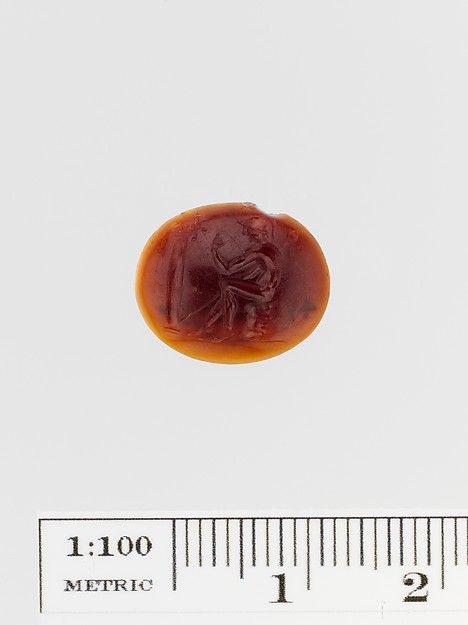
Sard ring stone - Roman, ca. 1st century BCE–3rd century CE, Sard
Metropolitan Museum of Art, New York, NY, 41.160.707. CC0
Where Accounts Differ
- Hera or Hades sent the Sphinx
- Typhon or Orthus as the Sphinx's father
- wording of the riddle
- suicide, slaying or military defeat
- wit or divine help
- Creon's sister or daughter
- Who sent the Sphinx is disputed. Apollodorus (Library 3.5.8) says Hera sent her, without giving a reason. In Euripides's Phoenician Women (810) the chorus says she was sent by Hades. Hesiod (Theogony 326) names her only as Phix, a destruction for the Cadmeans, and says nothing of who sent her.
- Her parentage differs. Apollodorus (Library 3.5.8) makes her the daughter of Echidna and Typhon. Hesiod (Theogony 326-327) has her born to Orthus, and his Greek leaves open whether the mother is Echidna or the Chimera.
- The riddle's wording varies. Apollodorus (Library 3.5.8) gives the one-voice, four-, two- and three-footed form. Diodorus (4.64.3) has only biped, triped and quadruped. Athenaeus (Deipnosophists 10.456b) quotes a longer hexameter version from Asclepiades. Sophocles's Oedipus Tyrannus alludes to the riddle (393-398, 1525) but never states its text.
- Her death differs. Apollodorus (Library 3.5.8) has her throw herself from the citadel and Diodorus (4.64.4) down a precipice. The chorus of Sophocles's Oedipus Tyrannus (1197-1199) speaks of Oedipus as having destroyed her. Pausanias (9.26.2) reports a rationalized version in which she was a pirate leader whom Oedipus overwhelmed with an army.
- How Oedipus solved it is framed differently. In Sophocles's Oedipus Tyrannus the priest says he did it with a god's help (38), while Oedipus himself boasts he did it by wit alone, untaught by birds (396-398). Pausanias (9.26.4) records a version in which the riddle was a secret oracle that Oedipus had learned in a dream.
- Who offered the reward differs. Apollodorus (Library 3.5.8) and Euripides's Phoenician Women (45-50) name Creon, Jocasta's brother. Diodorus (4.64.1, 4.64.3) says only that a reward was offered, and calls Jocasta the daughter of Creon.
Read the full source verification →
Mythology
Figures In This Myth
Also Connected
Related Terms
Referenced By
Sources
- Apollodorus, Library 3.5.7
- Apollodorus, Library 3.5.8
- Apollodorus, Library 3.5.9
- Hesiod, Theogony 326-332
- Pausanias, Description of Greece 9.26.2-9.26.4
- Diodorus Siculus, Bibliotheca Historica 4.64.3-4.64.4
- Sophocles, Oedipus Tyrannus 391-398
- Euripides, Phoenissae 45-50
- Timothy Gantz, Early Greek Myth (1993)