Cadmus
Cadmus is the Phoenician prince who founded Thebes. Sent to find his abducted sister Europa, he was told at Delphi to follow a cow and build a city where it lay down. There he killed a serpent sacred to Ares, sowed its teeth, and married Harmonia, whose parents were the gods Ares and Aphrodite. Late in life, he and Harmonia became serpents.
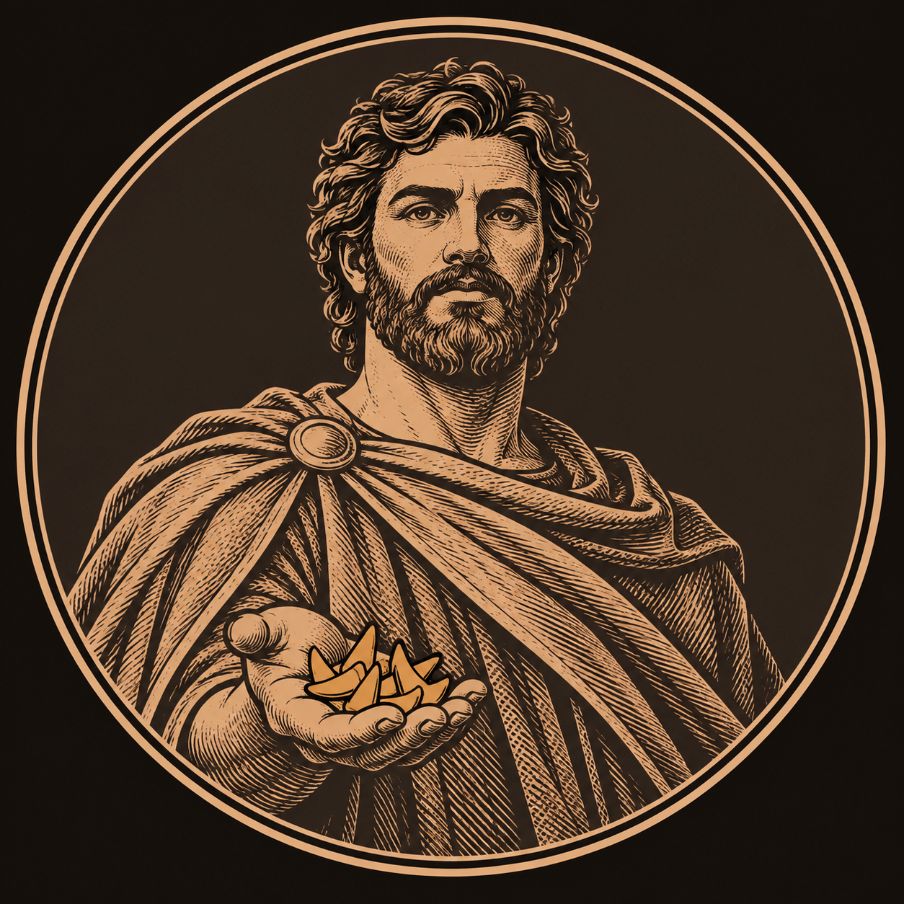
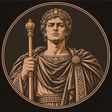
Cadmus, bronze medallion illustration
Generated by AI from this page's own facts, not an ancient image or evidence of anything. How this site uses generated images
Sections on this page
See Cadmus in the Greek family tree.
Core Myth
Apollodorus's Library makes Cadmus a son of Agenor and Telephassa, and brother of Europa, Phoenix and Cilix. When Zeus carried Europa away as a bull, Agenor sent his sons to find her and told them not to come home without her. The versions of the search differ. Apollodorus has Cadmus and his mother settle in Thrace, and only after Telephassa's death does he go to Delphi to ask about his sister. Ovid's Metamorphoses has Agenor threaten Cadmus with exile if he fails, so the young man consults Apollo's oracle looking for a new home. Herodotus adds that on the way Cadmus put in at the island later called Thera and left a kinsman there with other Phoenicians.
The oracle told him to give up the search, follow a cow, and found a city where she lay down. Apollodorus says the cow came from the herds of Pelagon and sank down on the site of Thebes. Pausanias heard the same at Thebes, adding that the cow had a white mark like a full moon on each side. Cadmus meant to sacrifice her and sent his men to a spring for water. A serpent guarded it. Apollodorus calls the spring Ares's and says some thought the creature was a son of Ares. Ovid calls it sacred to Mars, the Roman Ares, and describes it killing the whole water party. Cadmus killed it. Ovid gives the fight in detail: a thrown millstone glances off its scales, and his spear finally pins its neck to an oak. The whole tale, from the cow to the sown men, is told in Cadmus and the Dragon.
On Athena's advice, Cadmus sowed the serpent's teeth, and armed men rose from the ground. Apollodorus says these Sparti, the sown men, killed each other in a brawl or by mistake. He also reports that the older writer Pherecydes had Cadmus throw stones among them so that each blamed the other. Five survived: Echion, Udaeus, Chthonius, Hyperenor and Pelorus. The killing still had a price. Apollodorus says Cadmus served Ares for an eternal year, equal to eight human years. Athena then gave him the kingdom, and Zeus gave him Harmonia, daughter of Ares and Aphrodite. The gods came down to feast at the wedding, and Cadmus gave his bride a robe and a necklace made by Hephaestus.
Who does Cadmus marry?
Cadmus married Harmonia, daughter of Ares and Aphrodite. Hesiod's Theogony names her as Ares's daughter by Cytherea, an Aphrodite title, and as the wife of Cadmus. Apollodorus says Zeus gave her to Cadmus after his eight years of service to Ares. All the gods left the sky to feast at the wedding in the Cadmea, the citadel of Thebes. Cadmus gave her a robe and a necklace made by Hephaestus. Pausanias found the site of her bridal chamber still shown at Thebes. He also saw the place where the Muses were said to have sung at the wedding.
Apollodorus, Library 3.4.2
What was the curse of Cadmus?
The ancient texts give no single named curse. They link the troubles of his house in two ways. Ovid makes the killing of the serpent sacred to Mars the root: an unseen voice warns Cadmus over the body that he too will become a serpent. Ovid also names Juno's anger against all of Europa's family. Whatever the cause, his daughters and grandsons suffered. Semele was burned by Zeus's fire, Actaeon was killed by his hounds, Ino leapt into the sea with her son, and Pentheus was torn apart by his mother Agave. Pausanias also follows Harmonia's necklace into the next generation's disaster, as the bribe paid to Eriphyle before the war of the Seven against Thebes.
Ovid, Metamorphoses 3.95-137
Why were Cadmus and Harmonia turned into serpents?
The sources give different reasons. In Ovid, the old Cadmus in Illyria wonders whether the serpent he killed was sacred. He prays that if the gods are angry, he may become a serpent himself. The change follows at once, and Harmonia asks to share it. In Euripides's Bacchae, the change is announced by Dionysus after Thebes rejected him. He adds that Ares will later bring the pair to the land of the blessed. Apollodorus gives no motive. He says only that Zeus changed them after their rule over the Illyrians and sent them to the Elysian Fields.
Ovid, Metamorphoses 4.563-603
Later Traditions
Hesiod's Theogony already knows Harmonia as the wife of Cadmus and names their children: Ino, Semele, Agave, Autonoe and Polydorus. Apollodorus lists the same five. Their lives went badly. Semele died when Zeus came to her in his full glory, and her son Dionysus was born from his thigh. Autonoe's son Actaeon was torn apart by his own hounds, and Ino leapt into the sea with her son. Ovid says Juno rejoiced at every blow to the house of Cadmus, since her anger fell on all of Europa's kin. Agave's son Pentheus, who had succeeded Cadmus, refused to honor Dionysus and was torn apart by his own mother on Mount Cithaeron. Euripides's Bacchae stages that story with Cadmus, old and willing, dressed for the god's rites beside the prophet Tiresias.
Cadmus and Harmonia then left Thebes. Apollodorus says they went to the Encheleans, led them to victory over the Illyrians as an oracle required, and ruled there. They were finally turned into serpents, and Zeus sent them to the Elysian Fields. Through Polydorus the line ran to Labdacus and Laius, whose son was Oedipus. Herodotus calls Laius the great-grandson of Cadmus. The family's gifts outlived them too. Pausanias saw a necklace said to have first been Harmonia's, later known as the necklace of Eriphyle. That was the bribe she took to send her husband to his death in the war of the Seven against Thebes.
Greek writers also credited Cadmus with things larger than one city. Herodotus says the Phoenicians who came with Cadmus brought the alphabet to Greece. He qualifies it as his own judgment, and he reports seeing Cadmean letters on tripods at Thebes. He also traces part of the Greek worship of Dionysus to Cadmus of Tyre and his followers. Pausanias records a Theban altar of Athena that Cadmus was said to have dedicated. He uses its Phoenician title to reject the view that Cadmus came from Egypt.
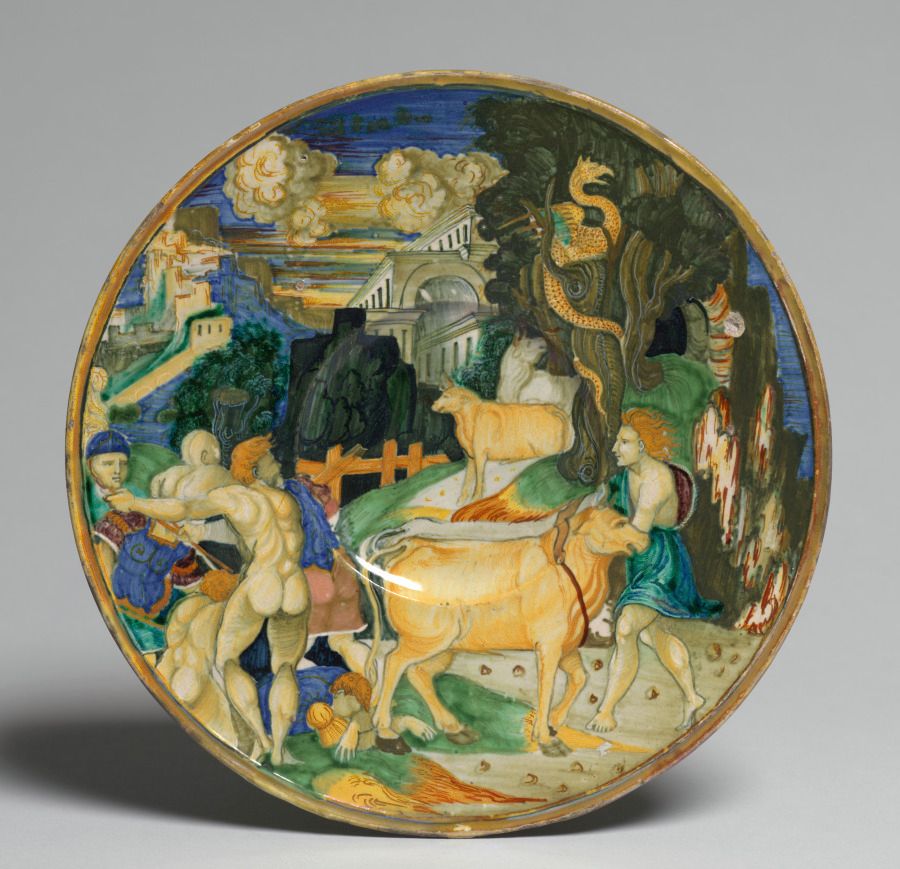
Plate Depicting the Myth of Cadmus - Italy, Urbino region, Gubbio, 16th century, 1526, tin-glazed earthenware with gold lustre (maiolica)
The Cleveland Museum of Art, Cleveland, OH, 1950.156. CC0
1 recorded relation, each with the ancient line behind it.
Children
-

Hesiod names Semele among the children Harmonia bore to Cadmus.
Also Connected
4 recorded connections, each with the ancient line behind it.
Connected
-
Actaeon is Cadmus's grandson through his daughter Autonoe. Ovid opens the story by calling him the first grandson to bring sorrow on Cadmus's good fortune.
-

Cadmus killed the serpent at the spring of Ares and served Ares for an eternal year in atonement before marrying Harmonia, Ares's daughter.
-
Pentheus is Cadmus's grandson through his daughter Agave. In the Bacchae, Cadmus names him the child of Echion to whom he gave control of the land.
Where Accounts Differ
- why Cadmus became a serpent
- origin of Harmonia's necklace
- how the sown men died
- god of the first sacrifice
- Phoenician alphabet and Egyptian origin
- who succeeded Cadmus
- The reason Cadmus and Harmonia became serpents differs by source. Ovid has Cadmus pray for the change, suspecting the gods' anger over the serpent of Mars. Euripides's Bacchae has Dionysus announce it as part of the punishment of Thebes. Apollodorus gives no motive and says only that Zeus sent them to the Elysian Fields.
- The necklace given to Harmonia has three origins in Apollodorus. Cadmus gave it, or Hephaestus gave it to Cadmus, or, according to Pherecydes, Europa gave it after receiving it from Zeus.
- The sown men die differently. Apollodorus says they fell in a chance brawl or by mistake, and cites Pherecydes for Cadmus throwing stones among them. Ovid has one warrior warn Cadmus off before the rest turn on each other. Both leave five survivors.
- Cadmus meant to sacrifice the cow to Athena in Apollodorus and to Jupiter in Ovid.
- Herodotus reports that the Phoenicians who came with Cadmus brought the alphabet to Greece, but marks the claim as his own opinion. Pausanias records a rival view that Cadmus was Egyptian, and rejects it on the evidence of a Phoenician cult title at Thebes.
- The succession is told two ways. Apollodorus has Agave's son Pentheus succeed Cadmus, with Polydorus reigning later. Pausanias says Polydorus took the kingdom when Cadmus left for the Encheleans.
Read the full source verification →
Mythology
Appears In
Related Terms
Referenced By
Sources
- Apollodorus, Library 3.1.1
- Apollodorus, Library 3.4.1
- Apollodorus, Library 3.4.2
- Apollodorus, Library 3.4.3
- Apollodorus, Library 3.4.4
- Apollodorus, Library 3.5.2
- Apollodorus, Library 3.5.4
- Apollodorus, Library 3.5.5
- Ovid, Metamorphoses 3.1-94
- Ovid, Metamorphoses 3.95-137
- Ovid, Metamorphoses 3.253-315
- Ovid, Metamorphoses 4.563-603
- Hesiod, Theogony 933-937
- Hesiod, Theogony 975-978
- Euripides, Bacchae 1-10
- Euripides, Bacchae 170-190
- Euripides, Bacchae 1330-1339
- Herodotus, Histories 2.49
- Herodotus, Histories 4.147
- Herodotus, Histories 5.58
- Herodotus, Histories 5.59
- Pausanias, Description of Greece 9.5.2
- Pausanias, Description of Greece 9.5.3
- Pausanias, Description of Greece 9.12.1-9.12.3
- Pausanias, Description of Greece 9.41.2
- Timothy Gantz, Early Greek Myth (1993)