Actaeon
Actaeon was a Theban hunter and a grandson of Cadmus through his daughter Autonoe. Apollodorus says the centaur Chiron raised him to hunt. He was changed into a stag and torn apart by his own hounds. Ovid's Metamorphoses makes his offence an accident: he saw Artemis bathing. Other sources blame a courtship of Semele or a boast that he hunted better than Artemis.
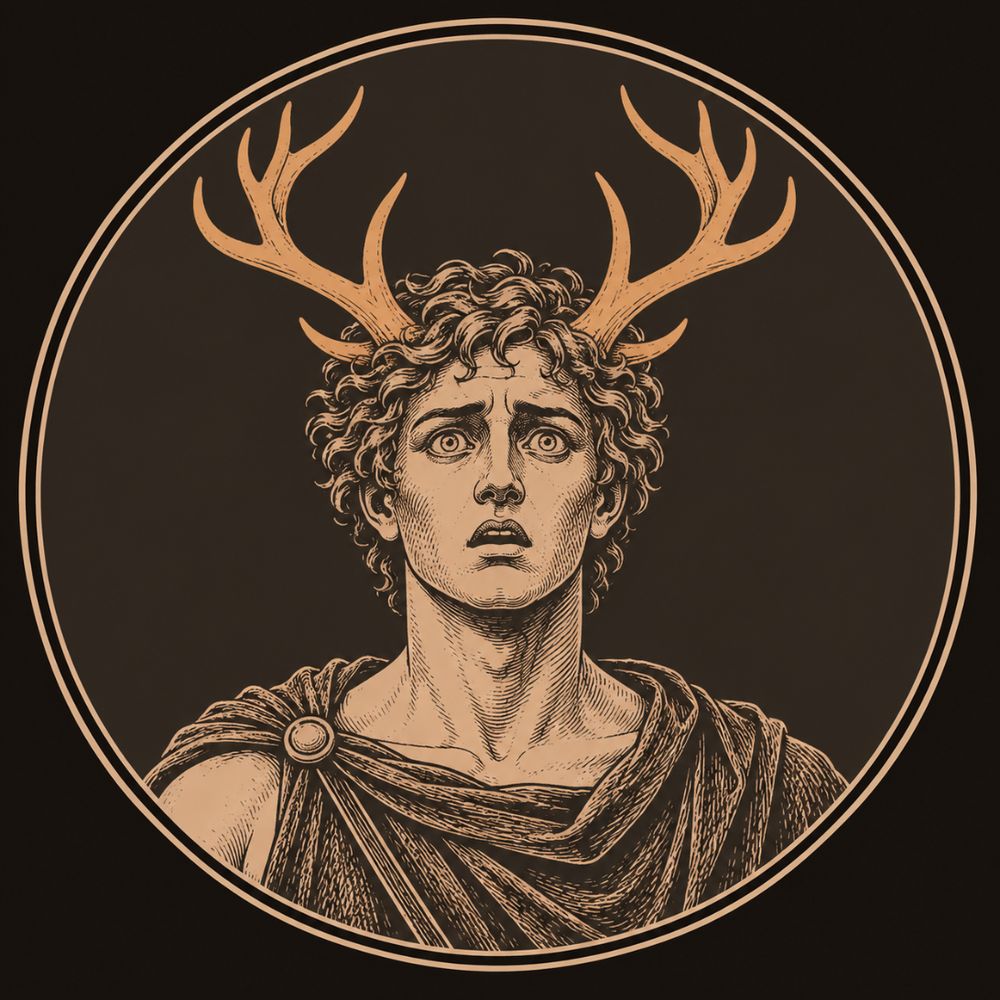
Actaeon, bronze medallion illustration
Generated by AI from this page's own facts, not an ancient image or evidence of anything. How this site uses generated images
Sections on this page
Core Myth
Actaeon belongs to the generation of Cadmus's grandsons. Apollodorus's Library says he was the son of Aristaeus and Autonoe, and Euripides's Bacchae names the same parents. Autonoe was a daughter of Cadmus, and Ovid's Metamorphoses opens the story by calling Actaeon the first grandson to bring sorrow on Cadmus's good fortune. His cousins were Pentheus, son of Agave, and Dionysus, son of Semele. Apollodorus adds that the centaur Chiron raised him to be a hunter.
Ovid's Metamorphoses gives the fullest account. At noon, after a morning's hunting, Actaeon tells his companions to take down the nets and rest. Nearby lies Gargaphia, a valley sacred to Diana, the Roman name for Artemis. In a grotto there she bathes with her nymphs. Actaeon wanders in by chance, uncertain of his way. The nymphs shriek and crowd round to hide her, but she stands taller than all of them. Wishing for her arrows, she throws water in his face instead. Go and tell it, she says, if you can, that you saw me unclothed. Then she gives him a stag's horns, a long neck, long legs and a dappled hide.
Only his understanding stays as it was. Ovid says Actaeon sees his horns reflected in a stream and tries to cry out, but he can only groan. He cannot choose between the palace and the woods. Fear keeps him from one, and shame from the other. Then his hounds find him, and Ovid names more than thirty of them. Actaeon wants to shout that he is their master, but no words come. His companions urge the pack on and call for Actaeon, complaining that he is missing the sport. The dogs tear him apart. Ovid says the goddess's anger was satisfied only when he died.
Ovid then reports how people judged it. Some thought the goddess too harsh, while others praised her chastity. Only Juno kept silent. She rejoiced at every blow to the house of Cadmus, because her anger fell on all of Europa's kin. Her next target, in Ovid, is Semele. When Pentheus is later attacked by the maenads in Ovid's version, he begs his aunt Autonoe to spare him for the sake of Actaeon's ghost. She tears off his right arm.
Why was Actaeon turned into a deer?
The ancient sources give different reasons. In Ovid's Metamorphoses, Actaeon wanders by chance into Diana's grotto while she bathes. She splashes him with water, dares him to tell that he saw her unclothed, and gives him a stag's horns. Apollodorus calls seeing Artemis bathing the more general opinion. He adds that Acusilaus blamed Zeus, angry that Actaeon wooed Semele. Pausanias reports Stesichorus's version, in which the goddess threw a deer-skin around him so his hounds would kill him, to stop him marrying Semele. Euripides's Bacchae gives a third cause: a boast that he hunted better than Artemis.
Ovid, Metamorphoses 3.138-252; Apollodorus, Library 3.4.4; Pausanias, Description of Greece 9.2.3; Euripides, Bacchae 337-340
What did Actaeon do to Artemis?
In the best-known account he did nothing on purpose. Ovid's Metamorphoses has him end a morning's hunt at noon and wander, uncertain of the way, into the valley of Gargaphia. There he comes upon the goddess, whom Ovid calls Diana, bathing with her nymphs. Ovid insists his fault was the crime of Fortune, not guilt, since a mistake is not a crime. Other writers make him guilty. In Euripides's Bacchae, Cadmus says Actaeon boasted he was a better hunter than Artemis. Diodorus Siculus reports that some said he tried to force a marriage on the goddess at her own temple.
Ovid, Metamorphoses 3.138-252; Euripides, Bacchae 337-340
Who is Actaeon in Greek mythology?
Actaeon is a hunter from the royal house of Thebes. Apollodorus's Library names his parents as Aristaeus and Autonoe, a daughter of Cadmus, and says the centaur Chiron raised him to hunt. Euripides's Bacchae also calls him Autonoe's son by Aristaeus. That makes him a cousin of Pentheus and Dionysus. He is remembered for his death. Changed into a deer, he was torn apart by his own hounds. Apollodorus places the death on Mount Cithaeron. In the Bacchae, Cadmus says Pentheus died where dogs once divided Actaeon.
Apollodorus, Library 3.4.4; Euripides, Bacchae 1227-1230; Euripides, Bacchae 1290-1292
How did Actaeon die?
His own hunting dogs killed him. In Ovid's Metamorphoses, the transformed Actaeon keeps a human mind but loses his voice. He cannot decide whether to go home or hide in the woods. His hounds find him, and Ovid names more than thirty of them. Actaeon tries to cry out that he is their master, but no words come. His companions urge the pack on and call for Actaeon, wondering where he is. The dogs tear him apart, and Ovid says the goddess's anger was only satisfied when he died. Apollodorus says the goddess drove mad a pack of fifty dogs.
Ovid, Metamorphoses 3.138-252; Apollodorus, Library 3.4.4
What happened to Actaeon's dogs?
Apollodorus says the dogs devoured Actaeon without knowing him and then searched for their master, howling. They came to the cave of the centaur Chiron, who had raised him. Chiron made an image of Actaeon, and it soothed their grief. Pausanias gives a rational account instead. In his view the hounds went mad without any god's help, and would have torn apart anyone they met. Ovid gives the dogs names and breeds, a long catalogue that includes Cretan, Spartan and Arcadian hounds.
Apollodorus, Library 3.4.4; Pausanias, Description of Greece 9.2.4; Ovid, Metamorphoses 3.138-252
Later Traditions
Other writers give Actaeon a different offence. Apollodorus's Library records two causes. Acusilaus said Zeus was angry because Actaeon wooed Semele. The more general opinion, Apollodorus says, was that he saw Artemis bathing. Pausanias says Stesichorus of Himera also told the Semele version. In it the goddess threw a deer-skin around Actaeon so that his hounds would kill him, to stop him marrying Semele. In Euripides's Bacchae, Cadmus warns Pentheus with Actaeon's fate. He was torn apart in the meadows, Cadmus says, for boasting that he hunted better than Artemis. Diodorus Siculus names two causes. Some said Actaeon tried to consummate a marriage with Artemis at her temple, others that he claimed greater skill as a hunter. Diodorus thought either would justify her anger.
Apollodorus says the goddess drove mad Actaeon's fifty dogs, which devoured him without knowing him. Afterwards they searched for their master, howling, until they came to Chiron's cave. The centaur made an image of Actaeon, and it soothed their grief. Pausanias saw a spring and a rock on the road from Megara to Plataea. The rock was called the bed of Actaeon, where he was said to have slept when tired from hunting, and into this spring he looked while Artemis bathed. Pausanias himself thought the hounds went mad without any god's help.
At Delphi, Pausanias describes the underworld painted by Polygnotus in the Lesche of the Cnidians. Actaeon sits there with his mother on a deer's skin, holding a young deer, with a hunting dog stretched out beside them. Pausanias reads the details as allusions to his way of life and his death. Callimachus's fifth Hymn, on the bath of Pallas, sets Actaeon beside Tiresias. After Tiresias loses his sight for seeing Athena bathe, the goddess comforts his mother: one day Autonoe will pray to have her son back merely blind. Actaeon, a hunting companion of Artemis, will see the goddess bathing against his will. His own dogs will devour him, and his mother will gather his bones from the thickets.
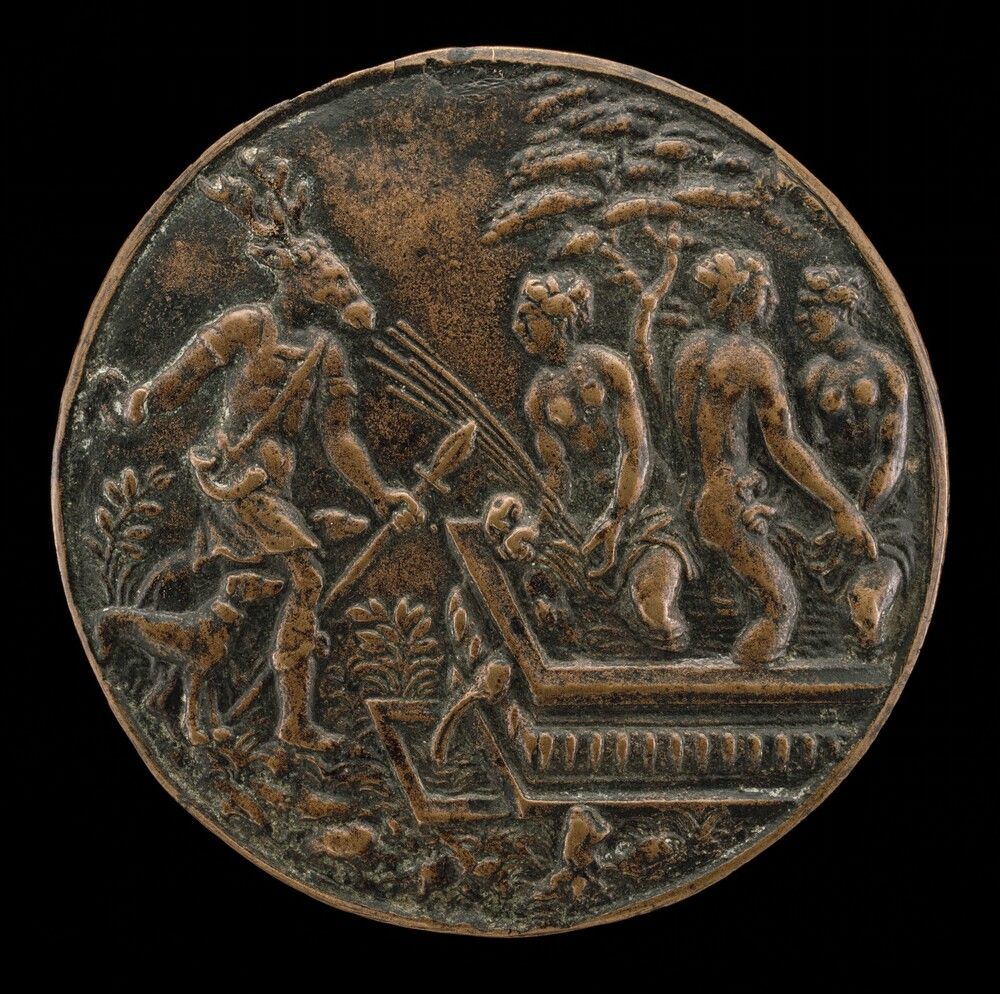
Diana and Actaeon - North Italian 16th Century, early 16th century, bronze//Medium brown patina
National Gallery of Art, Washington, DC, 1957.14.441. CC0
Also Connected
4 recorded connections, each with the ancient line behind it.
Connected
-
Actaeon is Cadmus's grandson through his daughter Autonoe. Ovid opens the story by calling him the first grandson to bring sorrow on Cadmus's good fortune.
-
Pentheus and Actaeon are cousins, sons of Cadmus's daughters Agave and Autonoe. In Ovid, the dying Pentheus begs Autonoe to spare him for the sake of Actaeon's ghost.
-

Semele is Actaeon's aunt. Stesichorus, as Pausanias reports, said the goddess killed Actaeon to stop him marrying Semele.
-

Apollodorus reports that, according to Acusilaus, Actaeon died because Zeus was angry at him for wooing Semele. The more general opinion blamed Artemis.
Where Accounts Differ
- what Actaeon did wrong
- which god caused his death
- stag transformation or deer-skin
- where Actaeon died
- whether Actaeon was guilty
- how many dogs
- The offence differs. Ovid's Metamorphoses has Actaeon see Diana bathing by chance, and Apollodorus calls this the more general opinion. Acusilaus, cited by Apollodorus, and Stesichorus, cited by Pausanias, make him a suitor of Semele. Euripides's Bacchae has him boast that he hunted better than Artemis. Diodorus Siculus reports both an attempted marriage with Artemis at her temple and a boast of greater skill.
- Which god drove his death differs. In Ovid and in Apollodorus's general version it is Artemis. Acusilaus, cited by Apollodorus, makes Zeus angry over Semele. In Stesichorus the goddess acts to stop the marriage to Semele. Pausanias himself thought no god was needed and that the hounds simply went mad.
- How he became prey differs. Ovid's goddess sprinkles him with water and changes his body into a stag's. Apollodorus says she transformed him into a deer. Stesichorus, cited by Pausanias, has her throw a deer-skin around him instead.
- The place differs. Apollodorus puts his death on Cithaeron, and in Euripides's Bacchae Cadmus says Pentheus died where dogs once divided Actaeon, which Agave's reply names as Cithaeron. Ovid sets the bath in the valley of Gargaphia. Pausanias saw a spring and a rock called the bed of Actaeon on the road from Megara to Plataea.
- His guilt is judged differently. Ovid calls it the crime of Fortune, not guilt, and says people afterwards argued over the goddess's harshness. Callimachus's fifth Hymn says he will see the bath against his will. Diodorus Siculus says the goddess was justified whichever offence he committed.
- The size of the pack differs. Apollodorus says fifty dogs. Ovid names more than thirty and says there were more than he will list.
Read the full source verification →
Mythology
Referenced By
Sources
- Ovid, Metamorphoses 3.138-252
- Ovid, Metamorphoses 3.253-315
- Ovid, Metamorphoses 3.712-733
- Apollodorus, Library 3.4.4
- Euripides, Bacchae 337-340
- Euripides, Bacchae 1227-1230
- Euripides, Bacchae 1290-1292
- Pausanias, Description of Greece 9.2.3
- Pausanias, Description of Greece 9.2.4
- Pausanias, Description of Greece 10.30.5
- Timothy Gantz, Early Greek Myth (1993)