Cadmus and the Dragon
Cadmus and the dragon is the founding story of Thebes. Following a cow to the place where she lay down, Cadmus sent his companions to a spring sacred to Ares, where a dragon killed them. He killed it, sowed its teeth on Athena's advice, and armed men rose from the earth and fought one another. Five survived, and Cadmus later served Ares for the killing.
Sections on this page
What Led To It
Cadmus's search begins with Europa. Apollodorus makes Agenor, Cadmus's father, send his sons to look for her and forbid them to come home without her. When they could not find her, they settled in different lands. Cadmus and his mother Telephassa went to Thrace. This story stays with the founding episode.
The Myth
The story begins with a search that goes wrong. Ovid says Agenor sent his son Cadmus to find the sister carried off by Jupiter, and proclaimed him doomed to exile if he came back without her. When Cadmus failed, he shunned his country and asked Phoebus's oracle for a land where he could live. Apollodorus tells it differently. In his Library Cadmus settles in Thrace after his mother dies, and only then goes to Delphi to ask about Europa. The god tells him to stop worrying about her and let a cow guide him. The earlier chapter of the family's story is in The Rape of Europa.
The oracle's instruction is simple. In Ovid, Phoebus says that a heifer that has never known the yoke will cross Cadmus's path, and where she lies down to rest he is to build a city. Cadmus leaves the Castalian cave, sees the unguarded heifer at once, and follows her over the Cephissus and through the fields of Panope into Boeotia. There she stops, lifts her broad forehead towards the sky, lows, and lies down on the grass. Cadmus kisses the foreign soil.
Apollodorus says the cow came from the herds of Pelagon, and that Cadmus followed her through Phocis. Pausanias heard the same tale at Thebes. Cadmus was leaving Delphi by the road to Phocis, and the cow he bought from Pelagon's herdsmen had a white mark like the orb of a full moon on each side. Thebans also pointed out the spot itself. Pausanias says there was an altar and an image of Athena in the open, said to have been dedicated by Cadmus.
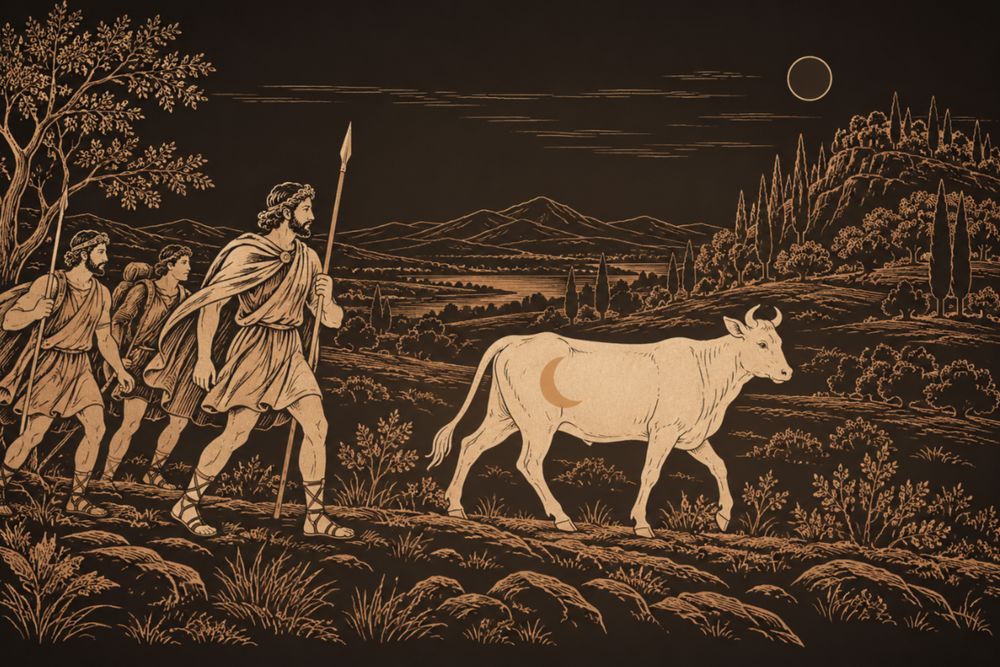
Following the heifer
Generated by AI from this page's own facts, not an ancient image or evidence of anything. How this site uses generated images
Cadmus meant to sacrifice the cow at once. Apollodorus says the offering was for Athena, and Ovid says it was for Jupiter. Either way, he needed water, and he sent some of his companions to fetch it. Apollodorus names the spring as the spring of Ares. Ovid describes an ancient grove that had never known an axe, with a cave under a low arch of osiers at its centre and a stream welling from its dark mouth.
The cave held a dragon sacred to Mars, the Roman Ares. Ovid gives it a crest, scales that shone, eyes like glowing coals, three tongues, and three rows of teeth. When the Tyrians lowered their urns into the water, it reared up and hissed. Ovid says it stung some of them to death, crushed others in its coils, and blasted the rest with its breath. Apollodorus is briefer: the dragon guarded the spring, some said it was a child of Ares, and it killed most of the men sent.
At midday, with his men still gone, Cadmus went after them. He wore a lion's skin and carried a lance and a javelin, and Ovid adds that he had a dauntless soul as well. He found the bodies and the dragon licking blood from their wounds, and swore to avenge them or share their death.
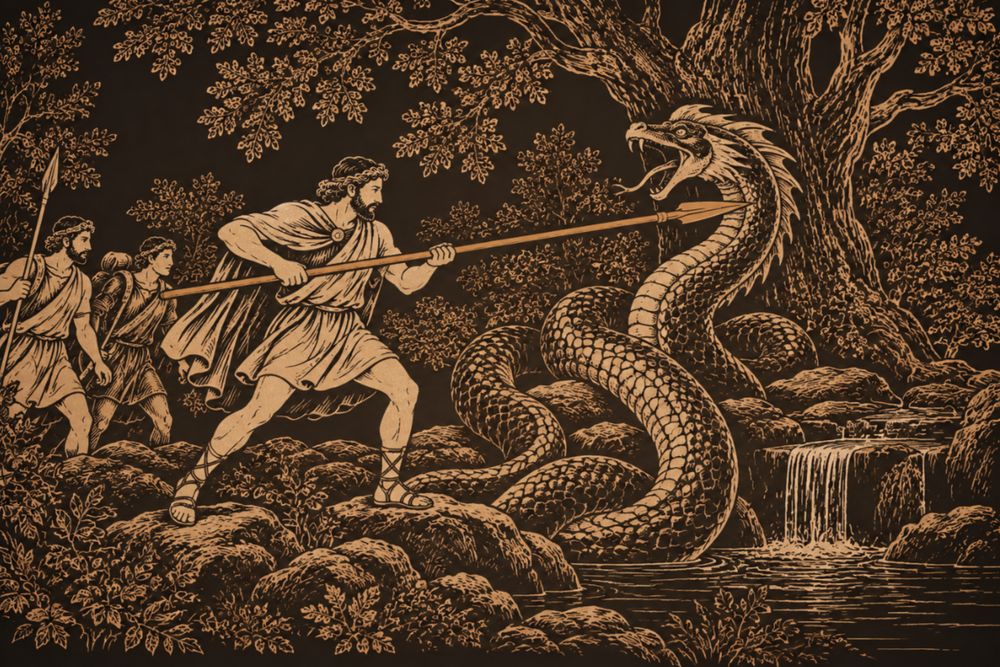
Cadmus fights the dragon
Generated by AI from this page's own facts, not an ancient image or evidence of anything. How this site uses generated images
The fight in Ovid is long and physical. Cadmus hurls a huge millstone, and the dragon's scales turn it aside. A javelin does better and goes through the middle of the spine, but the dragon twists and wrenches out the shaft, and the iron head stays in its bones. Enraged, it charges. Cadmus stands behind the lion's skin and jams his lance into its jaws. The dragon bites the steel, spits blood, and pulls back in time to save its throat. Cadmus follows, pressing the point deeper, until an oak blocks the way. He pins the dragon through the neck to the trunk, and the tree bends under its weight.
The other accounts are shorter and disagree on the weapon. Apollodorus says only that Cadmus killed the dragon in his indignation. In Euripides's Phoenissae the chorus sings of Ares's murderous dragon guarding the streams, and says Cadmus destroyed it with a jagged stone when he came to draw lustral water himself. No companions appear there.
Ovid does not let the victory settle. While Cadmus stands over the huge body, a voice speaks from a source he cannot find.
Son of Agenor, why art thou here standing by this carcase-worm, for others shall behold thy body changed into a serpent?
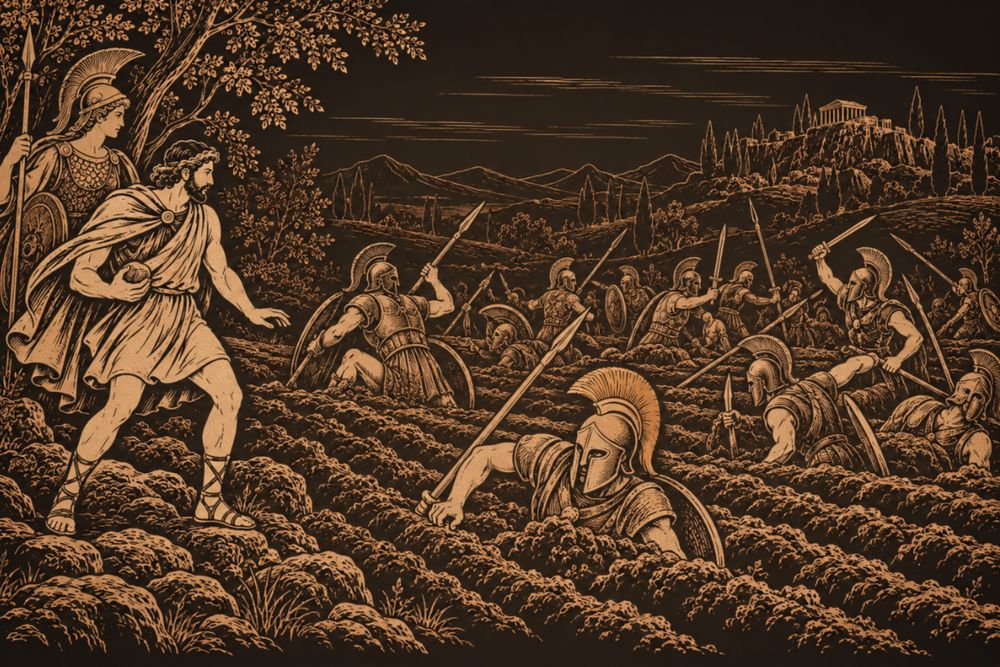
The sown men rise
Generated by AI from this page's own facts, not an ancient image or evidence of anything. How this site uses generated images
Cadmus goes pale, and his hair stands on end. Then Minerva appears from the air above and tells him to plough the ground and sow the dragon's teeth, so that another race of men can grow from them. Apollodorus and Euripides agree that Athena gave the advice, though Euripides calls her Pallas and says only that the teeth were cast on deep fields.
In Ovid, the crop appears like a curtain rising at the theatre: first spear points, then helmet crests, then shoulders, chests and arms. Cadmus prepares to arm himself, but one of the earth-born shouts at him not to arm and not to join a civil war. That man strikes down a brother with his sword and is himself pierced by a spear from far off. The rest fall on one another until, Ovid says, five are left. One of them, Echion, is warned by Minerva, throws down his arms and asks his brothers to stop.
Apollodorus calls the men Sparti, the sown men, and says they killed each other in a chance brawl or in ignorance. He adds that Pherecydes has Cadmus throw stones among them, so that each man thinks another threw it. Euripides has grim slaughter return the armed men to the earth. Apollodorus names the five survivors: Echion, Udaeus, Chthonius, Hyperenor and Pelorus.
Of the four accounts, only Apollodorus counts the price of the killing, and he counts it in service. The dragon belonged to Ares, or in Apollodorus some said it was his child, so Cadmus owed him atonement. The term is given in one line, quoted below.
Athena then procured him the kingdom, and Zeus gave him Ares's daughter Harmonia as his wife. Ovid has no servitude in the passage read here. His voice at the dragon's body foretells a serpent, and his next lines call Cadmus the son-in-law of Mars and Venus, with Thebes now founded. The serpent transformation is told later in the poem, and the character page follows it.
But Cadmus, to atone for the slaughter, served Ares for an eternal year; and the year was then equivalent to eight years of our reckoning.
What Followed
The killing at the spring of Ares does not end in Cadmus's lifetime. In Apollodorus, Zeus gave him Harmonia, and their children were Autonoe, Ino, Semele, Agave and Polydorus. Their lives went badly, as the pages for Semele, Actaeon and Pentheus show. Ovid, leading into Actaeon's story, warns that no man should be called happy until after his funeral rites. The whole run of Theban stories, from the founding to the war of the Seven, is gathered in the Theban Cycle.
Who was Cadmus in Greek mythology?
Cadmus was the Phoenician prince who founded Thebes. Apollodorus makes him a son of Agenor and Telephassa and a brother of Europa. He followed a cow to the site of the city, killed the dragon guarding the spring of Ares, and sowed its teeth to raise the armed Sparti. His whole life is on the Cadmus page.
Apollodorus, Library 3.4.1
Who did Cadmus marry?
Cadmus married Harmonia, daughter of Aphrodite and Ares. Apollodorus says Zeus gave her to him after his servitude to Ares for the dragon's death, and that all the gods left the sky to celebrate the marriage in the Cadmea. Cadmus gave her a robe and the necklace wrought by Hephaestus.
Apollodorus, Library 3.4.2
Who was Cadmus's father in Greek mythology?
His father was Agenor, whom Ovid calls a king. Apollodorus says Agenor was a son of Poseidon and Libya, went to Phoenicia, married Telephassa, and had a daughter Europa and three sons, Cadmus, Phoenix and Cilix. It was Agenor who sent his sons to search for the vanished Europa.
Apollodorus, Library 3.1.1
Who was Cadmus' daughter?
Cadmus had four daughters, Autonoe, Ino, Semele and Agave, and a son Polydorus. Apollodorus adds that Ino married Athamas, Autonoe married Aristaeus, and Agave married Echion. The story of Semele is on her own page.
Apollodorus, Library 3.4.2
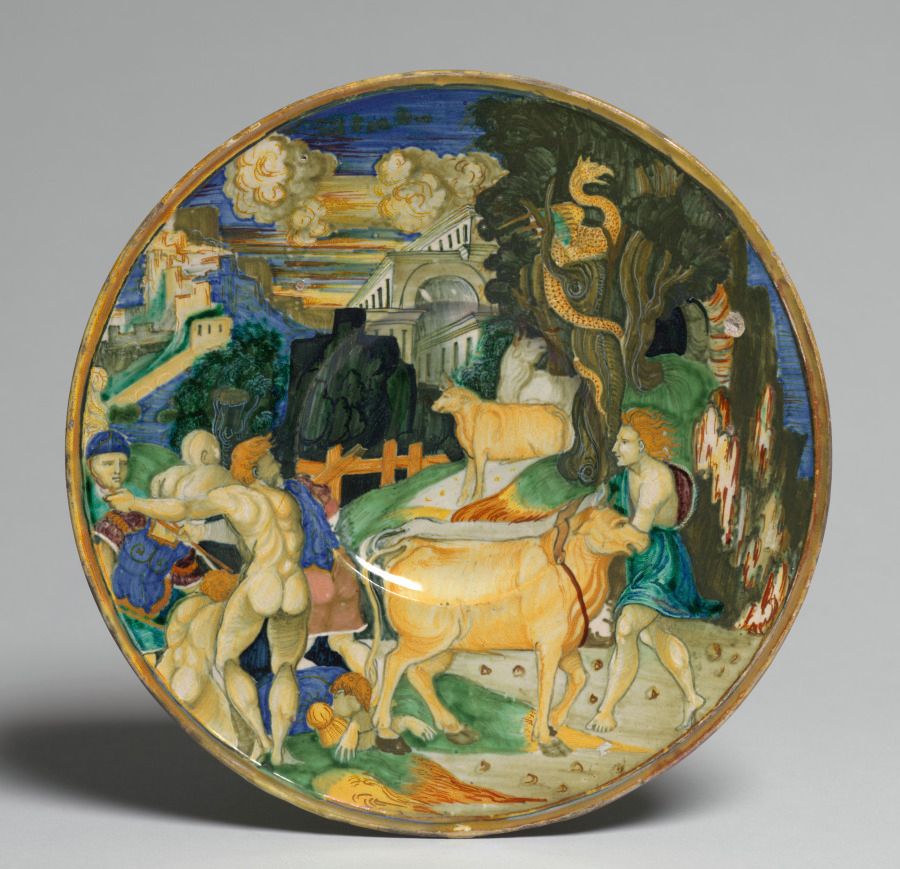
Plate Depicting the Myth of Cadmus - Italy, Urbino region, Gubbio, 16th century, 1526, tin-glazed earthenware with gold lustre (maiolica)
The Cleveland Museum of Art, Cleveland, OH, 1950.156. CC0
Where Accounts Differ
- why-cadmus-left-home
- who-fetched-the-water
- how-the-dragon-died
- dragon-child-of-ares
- athena-or-jupiter-sacrifice
- how-the-sown-men-died
- servitude-to-ares
- Why Cadmus reached Boeotia differs. Ovid, Metamorphoses 3.1-94, has Agenor threaten him with exile if he returns without Europa. Apollodorus, Library 3.4.1, has him settle in Thrace and go to Delphi only after Telephassa's death, where the god tells him to give up the search.
- Who fetched the water differs. Apollodorus, Library 3.4.1, and Ovid, Metamorphoses 3.1-94, send companions and lose them to the dragon. Euripides, Phoenissae 638-675, has Cadmus come to draw the water himself.
- The weapon differs. Ovid, Metamorphoses 3.1-94, has a millstone fail, then a javelin and a lance, ending with the dragon pinned to an oak. Euripides, Phoenissae 638-675, says he destroyed it with a jagged stone. Apollodorus, Library 3.4.1, names no weapon.
- The dragon's status differs. Apollodorus, Library 3.4.1, says some thought it a child of Ares. Ovid, Metamorphoses 3.1-94, calls it sacred to Mars. Euripides, Phoenissae 638-675, calls it Ares's murderous dragon.
- The intended sacrifice differs. Apollodorus, Library 3.4.1, says Cadmus wished to sacrifice the cow to Athena. Ovid, Metamorphoses 3.1-94, says he prepared a sacrifice to Jupiter.
- How the sown men died differs. Apollodorus, Library 3.4.1, says a chance brawl or ignorance, and cites Pherecydes for Cadmus throwing stones among them. Ovid, Metamorphoses 3.95-137, has one warrior cry against civil war and the rest fall in mutual slaughter. Euripides, Phoenissae 638-675, only says that slaughter returned them to the earth.
- Only Apollodorus, Library 3.4.2, gives the eternal year of service to Ares. In the Ovid passage read here, an unseen voice instead foretells that Cadmus will become a serpent.
Read the full source verification →
Mythology
Figures In This Myth
Also Connected
Related Terms
Referenced By
Sources
- Ovid, Metamorphoses 3.1-94
- Ovid, Metamorphoses 3.95-137
- Apollodorus, Library 3.1.1
- Apollodorus, Library 3.4.1
- Apollodorus, Library 3.4.2
- Euripides, Phoenissae 638-675
- Pausanias, Description of Greece 9.12.1
- Pausanias, Description of Greece 9.12.2
- Ovid, Metamorphoses 3.95-98
- J. G. Frazer, Apollodorus: The Library (Loeb, 1921), notes to 3.4.1-3.4.2