Harmonia
Harmonia is the wife of Cadmus, the founder of Thebes. Hesiod makes her a daughter of Ares and Aphrodite, and Apollodorus says Zeus gave her to Cadmus, with the gods feasting at the wedding. She bore Ino, Semele, Agave, Autonoe and Polydorus. Her wedding necklace later bribed Eriphyle, and she and Cadmus were turned into serpents.
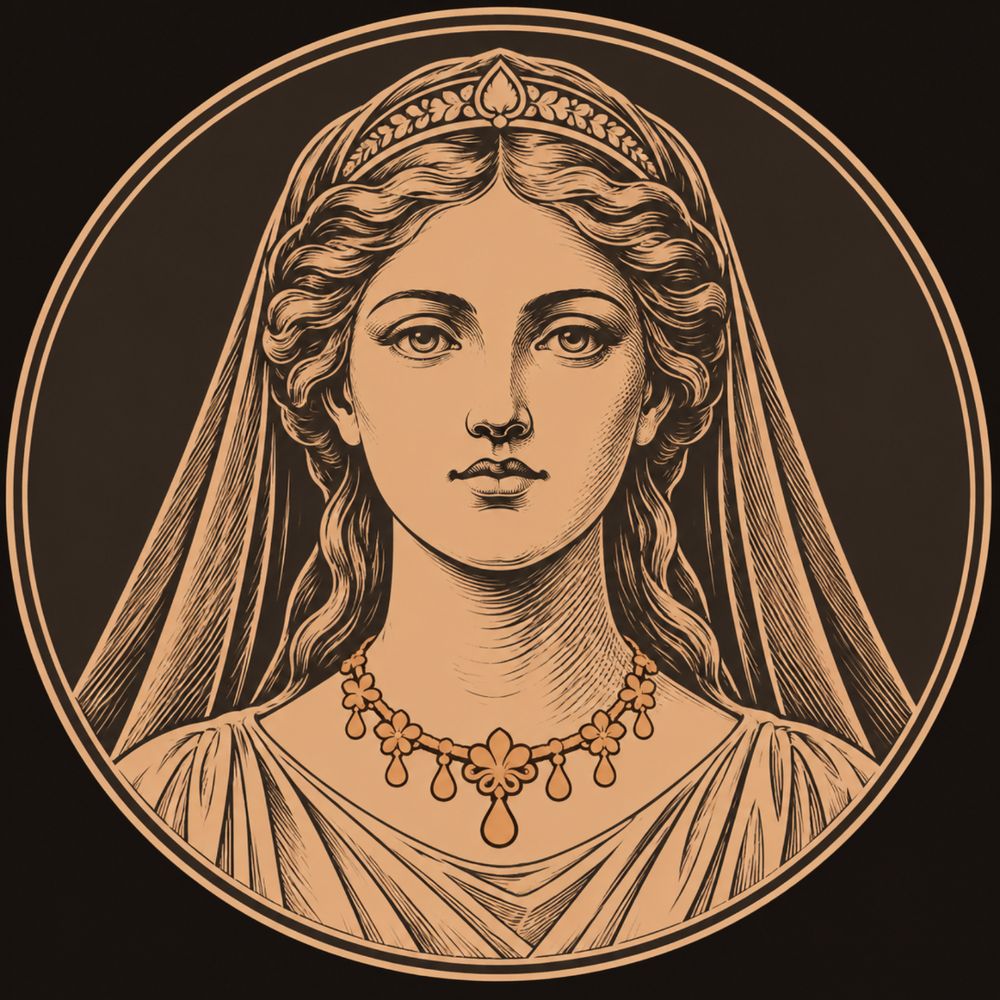
Harmonia wearing the wedding necklace
Generated by AI from this page's own facts, not an ancient image or evidence of anything. How this site uses generated images
Sections on this page
See Harmonia in the Greek family tree.
Core Myth
Harmonia is the wife of Cadmus, the Phoenician prince who founded Thebes. Hesiod's Theogony says that Cytherea, a title of Aphrodite, bore to Ares the gods Panic and Fear and also Harmonia, whom high-spirited Cadmus made his wife (Theogony 933-937). Apollodorus gives the same parents. He says Athena obtained the kingdom for Cadmus after his servitude, and Zeus gave him Harmonia, daughter of Aphrodite and Ares (Library 3.4.2).
Apollodorus says all the gods left the sky and feasted in the Cadmea, the citadel of Thebes, and celebrated the marriage with hymns (Library 3.4.2). Cadmus gave his bride a robe and a necklace. Apollodorus says the necklace was wrought by Hephaestus and adds that some say Hephaestus gave it to Cadmus. The wedding stands near the start of the Theban Cycle, the myths of one royal house that run on to Oedipus.
Hesiod names five children of Harmonia and Cadmus: Ino, Semele, Agave, Autonoe and Polydorus (Theogony 975-978). Apollodorus lists the same five. He says Ino married Athamas, Autonoe married Aristaeus and Agave married Echion (Library 3.4.2). Of the daughters, he tells next how Zeus loved Semele and bedded with her unknown to Hera (Library 3.4.3).
Ovid tells the end of the pair in the fourth book of the Metamorphoses. Cadmus and his wife come as exiles to Illyria, where he asks whether the serpent he once killed was sacred and prays to become a serpent himself. Harmonia cries out to him to put off the monster shape, then asks the gods to change her too. Both slither off to a nearby grove. Ovid adds that the two serpents never harm people, because they remember what they were (Metamorphoses 4.563-603). Apollodorus gives no reason. He says only that both were turned into serpents and that Zeus sent them to the Elysian Fields (Library 3.5.4).
Why did Harmonia marry Cadmus?
The sources give no wish of hers. Apollodorus says Zeus gave her to Cadmus once the hero had served Ares and Athena had secured him the kingdom, so the marriage reads as a settlement between the gods and the founder. Hesiod says only that Cadmus made her his wife. Euripides has Dionysus remind Cadmus that his wife is Ares's daughter, the same god whose serpent Cadmus had killed.
Apollodorus, Library 3.4.2
What did Hephaestus do to Harmonia?
Apollodorus says only that the necklace Cadmus gave Harmonia was made by Hephaestus, or in another version given to Cadmus by him. He calls it neither cursed nor a revenge. The later tale that Hephaestus made it in revenge for the deceit of Ares comes from writers such as Statius, outside the registry works checked here. The deceit it looks back to is the affair of Ares and Aphrodite, which Hephaestus exposes in the Odyssey.
Homer, Odyssey 8.266-366
Whose daughter was Harmonia?
Most sources make her the child of Ares and Aphrodite. Hesiod names Cytherea as the mother, and Apollodorus names Aphrodite and Ares. Diodorus Siculus rejects that account for Samothrace and says she was a sister of Iasion, born to Zeus and Electra. He also says this wedding was the first for which the gods provided the feast.
Hesiod, Theogony 933-937
Where was Harmonia remembered after her death?
Pausanias says the Thebans still pointed out the ruins of her bridal chamber and the spot where the Muses were said to have sung at her wedding. He also reports that at Amathus in Cyprus, in the sanctuary of Adonis and Aphrodite, a necklace was said to be dedicated that was first given to Harmonia, though it was called the necklace of Eriphyle because she took it as a bribe to betray her husband.
Pausanias, Description of Greece 9.41.2
Later Traditions
In Euripides's Bacchae the change is a prophecy. Dionysus tells Cadmus that he will become a dragon and that his wife Harmonia, the daughter of Ares, whom Cadmus though mortal had married, will receive the form of a serpent in exchange (Bacchae 1330-1339). Diodorus Siculus gives her a different origin. In his account of Samothrace, Harmonia is a daughter of Zeus and the Atlantid Electra and a sister of Iasion. He says this against the Greek myths that make her a daughter of Ares.
Her wedding gift outlived her. Apollodorus says Polynices took the necklace and the robe to Argos. He gave the necklace to Eriphyle and begged her to persuade her husband Amphiaraus to march. She accepted and persuaded him to join the war of the Seven against Thebes (Library 3.6.1-3.6.2). Apollodorus does not call the necklace cursed. Later writers such as Statius add that motive.
Lineage
See the full family tree3 recorded relations, each with the ancient line behind it.
Parents
-

Apollodorus names Aphrodite with Ares for the bride Zeus gave Cadmus. Diodorus Siculus disagrees.
-

Hesiod lists Harmonia among the children Cytherea bore to Ares.
Children
-

Hesiod says Harmonia bore Semele to Cadmus, with Ino, Agave, Autonoe and Polydorus.
Also Connected
1 recorded connection, each with the ancient line behind it.
Connected
-
Zeus gave Harmonia to Cadmus as his wife, and the gods feasted at the wedding in the Cadmea.
Where Accounts Differ
- Harmonia's parents: Ares and Aphrodite, or Zeus and Electra
- origin and curse of Harmonia's necklace
- Harmonia's parentage differs by source. Hesiod and Apollodorus make her the daughter of Ares and Aphrodite. Diodorus Siculus, in his account of Samothrace, makes her a daughter of Zeus and Electra and rejects the Greek tradition that calls her Ares's child.
- The necklace has several origins. Apollodorus says Cadmus gave it, or Hephaestus gave it to Cadmus, or, according to Pherecydes, Europa gave it after receiving it from Zeus. That it was cursed by Hephaestus is a later tale, found in writers such as Statius and not in Apollodorus.
Read the full source verification →
Mythology
Appears In
Referenced By
Sources
- Hesiod, Theogony 933-937
- Hesiod, Theogony 975-978
- Apollodorus, Library 3.4.2
- Apollodorus, Library 3.4.3
- Apollodorus, Library 3.5.4
- Apollodorus, Library 3.6.1-3.6.2
- Ovid, Metamorphoses 4.563-603
- Euripides, Bacchae 1330-1339
- Homer, Odyssey 8.266-366
- Pausanias, Description of Greece 9.12.1-9.12.3
- Pausanias, Description of Greece 9.41.2
- Diodorus Siculus, Bibliotheca Historica