Aphrodite
Aphrodite is the Olympian goddess of love, beauty, desire, and procreation, worshipped across the Greek world from Cyprus to Athens. Hesiod's Theogony describes her born from sea foam after Cronus cast Uranus's severed genitals into the water, while Homer's Iliad names her the daughter of Zeus and the Titaness Dione. Married to Hephaestus, she carried on a lasting affair with Ares.

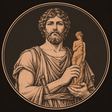
Aphrodite, Olympian goddess of love and beauty
Generated by AI from this page's own facts, not an ancient image or evidence of anything. How this site uses generated images
Sections on this page
Greek vs Roman: Aphrodite vs. Venus → See how Venus differs.
What does the name "Aphrodite" mean? →
See Aphrodite in the Greek family tree. Looking for a name of your own? Try the mythological name generator.
Core Myth
Aphrodite's birth has two major traditions. In Hesiod's Theogony, she arose from the sea foam produced when Cronus severed and cast away the genitals of his father Uranus. In Homer's Iliad, she is the daughter of Zeus and the Titaness Dione. Regardless of origin, Aphrodite was acknowledged as the most beautiful of the goddesses. She was married to Hephaestus but carried on a famous affair with Ares. Her power extended over nearly all beings - she was instrumental in causing the Trojan War by promising Helen to Paris. Her son Eros (Cupid in Roman sources, compared in Eros vs Cupid) served as her companion in spreading desire, and in Apollonius's Argonautica it is Aphrodite who arranges for Eros to make the princess Medea fall in love with Jason, without which the Argonauts could not have won the Golden Fleece.
Who are Aphrodite's parents?
Ancient sources disagree. Hesiod's Theogony describes Aphrodite forming from sea foam around the severed genitals of Uranus after Cronus cast them into the sea, giving her no mother at all. Homer's Iliad instead calls her the daughter of Zeus and the Titaness Dione, who comforts her on Olympus after she is wounded by Diomedes. Both traditions were current in antiquity; this page does not resolve the conflict between them.
Hesiod, Theogony 188-206; Homer, Iliad 5.370-371
Was Aphrodite married to Hephaestus?
Yes. In the Odyssey, the bard Demodocus sings of Aphrodite as the wife of Hephaestus, the smith god, and of her long affair with Ares, the god of war. Helios reports the affair to Hephaestus, who forges an unbreakable net, catches the pair in bed, and puts them on display before the other Olympians. The episode is comic in tone but treats the marriage itself as an established fact, not as a variant.
Homer, Odyssey, Book 8
Is Eros the son of Aphrodite?
Sources disagree here as well. Hesiod's Theogony makes Eros a primordial force present alongside Chaos and Earth at the very beginning of the cosmos, born before Aphrodite and with no parents named. Later writers, including Apollodorus's Library, instead make Eros a son of Aphrodite and Ares, born after their affair. Which version a given ancient source follows depends on whether it treats Eros as a cosmic principle or as a personal god.
Hesiod, Theogony 116-122
What is Aphrodite the goddess of?
Aphrodite governs love, beauty, desire, and procreation. The Homeric Hymn to Aphrodite opens by naming her power over gods, mortals, and animals alike, saying she stirs passion in nearly everything that lives on land, in the air, or in the sea. Only Athena, Artemis, and Hestia are said to resist her influence. Her worship centered on Cyprus and Cythera, and she carried the cult titles Cypris and Cytherea.
Homeric Hymn to Aphrodite 1-6
Later Traditions
In Roman religion, Aphrodite was identified with Venus, who became one of the most important Roman deities as the ancestor of the Julian family through her son Aeneas. Ovid's Metamorphoses also has Aphrodite answer a mortal's unspoken prayer directly: at her own festival on Cyprus, the sculptor Pygmalion wishes for a wife like the ivory statue he has carved, and she brings the statue to life. Apollodorus has her hide the infant Adonis in a chest and leave him with Persephone. In Ovid, Venus gives Hippomenes three golden apples to win his footrace against Atalanta, told in Atalanta and the Race.

5 recorded relations, each with the ancient line behind it.
Parents
-

disputed
Homer's Iliad names Dione as Aphrodite's mother, contested by Hesiod's sea-foam birth story.
-

disputed
Disputed parentage. Homer names Zeus and Dione; Hesiod (Theogony 188-200) instead has Aphrodite born from the sea foam around the severed genitals of Ouranos, with no mother and no Olympian father.
Children
-

Aphrodite bore Aeneas to the Trojan prince Anchises and named him for the grief she felt at sharing a mortal's bed.
-

disputed
Hesiod's Theogony gives Eros no parents at all; this later tradition, followed by Apollonius and most poets after Hesiod, makes him Aphrodite's son instead.
-

Apollodorus names Aphrodite with Ares for the bride Zeus gave Cadmus. Diodorus Siculus disagrees.
Also Connected
8 recorded connections, each with the ancient line behind it.
Enemies
-

Diomedes wounds Aphrodite in the wrist with his spear as she carries her son Aeneas from the battlefield, then taunts her as she flees.
-

Aphrodite plans his ruin for scorning her.
Connected
-

Aphrodite loves Adonis, warns him against the hunt, and mourns him after the boar kills him.
-

Aphrodite supplies the golden apples that beat Atalanta in the footrace.
-

Aphrodite cites Eos's love for the mortal Tithonus as precedent when explaining her own passion for Anchises.
-

Aphrodite tells the story of Ganymede to Anchises as proof that his Trojan family is the most godlike of mortals.
-

At Troezen Pausanias saw a temple of Aphrodite the Spy, named for Phaedra watching Hippolytus exercise.
-
Aphrodite grants Pygmalion's unspoken wish at her own festival, bringing his ivory statue to life and later attending the couple's wedding.
Where Accounts Differ
- birth variant
- Eros parentage variant
- Parentage variant: Hesiod's Theogony (188-206) gives Aphrodite no mother, born from sea foam around the severed genitals of Uranus. Homer's Iliad (5.370-371) instead names her the daughter of Zeus and the Titaness Dione. Both traditions stand; neither is treated as authoritative over the other.
- Eros parentage variant: Hesiod's Theogony (116-122) treats Eros as a primordial power with no parents, present at the start of the cosmos. Later sources, including Apollodorus's Library, make Eros the son of Aphrodite and Ares. This page follows Hesiod for cosmogony content and notes the later tradition where Eros appears as Aphrodite's child.
Read the full source verification →
Mythology
Appears In
Equivalent Figures
Related Terms
Referenced By
Sources
- Hesiod, Theogony 188-206
- Homer, Iliad 5.370-371
- Homer, Odyssey 8.266-366
- Homeric Hymn to Aphrodite 1-6
- Apollonius of Rhodes, Argonautica 3.1-166
- Ovid, Metamorphoses 10.274-297
- Apollodorus, Library 3.14.4
- Ovid, Metamorphoses 10.560-680
- Vinciane Pirenne-Delforge, L'Aphrodite grecque (1994)
- Timothy Gantz, Early Greek Myth (1993)