Greek Goddesses: Primordial, Titan, Olympian and Lesser
The Greek goddesses are the female deities of Greek myth: primordial and Titan figures such as Gaia, Nyx and Rhea, the Olympians Hera, Athena, Artemis, Aphrodite, Demeter and Hestia, and lesser powers such as Nike and Hebe. Hesiod makes Gaia the first goddess after Chaos. No ancient list fixes which goddesses sit among the twelve.
Sections on this page
Overview
Greek goddesses fall into generations, and Hesiod's Theogony is the text that sets the order. The poem starts with Chaos, then Earth, then Tartarus and Eros (Theogony 116-122). The goddesses below are grouped by when they appear in that order and by what they govern. The twenty-six members are the ones with a page on this site. They are not a complete roll, since the Greeks worshipped far more female powers than any one poem names.
The oldest goddesses are not Olympians. Gaia is the earth, and Night is born from Chaos without a partner (Theogony 123-125). The Titan goddesses follow, among them Rhea, Themis and Mnemosyne, the mothers of gods, of order and of the Muses. Leto and Metis come in as Zeus's partners before his marriage to Hera. Dione sits at the edge of the group. Homer names her as the mother of Aphrodite, while Hesiod gives Aphrodite a different birth.
The Olympian goddesses are the better known group. Hera, Athena, Artemis, Aphrodite, Demeter and Hestia are the six female candidates for the twelve seats described on the page for the Olympian gods. Hesiod names Hestia, Demeter and Hera as children of Rhea and Kronos (Theogony 453-458). Athena and Artemis belong to Zeus's own generation. Aphrodite belongs to neither generation in Hesiod's account.
A third group lives at the edges of the world: night, the dead and the sky's lights. Persephone becomes queen of the dead, a story told in the Homeric Hymn to Demeter and set in the Greek underworld. Hecate is Titan-descended and keeps a place in the Theogony that Homer never gives her. Eos and Selene, the dawn and the moon, are daughters of the Titan pair Hyperion and Theia (Theogony 371-374).
A fourth group is made of personified powers. Nike is Victory, a daughter of Styx, while Nemesis and Eris are daughters of Night (Theogony 211-225). Iris carries messages for Zeus and Hera. These goddesses are named for the thing they embody and have few myths of their own, though Eris throws the apple that starts the road to Troy in Apollodorus.
The last group serves the household and the sea. Hebe pours the gods' nectar and Eileithyia presides over childbirth. Amphitrite is the sea god Poseidon's wife, and Circe is a goddess who lives on an island and works magic in the Odyssey. They have no common myth, only a common sphere: the daily world of birth, youth, harbour and hospitality.
In This Topic (26)
-

Gaia Character
Gaia is the earth itself in Greek myth, the first being to take shape after Chaos and the ancestor of nearly every other god.
-

Nyx Character
Nyx is the primordial goddess of Night, born directly from Chaos, whose authority even Zeus feared to defy.
Born from Chaos, not from Earth, so the two oldest goddesses have separate origins in Hesiod.
-

Rhea Character
Rhea is the Titaness mother of the Olympian gods and wife of Kronos.
-

Themis Character
Themis is the Titaness of divine law and right order, a wife of Zeus who bore the Horae and the Moirai, and a source of prophecy older than Delphi's Apollo.
-

Mnemosyne Character
Mnemosyne is the Titaness of Memory whose nine nights with Zeus produced the nine Muses.
-

Leto Character
Leto is a Titaness in Greek myth, mother of Apollo and Artemis by Zeus, who could find no land willing to let her give birth until Delos accepted her.
-

Metis Character
Metis is the goddess of cunning intelligence in Greek myth, the first wife of Zeus and the mother of Athena, swallowed by Zeus before Athena was born.
Grouped with the Titan generation because she is Zeus's first wife in Hesiod, swallowed before Athena is born.
-

Dione Character
Dione is the goddess Homer names as Aphrodite's mother, a rival tradition to Hesiod's sea-foam birth story that ancient sources never fully reconciled.
Homer calls her Aphrodite's mother, which sets her against Hesiod's account of Aphrodite's birth from the sea.
-

Hera Character
Hera is the Greek goddess of marriage, women, and family, and the queen of the Olympian gods.
-

Athena Character
Athena is the Greek goddess of wisdom, strategic warfare, and civic arts.
-

Artemis Character
Artemis is the Greek goddess of the hunt, wilderness, wild animals, and the moon.
-

Aphrodite Character
Aphrodite is the Greek goddess of love, beauty, pleasure, and procreation.
An Olympian candidate whose parentage the sources dispute: Hesiod and Homer give two different births.
-

Demeter Character
Demeter is the Greek goddess of the harvest, agriculture, and the fertility of the earth.
-

Hestia Character
Hestia is the Greek goddess of the hearth, home, and domestic life.
Hesiod names her among Rhea's children, yet the lists of the twelve often leave her out in favour of Dionysus.
-

Persephone Character
Persephone is the Greek goddess of spring and queen of the underworld.
-

Hecate Character
Hecate is a Titan-descended goddess whom Hesiod's Theogony honors at extraordinary length even though Homer never mentions her once, and whom later tradition reshapes into the goddess of witchcraft, crossroads, and the night.
Placed with the powers of night and the dead, though the Theogony makes her a daughter of two Titans.
-

Eos Character
Eos is the Titan goddess of the dawn, remembered less for any myth centered on her directly than for the mortal lovers she carries off and the recurring epithet - 'rosy-fingered Dawn' - that opens scene after scene in Homer.
A Titan by descent, grouped with the lights of the sky because her work is the daily dawn.
-

Selene Character
Selene is the Titan goddess of the moon, sister of Helios the sun and Eos the dawn, whom Pan is said to have deceived with a gift of white wool.
-

Iris Character
Iris is the goddess of the rainbow and the swift messenger who carries Zeus's and Hera's words between Olympus and earth.
-

Nike Character
Nike is the goddess of Victory, daughter of the Titan Pallas and the Oceanid Styx, one of four siblings Zeus rewards with permanent, unbroken residence in his own household for their mother's early loyalty in the war against the Titans.
-

Nemesis Character
Nemesis is the primordial goddess of righteous retribution against human excess, born of Night alone in Hesiod's Theogony, and the goddess whose flight from a pursuing Zeus produces, in one variant tradition, the egg from which Helen of Troy is later hatched.
A daughter of Night in Hesiod, so she is related to Eris, not to Nike.
-
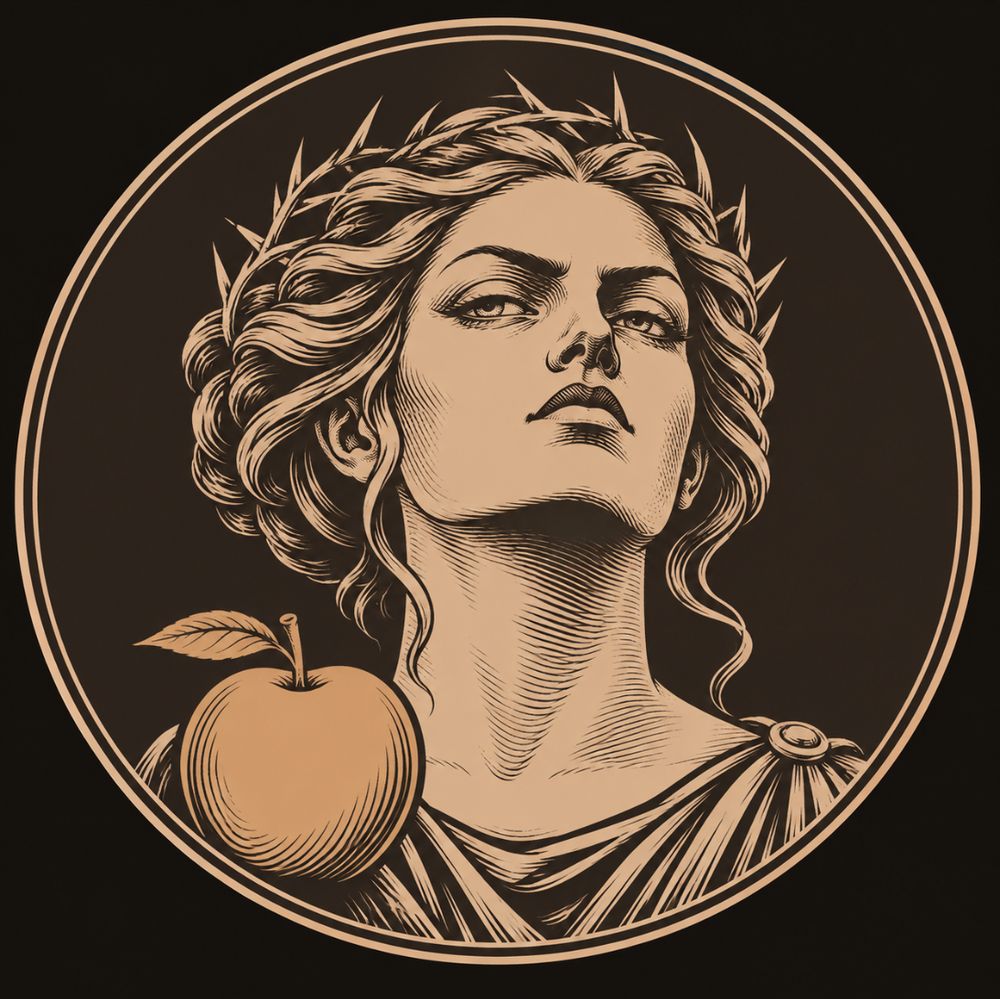
Eris Character
Eris is the Greek goddess of Strife, a daughter of Night who stirs up quarrelling in battle and, in Apollodorus, throws the apple that leads to the Judgement of Paris.
-

Hebe Character
Hebe is the goddess of youth, daughter of Zeus and Hera, who pours nectar for the gods on Olympus and becomes Heracles's wife once he joins their ranks.
-

Eileithyia Character
Eileithyia is the Greek goddess of childbirth, whose presence or absence at a birth ancient sources treat as the difference between an easy delivery and an agonizing one.
-

Amphitrite Character
Amphitrite is Poseidon's wife and the mother of Triton, a sea goddess whose own name became, in Homer, simply another word for the sea itself.
Placed with the sea goddesses of the last group as Poseidon's wife, the mother of Triton in Hesiod.
-

Circe Character
Circe is the sorceress-goddess who turns Odysseus's men into pigs, then becomes the source of the warnings that get him past Scylla and Charybdis.
A child of Helios who lives apart from the Olympians and belongs here as a goddess of the Odyssey's island world.
Which goddesses were among the twelve Olympians?
Six goddesses compete for the female seats: Hera, Athena, Artemis, Aphrodite, Demeter and Hestia. The sources checked here give no single canonical list. Hesiod names Hestia, Demeter and Hera as children of Rhea, and Athena and Artemis as children of Zeus. Persephone and the lesser goddesses are not counted. Hestia is the seat most often contested, since lists of the twelve sometimes give her place to Dionysus. The full argument, including the twelfth seat, is on the Olympian gods page.
Hesiod, Theogony 453-458; Hesiod, Theogony 886-900; Herodotus, Histories 2.4.2
Which goddesses never married, and why?
The Homeric Hymn to Aphrodite names three goddesses whom Aphrodite cannot sway: Athena, Artemis and Hestia. It says Athena loves war, Artemis loves the hunt, and Hestia was courted by Poseidon and Apollo but swore to remain a virgin. Callimachus has the young Artemis ask Zeus for eternal virginity. Hera, Demeter and Persephone are linked to a husband or a consort. The hymn gives these reasons as the goddesses' own choices, and the sources checked here offer no other explanation.
Homeric Hymn to Aphrodite 7-33; Callimachus, Hymn to Artemis 6-7; Hesiod, Theogony 912-914
Who is the oldest Greek goddess?
Gaia, the Earth, is the oldest goddess named in Hesiod's Theogony. The poet says that Chaos came first and Earth next, with Tartarus and Eros after. Night is born from Chaos in the next lines, so she is of the same early age but comes second in the telling. Chaos is not a goddess in the poem's own grammar, which gives it no sex and no parents, so Gaia leads the female line.
Hesiod, Theogony 116-122; Hesiod, Theogony 123-125
Who is Aphrodite's mother?
The sources give two answers. Hesiod has Aphrodite born from the foam around the severed flesh of Ouranos, so she has no mother. Homer's Aphrodite, wounded by Diomedes, runs to her mother Dione, who comforts her. The two accounts are not reconciled in the sources checked here.
Hesiod, Theogony 188-206; Homer, Iliad 5.370-371
Which Greek goddesses were daughters of Night?
Hesiod lists a long brood of Night, born of her alone, and two goddesses stand among them. Nemesis, retribution, and Eris, strife, are both named in that passage. Nike, Victory, is not Night's child. Hesiod makes her a daughter of Styx and Pallas, which separates the powers of conflict from the power of winning.
Hesiod, Theogony 211-225; Hesiod, Theogony 383-388
Where Accounts Differ
- no canonical list of Olympian goddesses
- Aphrodite born of the sea vs daughter of Dione
- editorial grouping of goddesses by generation and sphere
- No ancient source gives one list of the Olympian goddesses. This page names six candidates and points to the Olympian gods page for the twelfth seat instead of choosing.
- Aphrodite has two parentages in the sources: Hesiod's birth from the sea and Homer's Dione. Both are reported and neither is preferred.
- The groupings on this page are editorial. Hesiod gives genealogies and not categories, so the five groups follow his order and the goddesses' spheres, and no ancient author uses them.
Related Topics
Related Terms
Sources
- Hesiod, Theogony 116-122
- Hesiod, Theogony 123-125
- Hesiod, Theogony 188-206
- Hesiod, Theogony 211-225
- Hesiod, Theogony 371-374
- Hesiod, Theogony 383-388
- Hesiod, Theogony 453-458
- Hesiod, Theogony 886-900
- Hesiod, Theogony 912-914
- Homer, Iliad 5.370-371
- Homeric Hymn to Aphrodite 7-33
- Herodotus, Histories 2.4.2
- Callimachus, Hymn to Artemis 6-7