Eris
Eris, whose name means Strife, is the Greek goddess of conflict. Hesiod makes her a daughter of Night and the mother of Toil, Quarrels, Lying Words and other troubles. Homer calls her the sister of Ares and shows her stirring up battle. Apollodorus has her throw the apple that starts the Judgement of Paris.
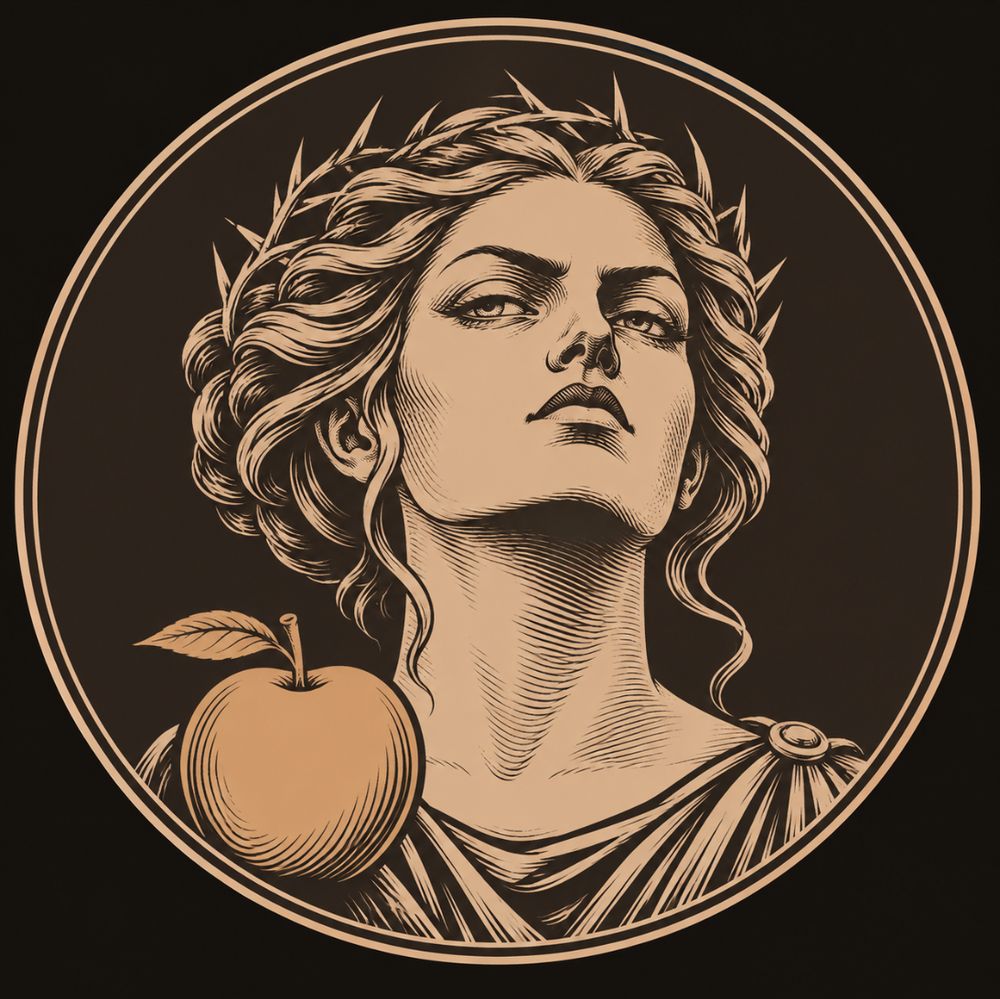
Eris
Generated by AI from this page's own facts, not an ancient image or evidence of anything. How this site uses generated images
Sections on this page
See Eris in the Greek family tree.
Core Myth
Hesiod makes Strife a daughter of Nyx, the goddess of Night. The Theogony lists her last among the children Night bears alone, after Nemesis, Deceit, Friendship and Old Age (Theogony 211-225). Hesiod calls her hard-hearted. He then gives Strife a family of her own, and every child is a trouble: Toil, Forgetfulness, Famine, Sorrows, Battles, Quarrels, Lying Words, Lawlessness, Ruin and Oath (Theogony 226-232).
Homer's Strife belongs to the battlefield. The Iliad calls her the sister and companion of Ares, small when she first rises and then lifting her head to the sky (Iliad 4.439-445). In Book 11 Zeus sends her to the Achaean ships. She stands by the ship of Odysseus and cries out so loudly that the Achaeans would rather fight than sail home (Iliad 11.3-14). In Book 18 Achilles wishes that strife would perish from among gods and men (Iliad 18.107-110).
Hesiod and Homer do not agree on her family. Homer makes her the sister of Ares. Hesiod makes her a child of Night, and he makes Ares a son of Hera (Theogony 921-923). The sources checked here do not settle the difference.
What is Eris the goddess of?
Eris is the goddess of strife, meaning fighting and quarrelling between people. In the Iliad she is the companion of Ares and the force that makes an army want to fight. In the Theogony her children are the troubles that follow a quarrel, from Lying Words and Battles to Ruin. Hesiod's Works and Days adds that strife can also mean rivalry that makes people work.
Homer, Iliad 11.3-14
What does Eris mean?
In Greek, eris means strife. It is both the goddess's name and an ordinary word. Hesiod opens the Works and Days by saying there is not one kind of strife alone but two, and there he uses the word for the quality itself. English translators render the goddess as Strife or as Discord, so the same figure appears under either name.
Hesiod, Works and Days 11-12
Is Eris a child of Nyx?
Yes, in Hesiod. The Theogony names Strife among the children of Night, and Works and Days calls the kinder Strife the elder daughter of dark Night. Homer does not name her parents. He calls her only the sister of Ares, and Hesiod makes Ares a son of Hera, so the two poets do not give her one shared family.
Hesiod, Theogony 211-225
Is Eris a good or bad goddess?
Hesiod says she is both, because there are two Strifes. One fosters evil war and battle, and no one loves her, though men honor her because the gods require it. The other is the elder daughter of Night, set by Zeus in the roots of the earth. She rouses even the idle to work, as neighbour competes with neighbour, and Hesiod calls her wholesome for men.
Hesiod, Works and Days 11-26
Who were the children of Eris?
Hesiod lists them in the Theogony: Toil, Forgetfulness, Famine, Sorrows, Fightings, Battles, Murders, Manslaughters, Quarrels, Lying Words, Disputes, Lawlessness, Ruin and Oath. Oath is the last and is said to trouble men most when one swears a false oath willingly. None of them has a story of their own in the sources checked here.
Hesiod, Theogony 226-232
Later Traditions
Apollodorus gives Strife the act that links her to Troy. He says she threw an apple as a prize of beauty, to be contended for by Hera, Athena and Aphrodite. Zeus then commanded Hermes to lead the three goddesses to Alexander on Mount Ida, to be judged by him (Epitome 3.2). Alexander is the name Apollodorus uses here for Paris. The page on the Judgement of Paris tells what follows.
The apple is the first link in the chain that the Trojan Cycle follows from the judgement to the war. The Iliad passages cited above do not mention it. The Iliad alludes to the judgement only once, late in the poem, and does not name the apple (Iliad 24.25-30). Apollodorus tells how the Greeks hid armed men in a wooden horse and how the fall of Troy came in a single night (Epitome 5.14-22).
Lineage
See the full family tree3 recorded relations, each with the ancient line behind it.
Parents
-

Hesiod's Theogony lists Strife among the children Night bears alone.
Siblings
-

disputed
The Iliad calls Strife the sister and companion of Ares. Hesiod gives the two different parents.
-

Hesiod names Nemesis and Strife in the same list of Night's children.
Where Accounts Differ
- whether Eris is the sister of Ares or a child of Night
- whether there is one Strife or two
- the apple of Strife in Apollodorus but not in the Iliad passages checked
- Homer calls Strife the sister and companion of Ares (Iliad 4.439-445). Hesiod makes her a child of Night and makes Ares a son of Hera (Theogony 211-225; 921-923). The sources checked here do not reconcile the two families, so the page reports both.
- Hesiod's Theogony knows one hard-hearted Strife (Theogony 211-225). The Works and Days says there are two, one harmful and one kind, and calls the kind one the elder daughter of Night (Works and Days 11-26). The page reports both accounts and does not fold them into one.
- The apple of Strife is told in Apollodorus (Epitome 3.2). The Iliad passages cited here (4.439-445, 11.3-14, 18.107-110) do not mention it, and the one Iliad allusion to the judgement does not name the apple (Iliad 24.25-30).
Read the full source verification →
Mythology
Appears In
Referenced By
Sources
- Hesiod, Theogony 211-225
- Hesiod, Theogony 226-232
- Hesiod, Theogony 921-923
- Hesiod, Works and Days 11-12
- Hesiod, Works and Days 11-26
- Homer, Iliad 4.439-445
- Homer, Iliad 11.3-14
- Homer, Iliad 18.107-110
- Homer, Iliad 24.25-30
- Apollodorus, Epitome 3.2