Nyx
Nyx is one of the first beings to exist, born from Chaos alongside her brother Erebus. With Erebus she bore Aether and Day, and on her own she bore a long line of children personifying fate and human experience, including Sleep, Death, and Nemesis. Homer's Iliad shows just how much authority she carries: Zeus himself holds back his anger at Sleep rather than risk offending Night.

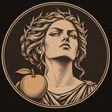
Nyx, primordial goddess of Night
Generated by AI from this page's own facts, not an ancient image or evidence of anything. How this site uses generated images
Sections on this page
See Nyx in the Greek family tree.
Core Myth
Hesiod's Theogony places Nyx among the very first beings to exist: Chaos came first, and from Chaos came Erebus and black Night. The sequence of first births is told in Creation from Chaos. Night then bore Aether, the bright upper air, and Day, through her union with Erebus, before going on, apparently without any further partner, to bear an entire generation of children who personify the harder facts of mortal life. Among them are Doom, Fate, and Death, Sleep and the tribe of Dreams, the three Fates who spin, measure, and cut the thread of every life, and, near the end of the list, Nemesis, born to afflict mortal men who overreach themselves. Hesiod also counts Eris, goddess of Strife, among her children (Theogony 225).
Homer's Iliad shows what that lineage means in practice rather than only listing it. When Sleep is asked to help Hera deceive Zeus a second time, he recalls the one time he tried it before, on Heracles's behalf, and how Zeus's fury nearly cost him everything - saved only because he fled to Night and begged her protection, and Zeus, for all his rage, held back rather than risk displeasing her. No other figure in the poem is shown restraining Zeus's anger simply because he feared her reaction.
Who are Nyx's parents?
She has none in the usual sense. Hesiod's Theogony names her, along with her brother Erebus, as coming directly from Chaos, making her one of the first beings to exist rather than the child of any prior union.
Hesiod, Theogony 116-125
Who did Nyx have children with?
With Erebus, she bore Aether, the bright upper air, and Day. Every child she bore afterward, including Sleep, Death, and Nemesis, is described as hers alone, with no father named, a very different pattern from the Titans' generation that follows.
Hesiod, Theogony 116-125
Which of Nyx's children are most important in later myth?
Sleep and Death, twin brothers who appear together carrying the dead from battle in Homer's Iliad, and Nemesis, goddess of retribution against human arrogance, are the three of her children who go on to have real roles of their own in Greek storytelling, far more than most of the abstract siblings Hesiod lists alongside them.
Hesiod, Theogony 211-225
Does Zeus outrank Nyx?
Not straightforwardly. Homer's Iliad has Sleep recall fleeing to Night for protection after angering Zeus, and Zeus, despite his fury, held back from punishing Sleep further specifically because he did not want to displease Night - the one moment in the poem where Zeus's anger is shown checked by fear of another god's reaction.
Homer, Iliad 14.249-262
Where does Nyx live, according to Hesiod?
In a remote region near the ends of the earth, close to where Atlas stands holding up the sky and near the gates of Tartarus - a place the sun's light never reaches, where she and Day are said to pass each other at the threshold as one goes out and the other comes in.
Hesiod, Theogony 744-761
Later Traditions
Hesiod also places Night's dwelling in the same remote region of the cosmos as Atlas and the gates of Tartarus, describing her house as one the sun's light never reaches, entered and left in turn by Day as the two pass each other at its threshold - a cosmic architecture that later Greek philosophy and poetry returned to repeatedly when describing the structure of the universe.
5 recorded relations, each with the ancient line behind it.
Parents
-

Hesiod names Night as coming directly from Chaos, alongside her brother Erebus.
Children
-
Hesiod's Theogony lists Strife among the children Night bears alone.
-

Hypnos is born to Night with no father named, alongside his twin brother Thanatos.
-

Hesiod's Theogony names Nemesis among the children Night bears entirely alone, with no father, born specifically to afflict mortal men.
-

Thanatos is born to Night with no father named, alongside his twin brother Hypnos.
Also Connected
1 recorded connection, each with the ancient line behind it.
Connected
-

Night's union with Erebus produced Aether, the bright upper air, and Day.
Read the full source verification →
Mythology
Appears In
Related Terms
Referenced By
Sources
- Hesiod, Theogony 116-125
- Hesiod, Theogony 211-225
- Hesiod, Theogony 744-761
- Homer, Iliad 14.249-262
- Timothy Gantz, Early Greek Myth (1993)