Creation from Chaos
In Hesiod's Theogony the Greek world is not made by one god. It grows by births: Chaos comes first, then Earth, Tartarus and Eros, then Night and Darkness. Earth bears Sky, the hills and the sea, and the first divine generation ends when Kronos wounds Sky and Aphrodite rises from the foam. Zeus is born long after.
Sections on this page
What Led To It
Nothing comes before this story. Hesiod frames it as an answer to a question put to the Muses, who are asked to tell how at the first gods and earth came to be, and rivers, and the sea, and the stars. The Theogony then answers in order of birth. The Muses have already told Hesiod they know how to say false things as though they were true, so the poem's own opening asks the reader to notice that the account is a song and not a report.
The Greek word Chaos is a gap or chasm. It is not an ancient name for disorder, and Hesiod does not describe a mess. Ovid's Roman Chaos is the one that is a jumble of clashing elements.
The Myth
The Greek account of creation is a family history, not a workshop. Hesiod's Theogony, the fullest surviving version, does not ask who made the world. It asks what came to be first, and answers with a list of beings who arrive one after another, some alone and some in pairs.
This page follows that sequence to its first turning point, the wound that ends the reign of Sky. Other tellings differ on the very first step. Aristophanes gives the birds an egg, Apollodorus begins with Sky, and Ovid begins with a lump of matter and a craftsman.
In truth at first Chaos came to be, but next wide-bosomed Earth, the ever-sure foundation of all the deathless ones who hold the peaks of snowy Olympus, and dim Tartarus in the depth of the wide-pathed Earth, and Eros (Love), fairest among the deathless gods
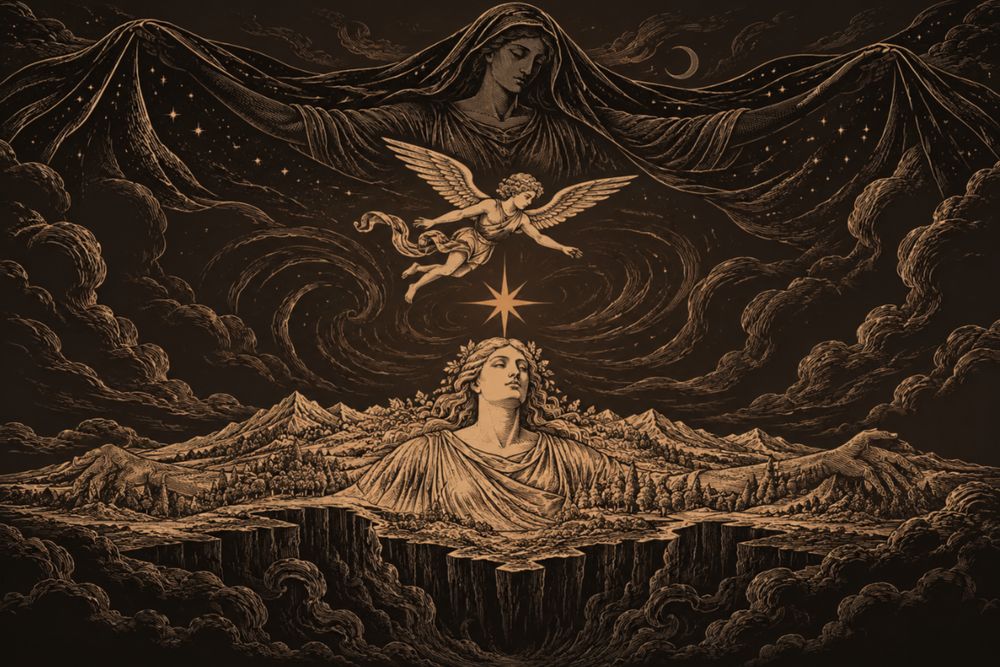
The first powers
Generated by AI from this page's own facts, not an ancient image or evidence of anything. How this site uses generated images
Hesiod names four first powers and gives none of them a parent: Chaos, Gaia, Tartarus and Eros. Earth is the firm footing of the gods on Olympus. Tartarus lies deep inside her. Eros is the force that will drive every union to come, and Hesiod says he overcomes the mind and counsels of gods and men alike.
The first births come from Chaos, and they come without a mate. Erebus and black Night are born from it, and then Night, joined in love to Erebus, bears Aether and Day. Darkness produces light in this scheme, and the opening of the poem reads less like physics than like a kinship chart.
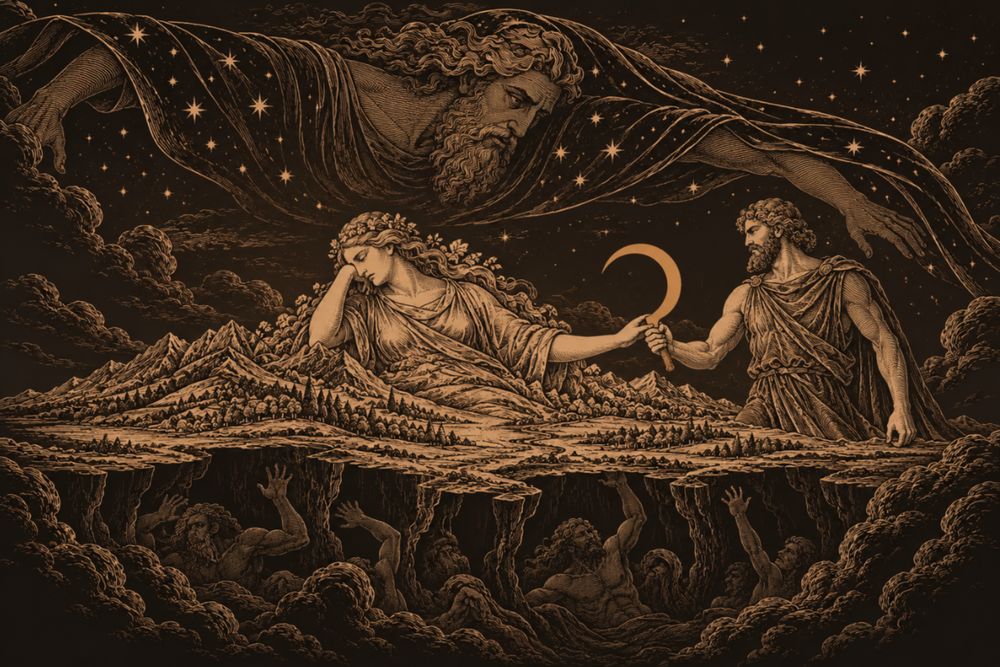
Gaia gives Kronos the sickle
Generated by AI from this page's own facts, not an ancient image or evidence of anything. How this site uses generated images
Earth now acts on her own account. She bears starry Heaven equal to herself, so that he may cover her on every side and be a lasting home for the blessed gods. She bears the long hills, where the Nymphs live in the glens, and she bears Pontus, the barren sea, without any union of love.
Only then does she lie with Ouranos. Their children are Oceanus, the Titans, the Cyclopes and the three Hundred-Handers. Hesiod says the youngest Titan, Kronos, was the wily one and hated his father. Ouranos hated the Hundred-Handers and hid them in a secret place of Earth as each was born, and would not let them into the light.
Apollodorus tells the motive differently. In his Library, Sky bound the Cyclopes and cast them into Tartarus, and Earth was grieved at the destruction of her children. He gives the sickle as adamantine. Evelyn-White's Hesiod translates the same material as grey flint.
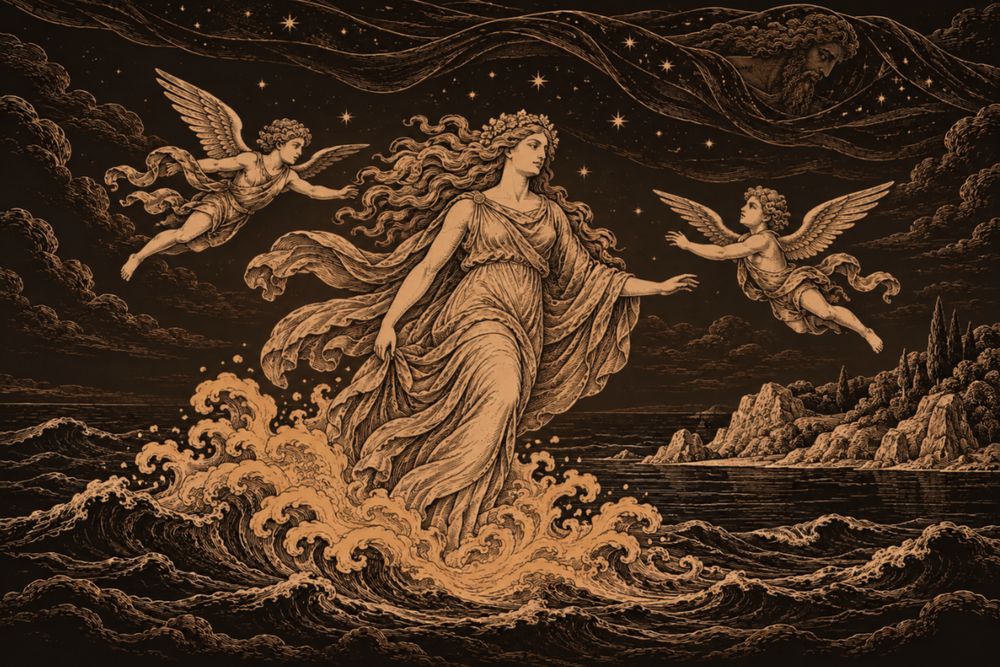
Aphrodite rises from the sea foam
Generated by AI from this page's own facts, not an ancient image or evidence of anything. How this site uses generated images
Earth groaned within and shaped a great sickle. She put her plan to her sons and told them to punish their father's outrage. Fear held all of them silent except Kronos, who said he would do it. Earth hid him in ambush, and when Sky came at night to lie upon her, Kronos struck.
The act ends the first divine reign, and Hesiod counts its consequences at once. The drops of blood that Earth received became the Erinyes, the armoured Giants and the ash-tree Nymphs called Meliae. Sky named his other sons the Titans, meaning Strainers, and said vengeance for their deed would come. That threat is the seed of the Titanomachy.
What fell into the sea drifted for a long time, and white foam gathered around it. In the foam a maiden grew. She came first to Cythera and then to Cyprus, and gods and men called her Aphrodite, the foam-born. Eros went with her, and Desire followed. The sea that Earth had made alone now gives the goddess of love her birth.
Aristophanes gives a comic, older-than-Zeus version in the Birds. His chorus says there was only Chaos, Night, dark Erebus and deep Tartarus. Earth, air and heaven did not yet exist. Night laid a germless egg in Erebus, and from it, after long ages, Eros with golden wings was born. Eros mated with Chaos in Tartarus and hatched the birds, and only later did Eros mix the elements that made Heaven, Ocean, Earth and the gods. The chorus uses this to argue that birds are older than the Olympians. It is a parody with a purpose, and it is not Hesiod.
Ovid opens his Metamorphoses with a Roman version. Chaos there is a shapeless mass in which the elements fight each other. "God, or kindly Nature", in the Perseus English translation, ends the strife by separating land from sky and sea from land, and Ovid admits that he does not know which god it was. The tale then goes on to living things and to humans, which the Theogony never does.
What Followed
The wound to Sky is the first of three successions. Kronos now rules, and Hesiod says that Earth and starry Heaven warned him he was destined to be overcome by his own son. He swallowed his children as they were born. Zeus is one of the children of Rhea and Kronos in Hesiod's list, so he is a member of the third generation and not a creator.
When the gods finished their struggle with the Titans, Hesiod says they pressed Olympian Zeus to reign, by Earth's prompting. That war is told in the Titanomachy, and the wider cluster is set out in Titans and Creation.
Afterlife and Modern Influence
The Theogony gave later Greek and Roman writers their standard genealogy, and even those who altered it, like Aristophanes and Ovid, worked against it. Apollodorus's Library, a prose handbook, retold the succession with Sky as the first ruler of the whole world. Ovid's opening lines then fixed a Latin version in which a single maker orders the elements, and that is the form of "creation from chaos" that most readers meet first. The two traditions ask different questions. Hesiod asks who begot whom. Ovid asks who arranged what.
How was the world created in Greek mythology?
In Hesiod's Theogony the world is not made but born. Chaos comes first, then Earth, Tartarus and Eros. Chaos alone produces Erebus and Night, and Night bears Aether and Day. Earth bears Heaven, the hills and the sea without a partner, then lies with Heaven and bears the Titans. No single creator shapes the whole. Later accounts, such as Ovid's, do give a maker.
Hesiod, Theogony 116-133
Did Zeus create the world in Greek mythology?
No. In Hesiod, Zeus is one of the children Rhea bore to Kronos, so he belongs to the third generation after Earth and Heaven. The gods pressed him to rule only after their struggle with the Titans, and Hesiod says this was by Earth's prompting. Apollodorus likewise makes Sky the first ruler of the whole world. Zeus inherits an ordered cosmos and reigns over it.
Hesiod, Theogony 881-885
How was humanity created in Greek mythology?
The Theogony's opening does not make humans. Apollodorus says Prometheus moulded men out of water and earth and gave them fire, hidden from Zeus in a fennel stalk. Hesiod's Works and Days has the Olympians make a golden race of mortals in the time of Kronos. Ovid says the maker of the world or Prometheus formed man from earth and water.
Apollodorus, Library 1.7.1
How did Greek mythology explain the natural world?
Hesiod explains landscape as offspring. Earth bears the long hills, where the Nymphs live in the glens, and she bears Pontus, the sea, without a partner. Heaven is a lid she made to cover her. Ovid gives a different cause: a god or Nature separates land, sea and sky from a warring mass, sets fountains, valleys and mountains in place, and fixes the winds.
Hesiod, Theogony 126-132
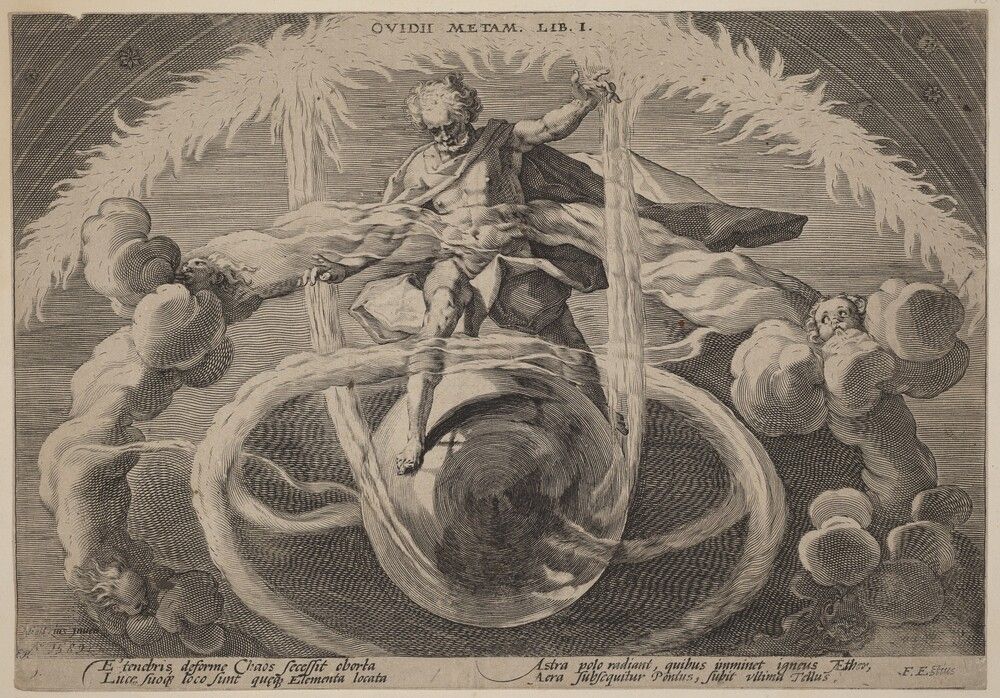
Chaos: The Untangling of Chaos, or the Creation of the Elements - Workshop of Hendrick Goltzius, after Hendrick Goltzius, 1589, engraving on laid paper
National Gallery of Art, Washington, DC, 2011.139.162. CC0
The museum catalogues this object as "Chaos: The Untangling of Chaos, or the Creation of the Elements"; the identification is not certain.
Where Accounts Differ
- where-creation-starts
- eros-origin
- sickle-flint-or-adamant
- motive-for-the-wound
- ovid-craftsman-god
- Where creation starts differs by author. Hesiod, Theogony 116-120, begins with Chaos, Earth, Tartarus and Eros. Apollodorus, Library 1.1.1, begins with Sky as the first ruler of the whole world and names no Chaos. Aristophanes, Birds 693-700, has a wind-egg laid by Night from which Eros hatches. This page follows Hesiod and marks where the others depart.
- Eros's origin is disputed. In Hesiod, Theogony 116-122, Eros is one of the four first powers and has no parent. In Aristophanes, Birds 693-700, Night lays an egg in Erebus and Eros hatches from it, so he is younger than Chaos, Night and Erebus in the play.
- The sickle is told two ways. Hesiod, Theogony 154-182, in the Evelyn-White translation, has Earth make it from grey flint. Apollodorus, Library 1.1.4, calls it adamantine. Other pages on this site render the same material as adamant, so this is a matter of translation and not necessarily of two traditions.
- The motive for the wound differs. In Hesiod, Theogony 154-182, Sky hides his children in Earth as each is born. In Apollodorus, Library 1.1.2-1.1.4, Sky binds the Cyclopes and casts them into Tartarus, and Earth persuades the Titans to attack him, with all but Ocean joining in.
- Ovid, Metamorphoses 1.5-88, gives a Roman cosmogony with a craftsman. God or kindly Nature ends the strife of elements, and Ovid says which god is unknown. The Theogony has no such maker. The question of who formed humans is left open between that unnamed god and Prometheus.
Read the full source verification →
Mythology
Figures In This Myth
Also Connected
Related Terms
Referenced By
Sources
- Hesiod, Theogony 116-133
- Hesiod, Theogony 154-182
- Hesiod, Theogony 183-187
- Hesiod, Theogony 188-206
- Hesiod, Theogony 207-210
- Hesiod, Theogony 453-458
- Hesiod, Theogony 881-885
- Hesiod, Works and Days 109-111
- Apollodorus, Library 1.1.1
- Apollodorus, Library 1.7.1
- Aristophanes, Birds 693-700
- Ovid, Metamorphoses 1.5-88
- Hesiod, Theogony 116-120
- J. G. Frazer, Apollodorus: The Library (Loeb, 1921), notes to 1.1.1-1.1.4