Giants
The Giants, in Greek Gigantes, are the earth-born race that attacked the Olympian gods.
Spear of the Giants
Generated by AI from this page's own facts, not an ancient image or evidence of anything. How this site uses generated images
Sections on this page
In Practice
Hesiod makes them spring from the blood of the wounded Ouranos. Apollodorus says Earth bore them by Sky after the Titans fell. Both treat them as a race apart from the Titans, the Cyclopes and the Hundred-Handers.
Hesiod describes them in one line of his catalogue. When Kronos cut off his father's members, drops of blood fell on Earth, and she bore among others "the great Giants with gleaming armour, holding long spears in their hands" (Theogony 183-187). The Theogony does not tell their war.
Apollodorus describes them as matchless in bulk and invincible in force, with long hair hanging from head and chin and the scales of dragons on their feet. He says some place their birth in Phlegrae and others in Pallene. They assaulted heaven by hurling rocks and burning oaks. Porphyrion and Alcyoneus were the two who stood out, and Alcyoneus was immortal while he fought in the land of his birth (Library 1.6.1).
An oracle told the gods that no Giant could perish at the hand of a god, only with the help of a mortal. Zeus therefore called on Heracles (Library 1.6.1). Apollodorus then lists the dead one by one: Ephialtes, Eurytus, Clytius, Mimas, Enceladus, Polybotes and others, each struck down by a named god (Library 1.6.2). The whole war is told on the page for the Gigantomachy.
Hesiod keeps the Giants apart from the older generations. His Titans are children of Heaven and Earth (Theogony 132-138), and so are the Hundred-Handers, who have a hundred arms each (Theogony 154-182). In English the word giant is often stretched to cover all of these. The Greek sources checked here do not do that.
Homer uses the name for an earlier people. Athena tells Odysseus that Eurymedon was once king of the insolent Giants, and that he destroyed his reckless people and himself (Odyssey 7.56-60). The Giants belong to the succession story traced in Titans and creation, where Earth turns against each new ruler of the cosmos in turn.
Who are all the giants in Greek mythology?
No source gives a complete list. Apollodorus names Porphyrion and Alcyoneus as the leaders, then Ephialtes, Eurytus, Clytius, Mimas, Enceladus, Pallas, Polybotes, Hippolytus, Gration, Agrius and Thoas as they fall to the gods. Hesiod names none. Other writers give other names, so the roll in Apollodorus is one version, not the whole race.
Apollodorus, Library 1.6.2
How tall were the Greek giants?
The sources checked here give no height in feet, cubits or any other measure. Apollodorus says only that the Giants were matchless in bulk of body. Pausanias argues that they were mortal men of great size, not monsters. Hesiod mentions their armour and spears and says nothing about their stature (Theogony 183-187).
Apollodorus, Library 1.6.1
Did the Giants really have snake feet?
Only in some sources. Apollodorus gives them the scales of dragons on their feet. Hesiod's armoured Giants have no serpent parts at all. Pausanias calls the tale of serpent-footed Giants an absurd one. Serpent-footed Giants are a feature of later art rather than of the oldest poetry.
Pausanias, Description of Greece 8.29.3
Who is the biggest giant in Greek mythology?
The sources do not rank the Giants by size. Apollodorus singles out Porphyrion and Alcyoneus as the two who stood out, and Pindar speaks of Porphyrion as the king of the Giants, but neither is measured against the others. Mighty Typhon is a different offspring of Earth and is not counted among the Giants.
Apollodorus, Library 1.6.1
Was Eurymedon the king of the Giants?
In Homer, yes. Eurymedon is called king of the insolent Giants, and his line ends with the ruin of his people. Pindar instead gives the title of king of the Giants to Porphyrion, whose defeat he credits to Apollo. The two poets do not name the same king, and no source checked here reconciles them.
Homer, Odyssey 7.56-60
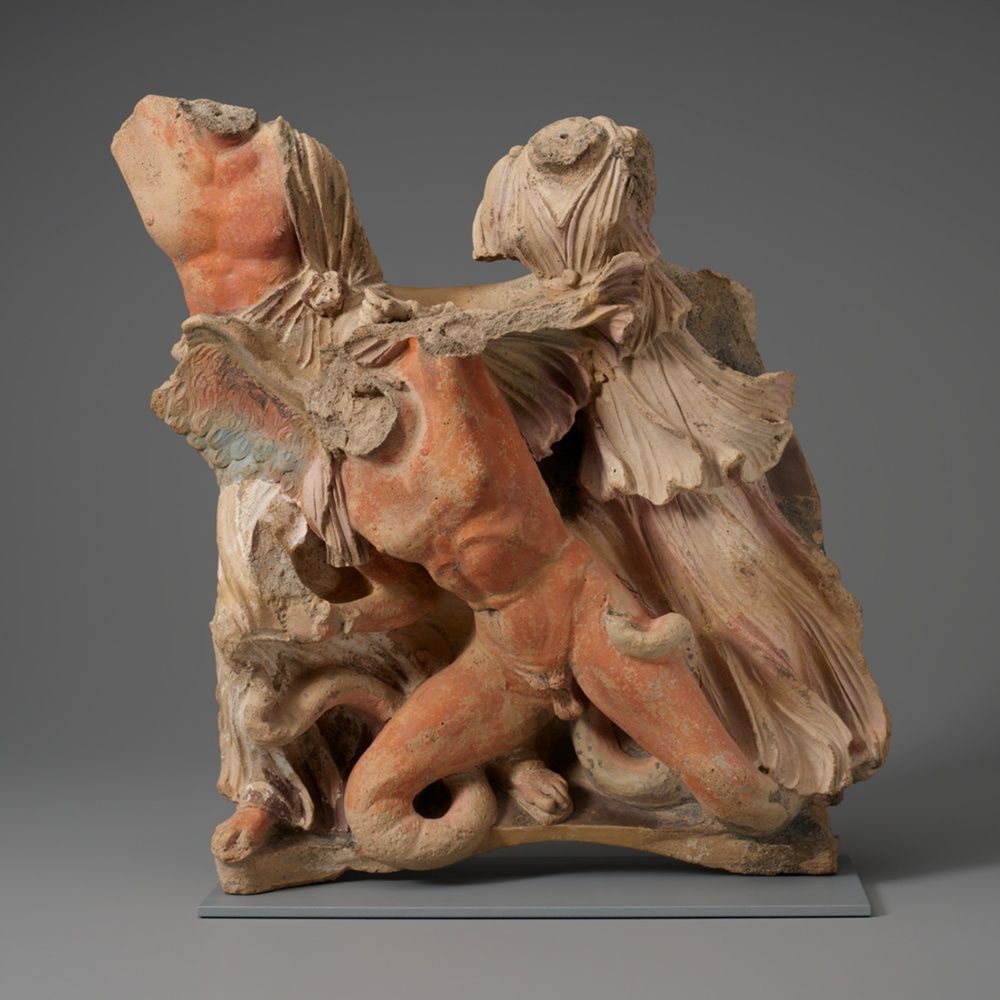
Architectural Relief Depicting the Gigantomachy (Battle Between Gods and Giants) - Etruria, 3rd-2nd century BCE, Terracotta and pigment
The Art Institute of Chicago, Chicago, IL, 1984.2. CC0
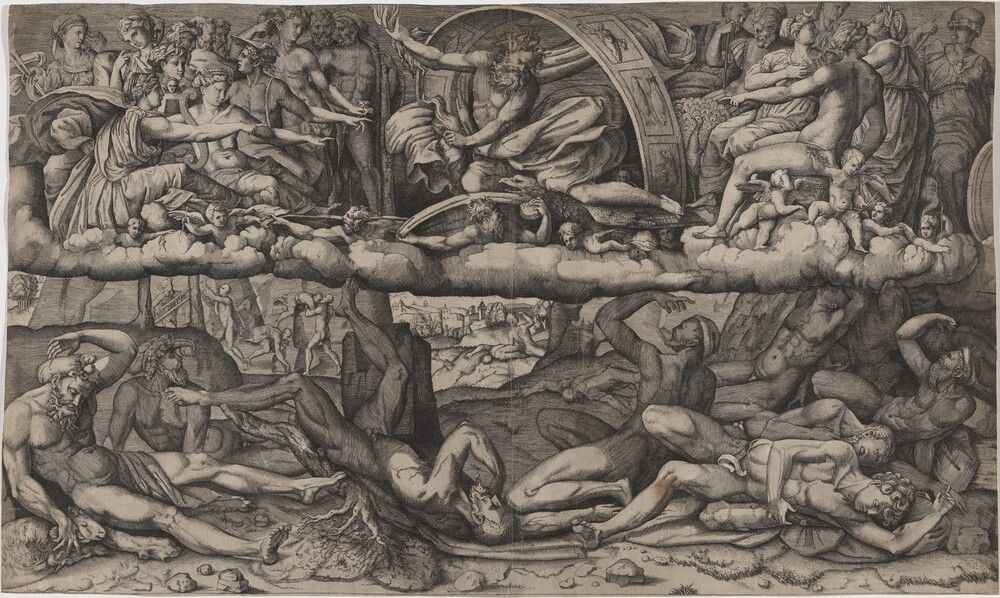
Jupiter Defeating the Giants - attributed to Girolamo Faccioli, after Perino del Vaga, 1540s, engraving on laid paper
National Gallery of Art, Washington, DC, 2020.89.1. CC0
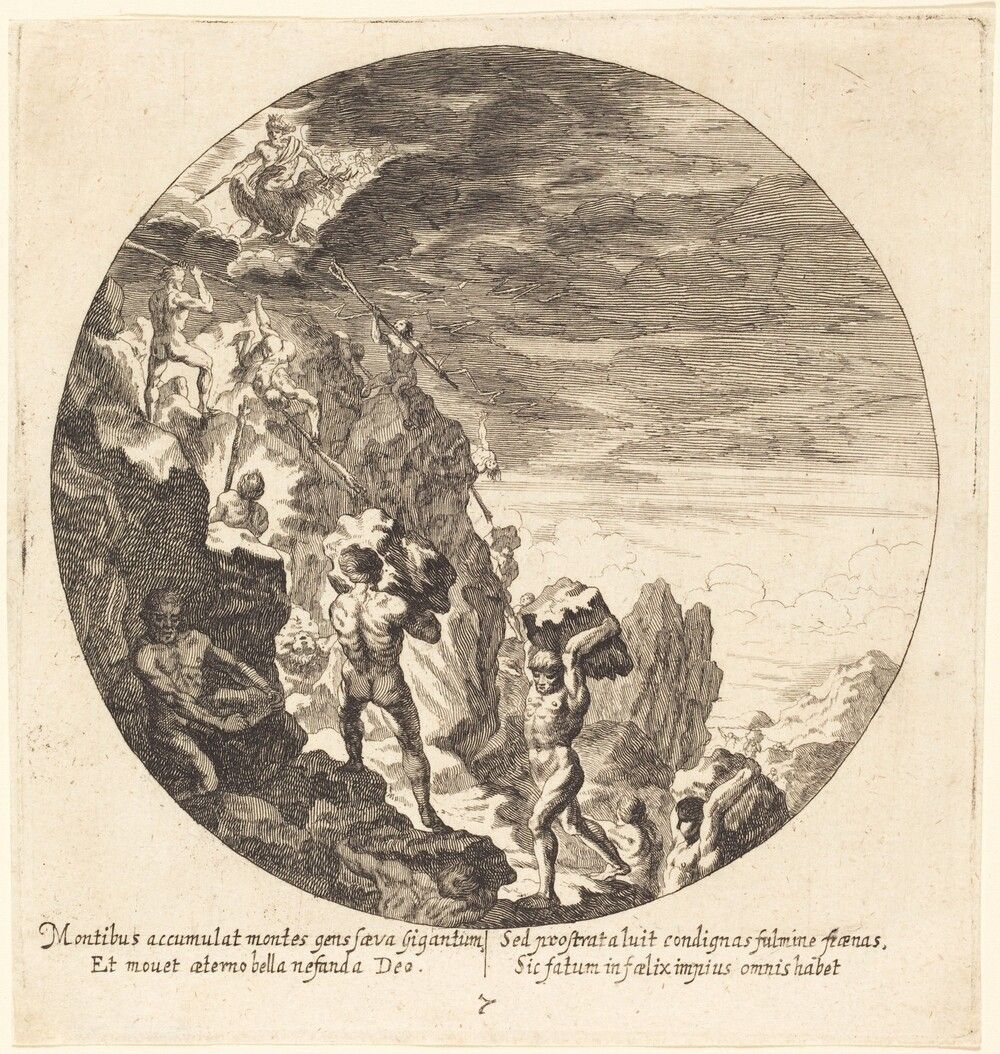
Giants Repelled by Jove - Georg Andreas Wolfgang the Elder, 1665, etching on laid paper
National Gallery of Art, Washington, DC, 2005.17.9. CC0
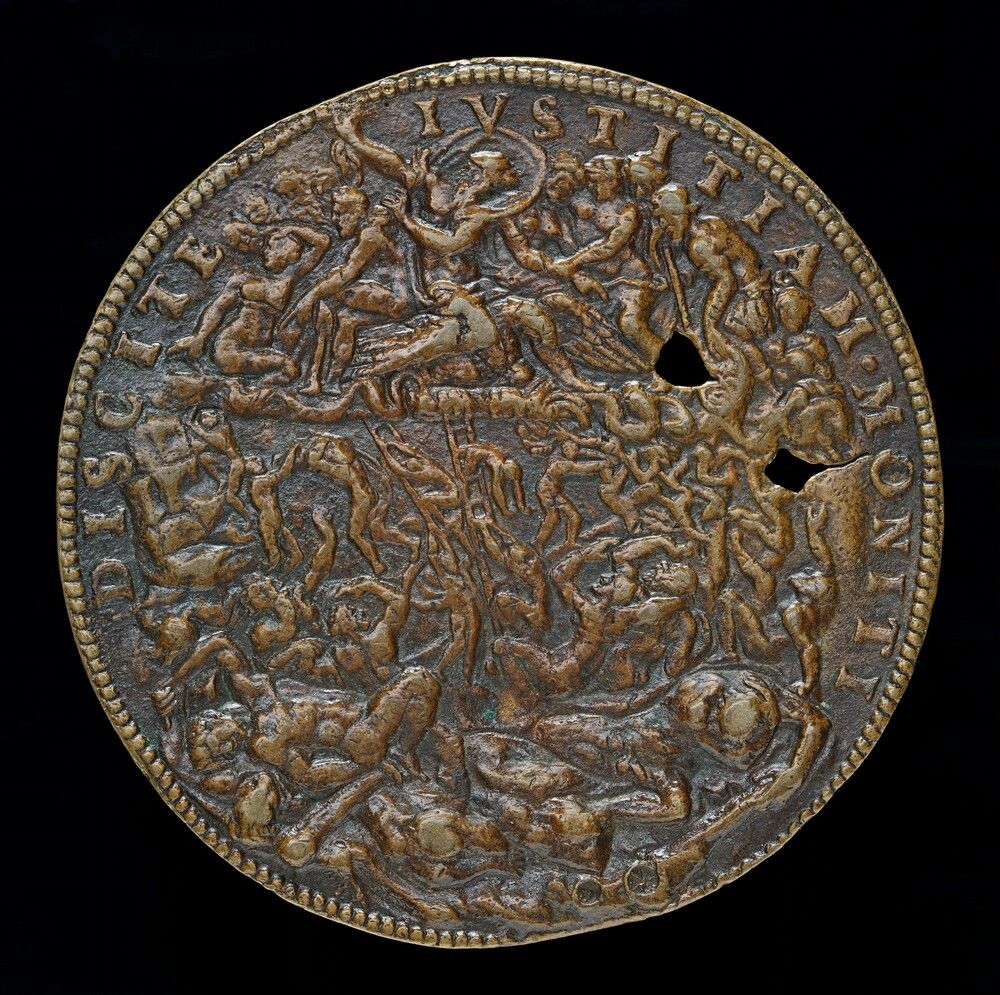
Jupiter Thundering against the Giants [reverse] - Leone Leoni, 1549, bronze//Late cast
National Gallery of Art, Washington, DC, 1957.14.1019.b. CC0
Where Accounts Differ
- birth-of-the-giants
- giants-serpent-feet-or-not
- king-of-the-giants
- The Giants' birth is told two ways. Hesiod, Theogony 183-187, has them spring from the blood of Ouranos's wound. Apollodorus, Library 1.6.1, says Earth bore them by Sky. This page gives both and does not choose one.
- The Giants' form differs. Apollodorus, Library 1.6.1, gives them dragons' scales for feet, Pausanias, Description of Greece 8.29.3, rejects that and takes them for large mortal men, and Hesiod, Theogony 183-187, shows armoured warriors with no serpent feet.
- The king of the Giants differs. Homer, Odyssey 7.56-60, names Eurymedon, while Pindar, Pythian Ode 8.12-18, names Porphyrion. The sources checked here do not settle which is meant.
Where This Appears
Sources
- Hesiod, Theogony 132-138
- Hesiod, Theogony 154-182
- Hesiod, Theogony 183-187
- Apollodorus, Library 1.6.1
- Apollodorus, Library 1.6.2
- Homer, Odyssey 7.56-60
- Pindar, Pythian Ode 8.12-18
- Pausanias, Description of Greece 8.29.3