The Gigantomachy
The Gigantomachy is the war in which the Olympian gods fought the Giants, the earth-born sons of Gaia, after the Titans had fallen. An oracle said the gods could not kill the Giants without a mortal's help, so Zeus called on Heracles. Each god slew a named Giant, and the Giants lost. It is a separate war from the Titanomachy.
Sections on this page
What Led To It
The Gigantomachy comes after the Titanomachy, the ten-year war in which Zeus and his siblings defeated Kronos and the other Titans. Apollodorus opens the Giants' war with a motive: Earth, vexed on account of the Titans, brought forth the Giants. Her own children had been bound in Tartarus, and she raised new ones against the victors.
The Giants are not Titans. Hesiod lists the Titans among the children Earth bore after lying with Heaven, while the Giants come later, from the blood of Ouranos's wound. Hesiod's Theogony mentions the Giants only at their birth. The war itself is told by Apollodorus, Pindar, Ovid and later writers, and by the temple sculptors and vase painters who made it a favourite subject of Greek art.
The Myth
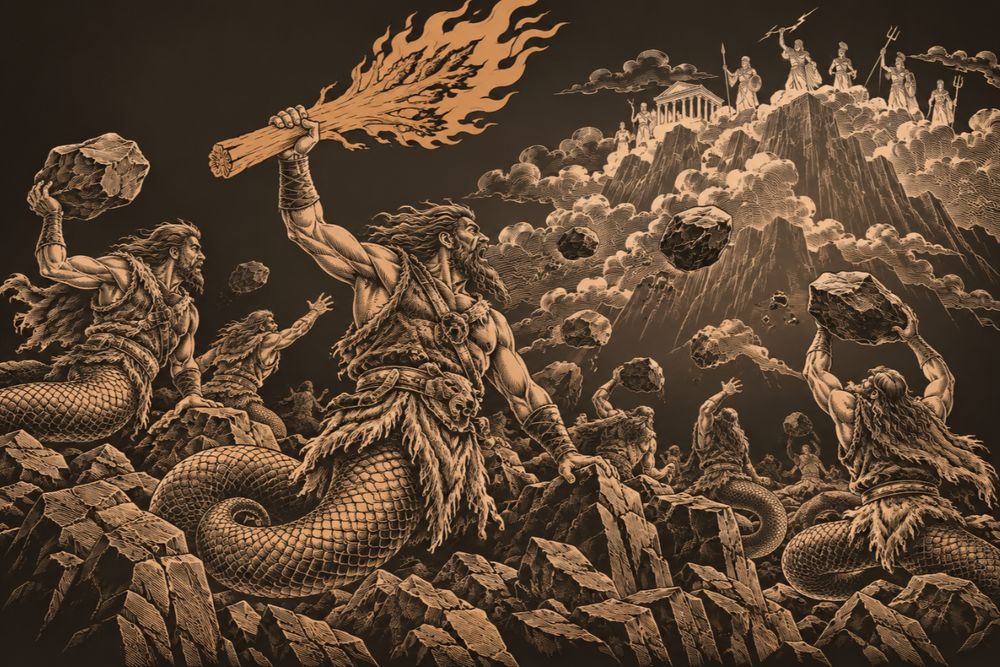
The Giants attack Olympus
Generated by AI from this page's own facts, not an ancient image or evidence of anything. How this site uses generated images
The Gigantomachy begins with a grievance. Apollodorus says that Earth, vexed on account of the Titans, brought forth the Giants, whom she had by Sky (Library 1.6.1). Hesiod gives a different birth: when Kronos cut off his father's members, every bloody drop fell on Earth, and in time she bore the Erinyes, the nymphs of the ash-trees, and "the great Giants with gleaming armour, holding long spears in their hands" (Theogony 183-187).
Apollodorus describes them as matchless in bulk and invincible in might, with long hair drooping from head and chin and dragons' scales for feet. They were born, as some say, in Phlegrae, and according to others in Pallene. They attacked the sky by hurling rocks and burning oaks.
Two Giants stood out, Porphyrion and Alcyoneus. Alcyoneus was immortal so long as he fought in the land of his birth. The gods, meanwhile, had an oracle that none of the Giants could die at the hand of a god. Only with the help of a mortal could they be finished off.
Now the gods had an oracle that none of the giants could perish at the hand of gods, but that with the help of a mortal they would be made an end of.
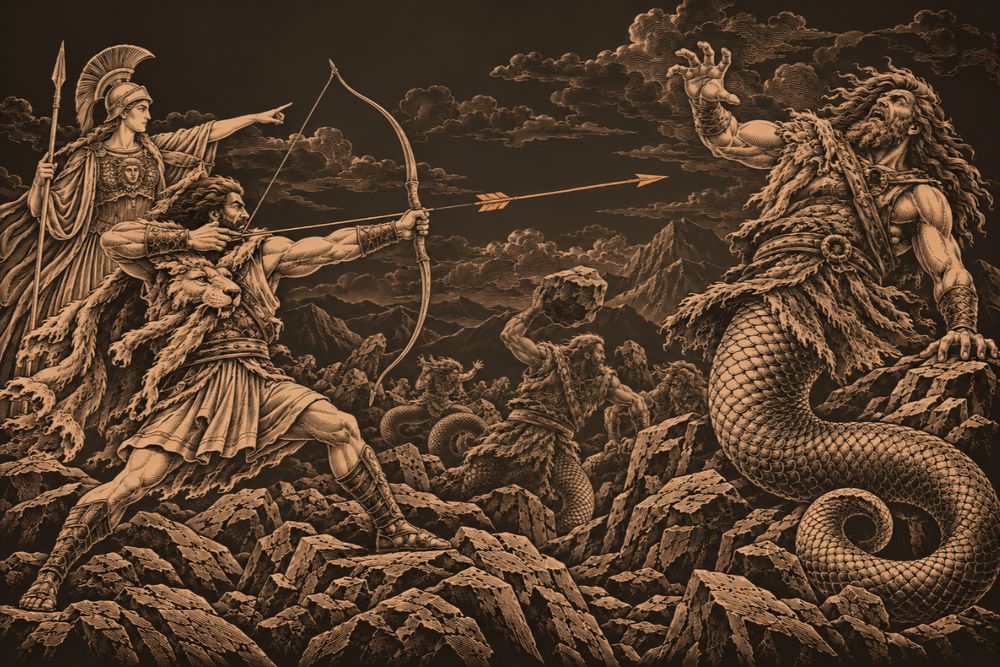
Heracles shoots the Giant Alcyoneus
Generated by AI from this page's own facts, not an ancient image or evidence of anything. How this site uses generated images
Earth heard the oracle and went looking for a herb, a "simple", that would protect her sons even from a mortal. Zeus forbade Dawn, Moon and Sun to shine, cut the herb himself before anyone else could reach it, and through Athena summoned Heracles to his side. Heracles was the mortal the oracle required.
He shot Alcyoneus first with an arrow, but the Giant fell to the ground and revived a little, because he touched his native earth. On Athena's advice Heracles dragged him outside Pallene, and there he died. Pindar, in Nemean 1, knows Heracles's part in the war as well. Tiresias foretells that when the gods meet the Giants on the plain of Phlegra, the Giants' shining hair will be stained with dirt beneath that hero's arrows.
In the fighting, Apollodorus says, Porphyrion attacked Heracles and Hera. Zeus then inspired Porphyrion with lust for Hera. When he tore her robes and would have forced her, she called for help, and Zeus struck him with a thunderbolt while Heracles shot him dead with an arrow.
The other Giants fell to named gods. Apollodorus gives the roll in one passage. Apollo shot Ephialtes in the left eye and Heracles shot him in the right. Dionysus killed Eurytus with a thyrsus. Hecate killed Clytius with torches. Hephaestus killed Mimas with missiles of red-hot metal. Artemis killed Gration, and Hermes, wearing the helmet of Hades, killed Hippolytus.
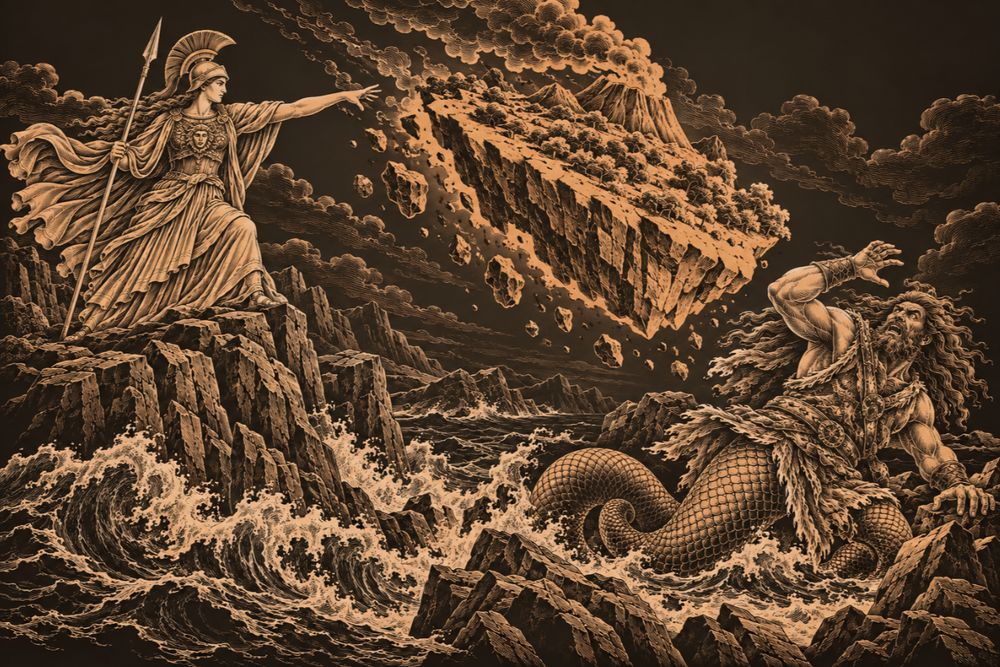
Athena throws Sicily on Enceladus
Generated by AI from this page's own facts, not an ancient image or evidence of anything. How this site uses generated images
Two of the killings moved land. Enceladus fled, and Athena threw the island of Sicily on him as he ran. She also flayed a Giant named Pallas and used his skin to shield her own body in the fight. Poseidon chased Polybotes through the sea to Cos, broke off a piece of the island called Nisyrum and threw it on him. The Fates, fighting with bronze clubs, killed Agrius and Thoas. Zeus destroyed all the remaining Giants with thunderbolts, and Heracles shot every one of them with arrows as they were dying.
Ovid tells a shorter and grimmer version. In Metamorphoses 1, the Giants pile mountain on mountain to reach the stars, Jove shoots his thunderbolts through Olympus and overturns Pelion from Ossa, and Earth, soaked with her sons' blood, gives it new life in the shape of men. Ovid names no Heracles and no individual duels.
What Followed
The war did not end Earth's resistance. Apollodorus says that when the gods had overcome the Giants, Earth, still more enraged, lay with Tartarus and bore Typhon in Cilicia. Typhon was born as the next challenge to Zeus. When the gods saw him rushing at heaven, Apollodorus says, they fled to Egypt.
The defeat also fixed the Giants in the landscape. In Apollodorus, Sicily lies on Enceladus and Nisyrum, a piece of Cos, on Polybotes. In his note to the passage, Frazer suggests that volcanic phenomena and the fossil bones of large extinct animals fed these tales. That is a modern scholar's guess, not an ancient claim.
Afterlife and Modern Influence
The best-known monument of the war is the great frieze on the Pergamon Altar, built by King Eumenes II of Pergamon in the first half of the second century BC. It shows the gods and Giants in high relief. In the scene on the east side, Athena drags the winged Giant Alcyoneus away from Earth, who rises from the ground beside them, while Nike flies in to crown Athena. The altar was excavated from 1878 by Carl Humann, and its panels went to Berlin, where they are displayed in the Pergamon Museum. Frazer adds that the war was also sculptured on the outside of Apollo's temple at Delphi, citing Euripides's Ion.
What is the Gigantomachy myth?
The Gigantomachy is the Greek myth of the war between the Olympian gods and the Giants, the earth-born sons of Gaia. Apollodorus says an oracle told the gods that no Giant could die at a god's hand, only with a mortal's help, so Zeus summoned Heracles. Each god killed a named Giant, Heracles finished them with arrows, and Zeus's rule survived the challenge.
Apollodorus, Library 1.6.1
Are Gigantomachy and Titanomachy the same?
No. They are two separate wars fought against two different groups. In the Titanomachy the Olympians fought the Titans, Kronos's own generation, for ten years. In the Gigantomachy they fought the Giants, whom Apollodorus says Earth brought forth after the Titans were beaten because she was vexed on their account. The Titanomachy is told most fully by Hesiod.
Apollodorus, Library 1.6.1
What is the difference between the Gigantomachy and the Titanomachy?
The Titanomachy was a war among gods for rule of the cosmos, and Zeus won it by freeing the Cyclopes and Hundred-Handers from Tartarus. The Gigantomachy came afterwards and was decided differently: an oracle said the gods needed a mortal, so Zeus called Heracles. The Titans were bound in Tartarus, while the Giants were killed one by one.
Apollodorus, Library 1.6.1
Who killed the giants in Greek mythology?
The Olympian gods killed them with Heracles's help. In Apollodorus, Athena and Heracles killed Alcyoneus, Zeus and Heracles killed Porphyrion, and Zeus struck down most of the rest with thunderbolts while Heracles shot them as they were dying. Apollo, Dionysus, Hecate, Hephaestus, Poseidon, Hermes, Artemis and the Fates each killed at least one named Giant.
Apollodorus, Library 1.6.2
Which giant opposed which god?
Apollodorus pairs them in one passage. Athena and Heracles faced Alcyoneus and Athena also fought Enceladus and Pallas. Apollo and Heracles shot Ephialtes, Dionysus killed Eurytus, Hecate killed Clytius, Hephaestus killed Mimas, Poseidon killed Polybotes, Hermes killed Hippolytus, Artemis killed Gration, and the Fates killed Agrius and Thoas. Porphyrion fell to Zeus and Heracles.
Apollodorus, Library 1.6.2
What is the difference between a giant and a Titan?
The two are different races, born differently. Hesiod says Earth bore the Titans after lying with Heaven, including Kronos and Rhea. The Giants came from the blood that fell on Earth when Kronos wounded his father, and Hesiod pictures them in gleaming armour with long spears. The Titans ruled before Zeus. The Giants only attacked his rule.
Hesiod, Theogony 183-187
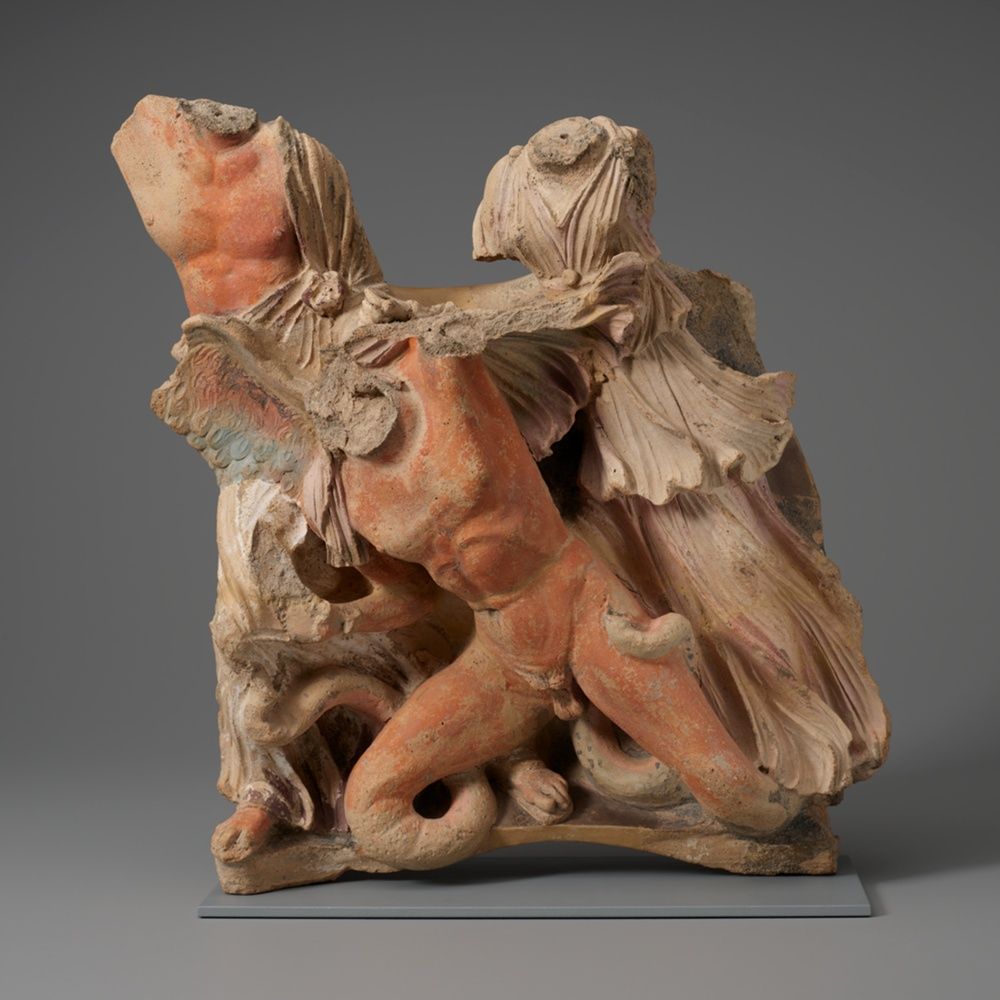
Architectural Relief Depicting the Gigantomachy (Battle Between Gods and Giants) - Etruria, 3rd-2nd century BCE, Terracotta and pigment
The Art Institute of Chicago, Chicago, IL, 1984.2. CC0
Where Accounts Differ
- birth-of-the-giants
- where-the-war-was-fought
- who-killed-porphyrion-and-mimas
- giants-serpent-feet-or-not
- ovid-version-without-heracles
- The Giants' birth is told two ways. Hesiod, Theogony 183-187, has them spring from the blood of Ouranos's wound. Apollodorus, Library 1.6.1, says Earth bore them by Sky. This page gives both and does not choose one.
- Where the war was fought is disputed. Apollodorus, Library 1.6.1, says the Giants were born in Phlegrae according to some and in Pallene according to others. Pindar, Nemean 1.67-72, has the battle on the plain of Phlegra. Pausanias, Description of Greece 8.29.1, reports that the Arcadians place it near their own Bathos, not at Pellene in Thrace.
- Who killed Porphyrion differs. Apollodorus, Library 1.6.2, has Zeus strike him with a thunderbolt and Heracles finish him with an arrow. Pindar, Pythian 8.12-18, names the king of the Giants and gives his defeat to Apollo's bow, setting it beside Zeus's thunderbolt against Typhon. In the note to 1.6.2, Frazer records that other sources also give Mimas's death to Zeus (Euripides's Ion) or to Ares (Apollonius Rhodius and Claudian) rather than to Hephaestus.
- The Giants' form differs. Apollodorus, Library 1.6.1, gives them dragons' scales for feet. Pausanias, Description of Greece 8.29.3, calls that an absurd tale and argues the Giants were mortal men of great size. Frazer notes that later monuments often show them serpent-footed, and Hesiod's armoured Giants have no serpent feet at all.
- Ovid, Metamorphoses 1.89-162, tells a different war. The Giants pile mountains against heaven, Jove shatters them with thunderbolts, and Earth makes men from their blood. There is no oracle, no Heracles and no roll of duels. This page follows Apollodorus for the details and marks where Ovid departs.
Read the full source verification →
Mythology
Figures In This Myth
Also Connected
Related Terms
Referenced By
Sources
- Apollodorus, Library 1.6.1
- Apollodorus, Library 1.6.2
- Apollodorus, Library 1.6.3
- Hesiod, Theogony 132-138
- Hesiod, Theogony 183-187
- Pindar, Nemean Odes 1.67-72
- Pindar, Pythian Ode 8.12-18
- Ovid, Metamorphoses 1.89-162
- Pausanias, Description of Greece 8.29.1-3
- J. G. Frazer, Apollodorus: The Library (Loeb, 1921), notes to 1.6.1-1.6.3
- Pergamon Altar, Antikensammlung, Staatliche Museen zu Berlin