Titans, Primordials and Creation
Hesiod's cosmos begins with Chaos and Gaia, not a single creator. Gaia bears Ouranos, then the Titans with him, and arms Kronos to castrate his father and seize power. Kronos's reign becomes the Golden Age, until fear of his own son leads him to swallow his children. Rhea saves Zeus, whose Olympians beat the Titans in a ten-year war, and Atlas alone is condemned to hold up the sky.
Sections on this page
Overview
Hesiod's Theogony opens not with a god but with a short list of things that simply exist. The births that follow are told in Creation from Chaos. None of them has a birth or a parent: Chaos, wide-bosomed Gaia, dim Tartarus, and Eros. Whether Chaos counts as a god in any ordinary sense is a real question, not a settled one. Hesiod gives it no personality and no story, and it never appears again anywhere in Greek myth. The Greek word itself names a yawning gap, not the empty space or the disorder either translation suggests today. Chaos does act once. Without any partner, it produces Erebus, primordial darkness, and black Night, who in turn bear Aether and Day through her union with Erebus. Gaia's own line begins separately and in parallel, not as a descendant of Chaos. She produces Ouranos, the starry sky, by herself, so that he might cover her completely, and does the same for the mountains and the sea.
Only after that does Gaia lie with her own son Ouranos and bear the twelve Titans, among them Kronos and Rhea, along with the Cyclopes and the Hundred-Handers. Ouranos hides each child inside Gaia as it is born. Gaia, crowded and in pain, makes a sickle of grey adamant and asks her children which of them will move against their father. Only Kronos agrees. Gaia arms him, and when Ouranos comes down over the earth, Kronos castrates him, ending the first divine reign and installing his own. This is the same succession pattern the cluster's contested question about Chaos sets up: creation in Hesiod is not one god shaping a world, but a sequence of kings each removed by the next generation.
Kronos's reign becomes, in Hesiod's separate poem Works and Days, the Golden Age: a generation of mortals who lived like the gods themselves, free of toil and grief, fed by an earth no one had to work. That peace does not extend to Kronos's own family. Gaia and Ouranos warn him that a child of his would overthrow him exactly as he had overthrown his father, so Kronos swallows each of his children by Rhea as they are born. Rhea, helped by Gaia, hides the infant Zeus on Crete and gives Kronos a stone wrapped in cloth to swallow in its place. Zeus grows up, forces his father to disgorge his swallowed siblings, and turns on him directly.
The resulting Titanomachy, the war between Kronos's Titans and Zeus's Olympians, lasts ten years in Hesiod's account with neither side able to force a result. Zeus breaks the stalemate by freeing the Cyclopes and the Hundred-Handers, whom Kronos had kept imprisoned, and their weapons and strength decide it. Punishment afterward is not uniform. Most of the male Titans go to Tartarus under guard; Atlas instead receives an individual sentence, condemned to hold up the sky at the world's western edge; the Titanesses, Rhea among them, are not described as punished at all. A later, softer tradition even has Zeus release Kronos to rule the Isles of the Blessed rather than remain in Tartarus, though Hesiod's own poem does not give him that ending. Prometheus complicates the family tree further: son of the Titan Iapetus rather than one of the original twelve, he sides with Zeus during the war itself. His own famous conflict with Zeus, over fire and the treatment of humanity, is a separate story that comes afterward, not part of the Titanomachy.
In This Topic (12)
-

Gaia Character
Gaia is the earth itself in Greek myth, the first being to take shape after Chaos and the ancestor of nearly every other god.
-

Ouranos Character
Ouranos is the sky in Greek myth, the first ruler of the universe, overthrown by his son Kronos at Gaia's instigation.
-

Kronos Character
Kronos is the king of the Titans who ruled the cosmos before being overthrown by his son Zeus.
-

Rhea Character
Rhea is the Titaness mother of the Olympian gods and wife of Kronos.
-
Golden Age Term
The Golden Age is the first and best of the five successive human races Hesiod describes in Works and Days, a generation of mortals who lived under Cronus's rule on Olympus before the current, harshest age began. Hesiod presents it not as a place or an event but as a lost condition of humanity itself, the earliest and only wholly untroubled stretch in a long decline that runs through silver, bronze, and heroic races down to the iron age he says he himself lives in. The golden race lived, in Hesiod's account, like the gods themselves: free of toil, grief, and the miseries of old age, their limbs never failing them, feasting away from all evils. Death came to them as gently as sleep, and the earth produced abundant food on its own, without anyone having to work it. Hesiod is explicit that this ease was not something the golden race earned through virtue so much as a feature of the era itself, tied directly to Cronus's reign rather than to any quality of the people. What happened to the golden race afterward matters as much as the description of their life. Hesiod does not say they simply vanished; he says that after the earth covered that generation, Zeus made them into benevolent spirits who roam the earth cloaked in mist, watching over judgments and cruel deeds and acting as guardians of mortal men and givers of wealth. That afterlife role gives the golden race a continuing presence in the world Hesiod's own audience lived in, rather than confining them to an irrecoverable past. The Golden Age concept became one of Greek and later Roman literature's most durable ways of framing decline, and it should not be confused with Elysium or the Isles of the Blessed, which Hesiod describes separately as an afterlife reward reserved for a portion of the heroic race rather than as the golden race's original home. The five-race sequence's downward trajectory, worsening from golden through silver and bronze to the iron age of toil and injustice, with the heroic race as a partial improvement inserted before the final decline, is itself the moral of Hesiod's account: each metal names not a literal substance but the character of the age it stands for. Ovid's Metamorphoses gives the concept's fullest Roman treatment, and it changes the framing in a few notable ways. Ovid compresses Hesiod's five races into four, dropping the heroic generation entirely, and describes the golden age through the absence of law rather than the presence of a specific ruler: no fear of punishment, no written statutes, no need for judges, because people did what was right without being forced to. He adds a detail Hesiod never mentions, that the golden age enjoyed eternal spring, with the earth bearing fruit without cultivation or a change of season. The two accounts agree on the essentials, ease without labor and food without sowing, while disagreeing on the specific mechanism that produced that ease. Ovid also carries the decline to its end: Jupiter decides to destroy the whole human race, which leads to the flood of Deucalion.
Belongs to this cluster as the human condition tied specifically to Kronos's reign, the peaceful interval this cluster's succession narrative passes through between Ouranos's fall and the Titanomachy.
-
Titan Term
The Titans are a race of powerful primordial deities who ruled the cosmos during the Golden Age, before being overthrown by the Olympian gods. They are the twelve children of Ouranos (Sky) and Gaia (Earth): Kronos, Rhea, Oceanus, Tethys, Hyperion, Theia, Coeus, Phoebe, Crius, Mnemosyne, Themis, and Iapetus. Kronos led the Titans, castrating his own father Ouranos at Gaia's urging to seize power, and ruled in his place until Zeus, his own son, led the Olympians against him in turn. The Titanomachy, the war between the Titans and the Olympians, lasted ten years according to Hesiod, with neither side able to force a decision. Zeus broke the stalemate by freeing two groups Kronos had kept imprisoned in Tartarus: the Cyclopes, who forged his thunderbolt, and the hundred-handed Hecatoncheires, whose combined strength in battle overwhelmed the Titans. Not every child of the Titans fought against Zeus - Prometheus and his brother Epimetheus, sons of the Titan Iapetus rather than Titans of the original twelve themselves, sided with the Olympians, and Prometheus is remembered afterward for a separate conflict with Zeus over fire and the treatment of humanity rather than for the Titanomachy itself. Defeat did not mean identical punishment for every Titan. Most of the male Titans who fought against Zeus were imprisoned in Tartarus behind bronze gates, guarded by the freed Hecatoncheires. Atlas received an individual sentence instead: condemned to hold up the sky on his shoulders at the western edge of the world, a permanent physical burden rather than confinement. The Titanesses, including Rhea, Themis, Mnemosyne, and Tethys, are generally not described as punished at all, and several continue to appear active in later myth and cult alongside the Olympians who defeated their brothers. Apollodorus, writing centuries after Hesiod, retells the same succession of castration, rule, and overthrow in prose rather than verse, and largely agrees with Hesiod's account of who fought on which side.
Covers the Titans as a group; the war itself is told in full on its own page, titanomachy.
-

Atlas Character
Atlas is the Titan condemned to hold up the sky for eternity.
-

Prometheus Character
Prometheus is the Titan who stole fire from the gods and gave it to humanity.
A Titan's son rather than one of the original twelve, and one who sides with Zeus against his own family in the Titanomachy - his place in this cluster is genealogical, not a matter of which side he fought on.
-
The Titanomachy Story
The Titanomachy is the ten-year war between Kronos's Titans and Zeus's Olympians for control of the cosmos. Neither side could force a result until Zeus freed the Cyclopes and Hundred-Handers, imprisoned since Ouranos's own reign, from Tartarus. Their thunderbolts and hurled rocks broke the stalemate, and most Titans were bound in Tartarus in turn.
-
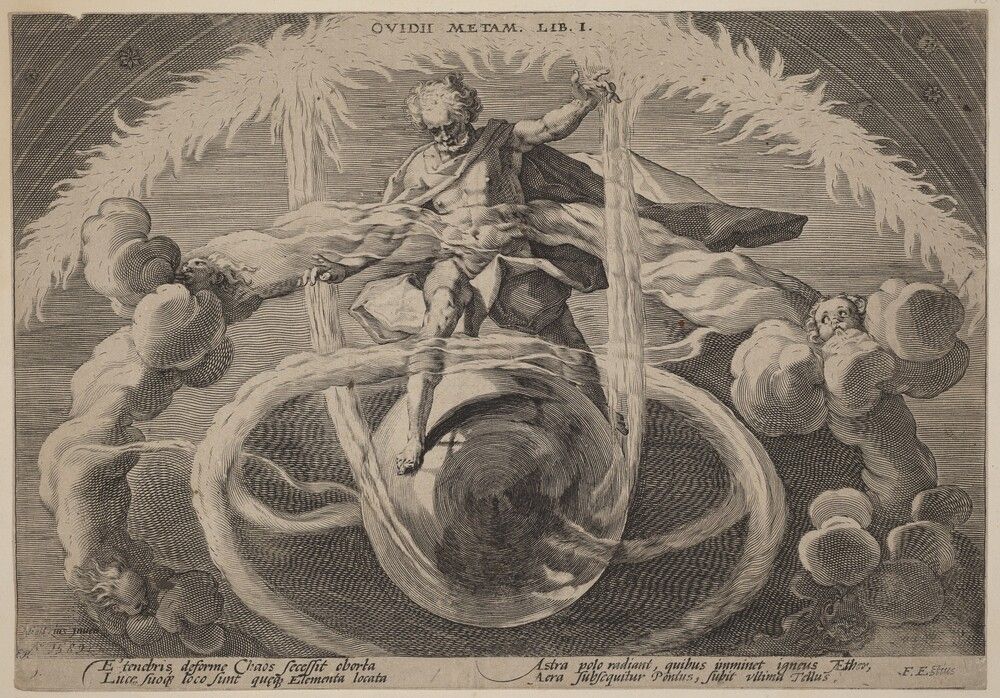
Creation from Chaos Story
In Hesiod's Theogony the Greek world is not made by one god. It grows by births: Chaos comes first, then Earth, Tartarus and Eros, then Night and Darkness. Earth bears Sky, the hills and the sea, and the first divine generation ends when Kronos wounds Sky and Aphrodite rises from the foam. Zeus is born long after.
The generation before the Titans rule: Hesiod's first powers, Earth and Sky, and the wound that ends Sky's reign, which leads straight into the Titanomachy.
-
Deucalion and the Flood Story
Deucalion and Pyrrha are the human survivors of Zeus's flood in Greek myth. In Apollodorus, Prometheus tells his son to build a chest, and the couple drift nine days to Parnassus. In Ovid, Jupiter drowns the world after Lycaon's crime, and Themis tells them to cast the bones of their great mother behind them. The stones become people.
The sequel to the succession story: Apollodorus makes Deucalion a son of the Titan Prometheus, and Zeus's flood remakes the human race after it.
-
Giants Term
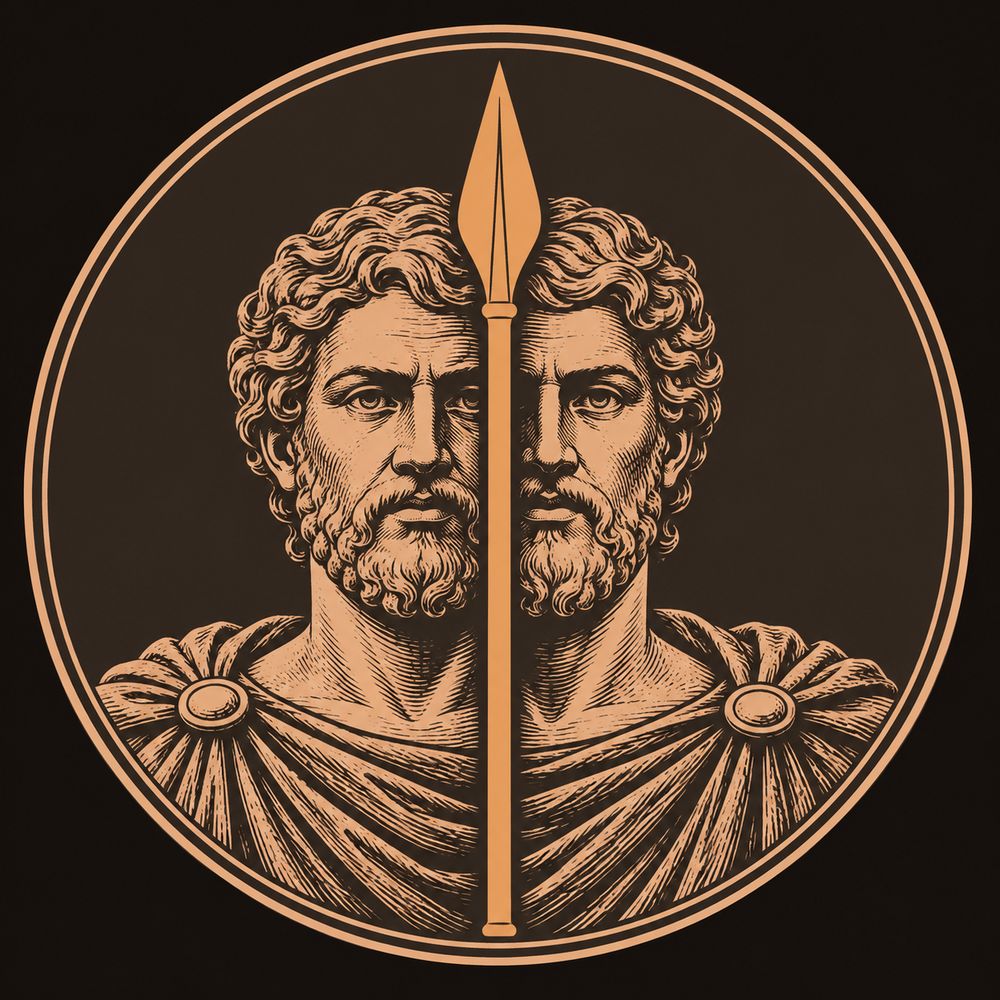
The Giants, in Greek Gigantes, are the earth-born race that attacked the Olympian gods. Hesiod makes them spring from the blood of the wounded Ouranos. Apollodorus says Earth bore them by Sky after the Titans fell. Both treat them as a race apart from the Titans, the Cyclopes and the Hundred-Handers. Hesiod describes them in one line of his catalogue. When Kronos cut off his father's members, drops of blood fell on Earth, and she bore among others "the great Giants with gleaming armour, holding long spears in their hands" (Theogony 183-187). The Theogony does not tell their war. Apollodorus describes them as matchless in bulk and invincible in force, with long hair hanging from head and chin and the scales of dragons on their feet. He says some place their birth in Phlegrae and others in Pallene. They assaulted heaven by hurling rocks and burning oaks. Porphyrion and Alcyoneus were the two who stood out, and Alcyoneus was immortal while he fought in the land of his birth (Library 1.6.1). An oracle told the gods that no Giant could perish at the hand of a god, only with the help of a mortal. Zeus therefore called on Heracles (Library 1.6.1). Apollodorus then lists the dead one by one: Ephialtes, Eurytus, Clytius, Mimas, Enceladus, Polybotes and others, each struck down by a named god (Library 1.6.2). The whole war is told on the page for the Gigantomachy. Hesiod keeps the Giants apart from the older generations. His Titans are children of Heaven and Earth (Theogony 132-138), and so are the Hundred-Handers, who have a hundred arms each (Theogony 154-182). In English the word giant is often stretched to cover all of these. The Greek sources checked here do not do that. Homer uses the name for an earlier people. Athena tells Odysseus that Eurymedon was once king of the insolent Giants, and that he destroyed his reckless people and himself (Odyssey 7.56-60). The Giants belong to the succession story traced in Titans and creation, where Earth turns against each new ruler of the cosmos in turn.
The race Earth raises against the Olympians after the Titans fall, kept apart from the Titans in Hesiod and Apollodorus.
Is Chaos a void or a god?
Neither modern category fits cleanly. Hesiod's Theogony names Chaos as the first thing to exist, with no parent and no partner, but gives it no personality, no story, and no later appearance anywhere in Greek myth - closer to a primordial condition than to an anthropomorphic god like Zeus or Athena. At the same time, the Greek word itself describes a yawning gap or chasm, not empty space in the modern physical sense and not disorder in the modern everyday sense, so translating it as either a literal void or a full god overstates the case in different directions.
Hesiod, Theogony 116-117
Which primordials were born from Chaos?
Only two, and directly: Chaos alone, without any partner, produces Erebus, the personification of primordial darkness, and black Night. Night then bears Aether, the bright upper air, and Day, through her union with Erebus. Gaia, Tartarus and Eros are not descendants of Chaos - Hesiod names all three as coming into being independently, at the same point in the account, rather than as Chaos's own offspring.
Hesiod, Theogony 116-117; 123-125
Is Prometheus really a Titan, the same way Kronos or Atlas is?
Not in the strict sense. Hesiod's twelve Titans are specifically the children of Ouranos and Gaia, and Prometheus is a generation further out, the son of the Titan Iapetus. That looser membership is also why he ends up on the opposite side of the Titanomachy from his own uncles and aunts: he and his brother Epimetheus side with Zeus rather than fighting for Kronos, and Prometheus's defining conflict with Zeus, over the theft of fire, is a separate story that comes after the war rather than part of it.
Hesiod, Theogony 507-511
Where Accounts Differ
- whether-chaos-is-a-god-or-a-void
- This hub does not restate the individual member entries' own full genealogies, question sets, or Ovid's separate account of the Golden Age; it draws the connecting line from Chaos and Gaia's independent first beings, through Ouranos's overthrow and Kronos's reign, to the Titanomachy and its unequal punishments.
- Chaos, Erebus, Night, Eros and Tartarus are referenced in the intro for narrative continuity but are not cluster members in their own right - they belong to Hesiod's creation account rather than to the Titan succession this cluster traces.
Related Terms
Referenced By
Sources
- Hesiod, Theogony 116-117
- Hesiod, Theogony 123-125
- Hesiod, Theogony 126-138
- Hesiod, Theogony 154-182
- Hesiod, Theogony 453-506
- Hesiod, Theogony 507-520
- Hesiod, Theogony 617-663
- Hesiod, Theogony 636-638
- Hesiod, Theogony 717-720
- Hesiod, Works and Days 109-126
- Apollodorus, Library 1.1.1-1.2.1