Deucalion and the Flood
Deucalion and Pyrrha are the human survivors of Zeus's flood in Greek myth. In Apollodorus, Prometheus tells his son to build a chest, and the couple drift nine days to Parnassus. In Ovid, Jupiter drowns the world after Lycaon's crime, and Themis tells them to cast the bones of their great mother behind them. The stones become people.
Sections on this page
What Led To It
Both tellings begin with a god who decides the human race must go. Apollodorus ties the flood to the end of the Bronze Age, and the golden age page sets out the Greek scheme of successive human ages. Ovid ties it to one particular crime. In either case the couple link back to earlier myth. Deucalion is the son of the Titan Prometheus, who gave fire to humans in Prometheus and the theft of fire. Pyrrha is the daughter of Epimetheus and Pandora. The survivors of the flood are therefore descendants of the first brother pair and the first woman.
The Myth
Deucalion and his wife Pyrrha are the two people who outlive the great flood in Greek myth. Zeus drowns the world, and the couple float to Mount Parnassus. They then remake humanity by throwing stones over their shoulders. The two main tellings give different reasons for the flood and for their survival.
Apollodorus, in his Library, says Zeus meant to destroy the men of the Bronze Age. Deucalion is the son of Prometheus and reigns near Phthia. His wife Pyrrha is the daughter of Epimetheus and Pandora. Apollodorus gives no crime that provoked the flood.
Ovid supplies one. In the Metamorphoses, Jupiter visits the house of Lycaon in Arcadia. Lycaon tests the god's divinity and serves him the flesh of a hostage, and Jupiter turns him into a wolf. The god then tells the divine council that all humankind has grown as wicked, and that he will destroy it.
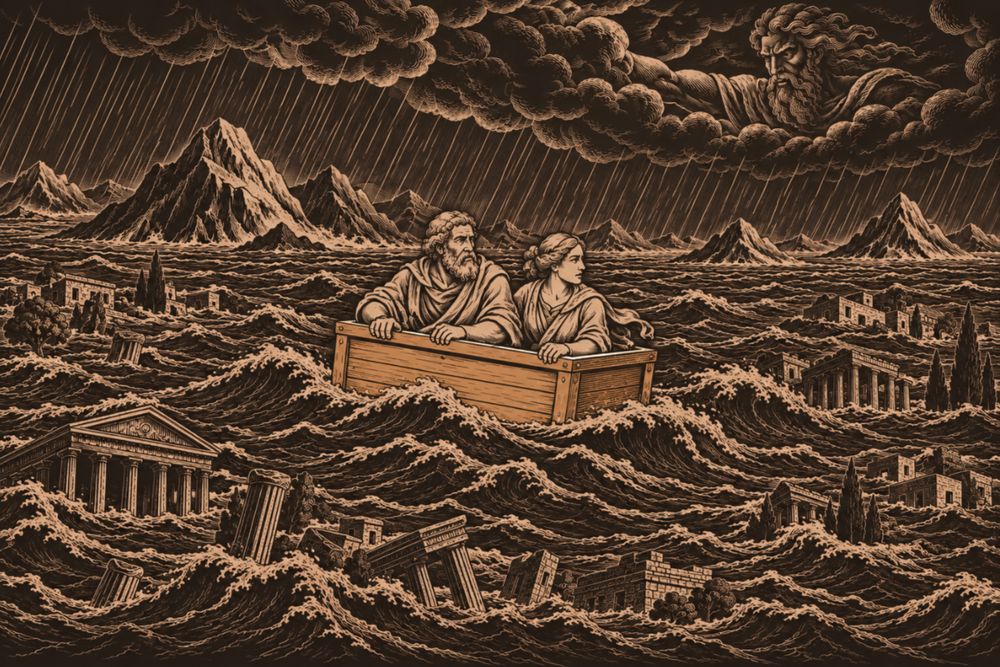
The flood
Generated by AI from this page's own facts, not an ancient image or evidence of anything. How this site uses generated images
In Apollodorus the rescue is a matter of foresight. On the advice of Prometheus, Deucalion builds a chest and stocks it with provisions. He and Pyrrha climb in. Zeus then sends heavy rain from heaven, floods most of Greece and kills nearly everyone. A few people escape to the high mountains nearby. The mountains of Thessaly split apart, and the world beyond the Isthmus and the Peloponnese is overwhelmed.
In Ovid the flood has more machinery. Jupiter first thinks of lightning, but fears the fire will ignite the heavens. He shuts the North Wind away and sends the South Wind out, dripping. Then he calls on his brother. At Neptune's word the rivers pour over their banks, and Poseidon in his Roman form strikes the earth with his trident so that her water sources burst open. Land and sea merge into one sea without a shore. Ovid fills the drowned world with details: a man rowing above his own grain, seals lying where goats grazed, dolphins tangled in oak branches.
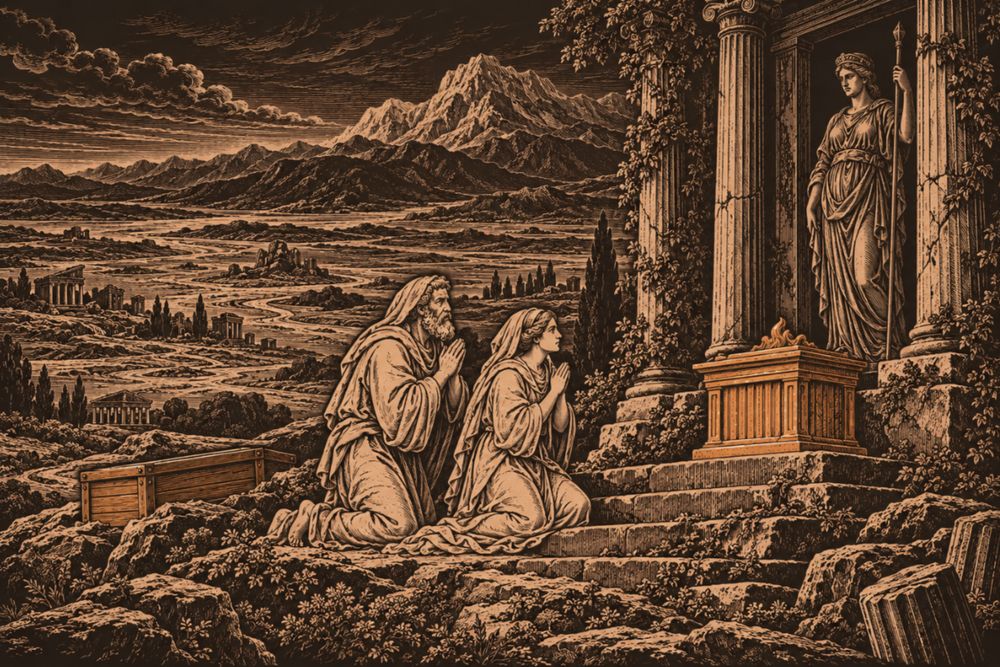
At the shrine of Themis
Generated by AI from this page's own facts, not an ancient image or evidence of anything. How this site uses generated images
Deucalion's craft floats over the sea for nine days and nights in Apollodorus, and it drifts to Parnassus. When the rain stops he lands and sacrifices to Zeus, the god of Escape. Zeus sends Hermes and lets Deucalion choose anything he wants. Deucalion asks for people.
Ovid has no chest. His Deucalion and Pyrrha arrive on Parnassus in a small, fragile boat, when only the twin peaks rise above the water. Ovid says they had come to worship the Corycian Nymphs, the mountain deities, and Themis, who in that age gave oracles. He adds that no man was better or more just than Deucalion, and no woman more devout than Pyrrha. Jupiter sees the last two innocent people and clears the sky.
When the sea retreats, Ovid's Deucalion weeps. He calls Pyrrha his sister and his wife, and wishes he could make people again by his father's art. The couple go to the temple of Themis, covered in moss and with its altar fires cold, and ask how the human race can be restored. Her answer is one of the most famous oracles in Greek and Roman myth.
Depart from me and veil your brows; ungird your robes, and cast behind you as you go, the bones of your great mother.
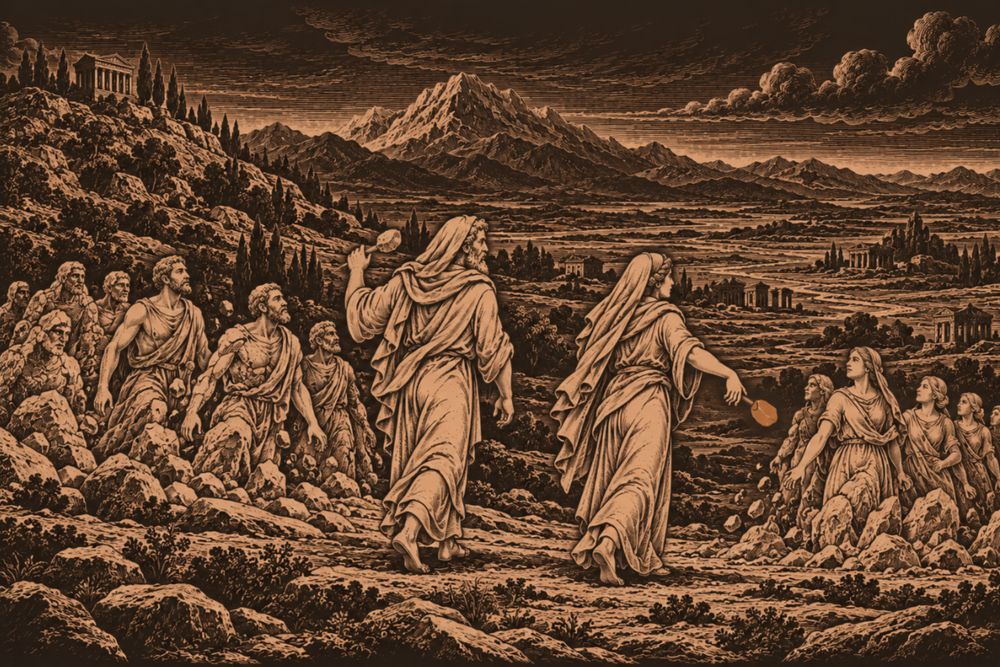
The stones become people
Generated by AI from this page's own facts, not an ancient image or evidence of anything. How this site uses generated images
Pyrrha refuses, afraid to insult her mother's bones. Deucalion works out the riddle. Their mother is the Earth, and the stones of the earth are her bones. They veil their heads, loosen their clothes and throw stones behind them. Ovid says it would be beyond belief, if the ages were not a witness. The stones soften and take on rough human form, like unfinished marble statues. The moist parts become flesh and the hard parts bone. The stones Deucalion throws become men, and the stones Pyrrha throws become women.
Apollodorus makes the stones a gift from Zeus, brought by Hermes. He derives the Greek word for people, laos, from laas, a stone. Pindar plays on the same pun in his ninth Olympian Ode. There Pyrrha and Deucalion come down from Parnassus by the ordinance of Zeus and found a unified race of stone offspring without a marriage-bed, and the stones give the people their name.
Apollodorus then lists the couple's children: first Hellen, then Amphictyon, then a daughter, Protogenia. He adds that some say Hellen's father was Zeus.
What Followed
Deucalion's children are the first generation of a new race. Apollodorus names Hellen, Amphictyon and Protogenia. Hellen is the eldest, and Apollodorus says some claim Zeus fathered him. Amphictyon reigns in Attica after Cranaus. The flood follows the cosmic history told in Creation from Chaos and opens the family histories that Apollodorus records for later generations.
Afterlife and Modern Influence
Ovid's Metamorphoses carried the tale into Roman literature, and its riddling oracle, in which the bones of the mother are the stones of the earth, is the best-known part. Pindar had already used the story to explain the word for people, and Apollodorus repeats the pun. The flood is remembered mostly through these three writers, who agree on the couple and the stones and differ on almost everything else.
How did Deucalion survive the flood?
In Apollodorus, Deucalion followed the advice of his father Prometheus and built a chest. He stocked it with provisions and sailed in it with Pyrrha for nine days and nights until it grounded on Parnassus. In Ovid the pair reach Parnassus in a small boat, and Jupiter stops the storm when he sees them.
Apollodorus, Library 1.7.2
What is the Greek myth about the flood?
Zeus decides to destroy humankind. In Apollodorus he wipes out the Bronze Age with heavy rain, and in Ovid he does it after Lycaon's crime, with Neptune's help. Only Deucalion and Pyrrha survive. Afterwards they throw stones over their shoulders, and the stones turn into a new human race.
Ovid, Metamorphoses 1.253-347
What is Deucalion known for?
Deucalion is known as the survivor of the flood and the man who repopulated the earth. He is the son of Prometheus and husband of Pyrrha. Apollodorus names Hellen as his first child. Apollodorus says he reigned in the region around Phthia.
Apollodorus, Library 1.7.2
What was the main reason that Deucalion and Pyrrha survived the flood?
The sources give two reasons. Apollodorus says Deucalion built a chest because Prometheus advised him to. Ovid says the pair were blameless and devout: Deucalion was the most just of men, and Pyrrha the most god-fearing of women, and Jupiter spared them when he saw them.
Ovid, Metamorphoses 1.253-347
Who is the son of Deucalion and Pyrrha in Greek mythology?
Their son is Hellen. Apollodorus lists Hellen first among their children, then Amphictyon and a daughter, Protogenia, and adds that some say Hellen's father was Zeus. Deucalion is the recorded father in the main line of the account. Amphictyon later reigned in Attica after Cranaus.
Apollodorus, Library 1.7.2
Who was Pyrrha in Greek mythology?
Pyrrha was Deucalion's wife and the daughter of Epimetheus and Pandora, the first woman. She survived the flood with him, sailed in the chest to Parnassus, and threw stones that became women. Ovid calls her Epimetheus' daughter and shows her hesitating before Themis's command.
Apollodorus, Library 1.7.2
Where Accounts Differ
- cause-of-the-flood
- chest-or-boat
- why-they-survived
- who-ordered-the-stones
- pindar-stone-born-race
- hellens-father
- neptunes-part
- The cause of the flood differs. Apollodorus, Library 1.7.2, says only that Zeus meant to destroy the men of the Bronze Age. Ovid, Metamorphoses 1.163-252, ties it to the crime of Lycaon and a divine council.
- The vessel differs. Apollodorus, Library 1.7.2, has a chest built on Prometheus's advice. Ovid, Metamorphoses 1.253-347, has a small boat and no warning. In Ovid, Deucalion and Pyrrha are simply the two left over.
- The reason for survival differs. Apollodorus credits Prometheus's advice. Ovid, Metamorphoses 1.253-347, credits the couple's virtue, and says Jupiter spared them when he saw them.
- Who ordered the stones differs. In Apollodorus, Library 1.7.2, Zeus sends Hermes, and Deucalion chooses to have men. In Ovid, Metamorphoses 1.348-415, Themis gives the riddling oracle, and the couple work out its meaning.
- Pindar, Olympian Ode 9.40-60, says the couple founded the stone-born race without a marriage-bed, and that Zeus ordained their coming down from Parnassus. Apollodorus and Ovid say nothing of a marriage-bed.
- The father of Hellen is disputed. Apollodorus, Library 1.7.2, names Deucalion as father but reports that some say Zeus was.
- Ovid, Metamorphoses 1.253-347, names Neptune as Jupiter's partner in the flood. Apollodorus, Library 1.7.2, names only Zeus.
Read the full source verification →
Mythology
Figures In This Myth
Also Connected
Related Terms
Referenced By
Sources
- Apollodorus, Library 1.7.2
- Ovid, Metamorphoses 1.163-252
- Ovid, Metamorphoses 1.253-347
- Ovid, Metamorphoses 1.348-415
- Pindar, Olympian Ode 9.40-60