Themis
Themis is one of the twelve original Titans, a daughter of Ouranos and Gaia whose name means something close to "that which is laid down" - divine law, custom, and right order. After the Olympians' rise, Zeus took her as a wife, and she bore him the Horae, who govern the seasons and the works of mortal life, and the Moirai, the three Fates who measure out every life's length. Unlike most Titans, she survives into later cult and literature as an active force: a goddess of prophecy in her own right, once said to have held the Delphic oracle before Apollo, and, in Aeschylus, the mother whose foreknowledge saves Prometheus from Kronos's fate.

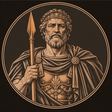
Themis, Titan of divine law and prophecy
Generated by AI from this page's own facts, not an ancient image or evidence of anything. How this site uses generated images
Sections on this page
See Themis in the Greek family tree.
Core Myth
Hesiod's Theogony lists Themis among the twelve Titans born to Ouranos and Gaia, the generation that ruled the cosmos before the Olympians. After Zeus's rise to power, Hesiod records that he took Themis as one of his wives, and that she bore him the Horae, Eunomia (Order), Dike (Justice), and Eirene (Peace), who tend the affairs of mortal men, and separately the three Moirai, Clotho, Lachesis, and Atropos, the Fates to whom Zeus himself grants the greatest honor. Unusually for a Titan of her generation, Themis is not simply absorbed into the succession myth as a name in a family tree - Hesiod's phrasing treats her marriage to Zeus, and the offices her daughters hold, as part of how the new Olympian order actually functions.
Who are Themis's parents and siblings?
Hesiod names her as one of the twelve Titans born to Ouranos and Gaia, making her a sibling of Kronos, Rhea, Mnemosyne, and the rest of that first generation, all born before the Olympians existed.
Hesiod, Theogony 132-138
What children did Themis have with Zeus?
Two sets of daughters. The Horae, Eunomia (Order), Dike (Justice), and Eirene (Peace), who mind the works of mortal life, and separately the three Moirai, Clotho, Lachesis, and Atropos, the Fates, to whom Hesiod says Zeus himself gave the greatest honor of all.
Hesiod, Theogony 901-906
Was Themis ever connected to the Delphic oracle?
Yes, in a tradition that predates and complicates Apollo's own claim to it. Ancient sources describe a succession of owners at Delphi before Apollo took the shrine for himself, and Themis appears in that line as an early holder of its prophetic power, giving her an authority over foresight that outlasts her single scene in Hesiod's genealogy.
Is Themis really Prometheus's mother?
In one tradition, yes, though it is not the standard genealogy. Aeschylus's Prometheus Bound has Prometheus call Themis, whom he identifies as one and the same with Gaia under different names, his own mother, and credit her foreknowledge with the advice that let him side with Zeus during the Titanomachy. Hesiod and most other sources instead name Iapetus and the Oceanid Clymene as his parents; the two accounts were never reconciled.
Aeschylus, Prometheus Bound 209-213
Why does the Moirai's parentage disagree with the rest of Hesiod's account of them?
Hesiod actually gives the Moirai two different origins in the same poem: once as daughters of Night alone, born of no father, and once, in the passage about Themis, as daughters of Zeus and Themis, ranked among the honors Zeus grants. The two genealogies sit side by side without being reconciled, and later authors used whichever suited the scene they were writing.
Hesiod, Theogony 901-906
Later Traditions
Themis's association with prophecy outgrew her single scene in the Theogony. Later tradition held that she once possessed the oracle at Delphi, later spoken through the priestess known as the Pythia, before handing it down (through Phoebe, in some versions) to Apollo, giving her a claim to prophetic authority older than the god most associated with it. Aeschylus's Prometheus Bound goes further and makes the connection personal: Prometheus calls Themis, whom he identifies with Gaia as "one form, many names," his own mother, and credits her foreknowledge with the counsel that let him back the winning side in the war between the Titans and the Olympians - a variant that sits alongside, rather than replaces, the more common account naming Iapetus and the Oceanid Clymene as his parents. Ovid gives her a part in the flood story: Deucalion and Pyrrha, the only survivors, ask her oracle how to renew humanity, and she tells them to throw the bones of their great mother behind them.
Lineage
See the full family tree3 recorded relations, each with the ancient line behind it.
Parents
-

Ouranos and Gaia are the parents of all twelve original Titans, including Themis.
-

Ouranos and Gaia are the parents of all twelve original Titans, including Themis.
Siblings
-

Both are counted among the twelve original Titans in Hesiod's Theogony.
Also Connected
3 recorded connections, each with the ancient line behind it.
Connected
-
Themis warns that Thetis's son will be stronger than his father and counsels that she be given to Peleus, the most pious man of Iolcus.
-

In Aeschylus's Prometheus Bound, Prometheus names Themis, identified there with Gaia as one form under many names, as his own mother and the source of the foreknowledge that let him side with Zeus. Hesiod and most other sources instead name Iapetus and Clymene as his parents.
-

Themis prophesies that Thetis's son will be mightier than his father, the warning that leads Zeus and Poseidon to marry Thetis to the mortal Peleus instead.
Read the full source verification →
Mythology
Appears In
Related Terms
Referenced By
Sources
- Hesiod, Theogony 132-138
- Hesiod, Theogony 901-906
- Aeschylus, Prometheus Bound 209-213
- Ovid, Metamorphoses 1.253-347
- Ovid, Metamorphoses 1.348-415
- Timothy Gantz, Early Greek Myth (1993)