Pandora
Pandora was created by the gods on Zeus's orders as a punishment for humanity after Prometheus stole fire. Each god gave her a gift - beauty, cunning, curiosity - and she was sent to earth with a sealed jar. When she opened it, all the evils of the world escaped, leaving only Hope inside.

Pandora, the first mortal woman of Greek myth
Generated by AI from this page's own facts, not an ancient image or evidence of anything. How this site uses generated images
Sections on this page
What does the name "Pandora" mean? →
Looking for a name of your own? Try the mythological name generator.
Core Myth
Hesiod tells the story twice, in two different works, with different emphases each time. In the Theogony, Zeus orders Pandora's creation as direct retaliation. Prometheus has tricked him at a sacrifice and then stolen fire for humanity a second time. Hephaestus shapes her out of earth and water in the likeness of a modest maiden, and Athena dresses and adorns her (Theogony 570-584). Hesiod frames the result as a "beautiful evil" given to men in exchange for the good of fire (Theogony 585). It is a trap built to look like a gift.
Works and Days tells the fuller version of what happens next. Every god contributes something to her making. Hephaestus again shapes her body, and Athena teaches her needlework and weaving. Aphrodite pours grace and painful longing over her. Hermes gives her a deceptive nature, cunning, and the power of speech (Works and Days 60-68). That is why she is named Pandora, "all-gifted" (Works and Days 80-82). Zeus gives her a sealed storage jar, a pithos. He sends her to Epimetheus, Prometheus's brother, whose name means "afterthought." Epimetheus accepts the gift despite his brother's explicit warning never to take anything from Zeus (Works and Days 83-89). Pandora opens the jar, whether from curiosity or because opening it was simply what she was made to eventually do. She releases sickness, hard labor, and countless other evils to spread invisibly among mortals, who had lived free of them before (Works and Days 90-104). Only Hope, Elpis, remains trapped inside when she claps the lid back down (Works and Days 96-99).
Hesiod then offers a second account of the same loss. Straight after the jar, the Works and Days describes five successive races of humankind, beginning with the carefree Golden Age and sinking to the toil of the present Iron Age.
Why did Zeus create Pandora?
As punishment. After Prometheus stole fire for humanity a second time, following an earlier trick at a sacrifice, Hesiod's Theogony has Zeus order Pandora's creation as retaliation, calling the result explicitly a "beautiful evil" given to men in exchange for the good of fire, a gift designed to look desirable while causing harm.
Hesiod, Theogony 570-590
Which gods contributed to making Pandora, and what did each one give her?
Hephaestus shaped her body out of earth and water; Athena dressed her and taught her skilled needlework; Aphrodite gave her grace and a longing that causes pain; and Hermes gave her a deceptive character, cunning, and the gift of speech. Her name, meaning "all-gifted," refers directly to this collective divine contribution rather than to any single origin.
Hesiod, Works and Days 60-82
Was it really a box that Pandora opened?
No - the original Greek word is pithos, a large storage jar, not a small box. The mistranslation comes from the sixteenth-century scholar Erasmus, who rendered it into Latin as pyxis, meaning box, likely confusing it with an unrelated story. "Pandora's box" has stuck in English ever since despite not matching the Greek text.
Hesiod, Works and Days 94-98
Why did Epimetheus accept Pandora despite his brother's warning?
Hesiod does not give Epimetheus a clear motive beyond his name itself, which means "afterthought" or "hindsight" - the opposite of Prometheus, "forethought." He is characterized as the brother who understands a mistake only once it has already happened, and accepting Pandora despite Prometheus's explicit warning is presented as exactly that kind of failure.
Hesiod, Works and Days 83-89
Why did Hope stay in the jar while all the evils escaped?
Hesiod states the fact - that Hope alone remained under the jar's lip when Pandora shut it - without explaining whether this is fortunate or cruel. Ancient and modern readers disagree: some read it as a small mercy that spared humanity at least one relief, others as a further punishment, keeping hope permanently out of reach of the suffering already loose in the world. The text itself does not resolve which reading is correct.
Hesiod, Works and Days 96-99
Later Traditions
Erasmus, translating the story into Latin in the sixteenth century, rendered pithos as pyxis, a small box. He apparently confused it with an unrelated story he knew from Latin sources. "Pandora's box" has been the standard English phrase ever since, even though nothing in the Greek text describes anything box-shaped. Hope may be a small mercy or a further cruelty that keeps hope out of reach of the suffering the jar releases. That has been argued over since antiquity, and Hesiod's text does not settle it either way. Modern feminist scholarship has widely read Pandora as a Greek counterpart to Eve, the woman blamed for the world's troubles, though the two stories developed independently. The premise that a woman's body can be shaped rather than born recurs elsewhere in Greek myth, most directly in Pygmalion's ivory statue, carved by his own hand and warmed into life by Aphrodite rather than shaped by a craftsman-god at Zeus's order.

Pandora - Odilon Redon, 1910/1912, oil on canvas
National Gallery of Art, Washington, DC, 1963.10.56. CC0
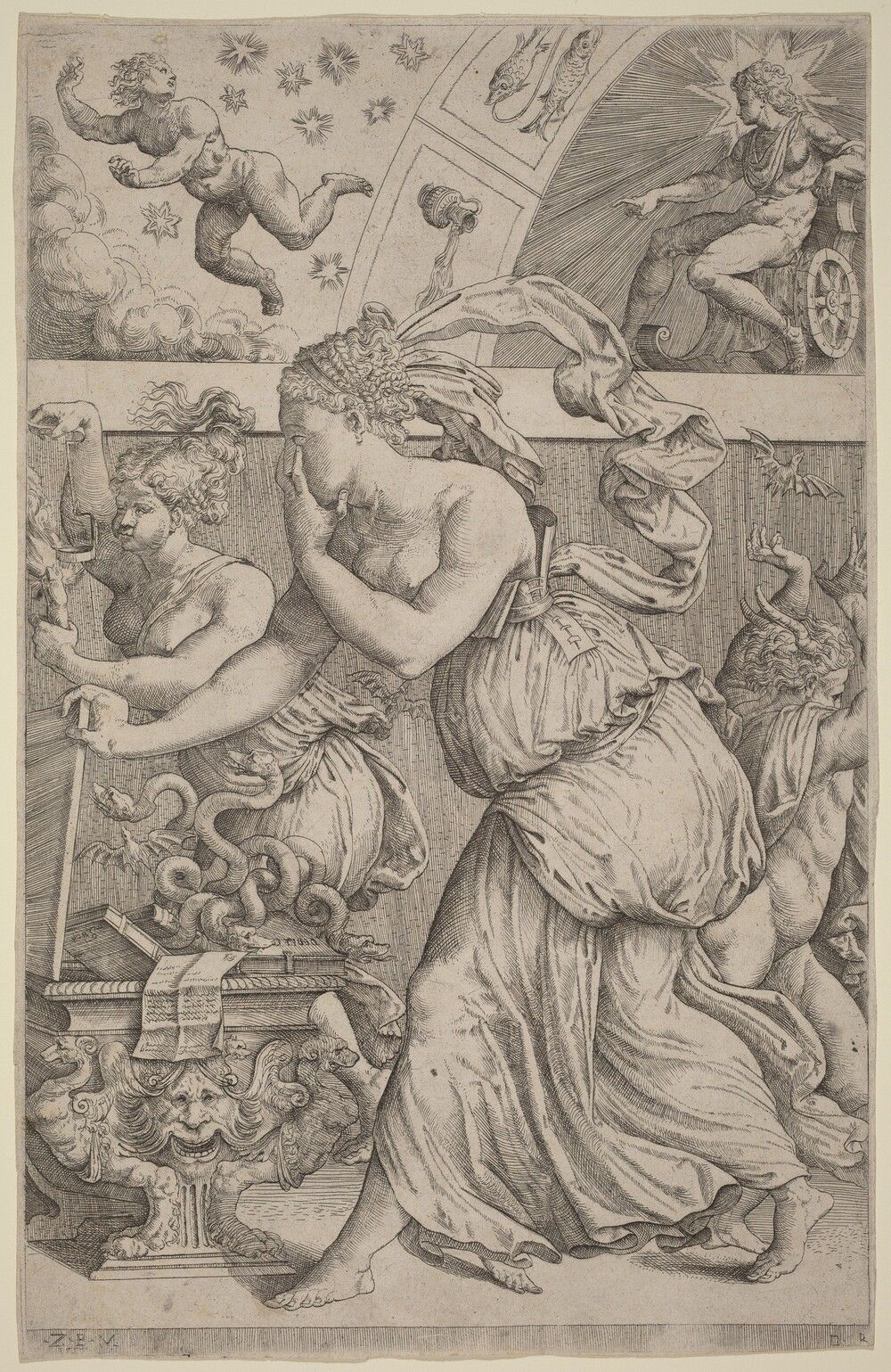
Pandora Opening Her Box - Master Z.B.M., 1557, etching with engraving on laid paper
National Gallery of Art, Washington, DC, 1972.33.8. CC0
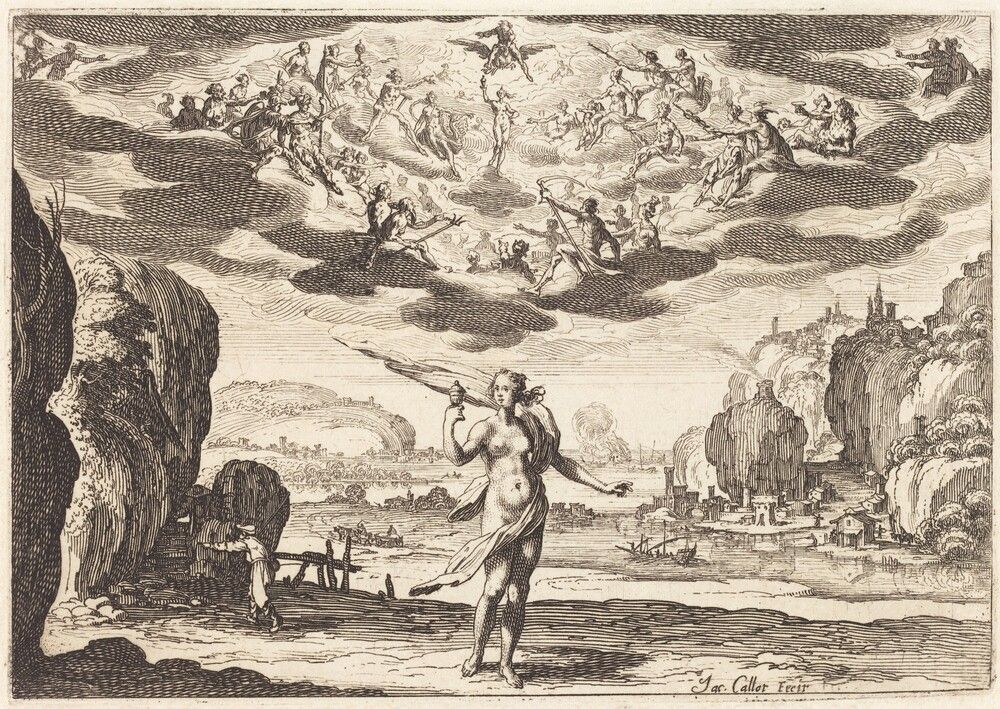
Pandora - Jacques Callot, 1625, etching on laid paper
National Gallery of Art, Washington, DC, 1969.15.545. CC0
Also Connected
6 recorded connections, each with the ancient line behind it.
Connected
-

Athena dressed her and taught her skilled needlework, one of several gods who each contributed a gift to her making.
-

Epimetheus accepts Pandora as his wife despite Prometheus's warning, the decision his whole myth turns on.
-

Hephaestus shaped her body out of earth and water at Zeus's command, the same craftsman's role he plays in several other origin stories.
-

Zeus ordered Pandora's creation specifically as retaliation after Prometheus stole fire for humanity a second time; her entire myth exists as the price of his theft.
-
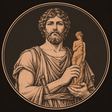
Both are women's bodies shaped by a craftsman and then animated by divine power rather than born: Pandora molded from earth and water by Hephaestus at Zeus's order, Pygmalion's ivory statue carved by his own hand and warmed to life by Aphrodite.
-

Zeus ordered her making, gave her the sealed jar of evils, and sent her to earth as his own act of retaliation against humanity.
Where Accounts Differ
- jar vs box translation
- was Hope's containment mercy or cruelty
- The original Greek says pithos (storage jar), not pyxis (box); the mistranslation traces to Erasmus in the sixteenth century and persists in popular culture as "Pandora's box."
- Whether Hope remaining in the jar is a mercy or a further cruelty is genuinely unresolved in Hesiod's text and has been argued over since antiquity.
Read the full source verification →
Mythology
Appears In
Related Terms
Referenced By
Sources
- Hesiod, Works and Days 53-105
- Hesiod, Theogony 570-590
- Apollodorus, Library 1.7.2
- Hesiod, Works and Days 109-201
- Dora and Erwin Panofsky, Pandora's Box (1956)
- Timothy Gantz, Early Greek Myth (1993)