Myth in Everyday Language
Dozens of English words come from Greek and Roman myth. Some trace straight back to a god's name: cereal from Ceres, money from Juno Moneta. Others are idioms built on a story, such as a Sisyphean task or the Midas touch. Several rest on details the oldest sources lack. Hesiod's Pandora opens a jar, not a box, and Homer's Achilles has no vulnerable heel.
Sections on this page
Overview
English borrowed some of its most ordinary words from the gods of Rome. Cereal comes from Ceres, the Roman grain goddess, through the Latin adjective cerealis. Money and mint come from the temple of Juno Moneta on the Capitol, where Rome struck its coins. January is the month of Janus, the god of doorways, and Ovid says King Numa placed it before the old months of the year. Not every likely pair holds up. The monster Typhon probably only reinforced the spelling of typhoon, a word most etymologists trace mainly to Arabic and Chinese.
A second group of words carries a whole story. A Sisyphean task is the endless labor of the king who rolls a stone uphill in Hades. The Midas touch is the golden gift that turns the king's food to metal in Ovid, though in English it now means a knack for making money. A hydra-headed problem grows back wherever it is cut, as the Hydra's heads did. The warning about Greeks bearing gifts belongs to Virgil's Laocoon, spoken before the wooden horse enters Troy. Nemesis was a goddess of retribution long before she was anyone's archrival, and nostalgia joins the Greek nostos, homecoming, to algos, pain.
A third group was coined by modern writers who read the myths for their own purposes. Freud named the Oedipus complex after Oedipus and drew on Sophocles's play to do it. Jung's Electra complex borrowed Electra, and Freud rejected the term. The psychiatric word narcissism, from Narcissus, dates only from 1899. Even older idioms can rest on later additions. Pandora opens a great jar in Hesiod, and the box arrived with a Renaissance translation. The aegis was a god's goatskin before it meant a sponsor's protection, a labyrinthine plan descends from one maze on Crete, and Lethean forgetfulness comes from Lethe, the river of forgetting.
In This Topic (17)
-

Ceres Character
Ceres is the Roman goddess of grain and agriculture, equivalent to the Greek Demeter, and patron goddess of Rome's common people.
-

Juno Character
Juno is the Roman queen of the gods and a member of the Capitoline Triad, equivalent to the Greek Hera.
The source of money and mint, through her title Moneta and the mint that worked at her temple on the Capitol.
-
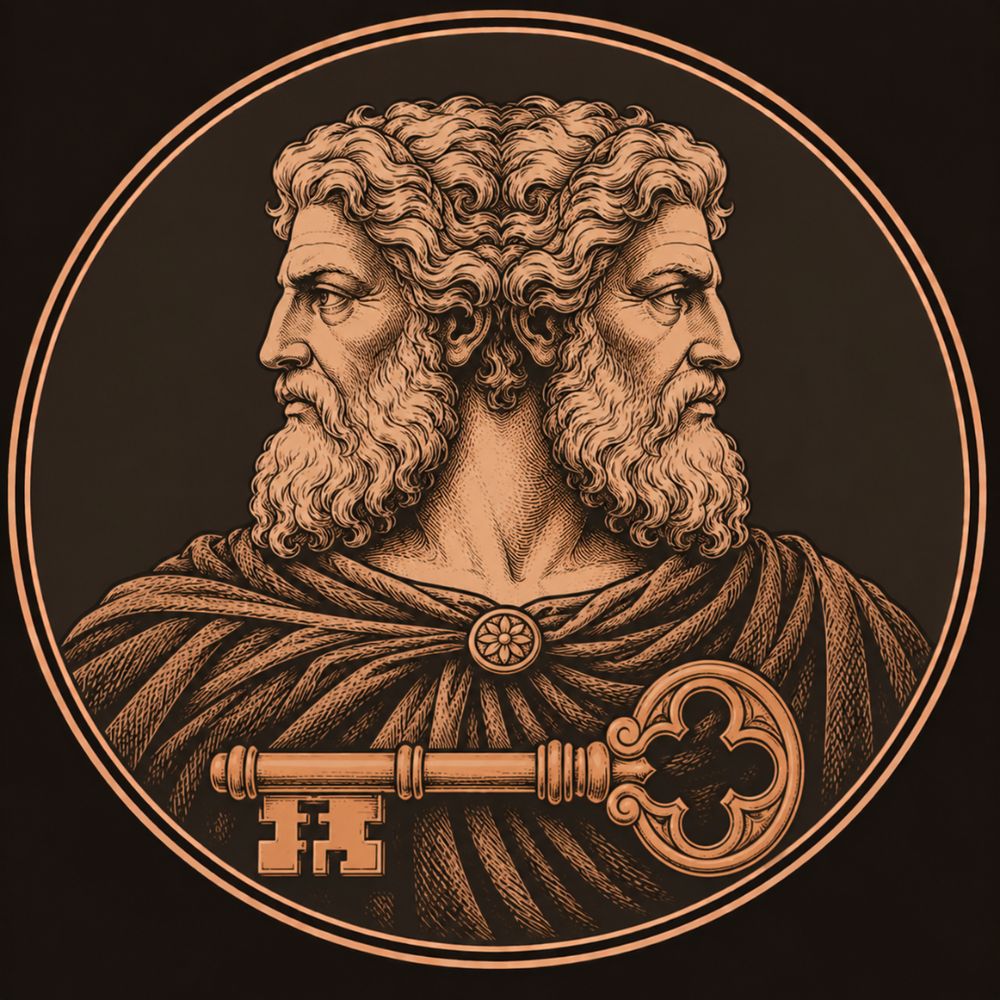
Janus Character
Janus is the two-faced Roman god of doorways, gates and beginnings, whose shrine stood open in war and shut in peace.
-

Typhon Character
Typhon is the most fearsome monster in Greek mythology, born to challenge Zeus's rule and defeated only after an enormous battle.
The cautionary case. The resemblance to typhoon is real, but the word's history runs mainly through Arabic and Chinese, with the Greek name at most shaping its spelling.
-
Sisyphus and the Boulder Story
Sisyphus pushes a boulder uphill in Hades, and it rolls back each time, as Odysseus sees in Homer's Odyssey. Apollodorus and Pausanias say the punishment follows his telling the river god Asopus that Zeus had carried off Aegina. Later scholia add that he chained Death, and Theognis says he talked Persephone into letting him return from Hades.
-
Midas and the Golden Touch Story
The golden touch is the gift Dionysus gives King Midas of Phrygia in Ovid's Metamorphoses, after Midas returns the captured Silenus: whatever he touches turns to gold. It ruins his meals, and Dionysus tells him to wash in the source of the river Pactolus, which takes the gift away. The tale of Midas turning his daughter to gold is not ancient. It comes from Nathaniel Hawthorne, in 1851.
-

Hydra Character
The Hydra is a many-headed serpentine monster whose heads regenerated when cut off.
-
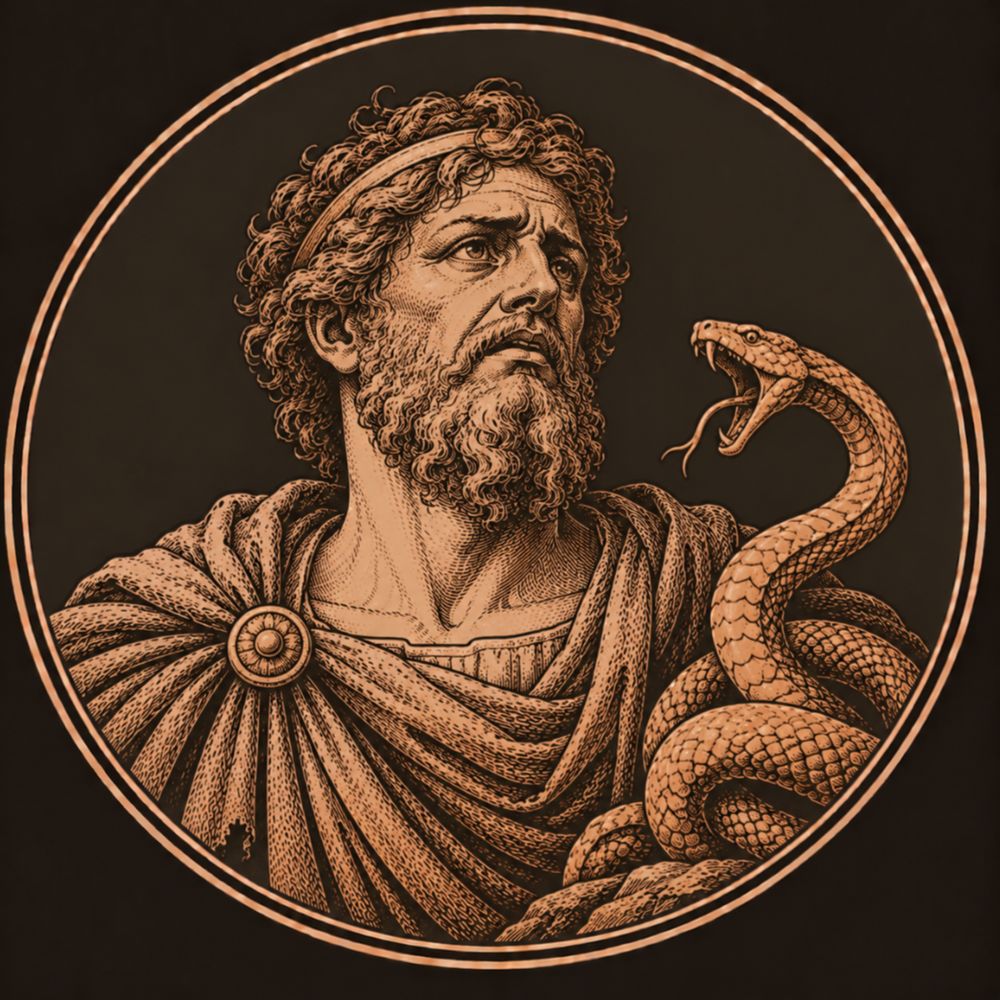
Laocoön Character
Laocoön is the Trojan priest who warned his city against the wooden horse and was then attacked by sea serpents, in a story whose cause and victims change with each ancient teller.
The speaker of the line behind beware of Greeks bearing gifts, Virgil's timeo Danaos et dona ferentis.
-
Nemesis (Concept) Term
In modern English, a "nemesis" is an archrival or an inescapable downfall, the person or force that finally brings someone low after a run of unearned success. That usage descends from the goddess Nemesis, but it captures something broader than her: a moral and cosmic idea, present throughout Greek thought long before and independent of her personification, that excessive good fortune or overreaching pride eventually calls down a corrective response. This entry covers that idea; the goddess's own genealogy and myths belong on her own page. Herodotus gives the idea its most famous ancient statement outside Hesiod, in the speech of Artabanus warning Xerxes before the invasion of Greece. Artabanus tells the king that the god strikes down anything that grows too great and refuses to let it show pride, that lightning bolts always fall on the tallest buildings and trees rather than small ones, and that the god tolerates greatness and pride in no one but himself. The passage does not describe the goddess Nemesis directly; it states the underlying logic she personifies, that the divine actively resists and eventually corrects human excess, entirely on its own terms. Hesiod's Works and Days makes the same point through the figure of Justice rather than Nemesis by name: Justice, dragged off and abused by corrupt judges who take bribes, nonetheless catches up with wrongdoing in the end, and "the fool learns this only when he has suffered." The delay between an offense and its correction, not an instant punishment, is the recurring shape of the idea across these different tellings, whether the corrective force is named Nemesis, Justice, or simply "the god." The concept is tightly bound to hubris, the specific kind of overreaching pride or disrespect that provokes it: nemesis is less a punishment for any wrongdoing than the answer specifically to hubris, to claiming more standing, honor, or fortune than a mortal is entitled to. That coupling, hubris followed eventually by nemesis, became one of the most durable narrative patterns in Greek tragedy and historiography alike, and it is the pattern that survives into English every time the word names an unavoidable rival or comeuppance rather than a Greek goddess.
-
Nostos Term
Nostos is Greek for "homecoming" or "return," and in the study of Greek epic it names both a specific idea and a whole lost genre. As an idea, it is the theme of a hero's journey back from Troy to his own home and kingdom, and it stands opposite kleos, the lasting glory a hero wins through great deeds. Where kleos is what a hero is remembered for, nostos is whether he actually gets to go home and enjoy it, and the two do not automatically come together: a hero can win one and lose the other. Homer's Odyssey states the theme in its opening lines, before the story itself begins: the poet asks the Muse to tell of the man who wandered for years, suffering greatly at sea, trying to save his own life and win the return, nostos, of his companions. The entire twenty-four-book epic is built around that single word, following the one homecoming in the tradition that actually succeeds, after a full decade of delay, monsters, divine obstruction, and the deaths of every companion whose own nostos the poem's opening line has already told the audience will fail. On Aeaea, Circe's drugged food is meant to make his men forget their native land, as told in Circe and the Swine. On Scheria the princess Nausicaa bids him farewell and asks him to remember her in his own land (Odyssey 8.457-468). Odysseus's nostos was not unique in ancient poetry, only the one that survived complete. A now-lost epic called the Nostoi, "the Returns," once told the homecomings of the other Greek leaders from Troy, and while the poem itself has not survived, Apollodorus's Epitome preserves a summary of its outline. It describes a fleet scattered by a storm that Athena herself asked Zeus to send, still angry at the Greeks for their conduct at Troy, wrecking many ships at once; Menelaus blown off course all the way to Egypt; and other leaders meeting death or prolonged wandering on their way home. Read against that outline, Odysseus's own decade-long ordeal looks less like an exceptional punishment aimed at him alone and more like the fate that met the entire victorious army returning from Troy, one version among several equally troubled returns, distinguished mainly by having survived as a complete poem in its own right. The pattern recurs across the wider tradition: Agamemnon's nostos ends in his murder the moment he reaches home, and in Apollodorus's Epitome the revenge that follows begins when his daughter Electra smuggles the boy Orestes away to Phocis; and other heroes are said to have wandered for years or founded cities far from where they started rather than ever truly returning. "Nostos" as a scholarly term now covers this entire pattern, the idea that surviving the war was never the same as making it home, and it survives in English in the medical word "nostalgia," literally the pain, algos, of nostos, of longing for a home a person cannot yet reach.
The Greek half of nostalgia, the ache of longing for home.
-
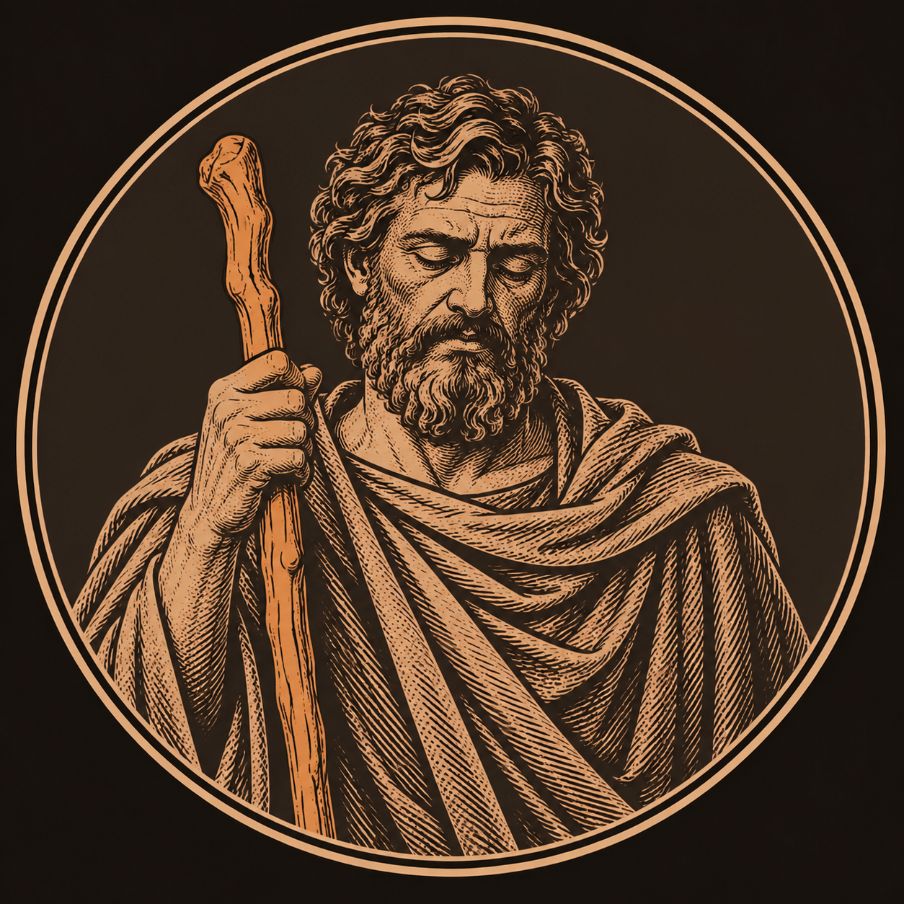
Oedipus Character
Oedipus is the king of Thebes who killed his father and married his mother without knowing either was his parent, the best-known case in Greek myth of a prophecy fulfilled by the flight from it.
-
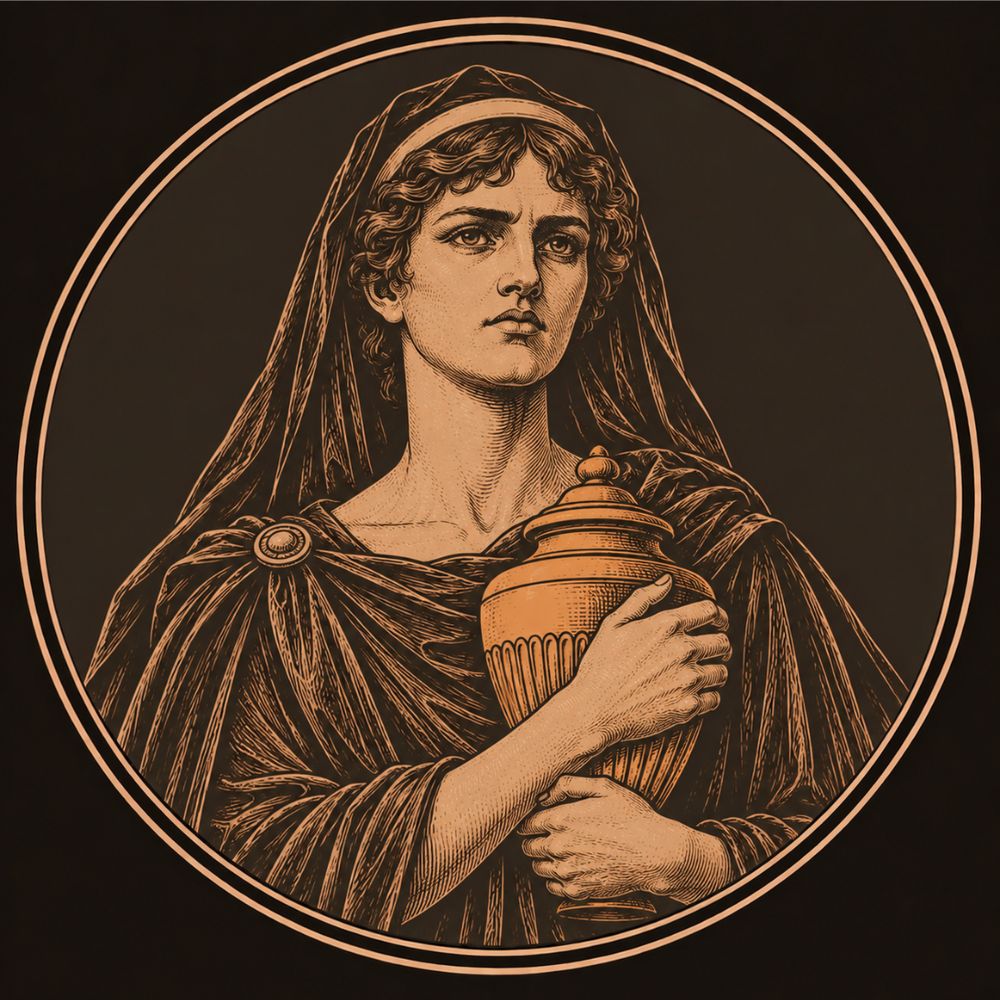
Electra Character
Electra is the daughter of Agamemnon and Clytemnestra who mourns her murdered father for years and helps her brother Orestes avenge him by killing their mother.
Named in Jung's Electra complex of 1913, a term built on the Oedipus complex that Freud himself did not accept.
-
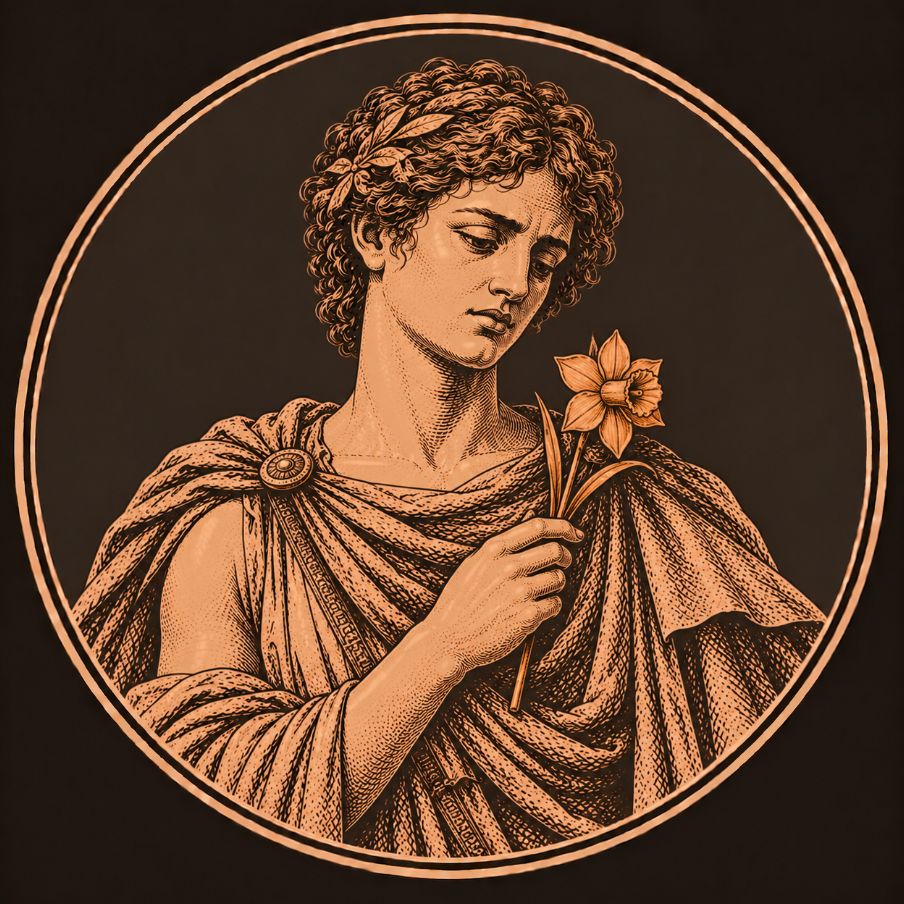
Narcissus Character
Narcissus is the beautiful youth of Boeotian Thespiae who spurned every lover and fell for his own reflection, and whose death gave its name to a flower.
The source of narcissism, a clinical term chosen in 1899, centuries after Ovid's story and with a narrower meaning than the everyday word.
-

Pandora Character
Pandora is the first mortal woman in Greek mythology, who opened a jar releasing all evils into the world.
-
Aegis Term
The aegis is a divine defensive device carried by Zeus and Athena in Greek mythology, most often described as a tasseled goat-skin shield or breastplate edged with serpents and capable of spreading terror across a battlefield. Homer calls it shaggy, dazzling, and unageing, and treats it as Zeus's own possession first: he lends it to Apollo and to Athena in different passages of the Iliad, and whoever carries it can rout an army simply by shaking it. In the fullest Homeric description, Athena arms herself with the aegis before battle and it carries images of Rout, Strife, Might, and Pursuit worked into its surface, with the Gorgon's head fixed at its center, ringed by Terror. This is the detail every later source keeps: after Perseus killed Medusa and gave her head to Athena, the goddess mounted it on her aegis, so the two objects - the divine shield and the monster's severed head - become permanently associated even though Homer's version of the aegis already carried a Gorgon-image before that story was fully attached to it. Craftsmanship is credited to Hephaestus in later tradition, which places the aegis alongside his other divine commissions, but Homer himself does not name a maker; he simply treats it as one of Zeus's standing attributes, part of why the poet's stock epithet for Zeus is "aegis-bearing." Whether the aegis is a shield, a cloak, or a breastplate is genuinely inconsistent across the ancient sources, and the disagreement is not a modern confusion so much as a real feature of how the object was imagined differently by different poets and vase painters. The word survives well past its mythological origin. "Under the aegis of" entered English as a phrase for protection or official sponsorship directly from this object's function as a source of divine cover, and the term is used this way in modern institutional and legal contexts with no reference to Zeus, Athena, or the Gorgon's head at all - a rare case of a specific piece of mythological equipment, rather than a god's name or a general theme, becoming ordinary vocabulary on its own.
The rare idiom built on an object rather than a god: under the aegis of, from the divine cover the aegis gave Zeus and Athena.
-
The Labyrinth Term
The Labyrinth is the vast, inescapable maze built beneath the palace of Knossos on Crete, designed by the craftsman Daedalus at the command of King Minos to hold the Minotaur, a creature with a bull's head on a man's body. The Minotaur is itself the product of an earlier offense: Minos had failed to sacrifice a bull Poseidon sent him, and in punishment the god made Minos's wife Pasiphaë fall in love with the animal, with Daedalus building a wooden cow to let her conceive; the Minotaur is the result, and the Labyrinth is built specifically to contain what that punishment produced. Minos himself owed his own birth to a bull in disguise: Zeus had carried his mother, the Phoenician princess Europa, to Crete in that same shape a generation earlier. Athens paid a periodic tribute of youths and maidens, sent into the Labyrinth to be devoured by the Minotaur, as the price of a war Minos had won against the city. Theseus, son of the Athenian king, volunteers to go among the tribute intending to kill the Minotaur, and succeeds only with outside help: Ariadne, Minos's daughter, falls in love with him and gives him a ball of thread to unwind as he enters, so that after killing the Minotaur he can find his way back out of a maze that was otherwise designed to make return impossible. Daedalus himself was later imprisoned in the Labyrinth by Minos, along with his son Icarus, precisely because he had helped Ariadne betray the maze's secret - which is the reason the two escape by flying with wings of feathers and wax rather than by any land or sea route, tying the Labyrinth directly to the separate story of Icarus's fall. The Labyrinth's name has outlasted the specific myth: "labyrinthine" now describes any structure or situation so intricate that navigating it without a guide is effectively impossible, a generalization from a maze built for one particular monster into a word for structural complexity itself, independent of Minos, the Minotaur, or Crete.
-
Lethe Term
Lethe is Greek for "forgetfulness," and the word names two related but distinct things in the ancient sources: a primordial personification in the earliest genealogical tradition, and a river of the underworld in the later tradition that became far more famous. The two are connected by meaning rather than by a single continuous story, and most people who encounter the name today only know the second. Hesiod's Theogony places Forgetfulness among the grim children born to Strife (Eris) alone, in the same short list as Toil, Famine, Sorrows, and outright violence such as Murder and Manslaughter. In this earliest appearance she is an abstraction with no river, no cult, and no independent myth of her own, one item in a catalogue of the miseries that Strife brings into the world rather than a place souls visit. The river tradition develops separately and later, and becomes the version modern readers actually mean by "the river Lethe." Virgil's Aeneid gives the fullest classical account: in the underworld, souls destined to be reincarnated gather at the river's edge and drink its water specifically to lose the memory of their former lives before being sent back to a new body. The drinking is not incidental, it is the mechanism of reincarnation itself, wiping clean whatever came before so the soul can begin again without carrying its old memories forward. The river's function sits in deliberate opposition to Mnemosyne, the Titan goddess of Memory, whose name is built from the same root as "mnemonic" the way Lethe's is built from the root behind "lethal" and "lethargy." Where Mnemosyne preserves, Lethe erases, and the pairing of a goddess of Memory with a river of Forgetting in the same broader cosmology reflects how central the tension between remembering and forgetting was to how the Greeks and Romans thought about death, the underworld, and what, if anything, survives a soul's passage through it. Ovid's Metamorphoses uses Lethe differently again, locating it as the murmuring stream running past the cave of Somnus, the god of Sleep, where its sound helps induce drowsiness rather than serving the reincarnation function Virgil describes. The river shows up across Greco-Roman literature wherever a poet needs a physical image for forgetting, sleep, or the erasure of memory, which is exactly why the word survives today as an ordinary English adjective, "Lethean," describing anything that induces forgetfulness or oblivion.
The source of Lethean, the literary adjective for anything that brings forgetfulness.
Did Freud find the Oedipus complex in Sophocles?
He found his evidence there, but the play's hero does not have the desire Freud named after him. In Sophocles's Oedipus Tyrannus, Oedipus flees Corinth to escape the prophecy that he will kill his father and marry his mother, and he does both without knowing who they are. The line Freud seized on belongs to Jocasta. Trying to calm her husband, she tells him that many men before now have lain with their mothers in dreams, and that whoever thinks nothing of such things lives most easily. Freud quoted the passage in The Interpretation of Dreams and named the complex in 1910. The wish is his reading. The myth itself turns on ignorance.
Sophocles, Oedipus Tyrannus 980-983
Where do the Achilles heel and Pandora's box come from, if not Homer and Hesiod?
Both idioms rest on details the oldest sources lack. Homer's Iliad treats Achilles as mortal and doomed, and never mentions an invulnerable body or a heel left dry in the Styx. That story is first securely attested in the Roman poet Statius's unfinished Achilleid, in the first century CE. Apollodorus has Achilles shot in the ankle at the Scaean gate, but says nothing of a single weak spot. Hesiod's Works and Days gives Pandora a pithos, a great storage jar, and she lifts its lid to scatter evils among men. The box arrived in the sixteenth century, when Erasmus rendered the jar in Latin as pyxis, a small box.
Hesiod, Works and Days 94-98; Apollodorus, Epitome 5.3; Statius, Achilleid
Is beware of Greeks bearing gifts an ancient saying?
Yes. It is Virgil's, and it belongs to Laocoon. In the Aeneid, the Trojan priest runs down from the citadel while his people crowd around the wooden horse. He asks whether they really think any gift of the Greeks is free of trickery, and ends with the line that became the proverb: I fear the Greeks even when they bring gifts. Homer's version of the horse has no Laocoon and no such warning. In the Odyssey, the bard Demodocus sings of the Trojans debating whether to break the horse open, throw it from the cliffs or leave it as an offering to the gods, and choosing the last.
Virgil, Aeneid 2.40-56; Homer, Odyssey 8.492-520
Where Accounts Differ
- pandoras-jar-vs-box
- achilles-heel-absent-from-homer
- oedipus-complex-modern-reading
- Etymology is modern philology, not an ancient claim. The ancient works cited here show what the myths say; the descent of each English word is recorded on the member pages, and where it is disputed, as with typhoon, it is marked as disputed.
- Pandora's container is a pithos, a storage jar, in Hesiod. The box comes from Erasmus's Latin pyxis in the sixteenth century, as traced by Dora and Erwin Panofsky.
- The invulnerable Achilles with one weak heel is absent from Homer and first securely attested in Statius's Achilleid. Apollodorus has Achilles shot in the ankle without making it his only vulnerable spot.
Related Topics
Related Terms
Sources
- Sophocles, Oedipus Tyrannus 980-983
- Hesiod, Works and Days 94-98
- Apollodorus, Epitome 5.3
- Statius, Achilleid
- Virgil, Aeneid 2.40-56
- Homer, Odyssey 8.492-520
- Ovid, Fasti 1.43-44
- Ovid, Metamorphoses 11.85-145
- Sigmund Freud, The Interpretation of Dreams (1900)
- Sigmund Freud, On Narcissism: An Introduction (1914)
- Dora and Erwin Panofsky, Pandora's Box (1956)