Laocoön
Laocoön was a Trojan priest who warned his city against the wooden horse. In Virgil's Aeneid he serves Neptune, hurls a spear into the horse, and is killed with both his sons by two sea serpents. Other ancient sources make Apollo or Athena the cause, and some spare the father. The Trojans then drag the horse inside.
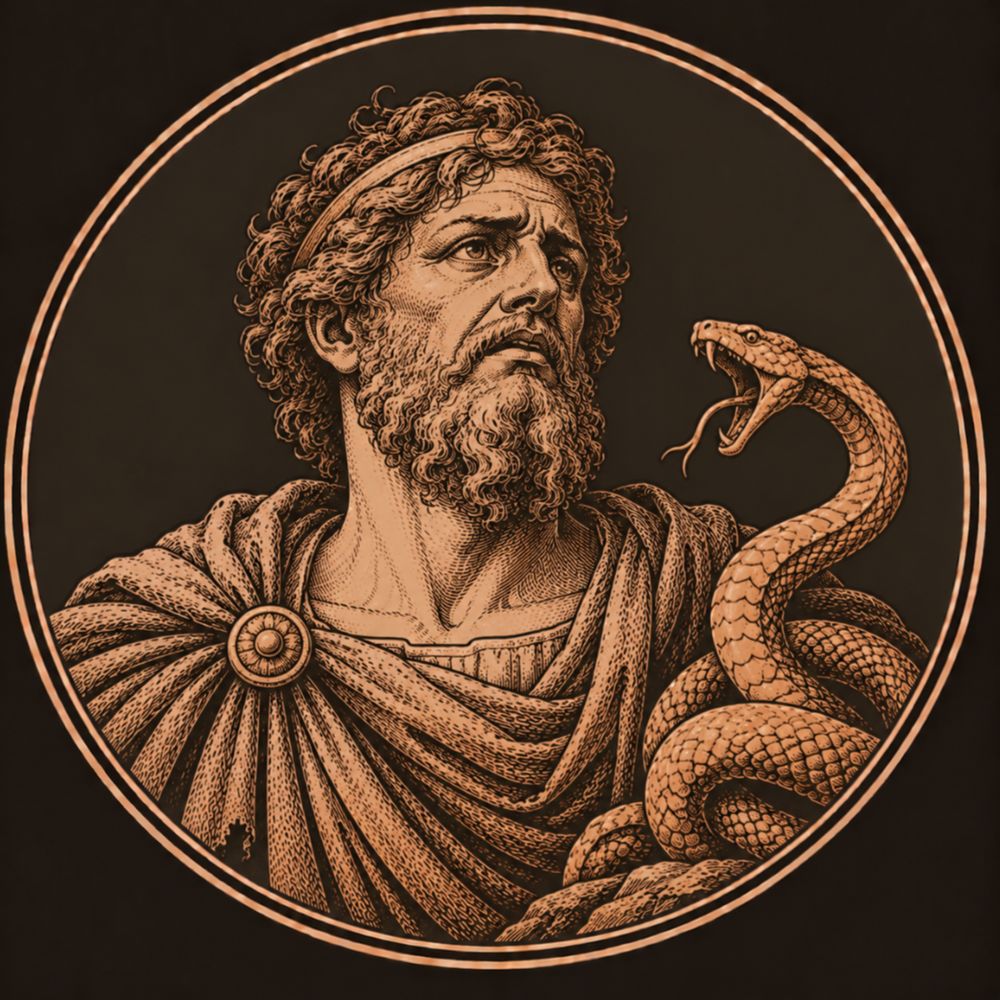
Laocoon, bronze medallion illustration
Generated by AI from this page's own facts, not an ancient image or evidence of anything. How this site uses generated images
Sections on this page
Core Myth
Laocoön was a priest at Troy in the last days of the siege, and the sources do not agree on whose. Virgil makes him a priest of Neptune, chosen by lot. Hyginus calls him a priest of Apollo, the son of Acoetes and brother of Anchises, which would make him the uncle of Aeneas. The commentator Servius, citing the poet Euphorion, says he was a priest of Thymbraean Apollo picked by lot when the Trojans needed someone to sacrifice to Neptune, and gives his wife's name as Antiopa.
The best-known scene is in Book 2 of Virgil's Aeneid. The Greeks have sailed away, leaving the wooden horse on the beach. Laocoön runs down from the citadel with a crowd behind him and asks whether the Trojans think the Greeks have really gone. He asks whether any Greek gift is free of trickery, and whether anyone knows Odysseus as an honest man. He guesses that armed men are hidden in the wood, or that it is a siege engine. His verdict is the famous line "quicquid id est, timeo Danaos et dona ferentis": whatever it is, I fear the Greeks even when they bring gifts. Then he throws a heavy spear into the horse's flank. It quivers, and the hollow belly rings. Virgil adds that if the fates and the Trojans' minds had not been against them, that spear would have torn open the Greek hiding place and Troy would still stand.
Apollodorus has no spear. In his Epitome the Trojans find the Greek camp deserted and drag the wooden horse next to Priam's palace. Cassandra says armed men are inside, and Laocoön the seer backs her. Some Trojans want to burn the horse, others to throw it off a cliff, but most want to keep it as an offering to a god. In this version Laocoön is a seer who gives correct advice, and he is ignored.
In Virgil the warning is answered by a portent, just after the Trojans believe the lies of Sinon. Laocoön is sacrificing a great bull at the altars when two serpents cross the calm sea from Tenedos, their crests standing above the waves. The crowd scatters. The serpents make for Laocoön and go first for his two young sons and feed on their limbs. When Laocoön comes to help, armed, they seize him too, and wind twice around his middle and twice around his neck. His priestly headbands are soaked with venom and blood. He tries to tear the coils apart and roars like a wounded bull that has shaken the axe from its neck and escaped the altar.
The serpents then glide up to the shrine on the citadel and hide under the feet of the goddess and the round of her shield. Virgil calls her Tritonis, meaning Athena (Minerva). The frightened Trojans draw a conclusion: Laocoön has paid for a crime, because he struck the sacred oak with his spear. They demand that the image be honored and the horse brought in. They breach their own wall, fit rollers under the horse and haul it up on ropes to the song of boys and girls. Four times it stalls at the threshold, and four times the armor inside clashes. Cassandra opens her mouth once more with a true warning and is not believed, and the Trojans hang the temples with festal garlands.
Who is Laocoön in Greek mythology?
He is the Trojan priest who tried to stop the Trojans taking the wooden horse into their city. Virgil makes him a priest of Neptune chosen by lot. Hyginus calls him a priest of Apollo and brother of Anchises. In every version he is attacked by two sea serpents, and in most his two sons die. The Trojans read this as a sign against him, or a sign from the gods, and drag the horse inside. Troy falls that night.
Virgil, Aeneid 2.199-231
What is the meaning of Laocoön?
The Greek name Laokoon is usually analysed as laos, "people", joined to a verb of hearing or noticing. The Online Etymology Dictionary gives koein, "to mark, perceive, hear", so the name would mean something like one who marks or heeds the people. The ancient sources I checked do not explain the name. The analysis is a modern one, and this page does not rest any claim on it.
Why was Laocoön killed?
The ancient sources give three reasons. In Virgil the Trojans think he was punished for hurling his spear at the horse. In Hyginus and Servius, Apollo sends the serpents because Laocoön married and had children against the god's will, or lay with his wife before the god's image. In Quintus Smyrnaeus, Athena punishes him for urging the Trojans to burn the horse. Quintus blinds him, then kills his sons.
Virgil, Aeneid 2.225-231
What is the myth of Laocoön and his sons?
In Virgil's telling, Laocoön warns the Trojans not to trust the wooden horse and throws a spear into its side. Soon afterwards he is sacrificing a bull at the altar when two serpents come across the sea from Tenedos. They seize his two young sons first, then him as he tries to help. The serpents disappear into Athena's shrine on the citadel. The Trojans decide he has been punished, and they pull the horse inside.
Virgil, Aeneid 2.199-231
What happened to Laocoon and his sons?
It depends on the source. In Virgil and Hyginus the serpents kill the sons and then Laocoön. Apollodorus's Epitome says only that two serpents devoured his sons. Quintus Smyrnaeus has Athena blind Laocoön and then kill the sons before his eyes, so that the father survives to mourn. Frazer, citing the epic Sack of Troy by Arctinus, says that poem had the serpents kill Laocoön and only one son.
Apollodorus, Epitome 5.18
Who did the Laocoön?
The famous Laocoön sculpture is credited to three sculptors of Rhodes: Hagesander, Polydorus and Athenodorus. Pliny the Elder names them in his Natural History, where he says the group stood in the palace of the emperor Titus and was carved from one block of stone. A marble group unearthed in Rome in 1506 is now in the Vatican Museums. Whether it is Pliny's original or a copy is debated.
Pliny the Elder, Natural History 36.37
Later Traditions
The sources disagree most about why he died. Apollodorus says only that Apollo sent a sign: two serpents swam from the neighboring islands and devoured the sons of Laocoön. His account does not say the priest himself died or that anyone had offended a god. Hyginus makes Laocoön a priest of Apollo who had married and had children against the god's will. The lot chose him to sacrifice to Neptune on the shore, and Apollo used the chance to send two snakes from Tenedos against his sons Antiphantes and Thymbraeus. They killed Laocoön too when he tried to help. Hyginus adds that the Phrygians thought the cause was his spear thrown at the horse.
Servius offers the fullest form of the Apollo version. He says Laocoön committed a sacrilege before the image of the god by lying with his wife, and was killed with his sons by serpents sent for that reason. This, Servius says, is what the story contains, but Virgil turned it into an excuse for the Trojans, who did not know about the earlier offense. Virgil's own Trojans blame the spear. Servius also passes on another view: after Laomedon cheated Neptune, Troy had no fixed priest of that god, which would explain why a priest had to be chosen by lot.
Quintus Smyrnaeus, a later Greek epic poet, gives a third cause in Book 12 of the Posthomerica. Laocoön urges the Trojans to burn the horse and Athena, angry with him, shakes the ground under his feet. She blinds him with a burning pain in his eyes. She then sends two serpents from a cave on the island of Calydna against his sons. His sons are seized and killed while he stands helplessly by. The serpents vanish into the earth near the shrine of Apollo in Pergamus, and the Trojans raise an empty tomb for the boys. In Quintus, Laocoön survives, blind.
J. G. Frazer, in the notes to his edition of Apollodorus, sets these out as three body counts. According to Arctinus, the oldest authority, the serpents killed Laocoön and one son. Virgil, Hyginus and Servius have both sons and their father die. Quintus has only the sons perish. Frazer also says Sophocles wrote a play on the subject, of which a few fragments survive, and its contents are unknown.
Modern Influence
Laocoön's line gave English the proverb about Greeks bearing gifts, from Virgil's "timeo Danaos et dona ferentis". His death also gave the ancient world one of its most admired statues. Pliny the Elder, in Book 36 of his Natural History, says the Laocoön in the palace of the emperor Titus was better than any painting or bronze. He says Laocoön, his children and the snakes' coils were carved from a single block by three sculptors of Rhodes, Hagesander, Polydorus and Athenodorus. A marble group found in Rome in 1506 is widely thought to be the one Pliny saw, and is now in the Vatican Museums. Scholars still debate whether the Rhodians made an original or copied an earlier bronze.
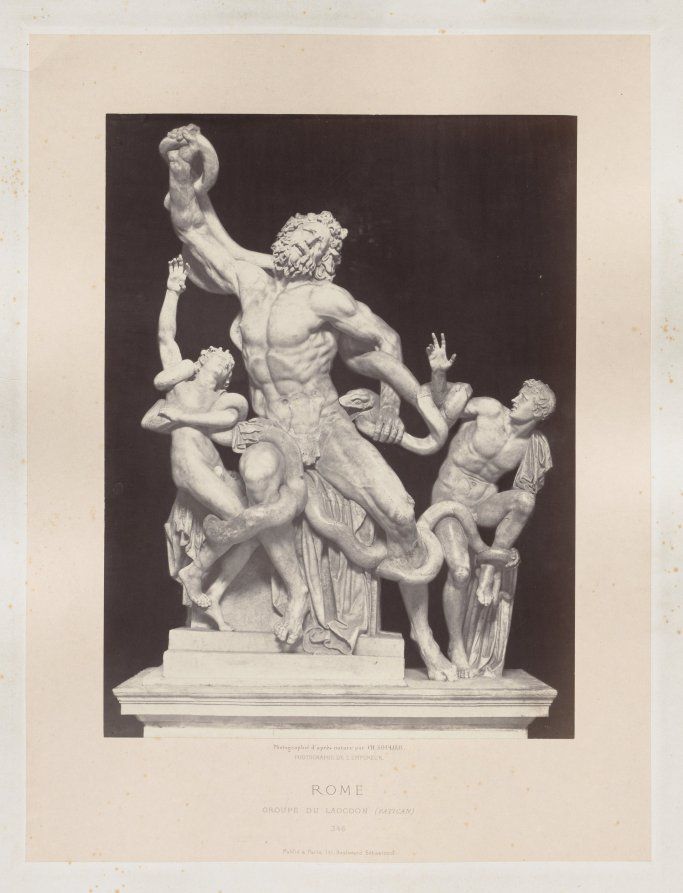
Rome: Groupe de Laocoon (Vatican) - France, 19th century, c. 1860, albumen print from a collodion negative
The Cleveland Museum of Art, Cleveland, OH, 2012.439. CC0
Also Connected
4 recorded connections, each with the ancient line behind it.
Connected
-

Apollodorus says Apollo sent the serpents that devoured Laocoön's sons as a sign. Hyginus makes Laocoön Apollo's priest, punished for marrying against the god's will.
-

In Virgil the serpents take refuge at the feet of Athena's image after killing Laocoön, and the Trojans read his death as the price of striking the horse. In Quintus Smyrnaeus, Athena herself blinds him and sends the serpents against his sons.
-

Virgil makes Laocoön a priest of Neptune, the Roman counterpart of Poseidon, chosen by lot, and has him killed at the altar during a sacrifice to that god.
-
In Virgil, Sinon's lie wins the Trojans over, and the serpents then kill Laocoon, who had struck the horse. The Trojans read his death as the price of that sacrilege and haul the horse into the citadel.
Where Accounts Differ
- whose priest Laocoön was
- why Laocoön was killed
- who died in the serpents' attack
- where the serpents came from
- which Laocoön
- Whose priest he was differs. Virgil (Aeneid 2.201) calls him a priest of Neptune chosen by lot. Hyginus (Fabulae 135) and Servius (on Aeneid 2.201) make him a priest of Apollo, the latter of Thymbraean Apollo. Only Hyginus makes him a son of Acoetes and brother of Anchises.
- Why he died is the central disagreement. Virgil (Aeneid 2.229-231) has the Trojans say he paid for striking the sacred oak with his spear, and never says who sent the serpents. Apollodorus (Epitome 5.18) says Apollo sent them as a sign. Hyginus (Fabulae 135) has Apollo send them because Laocoön married against his will, and also reports the spear as the Phrygians' explanation. Servius says he lay with his wife before the god's image, and that Virgil recast the story as an excuse for the Trojans. Quintus Smyrnaeus (Posthomerica 12) has Athena blind him for urging the burning of the horse and then send the serpents.
- Who died differs. Virgil (Aeneid 2.213-219) and Hyginus have the serpents kill Laocoön and both sons. Apollodorus (Epitome 5.18) names only the sons. Quintus Smyrnaeus has the sons die and the father live on, blind. Frazer, reporting Arctinus, gives Laocoön and one son.
- Where the serpents came from differs. Virgil (Aeneid 2.203) and Hyginus say Tenedos. Apollodorus (Epitome 5.18) says only the neighboring islands. Quintus Smyrnaeus says the island of Calydna.
- The name is shared. Hyginus (Fabulae 14) lists a different Laocoön, son of Porthaon and brother of Oeneus, among the Argonauts. That Calydonian Laocoön is a separate figure with no link to Troy.
Read the full source verification →
Mythology
Appears In
Related Terms
Referenced By
Sources
- Virgil, Aeneid 2.40-56
- Virgil, Aeneid 2.199-231
- Virgil, Aeneid 2.232-249
- Apollodorus, Epitome 5.17
- Apollodorus, Epitome 5.18
- Hyginus, Fabulae 135
- Servius, Commentary on the Aeneid 2.201
- Quintus Smyrnaeus, Posthomerica 12
- Pliny the Elder, Natural History 36.37
- Virgil, Aeneid 2.195-198
- J. G. Frazer, note on Apollodorus, Epitome 5.18 (Loeb edition, Perseus Digital Library)
- Online Etymology Dictionary, s.v. Laocoon
- Laocoön and His Sons, Wikipedia, on the 1506 find and the copyist debate