Pandora's Box
Pandora's box is the story of the first woman, who lifts the lid of a great jar and lets evils loose among mortals. In Hesiod's Works and Days, Zeus sends her to Epimetheus as the price of stolen fire. The evils scatter and only Hope stays inside. Hesiod's word is jar, not box.
Sections on this page
What Led To It
The Theogony tells the making of the woman earlier and more briefly. Hephaestus forms a shy maiden from earth as Zeus wills, and Athena clothes her and sets garlands on her head. Hephaestus makes a gold crown for her (Hesiod, Theogony 570-584). Zeus leads her out, and gods and men are amazed (Hesiod, Theogony 585-589). Hesiod says the race of women descends from her and compares women to drones in a hive (Hesiod, Theogony 590-600). The Theogony passages checked here give the woman no name and mention no jar.
The Myth
The story begins with fire, not with the jar. In Works and Days Hesiod says the gods keep the means of life hidden from men. Zeus hid fire because Prometheus had deceived him, and Prometheus stole it again in a hollow fennel stalk. Zeus then speaks to him in anger (Hesiod, Works and Days 42-55). His answer is the first mention of what becomes Pandora. Prometheus and the gift of fire tells the theft itself.
But I will give men as the price for fire an evil thing in which they may all be glad of heart while they embrace their own destruction.
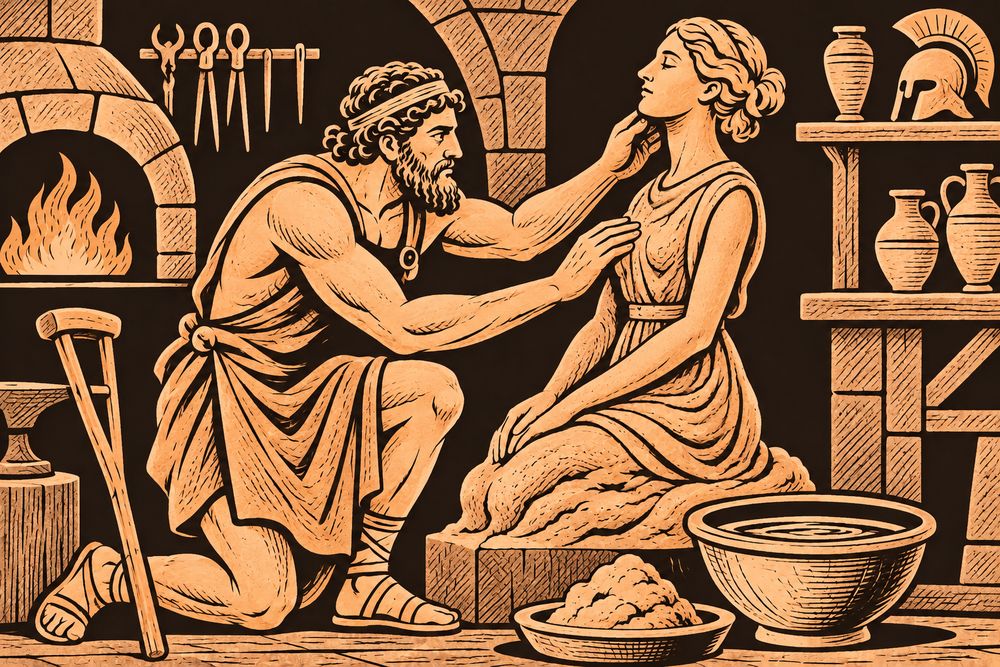
Hephaestus shapes the first woman
Generated by AI from this page's own facts, not an ancient image or evidence of anything. How this site uses generated images
Zeus laughs and orders Hephaestus to mix earth and water and make a lovely maiden with a human voice and strength. Athena teaches her weaving. Aphrodite gives her grace, and a desire that brings cares. Hermes gives her a shameless mind and a deceitful nature (Hesiod, Works and Days 59-70). The Graces, Persuasion and the Hours adorn her, and Athena dresses her (Hesiod, Works and Days 71-76).
Hermes also puts lies, crafty words and speech in her. Hesiod explains the name Pandora in the same lines. She is called Pandora, the all-endowed, because every Olympian gave her a gift. He adds that she is a plague to men who eat bread (Hesiod, Works and Days 77-82).
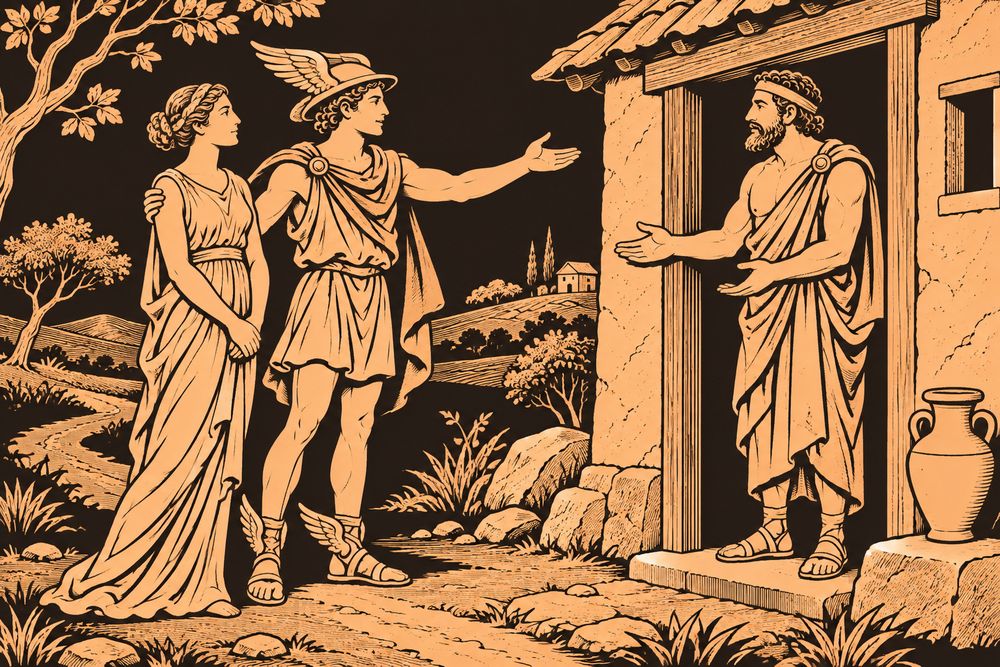
Hermes brings the gift to Epimetheus
Generated by AI from this page's own facts, not an ancient image or evidence of anything. How this site uses generated images
Zeus sends Hermes to take the gift to Epimetheus. Prometheus had told his brother never to accept a gift from Zeus. Epimetheus takes it anyway and understands the harm only afterward (Hesiod, Works and Days 83-89). The woman, Pandora, is now among men.
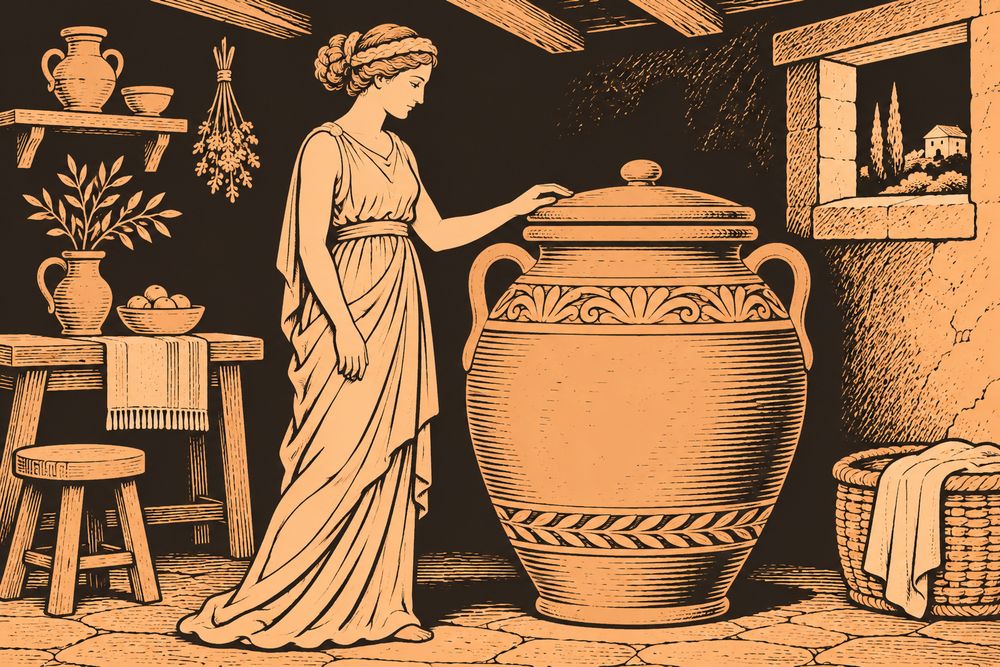
The sealed jar beside the first woman
Generated by AI from this page's own facts, not an ancient image or evidence of anything. How this site uses generated images
Hesiod then describes what mortals had lost. Before this, men lived on earth free from troubles, hard toil and sicknesses (Hesiod, Works and Days 90-93). The woman takes the lid off the great jar, and its contents scatter. They bring sorrow and mischief to men. Hope alone stays inside, under the rim of the jar, because the lid is put back before she can fly out (Hesiod, Works and Days 94-99).
Countless other plagues now wander among people, and earth and sea are full of evils. Diseases come by day and by night in silence, because Zeus took their voice away. Hesiod closes the passage with the statement that there is no way to escape the will of Zeus (Hesiod, Works and Days 100-105).
What Followed
In Works and Days the jar is followed at once by a second account of why human life is hard. Hesiod introduces it as another story, and it describes the successive races of men (Hesiod, Works and Days 105-108). The first race lived like gods, free from toil and misery (Hesiod, Works and Days 109-120). The passages checked here do not say how the two accounts fit together.
Apollodorus keeps Pandora but drops the jar from the passage checked here. He calls her the first woman fashioned by the gods and makes her, with Epimetheus, the parent of Pyrrha, who survives the flood with Deucalion (Apollodorus, Library 1.7.2).
Afterlife and Modern Influence
The box is a later change. According to Dora and Erwin Panofsky's study Pandora's Box (1956), Erasmus rendered the Greek pithos, a large storage jar, as the Latin pyxis, a box, in his Adagia of 1508. Some modern scholars suggest he confused Pandora's jar with the box that Psyche opens in the tale of Cupid and Psyche. That is a hypothesis, not a settled finding. English kept the box, and the phrase now stands for an act that releases troubles which cannot be recalled. It sits among the other idioms in Myth in Everyday Language.
What is the meaning of Pandora's box?
In English it means a source of troubles that cannot be called back once released. The phrase comes from Hesiod's story, though his Greek says jar, not box. In that story the opened jar explains why mortals now know toil and sickness. In the passage checked here Hesiod does not present the opening as a warning. He ties the loss to Zeus's anger over fire.
Who actually opened Pandora's box?
Pandora did. Hesiod says the woman takes the lid off the great jar and the contents scatter. Epimetheus accepts her from Hermes but is not described opening the jar. Hesiod gives no reason why she lifts the lid. Curiosity is a later explanation, and it is not stated in the passage checked here.
What are the 7 evils of Pandora's box?
Hesiod gives no list of seven. He names troubles, hard toil and sicknesses as what men were once free from. He then speaks of sorrow, mischief and countless plagues that fill earth and sea, and of diseases that come silently by day and night. Named lists of vices, such as greed or envy, come from later retellings and are not in the passages checked here.
Why did Zeus put Evil in Pandora's box?
Hesiod says Zeus planned sorrow and mischief for men because Prometheus deceived him over fire. He promised an evil thing as the price of fire. The woman is that evil. Hesiod does not say that Zeus filled the jar, and the passages checked here do not say who did. The jar's contents are simply what escapes.
Why do people say don't open Pandora's box?
The saying uses the story as a picture of irreversible harm. Once the lid comes off in Hesiod, the evils spread among mortals and only Hope remains inside. The advice is modern. Hesiod records no warning against opening the jar. The only warning he gives is Prometheus's, and it tells Epimetheus not to accept a gift from Zeus.
Is Pandora's box good or bad?
In Hesiod it is bad. The jar holds what brings sorrow, mischief and plague to men. Hope is the open question. Hesiod says only that Hope stays under the rim when the lid is replaced. He does not say whether this is a mercy that spares men or a further cruelty that keeps Hope from them. The passage checked here leaves it unsettled.
Where Accounts Differ
- jar-or-box
- hope-in-the-jar
- theogony-and-works-and-days-versions
- The container differs from the English phrase. Hesiod's Greek names a pithos, a large storage jar. The box traces to Erasmus's Latin pyxis in 1508, as reported by Dora and Erwin Panofsky. A link to the box of Psyche is a modern suggestion, not a settled finding.
- Hope's place in the jar is not settled. Hesiod says Hope alone stays under the rim (Works and Days 94-99) and does not say whether this is good or bad for men.
- The two Hesiod poems tell the story differently. The Theogony has the making of the woman, her adornment and the race of women descended from her, but no jar and no name in the passages checked here (Theogony 570-600). Works and Days names her Pandora and has the jar (Works and Days 59-99).
Read the full source verification →
Mythology
Figures In This Myth
Related Terms
Referenced By
Sources
- Hesiod, Works and Days 42-55
- Hesiod, Works and Days 47-58
- Hesiod, Works and Days 56-58
- Hesiod, Works and Days 59-70
- Hesiod, Works and Days 71-76
- Hesiod, Works and Days 77-82
- Hesiod, Works and Days 83-89
- Hesiod, Works and Days 83-99
- Hesiod, Works and Days 90-93
- Hesiod, Works and Days 90-99
- Hesiod, Works and Days 90-105
- Hesiod, Works and Days 94-99
- Hesiod, Works and Days 100-105
- Hesiod, Works and Days 105-108
- Hesiod, Works and Days 109-120
- Hesiod, Theogony 570-584
- Hesiod, Theogony 585-589
- Hesiod, Theogony 590-600
- Apollodorus, Library 1.7.2
- Dora and Erwin Panofsky, Pandora's Box (1956)