Graces
The Graces, or Charites, are three Greek goddesses named Aglaea, Euphrosyne and Thaleia in Hesiod's Theogony. Hesiod makes them daughters of Zeus and Eurynome, a daughter of Ocean, and says love flows from their glancing eyes. Homer and the Homeric Hymn to Aphrodite keep them among the gods, and Pindar and Pausanias record a separate cult at Orchomenus.
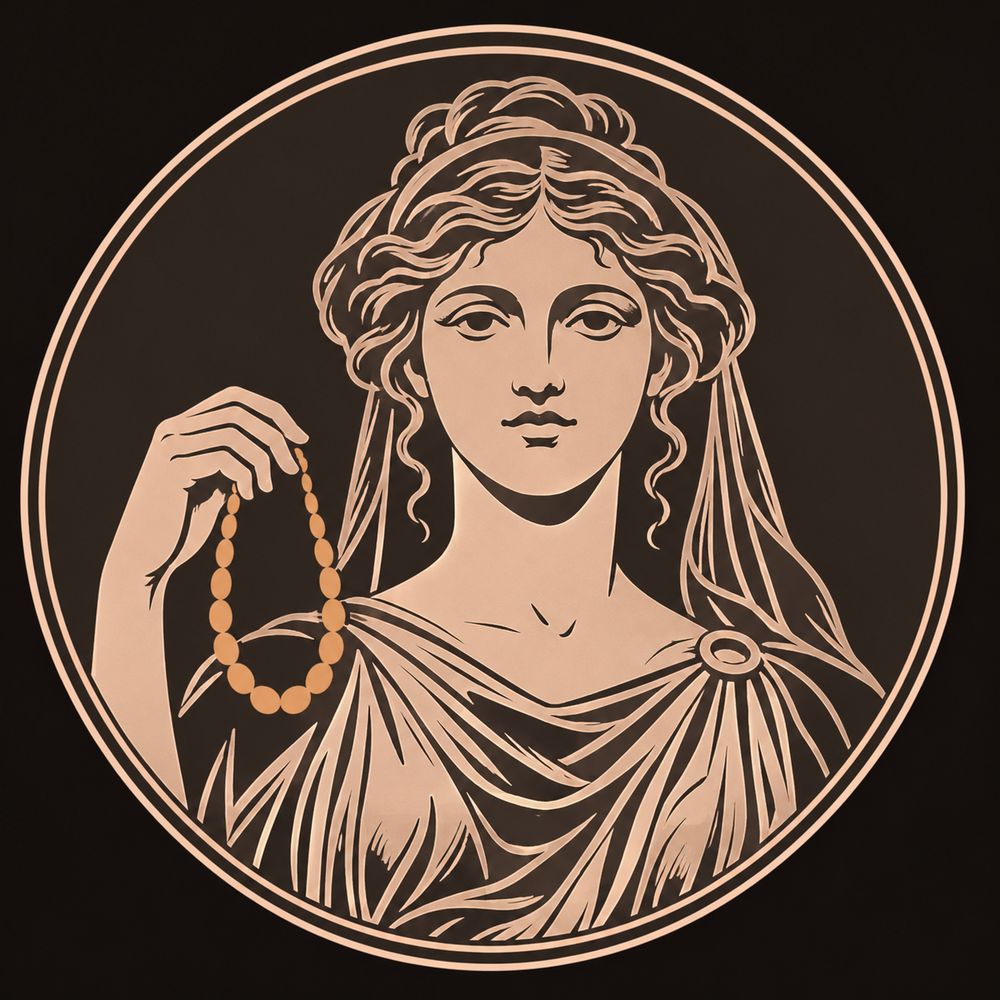
A Grace holding a gold necklace
Generated by AI from this page's own facts, not an ancient image or evidence of anything. How this site uses generated images
Sections on this page
See Graces in the Greek family tree.
Core Myth
The Graces are the Greek Charites. They are Aglaia, Euphrosyne and Thalia, daughters of Zeus and the Oceanid Eurynome (Hesiod, Theogony 907-911). Hesiod lists them in the Theogony among the children of Zeus. He says Eurynome, the daughter of Ocean, bore him three fair-cheeked Charites, Aglaea, Euphrosyne and lovely Thaleia. From their eyes as they glanced, Hesiod adds, flowed love that unnerves the limbs (Hesiod, Theogony 907-911). The translation checked here spells the names Aglaea and Thaleia. Pindar writes them Aglaia and Thalia. This page covers the goddesses, not any later religious use of the phrase.
Hesiod uses them again in the Works and Days. When the gods make the first woman, Pandora, the divine Graces and queenly Persuasion put necklaces of gold upon her, and the Hours crown her with spring flowers (Hesiod, Works and Days 69-82). The Theogony also gives one Grace a husband. Hephaestus, the Lame One, makes Aglaea, youngest of the Graces, his wife (Theogony 945-946).
Homer places them in the divine household. In the Iliad, Hera needs the god of Sleep to lull Zeus. She offers one of the younger Graces as a wife, and Sleep asks for an oath that she will give him one (Homer, Iliad 14.267-276). Hypnos is the Greek name of that god of Sleep. The Graces here are marriageable goddesses at Hera's disposal.
The Homeric Hymn to Aphrodite shows their usual work. After Aphrodite comes to Paphos, the Graces bathe her there with heavenly oil (Homeric Hymn to Aphrodite 61-63). When she later stands before Anchises, he guesses she may be one of the Graces who keep company with the gods and are called immortal (Homeric Hymn to Aphrodite 95). The hymn treats the Graces as a recognisable group of divine companions.
Who are the three Graces?
Hesiod names them Aglaea, Euphrosyne and Thaleia, and calls Aglaea the youngest. Pindar uses the spellings Aglaia, Euphrosyne and Thalia for the Graces of Orchomenus. Hesiod gives Zeus as their father and Eurynome as their mother. The sources checked here give the three the same names in both poets, though Pausanias says the Boeotians kept no tradition of the names Eteocles chose.
How many Graces are there in the world?
Greek sources do not agree. Hesiod and Pindar have three. Pausanias says the Spartans honoured two, Cleta and Phaenna, and the Athenians two, Auxo and Hegemone. He adds that the custom of praying to three came from Eteocles of Orchomenus. The sources checked here give no single number older than that Boeotian tradition, so three is the common count and not the only one.
Which Grace did Hypnos want to marry?
Homer names her Pasithea. Hera offers Sleep one of the younger Graces, and Sleep answers that she must be Pasithea, whom he has longed for all his days. Pasithea is not among the three Graces Hesiod lists, so Homer and Hesiod name different figures here. The sources checked here do not explain how the two lists relate.
Was Hephaestus married to a Grace?
In Hesiod he was. The Theogony says Hephaestus made Aglaea, youngest of the Graces, his wife. Homer's Iliad shows a Charis of the gleaming veil in his house, who comes forward to greet Thetis. The lines checked here do not say whether Homer's Charis is Hesiod's Aglaea, so this page does not equate them.
Later Traditions
Pindar gives the Graces a city. His Fourteenth Olympian Ode opens with an address to the songful queens, Graces of splendid Orchomenus, guardians of the ancient race of the Minyans. He then calls on Aglaia, Euphrosyne and Thalia by name, and names their father only as the strongest god (Pindar, Olympian Ode 14.1-15).
Pausanias describes the same cult in Boeotia. He says the Boeotians credit Eteocles with the first sacrifice to the Graces and with fixing their number at three. He adds that they have no tradition of the names Eteocles gave (Pausanias, Description of Greece 9.35.1-9.35.3). At Orchomenus the oldest sanctuary is that of the Graces. The people there honour its stones most, and say they fell from heaven for Eteocles (Pausanias, Description of Greece 9.38.1).
The Graces also stand in the Cretan royal house's story. Apollodorus says Minos was sacrificing to the Graces on Paros when word came that his son Androgeus was dead. He threw the garland from his head and stopped the flute, but finished the sacrifice (Apollodorus, Library 3.15.7-3.15.8). That death sets off the war with Athens told in The Theseus Cycle.
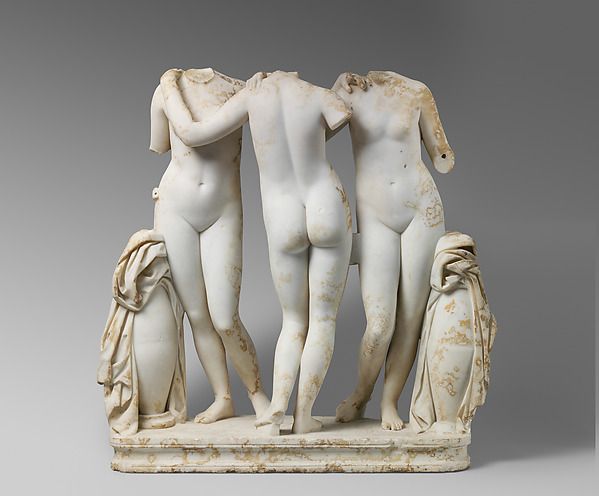
Marble Statue Group of the Three Graces - Roman, 2nd century CE, Marble
Metropolitan Museum of Art, New York, NY, 2010.260. CC0
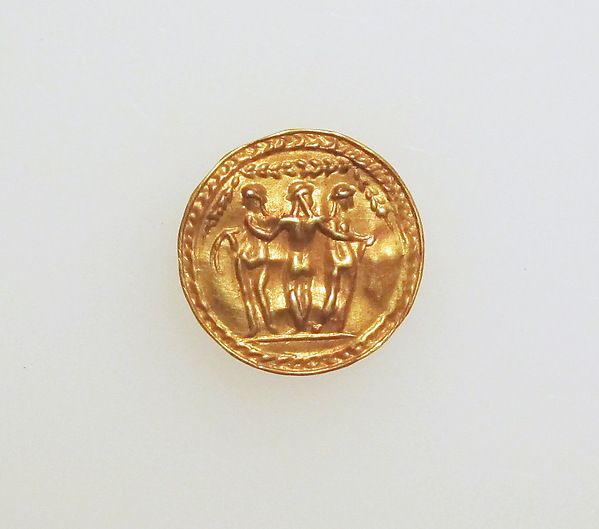
Roundel, disk with three graces - 4th century BCE, Gold
Metropolitan Museum of Art, New York, NY, 74.51.3662. CC0
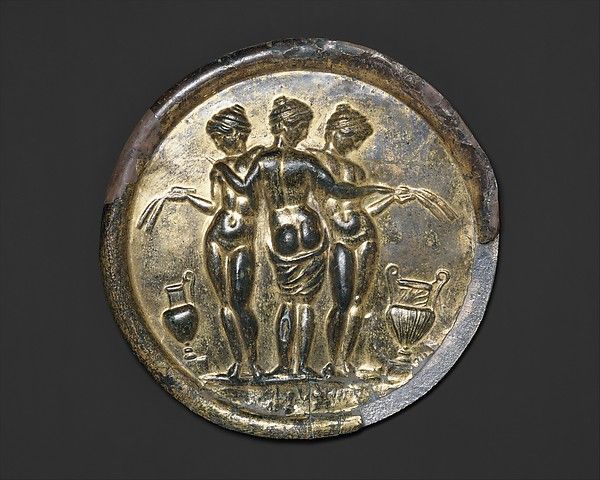
Gilded bronze mirror with the Three Graces - Roman, mid-2nd century CE, Bronze, silver, gold, speculum
Metropolitan Museum of Art, New York, NY, 1987.11.1. CC0
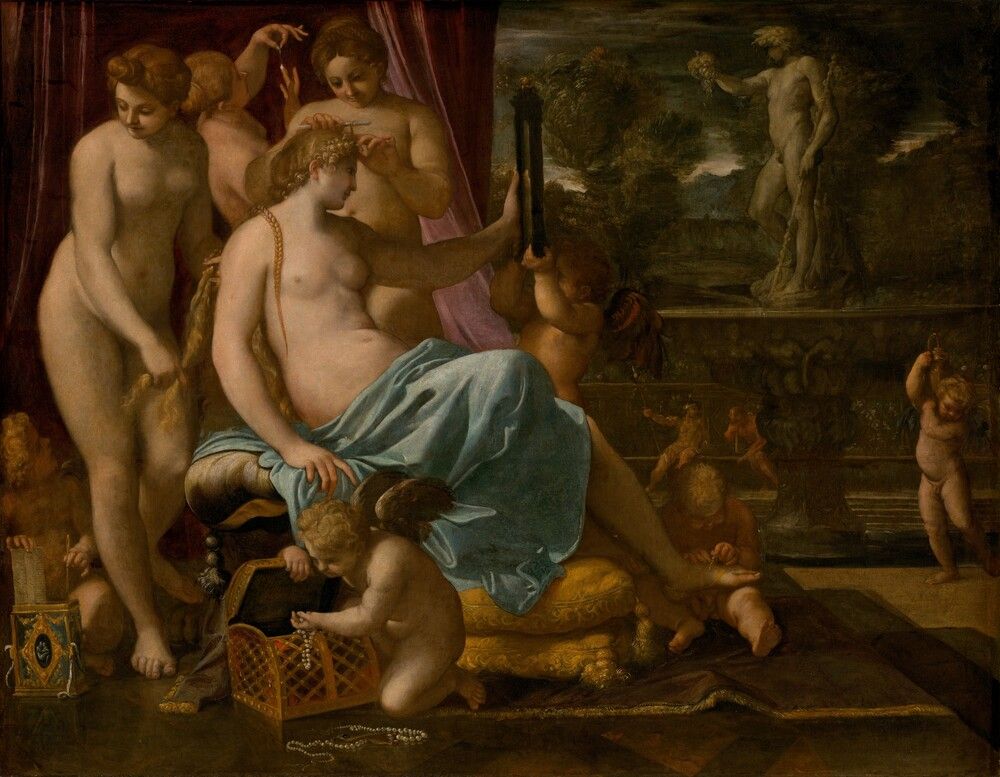
Venus Adorned by the Graces - Annibale Carracci, 1590/1595, oil on panel transferred to canvas
National Gallery of Art, Washington, DC, 1961.9.9. CC0
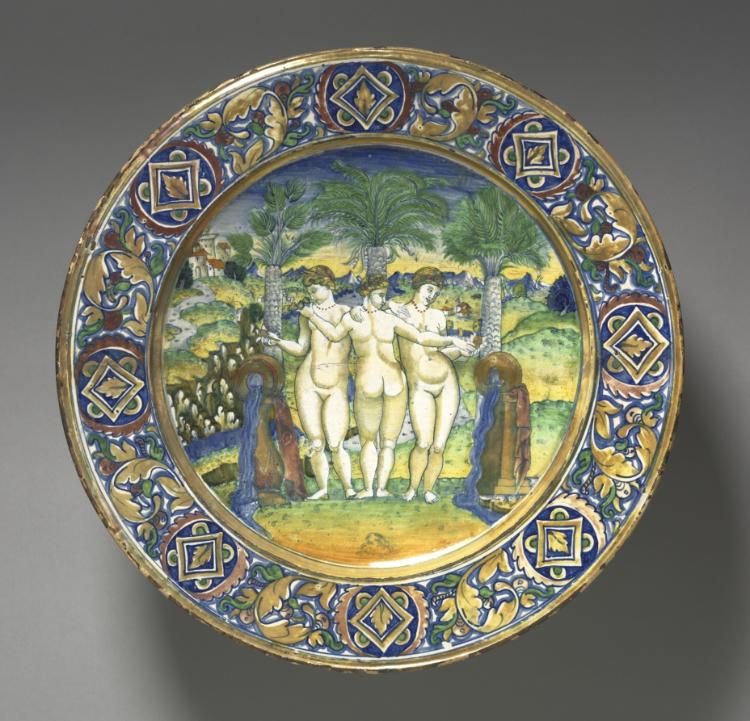
Charger Depicting the Three Graces - Italy, Urbino region, Gubbio, 16th century, c. 1525, tin-glazed earthenware with gold lustre (maiolica)
The Cleveland Museum of Art, Cleveland, OH, 1945.2. CC0
Lineage
See the full family tree1 recorded relation, each with the ancient line behind it.
Parents
-

In Hesiod, Eurynome, daughter of Ocean, bears Zeus the three Graces, Aglaea, Euphrosyne and Thaleia.
Also Connected
4 recorded connections, each with the ancient line behind it.
Connected
-

In the Homeric Hymn to Aphrodite the Graces bathe Aphrodite at Paphos with heavenly oil.
-

In the Theogony, Hephaestus makes Aglaea, youngest of the Graces, his wife.
-

Hera offers Sleep one of the younger Graces, Pasithea, as a wife, and he asks for her oath before he lulls Zeus.
-

In the Works and Days the divine Graces and Persuasion put gold necklaces on the first woman.
Where Accounts Differ
- how many Graces there are and what they are called (Hesiod, Pindar, Pausanias)
- The number of the Graces differs by place. Hesiod (Theogony 907-911) and Pindar (Olympian 14) give three. Pausanias (9.35.1-9.35.3) reports two Graces at Sparta and two at Athens, and says the Boeotians credit Eteocles with the number three. Pausanias also says the Boeotians kept no names from Eteocles, while Pindar names three for Orchomenus. The sources checked here do not reconcile this.
Read the full source verification →
Mythology
Appears In
Referenced By
Sources
- Hesiod, Theogony 907-911
- Hesiod, Theogony 945-946
- Hesiod, Works and Days 69-82
- Homer, Iliad 14.267-276
- Homer, Iliad 18.382-383
- Homeric Hymn to Aphrodite 61-63
- Homeric Hymn to Aphrodite 95
- Pindar, Olympian Ode 14.1-15
- Pausanias, Description of Greece 9.35.1-9.35.3
- Pausanias, Description of Greece 9.38.1
- Apollodorus, Library 3.15.7-3.15.8