Minos
Minos was the legendary king of Crete, born to Zeus and Europa. Apollodorus says he kept a bull Poseidon sent for sacrifice, so the god made his wife Pasiphae bear the Minotaur, which Minos shut in the Labyrinth. After his son Androgeus died in Attica, he forced Athens to send youths as its food. Homer places him in Hades, judging the dead.
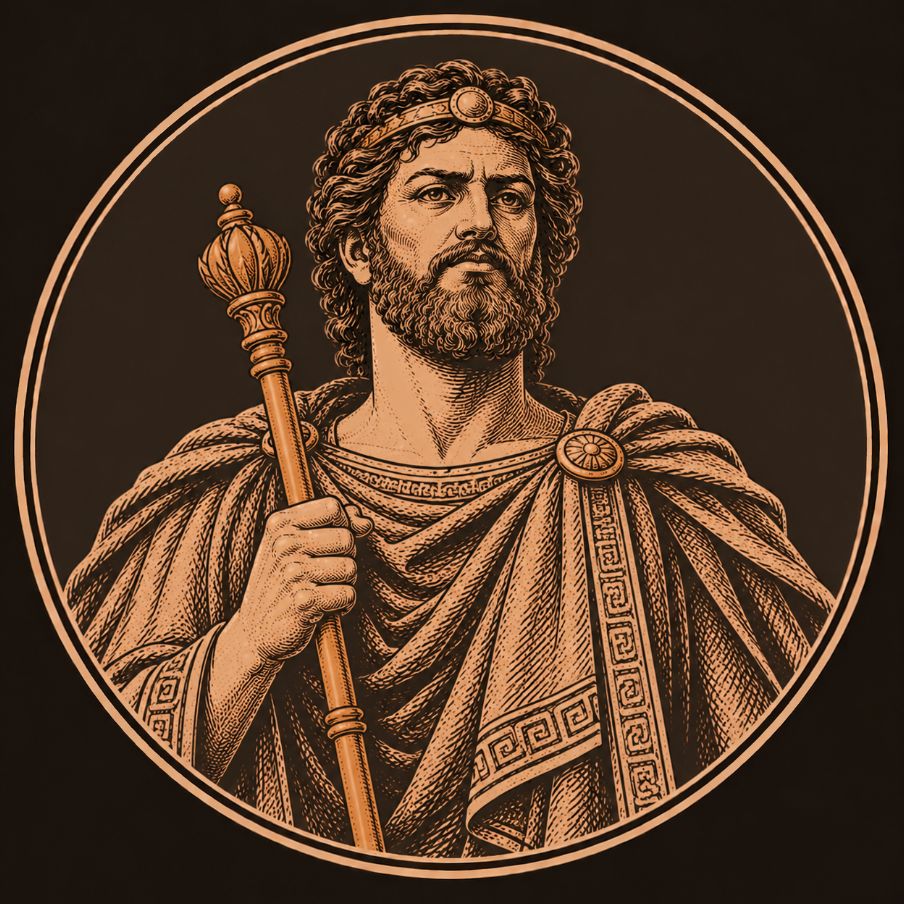
Minos, bronze medallion illustration
Generated by AI from this page's own facts, not an ancient image or evidence of anything. How this site uses generated images
Sections on this page
See Minos in the Greek family tree.
Core Myth
Minos was born on Crete to Zeus and Europa, the princess Zeus carried over the sea in the shape of a bull in the abduction of Europa. Homer's Iliad already knows the pedigree. Zeus names the daughter of Phoenix who bore him Minos and Rhadamanthys. The Cretan warrior Idomeneus boasts that Zeus fathered Minos to watch over Crete. Apollodorus adds a third brother, Sarpedon, while noting that Homer makes Sarpedon a son of Laodamia instead. The Cretan king Asterius married Europa and raised her sons. When the brothers quarrelled over a boy named Miletus, Minos won and the others fled. Herodotus tells the quarrel as a fight over the kingship, which ended with Sarpedon's followers settling in Lycia.
Apollodorus makes the Cretan throne the start of his trouble. Asterius died childless and Minos's claim was opposed, so he said the gods had given him the kingdom and would grant whatever he prayed for. He asked Poseidon to send a bull from the sea and promised to sacrifice it. Poseidon sent the Cretan Bull, and Minos won the kingdom. Then he sent the animal to his herds and sacrificed another.
The god answered by making the bull savage and making Minos's wife Pasiphae, a daughter of the Sun, fall in love with it. Daedalus, an Athenian exile, built her a hollow wooden cow, and she bore the Minotaur. Minos, following certain oracles, shut the creature in the Labyrinth that Daedalus built. Apollodorus lists his sons by Pasiphae as Catreus, Deucalion, Glaucus and Androgeus, and his daughters as Acalle, Xenodice, Ariadne and Phaedra.
The war with Athens began with a dead son. Apollodorus says Androgeus beat every competitor at the Panathenaic games, and King Aegeus then sent him against the bull of Marathon, which killed him. Others said jealous rivals ambushed him on the road to Thebes. Minos heard the news while sacrificing to the Graces on Paros. He finished the rite without garland or flute, and the islanders kept that custom afterwards.
Being master of the sea, Minos attacked with a fleet and captured Megara. There Scylla, daughter of King Nisus, fell in love with him and pulled out the purple hair that kept her father alive. Apollodorus says Minos repaid her by tying her feet to his ship's stern and drowning her. When Athens still held out, he prayed to Zeus for revenge, and famine and plague struck the city. An oracle told the Athenians to give Minos whatever satisfaction he chose. He demanded seven youths and seven maidens as food for the Minotaur. That tribute ended only when Theseus killed the monster, as told in Theseus and the Minotaur.
Theseus escaped the maze because Ariadne, on Daedalus's advice, gave him a thread. Apollodorus's Epitome says Minos, learning of the flight, shut Daedalus and his son Icarus in the Labyrinth, which set up the fall of Icarus. Daedalus flew on to Camicus in Sicily.
Minos hunted the craftsman from country to country carrying a spiral shell. He promised a great reward to anyone who could pass a thread through it, knowing only Daedalus could. At the court of King Cocalus the shell came back threaded, because Daedalus had tied the thread to an ant. Minos demanded his surrender. Cocalus promised it and held a feast, but after his bath Minos was killed by the daughters of Cocalus. Some said boiling water was poured over him. Herodotus also says Minos died a violent death in Sicily while searching for Daedalus. He adds that the Cretans later besieged Camicus for five years to avenge him and failed.
Why did Poseidon curse King Minos?
Because Minos broke a promise to him. Apollodorus says Minos, facing rivals for the Cretan throne, claimed the gods would grant whatever he prayed for. He asked Poseidon to send a bull from the sea and vowed to sacrifice it. Poseidon sent a fine bull and Minos won the kingdom, but he put the animal among his herds and sacrificed another. The angry god made the bull savage and made Minos's wife Pasiphae fall in love with it. Their union produced the Minotaur.
Apollodorus, Library 3.1.3-3.1.4
Why was King Minos killed?
He died chasing Daedalus. Apollodorus's Epitome says Minos hunted the escaped craftsman with a spiral shell that only Daedalus could thread. When the threaded shell came back from the court of King Cocalus in Sicily, Minos demanded Daedalus's surrender. Cocalus pretended to agree and entertained him, but after his bath Minos was killed by Cocalus's daughters. Some said boiling water was poured over him. Herodotus confirms a violent death in Sicily during the search for Daedalus.
Apollodorus, Epitome 1.14-1.15
What was King Minos punishment?
In life, his punishment was the Minotaur. Apollodorus says Poseidon made Minos's wife Pasiphae desire the bull Minos had failed to sacrifice, and the monster she bore had to be hidden in the Labyrinth. After death Minos is not punished at all. Homer's Odyssey shows him in Hades holding a golden scepter while the dead ask him for judgment. He sits among the underworld's figures of authority, not among its sufferers such as Tantalus or Sisyphus.
Homer, Odyssey 11.568-571
Was Minos a good guy?
The ancient sources disagree. Homer's Odyssey honours him as the king who held converse with Zeus, and Plutarch recalls Hesiod calling him the most royal Minos. Plutarch also says the Athenian stage always showed him as cruel and violent, and that in fact he was a king and lawgiver. His own deeds cut both ways. Apollodorus has him cheat Poseidon, drown Scylla of Megara, and demand Athenian youths to feed the Minotaur.
Plutarch, Life of Theseus 16
Who are the three judges of the dead in Greek mythology?
Minos, his brother Rhadamanthys, and Aeacus. The trio is not Homeric. In the Odyssey Minos alone sits in judgment, settling the disputes of the dead with a golden scepter. Apollodorus says Rhadamanthys judges in Hades along with Minos. Plato's Gorgias adds Aeacus and sets them at a fork in the road below, one way leading to the Isles of the Blest and the other to Tartarus. Minos gets the final decision whenever the other two are in doubt.
Apollodorus, Library 3.1.2
Later Traditions
Minos the judge of the dead is older in the sources than most of his crimes. In Homer's Odyssey, Odysseus sees him in the house of Hades, seated with a golden scepter while the dead gather round to ask him for judgment. Homer does not say he sorts the good from the wicked. He settles the disputes of the shades, as a king settles disputes among the living.
Later writers widened the office. Apollodorus says Rhadamanthys judges in Hades along with Minos. Plato's Gorgias names three judges of the underworld, Minos, Rhadamanthys and Aeacus, and gives Minos the final decision whenever the other two are in doubt. Virgil's Aeneid places him beside the souls condemned by unjust verdicts, shaking the urn of judgment and hearing the story of each life.
The ancient verdict on his character split along a line that ran through Athens. Homer's Odyssey calls Cnossus the city where Minos reigned and held converse with great Zeus. The Greek word for the timing is ambiguous. It can mean nine years or every ninth year, and Murray's translation even makes him king at nine years old. Plato's dialogue Minos reads it as a visit to Zeus's cave every ninth year to learn law. The same dialogue calls Minos the best of ancient lawgivers, with Rhadamanthys guarding his laws in the city and Talos across the rest of Crete. It blames Attic tragedy for his name as a harsh and unjust king, revenge for the tribute. Plutarch's Life of Theseus makes the same complaint and recalls Hesiod calling him the most royal Minos.
Diodorus Siculus answers the tension another way. He splits Minos into two kings: a first Minos, son of Zeus and Europa, and his grandson, a second Minos, who first built a great navy and married Pasiphae.
Greek historians treated Minos as the first ruler of the sea. Herodotus says the Carians once manned ships for him. He calls Polycrates the first Greek to aim at mastery of the sea. But he sets aside Minos of Cnossus as belonging to an age before what may be called the human race. Thucydides opens his history with Minos as the earliest known builder of a navy. He cleared the sea of pirates and set his sons over the Cyclades as governors.
Modern Influence
Minos gave his name to a whole civilization. The archaeologist Arthur Evans, excavating the palace at Knossos from 1900, called the Bronze Age culture of Crete Minoan after the legendary king. The palace's winding ground plan and its many double axes, the labrys, encouraged a modern theory that the Labyrinth story remembers the building itself. That link is a modern reading of the ruins, not a claim any ancient source makes.
3 recorded relations, each with the ancient line behind it.

Also Connected
4 recorded connections, each with the ancient line behind it.
Enemies
-
The death of Minos's son Androgeus led to his war on Athens and the tribute of youths and maidens.
-

Minos pursued Daedalus to Sicily and died at the court of Cocalus.
Connected
-

Minos shut the Minotaur, born to his wife Pasiphae, in the Labyrinth.
-

Poseidon sent Minos a bull to sacrifice; Minos kept it, and Poseidon made the bull savage.
Where Accounts Differ
- frequency of the Athenian tribute
- fate of Scylla of Megara
- how Androgeus died
- how Minos died
- Minos as judge of the dead
- one Minos or two
- just lawgiver or cruel tyrant
- Sarpedon as Minos's brother
- How often Athens paid the tribute differs by source. Apollodorus's Library says the Athenians sent seven youths and seven maidens every year. Ovid's Metamorphoses and Plutarch's Life of Theseus say every ninth year, and Plutarch adds that most writers agree. Plutarch also reports Philochorus, for whom the Labyrinth was an ordinary prison and the youths were prizes at games, and Aristotle, for whom they lived out their lives as slaves in Crete.
- Scylla of Megara meets two different ends. Apollodorus's Library has Minos tie her by the feet to his ship's stern and drown her. Ovid's Metamorphoses has Minos reject her with horror but take Megara anyway; she clings to his departing ship and is turned into a bird, the ciris.
- How Androgeus died is disputed. Apollodorus's Library gives two versions: Aegeus sent him against the bull of Marathon, or jealous rivals ambushed him on the way to games at Thebes. Diodorus Siculus says Aegeus had him murdered near Oenoe out of fear of his friendship with the sons of Pallas.
- Apollodorus's Epitome gives two deaths for Minos in Sicily: killed after his bath by the daughters of Cocalus, or scalded with boiling water. Herodotus says only that he died violently at Camicus. Plutarch's Life of Theseus reports Cleidemus, for whom a storm drove Minos to Sicily while he pursued Daedalus by sea.
- Homer's Odyssey makes Minos an arbiter who settles the disputes of the dead, not a judge who sorts souls by their lives. Apollodorus pairs him with Rhadamanthys, and Plato's Gorgias sets up the three judges, Minos, Rhadamanthys and Aeacus, with Minos holding the final vote.
- Most sources know one Minos. Diodorus Siculus splits him into two kings: Minos the son of Zeus and Europa, and his grandson, the second Minos, who built the navy and married Pasiphae. Apollodorus and Homer give one Minos who does both.
- Homer, Hesiod as quoted by Plutarch, and Plato's Minos present him as a just lawgiver taught by Zeus. Plato's Minos and Plutarch's Life of Theseus both say Athenian tragedy made him a cruel tyrant in revenge for the tribute. The Greek word in Odyssey 19.179 describing his converse with Zeus can mean nine years or every ninth year; Plato's Minos takes the second reading.
- Apollodorus names three sons of Zeus and Europa, Minos, Rhadamanthys and Sarpedon, but notes that Homer makes Sarpedon a son of Laodamia. Homer's Iliad names only Minos and Rhadamanthys as Europa's sons, and calls their mother the daughter of Phoenix rather than of Agenor.
Read the full source verification →
Mythology
Appears In
Related Terms
Referenced By
Sources
- Homer, Iliad 13.449-454
- Homer, Iliad 14.321-322
- Homer, Odyssey 11.568-571
- Homer, Odyssey 19.178-179
- Apollodorus, Library 3.1.1
- Apollodorus, Library 3.1.2
- Apollodorus, Library 3.1.3-3.1.4
- Apollodorus, Library 3.15.7
- Apollodorus, Library 3.15.8
- Apollodorus, Epitome 1.8-1.9
- Apollodorus, Epitome 1.12-1.13
- Apollodorus, Epitome 1.14-1.15
- Herodotus, Histories 1.171
- Herodotus, Histories 1.173
- Herodotus, Histories 3.122
- Herodotus, Histories 7.169-7.171
- Ovid, Metamorphoses 8.1-151
- Ovid, Metamorphoses 8.152-182
- Virgil, Aeneid 6.432-433
- Plutarch, Life of Theseus 15
- Plutarch, Life of Theseus 16
- Plutarch, Life of Theseus 19