Phaedra
Phaedra is a Cretan princess, daughter of Minos and Pasiphae and sister of Ariadne, who became the wife of Theseus of Athens. In her best-known story she falls in love with her stepson Hippolytus. When the secret comes out, she accuses him falsely and takes her own life. Euripides, Apollodorus and Diodorus disagree about how she made the accusation and when she died.
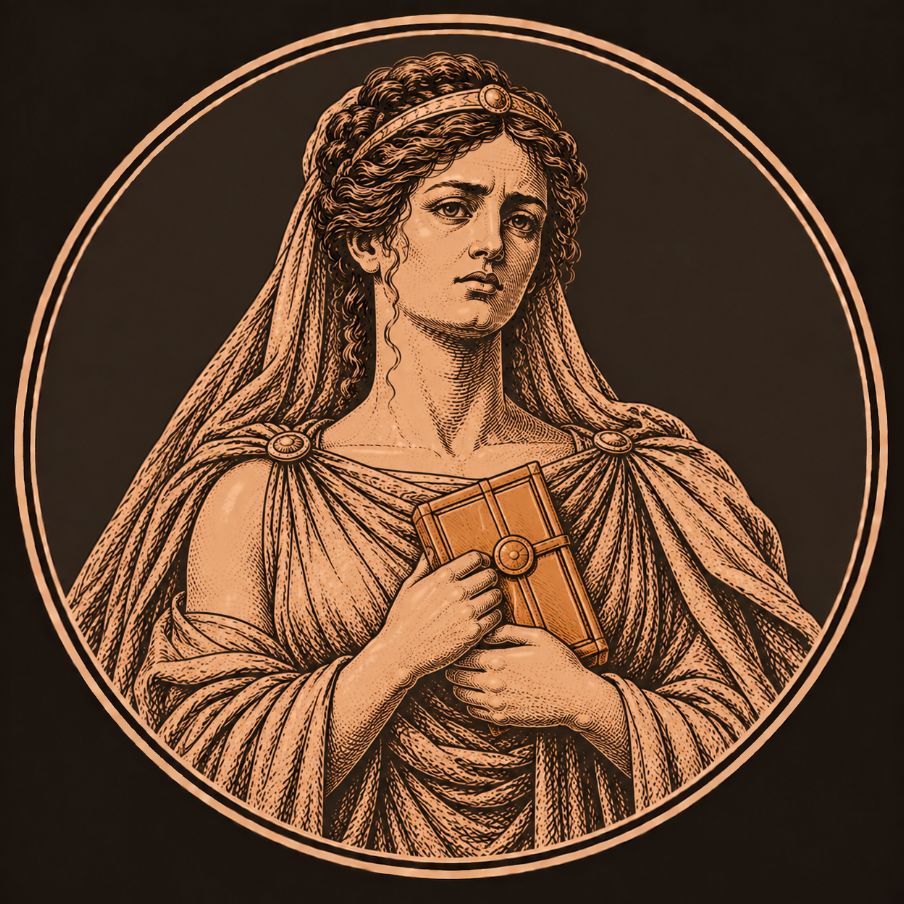
Phaedra, bronze medallion illustration
Generated by AI from this page's own facts, not an ancient image or evidence of anything. How this site uses generated images
Sections on this page
See Phaedra in the Greek family tree.
Core Myth
Phaedra was one of the daughters of Minos, king of Crete, and his wife Pasiphae, a daughter of the Sun. Apollodorus's Library lists her beside her sister Ariadne among Minos's children. Her marriage to Theseus came after Ariadne was lost to him. In Apollodorus's Epitome, Theseus receives Phaedra in marriage from her brother Deucalion. Diodorus Siculus adds that Deucalion, then ruling Crete, made an alliance with the Athenians and sealed it with this marriage. Apollodorus says Theseus's earlier Amazon wife, whom some called Hippolyte, arrived armed at the wedding and was killed there, though others said Theseus killed her in battle. Phaedra bore Theseus two sons, Acamas and Demophon.
The story that defines her is told most fully in Euripides's Hippolytus, staged at Athens in 428 BCE. The prologue belongs to Aphrodite. She is angry with Hippolytus, Theseus's son by the Amazon, because he scorns love and honors only Artemis. Her chosen instrument is Phaedra, who saw the young man at Athens and was seized with desire for him. While Theseus lives in exile at Troezen, Phaedra starves herself for three days and will not say why. Her nurse finally draws the truth out of her by clinging to her as a suppliant. Phaedra then explains that she tried silence, then self-control, and chose death once both failed, so as never to shame her husband or her children.
The nurse promises a cure and instead tells Hippolytus under an oath of secrecy. He reacts with fury, and Phaedra overhears him. Convinced that he will expose her, she resolves to die that day and to make her death harm him too. She hangs herself. When Theseus returns, he finds a sealed writing tablet hanging from her hand. It accuses Hippolytus of assaulting her. Theseus curses his son with one of the prayers Poseidon had promised him. Only at the end does Artemis reveal the truth: the nurse betrayed Phaedra, and Phaedra wrote a lying letter out of fear of being found out.
Why did Aphrodite curse Phaedra?
In Euripides's Hippolytus, Aphrodite has no quarrel with Phaedra at all. Her anger is aimed at Hippolytus, who calls her the vilest of the gods and refuses love and marriage. Phaedra is simply the means of punishing him. Aphrodite says openly that Phaedra will die, with honor but still die, because her suffering matters less than repaying the goddess's enemies. Phaedra herself sees a pattern in her family, recalling her mother Pasiphae's love for the bull and her sister Ariadne's fate.
Euripides, Hippolytus 40-50
Was Phaedra in love with Hippolytus?
Yes, in every ancient version, though the sources differ on where it began. Euripides and Diodorus Siculus say she first saw him at Athens when he came for the Mysteries. Euripides adds that she built a temple to Aphrodite in his honor. The Troezenians told Pausanias instead that she first saw him at Troezen, when Theseus went there for purification. In Euripides she fights the passion and hides it. In Apollodorus she openly asks Hippolytus to sleep with her.
Euripides, Hippolytus 24-40
Why did Theseus marry Phaedra instead of Ariadne?
Because Ariadne was already gone. Apollodorus's Epitome says Dionysus fell in love with Ariadne at Naxos and carried her off after she fled Crete with Theseus. Homer's Odyssey tells a different end, in which Artemis killed her on the island of Dia. Theseus married Phaedra later, receiving her from her brother Deucalion. Diodorus Siculus presents that marriage as the seal on an alliance between Deucalion's Crete and Athens, not as a romance.
Apollodorus, Epitome 1.17
What is the curse of Phaedra?
There is no single named curse in the ancient sources. In Euripides, what destroys Phaedra is a passion Aphrodite sends to punish Hippolytus. Phaedra reads it as an inherited misfortune, naming her mother's love for the bull and her sister's unhappy love before calling herself the third. The only formal curse in the play is spoken by Theseus. Believing her letter, he calls on Poseidon to kill his own son, and the god fulfills the prayer.
Euripides, Hippolytus 310-352
Later Traditions
Other ancient accounts keep the outline and change the details. Apollodorus's Epitome makes Phaedra propose to Hippolytus herself. When he flees, she breaks open the doors of her bedchamber, tears her clothes, and charges him with assault. Theseus's curse kills Hippolytus, and only after her passion becomes public does she hang herself. Diodorus Siculus gives a third order of events. Phaedra accuses Hippolytus in person, but Theseus doubts her and summons his son to be examined. Fearing the test, she hangs herself before it can take place. Plutarch, writing his Life of Theseus, declined to retell the story at all. He noted that historians had never contradicted the tragic poets about Phaedra, so their version should stand.
Pausanias found Phaedra's story rooted in the ground at Troezen. The Troezenians showed him a temple of Aphrodite overlooking the race-course of Hippolytus, where they said Phaedra used to watch him exercise. Beside it grew a myrtle whose every leaf was pierced with holes. Local legend said Phaedra had stabbed the leaves with the pin from her hair, venting her despair. Her grave stood near the tomb of Hippolytus. At Delphi, in the painting by Polygnotus of the underworld, Pausanias saw Phaedra on a swing, gripping its ropes, while Ariadne watched her. He read the pose as a hint at the manner of her death. Homer's Odyssey had already placed her among the shades of famous women that Odysseus saw, naming her beside Ariadne.
Modern Influence
Roman writers kept returning to Phaedra. Ovid's fourth Heroides is a letter written in her voice to Hippolytus, confessing her love. Seneca's tragedy Phaedra reshapes the accusation once more. There she uses the sword Hippolytus left behind as her evidence, and after his death she confesses the lie to Theseus and falls on a sword. Jean Racine drew on Euripides and Seneca for Phèdre, first performed in Paris in 1677, which remains the best-known modern version of her story.
Lineage
See the full family tree2 recorded relations, each with the ancient line behind it.
Parents
Siblings
Also Connected
3 recorded connections, each with the ancient line behind it.
Enemies
-
Rejected by him, she accused him falsely to Theseus.
Connected
-

At Troezen Pausanias saw a temple of Aphrodite the Spy, named for Phaedra watching Hippolytus exercise.
-

Theseus married Phaedra, who bore him Acamas and Demophon.
Where Accounts Differ
- how Phaedra accused Hippolytus
- when and how Phaedra died
- where Phaedra first saw Hippolytus
- Euripides's two Hippolytus plays
- How Phaedra accused Hippolytus differs by source. Euripides has her leave a sealed writing tablet on her body. Apollodorus has her break open her chamber doors and tear her clothes to stage an assault. Diodorus Siculus has her accuse him in person to Theseus. Seneca, in Latin, has her produce the sword Hippolytus left behind.
- When and why Phaedra died is also disputed. In Euripides she hangs herself before Theseus returns, once the nurse's betrayal makes exposure certain. Apollodorus places her hanging after Hippolytus's death, when her passion became public. Diodorus Siculus says she hanged herself before Hippolytus could be examined. Seneca has her confess and die by the sword after his death. Pausanias read the swing in Polygnotus's painting at Delphi as an allusion to hanging.
- Where Phaedra first saw Hippolytus is told two ways. Euripides and Diodorus Siculus place it at Athens during the Mysteries. The Troezenians told Pausanias it happened at Troezen, where Theseus had gone for purification.
- The surviving Hippolytus is Euripides's second play on the subject. An earlier version, now lost and known as Hippolytus Veiled, appears to have shown Phaedra declaring her love to Hippolytus directly. The ancient summary of the surviving play, attributed to Aristophanes of Byzantium, says what was unseemly in the first version was corrected in the second. This rests on secondary scholarship and fragments, not on a text this site can check line by line.
Read the full source verification →
Mythology
Referenced By
Sources
- Euripides, Hippolytus 24-40
- Euripides, Hippolytus 40-50
- Euripides, Hippolytus 198-265
- Euripides, Hippolytus 310-352
- Euripides, Hippolytus 373-430
- Euripides, Hippolytus 565-600
- Euripides, Hippolytus 715-730
- Euripides, Hippolytus 776-802
- Euripides, Hippolytus 856-885
- Euripides, Hippolytus 1296-1310
- Apollodorus, Library 3.1.2
- Apollodorus, Epitome 1.9
- Apollodorus, Epitome 1.16
- Apollodorus, Epitome 1.17
- Apollodorus, Epitome 1.18
- Apollodorus, Epitome 1.19
- Diodorus Siculus, Bibliotheca Historica 4.62
- Homer, Odyssey 11.321
- Pausanias, Description of Greece 1.22.1-1.22.2
- Pausanias, Description of Greece 2.32.3-2.32.4
- Pausanias, Description of Greece 10.25.1
- Pausanias, Description of Greece 10.29.3
- Plutarch, Life of Theseus 28
- R. Lauriola, "Aristophanes and Euripides, Once Again: From Hippolytus 345 to Knights 16-18", Prometheus