Troezen
Troezen is a small city of the Peloponnese, the seat of King Pittheus, where Aegeus fathered Theseus and where the boy grew up.
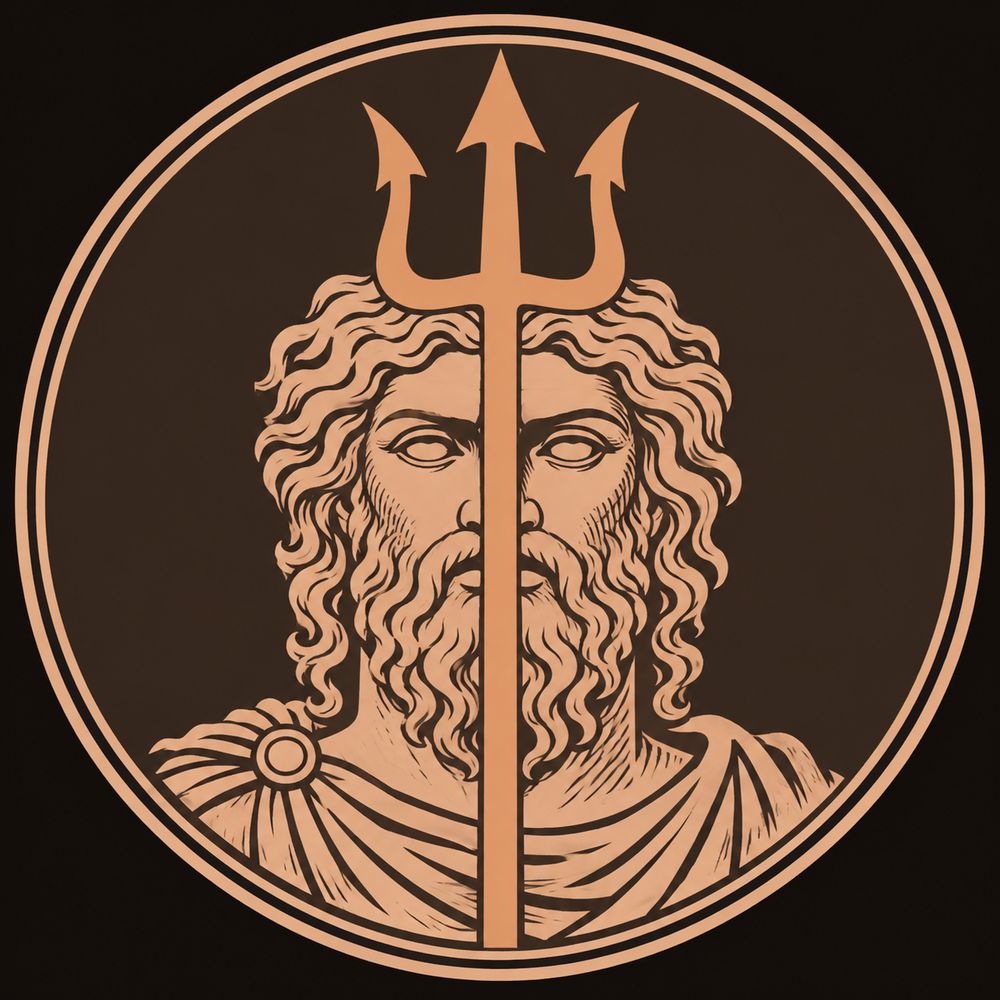
Trident on Troezen coinage
Generated by AI from this page's own facts, not an ancient image or evidence of anything. How this site uses generated images
Sections on this page
In Practice
Plutarch says Pittheus governed it and was the grandfather of Theseus (Plutarch, Life of Theseus 3). Euripides sets the tragedy of Hippolytus in the land of Troezen (Euripides, Hippolytus 1-33).
The birth of Theseus is told in a fixed order. Aegeus, king of Athens, travelled by way of Troezen and lodged with Pittheus. Pittheus understood the oracle Aegeus had received, made him drunk and caused him to lie with his daughter Aethra (Apollodorus, Library 3.15.7). Aegeus left a sword and sandals under a rock. Apollodorus says Aethra bore a son, Theseus, who pushed the rock away when grown and took up the tokens (Apollodorus, Library 3.16.1). Aegeus is thus tied to the city by one night and one hidden pledge.
Plutarch fills in what happened between the birth and the departure. He calls Pittheus a man of the greatest knowledge and wisdom of his time. Pittheus brought the boy up with a tutor named Connidas, and Aethra led him to the stone and told him who his father was. Theseus lifted it without difficulty, took the sword and shoes, and refused the safer sea road to Athens. Plutarch says robbers held every part of that road. He chose the road by land, because he wished to match the deeds of Heracles (Plutarch, Life of Theseus 3).
Troezen also frames the last act of the Theseus story. In Euripides, Aphrodite says Hippolytus, ward of Pittheus, calls her the basest of the gods, and she makes his stepmother Phaedra fall in love with him (Euripides, Hippolytus 1-33). The sufferings of Hippolytus are told on his own page. The cycle of Minos, Aegeus and Theseus is gathered in the Theseus Cycle.
Who is the father of Theseus in the Troezen tradition?
The sources name two fathers. Apollodorus says Aethra bore Theseus to Aegeus, and that Poseidon also lay with her the same night. Plutarch reports that Aethra at first hid the truth and Pittheus spread the story that Poseidon was the father. He explains why: the Troezenians honor Poseidon above all gods, offer him their first-fruits and stamp their coins with a trident. Plutarch adds that Aegeus left the sword and shoes for a son he suspected Aethra carried.
Apollodorus, Library 3.15.7; Plutarch, Life of Theseus 3
Why did Theseus leave Troezen by land and not by sea?
Plutarch says Aethra, Pittheus and Theseus's own family urged the sea route, which was much safer. Robbers and murderers held every part of the road to Athens. Theseus refused. He had long admired Heracles, who was his cousin, and thought it shameful to flee from the adventures that lay in his path. Plutarch says Pittheus described each robber in turn to dissuade him, without success.
Plutarch, Life of Theseus 3
What happens at Troezen in Euripides's Hippolytus?
Aphrodite opens the play by announcing her plan. Hippolytus, living in Troezen as Pittheus's ward, honors Artemis and scorns her. Phaedra, his father's wife, had seen him and been seized with desire. She had built a temple to Aphrodite beside the rock of Athena before she came to Troezen. Phaedra later hangs herself, and at the close Artemis promises Hippolytus honors at Troezen.
Euripides, Hippolytus 1-33; Euripides, Hippolytus 776-802; Euripides, Hippolytus 1423-1430
Did Troezen honor Hippolytus as a hero?
Yes, in Pausanias and in Euripides. Pausanias says the Troezenians dedicated a very famous precinct to Hippolytus, with a temple and an old image. They believed the constellation called the Charioteer was Hippolytus, a sign of his honor among the gods. In Euripides, Artemis promises that unmarried girls will cut their hair for him before marriage, and that maidens will always sing of him.
Pausanias, Description of Greece 2.32.1; Euripides, Hippolytus 1423-1430
Where Accounts Differ
- who fathered Theseus: Aegeus or Poseidon
- The father of Theseus is told two ways. Apollodorus (Library 3.15.7) has Aegeus and Poseidon both lie with Aethra on the same night. Plutarch (Theseus 3) says Pittheus gave out that Poseidon was the father, because Troezen revered that god.