Hippolytus
Hippolytus is the son of Theseus by an Amazon, raised at Troezen and devoted to Artemis. He scorned Aphrodite, so she made his stepmother Phaedra fall in love with him. Phaedra falsely accused him, Theseus cursed him through Poseidon, and a bull from the sea panicked his chariot horses, which dragged him to death. Later sources say Asclepius raised him.
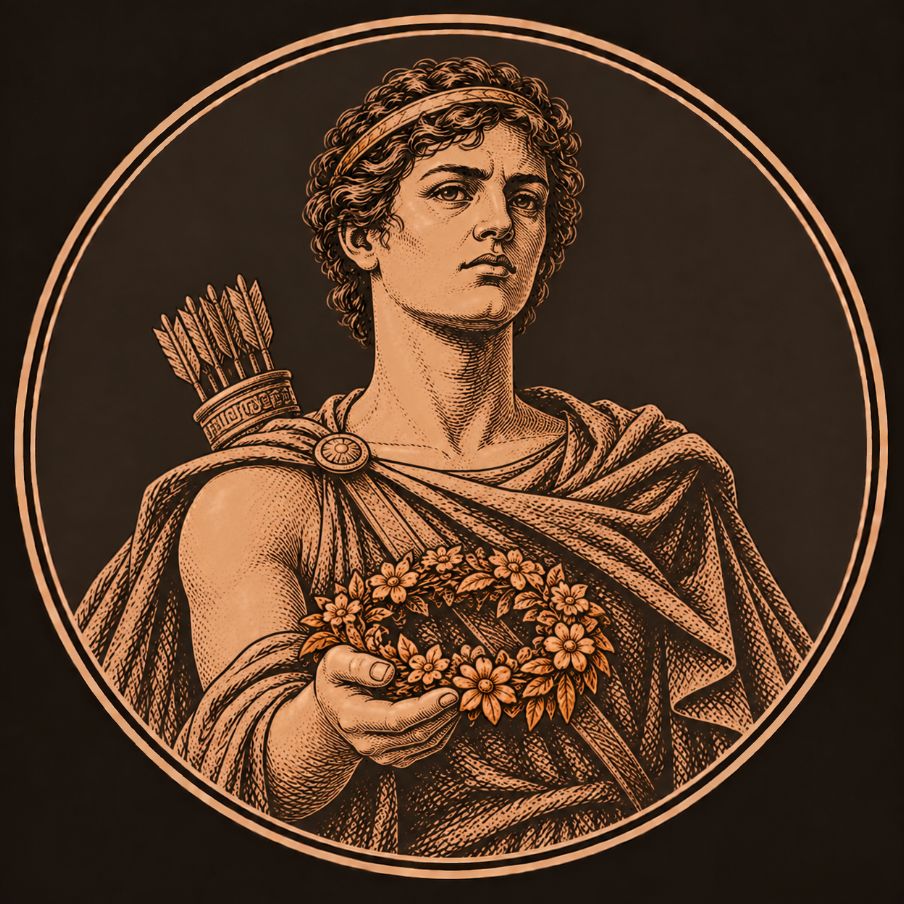
Hippolytus, bronze medallion illustration
Generated by AI from this page's own facts, not an ancient image or evidence of anything. How this site uses generated images
Sections on this page
See Hippolytus in the Greek family tree.
Core Myth
Hippolytus was the son of Theseus by an Amazon. Euripides's Hippolytus calls him simply the son "born of the Amazon" and says he was brought up at Troezen by the holy Pittheus. Apollodorus's Epitome agrees that Theseus had him by the Amazon he carried off, whom most writers named Antiope and Simonides called Hippolyte. Pausanias adds a reason for the Troezen upbringing: when Theseus was about to marry Phaedra, he sent his son to Pittheus to be raised as the future king of Troezen, so that he would neither serve nor displace any children of the new marriage.
Euripides builds the young man around a single loyalty. He hunts the woods with his hounds in the company of Artemis, whom he counts the greatest of goddesses, and he wants nothing to do with love or marriage. In the opening scene he lays a woven wreath, gathered from an untouched meadow, before her image and says that he alone of mortals may speak with her and hear her voice. When an old servant urges him to honor Aphrodite too, whose statue stands at his own gate, he answers that he greets her from a distance and bids her a long farewell.
That refusal is the cause of everything that follows. Aphrodite speaks the play's prologue herself and states her purpose plainly: she will punish Hippolytus this very day for slighting her. Her instrument is his stepmother Phaedra, the daughter of Minos, whom the goddess had already filled with desire for him when he came to Athens for the Mysteries. Phaedra's side of the story belongs to her own page. For Hippolytus, the turning point comes when her nurse reveals the secret to him under an oath of silence. He reacts with horror and a long tirade against women, but he keeps the oath. His famous line concedes that his tongue swore while his heart did not, yet he never breaks it.
Phaedra hangs herself and leaves a sealed letter accusing him of rape. Theseus reads it and calls on his father Poseidon, who had promised to grant him three prayers, to kill his son before the day is out. He also banishes Hippolytus. Apollodorus's Epitome tells the same story more starkly: Phaedra tears her own clothes, breaks open the doors of her bedroom and accuses him, and Theseus believes her and prays for his son's death.
The death is told by a messenger in Euripides. Hippolytus harnessed his horses and drove out along the shore road toward Argos and Epidaurus. At a lonely stretch of beach a huge wave rose from the Saronic Gulf, and out of it came a monstrous bull whose bellowing terrified the team. He was an expert driver. He wrapped the reins around his body and leaned back on them like a rower, but the bull kept turning the horses toward the rocks until a wheel struck a stone and the chariot broke apart. Tangled in the reins, he was dragged over the rocks. The Epitome gives the same end: Poseidon sent up a bull from the surf, the horses bolted, and Hippolytus, caught in the reins, was dragged to death.
In Euripides he is carried back to the palace still alive. Artemis appears and tells Theseus the truth: Phaedra's charge was false, Aphrodite planned it all, and the curse was a misuse of Poseidon's gift. Artemis promises Hippolytus lasting honors at Troezen. Unmarried girls will cut their hair for him before their weddings, and maidens' songs will keep his memory alive. At her urging he forgives his father and frees him from the guilt of his death before he dies.
Who was Hippolytus in Greek mythology?
He was the son of Theseus, king of Athens, by an Amazon, raised at Troezen by the wise Pittheus. Euripides presents him as a chaste hunter devoted to Artemis who refuses any honor to Aphrodite. For that slight Aphrodite makes his stepmother Phaedra fall in love with him. The result is a false accusation, his father's curse, and his death in a chariot wreck caused by a bull from the sea. Troezen later worshipped him as a hero, and Roman writers said he was revived.
Euripides, Hippolytus 10-20
What is the relationship between Hippolytus and Artemis?
He is her devoted follower. In Euripides he hunts with her in the woods, offers her a woven wreath from an untouched meadow, and claims the rare privilege of hearing her voice without seeing her face. Artemis cannot save him from Aphrodite, but she appears at his death to clear his name and promise him lasting honors at Troezen. Roman tradition goes further. Ovid and Virgil say she hid the revived Hippolytus in her grove at Aricia under the name Virbius.
Euripides, Hippolytus 58-85
Did Hippolytus love Phaedra?
No. In every ancient account the desire runs one way, from Phaedra to him, and he rejects it. Apollodorus's Epitome says he fled her advances because he hated all women. In Euripides he learns of her love from the nurse, reacts with disgust, and keeps silent only because he has sworn an oath. The Troezenians told Pausanias that Phaedra watched him exercise from a temple of Aphrodite above his race-course, but nothing suggests he returned her feelings.
Apollodorus, Epitome 1.18-1.19
What was Hippolytus accused of?
He was accused of raping his stepmother Phaedra. In Euripides's Hippolytus, Phaedra hangs herself and leaves a sealed letter on her body claiming that he forced himself on her. Theseus reads it and believes it. In Apollodorus's Epitome she makes the accusation while alive, tearing her clothes and breaking open the doors of her bedroom to stage an assault. Both sources agree the charge was false and that Phaedra made it out of fear that he would expose her.
Euripides, Hippolytus 885-890
Why did Theseus curse his son?
Because he believed Phaedra's accusation. Poseidon had promised Theseus three prayers that would always be granted, and he spent one on his son's death without any inquiry, oath test or prophecy. In Euripides, Artemis later rebukes him for exactly that haste, telling him he used a gift meant for an enemy against his own child. She also excuses him in part: Aphrodite planned the deception, and Theseus acted in ignorance. The dying Hippolytus forgives him.
Euripides, Hippolytus 885-890
Later Traditions
The honors Artemis promises in Euripides were real cult practice. Pausanias, visiting Troezen, describes a famous precinct of Hippolytus with a temple and an old image, a priest who served for life and yearly sacrifices. Every girl cut a lock of hair before her marriage and dedicated it in his temple. The Troezenians, he says, would not accept that the horses dragged him to death. They knew where his grave was but would not show it, and they identified him with the constellation called the Charioteer. The same precinct held a race-course named after him, and above it a temple of Aphrodite the Spy, from which Phaedra was said to have watched him exercise. Athens also claimed him: Pausanias saw a burial mound of Hippolytus below the Acropolis, beside a temple of Themis.
A second tradition refuses to let him stay dead. Apollodorus's Library lists Hippolytus among the dead raised by Asclepius, and credits the story to the lost epic called the Naupactica. At Epidaurus, Pausanias read an old slab saying Hippolytus had dedicated twenty horses to the healing god. The people of Aricia in Italy told him that Asclepius revived Hippolytus. He then refused to forgive his father, went to Aricia, became king and set up a precinct to Artemis there.
The Roman poets develop that Italian ending. In Ovid's Metamorphoses, Hippolytus himself tells the story to the grieving nymph Egeria in the grove of Aricia. He describes the bull from the sea and his body torn apart in the reins. Then he tells how Apollo's son restored him with potent herbs, against the will of the ruler of the dead. Diana hid him in clouds, made him look older so he would not be recognized, and gave him a new name, Virbius, because the old one recalled his horses. He now lives in her grove as one of the lesser gods.
Virgil's Aeneid tells it slightly differently. It sends a warrior named Virbius, son of Hippolytus and Aricia, to fight for the Latins. Virgil explains that Diana's love and Paeonian herbs brought Hippolytus back, and that Jupiter, angry that a mortal had returned from the dead, struck down the healer with a thunderbolt. Diana hid Hippolytus in Egeria's grove, where he lived on alone under the name Virbius. For that reason, Virgil says, horses are kept out of Diana's temple and sacred groves.
Euripides himself dramatized the story twice. The surviving play is his second version. The first, known in modern scholarship as Hippolytus Veiled, is lost. The production note preserved with the surviving text dates it to the archonship of Epameinon, 428 BCE, and records that Euripides took first prize, ahead of Iophon and Ion. Seneca's Latin tragedy Phaedra retells the story again, with Phaedra confessing her love to Hippolytus herself rather than through the nurse.
Modern Influence
Jean Racine's tragedy Phèdre, first performed in Paris on 1 January 1677 at the Hôtel de Bourgogne, draws on both Euripides's Hippolytus and Seneca's Phaedra. Racine makes a notable change to the young man at the center of the story. His Hippolyte is no longer indifferent to love: he loves Aricie, the last survivor of a royal house Theseus overthrew. The false accusation is devised by Phèdre's nurse, Oenone. His death still follows the ancient pattern, with a horned monster rising from the waves and his panicked horses dragging him against the rocks.
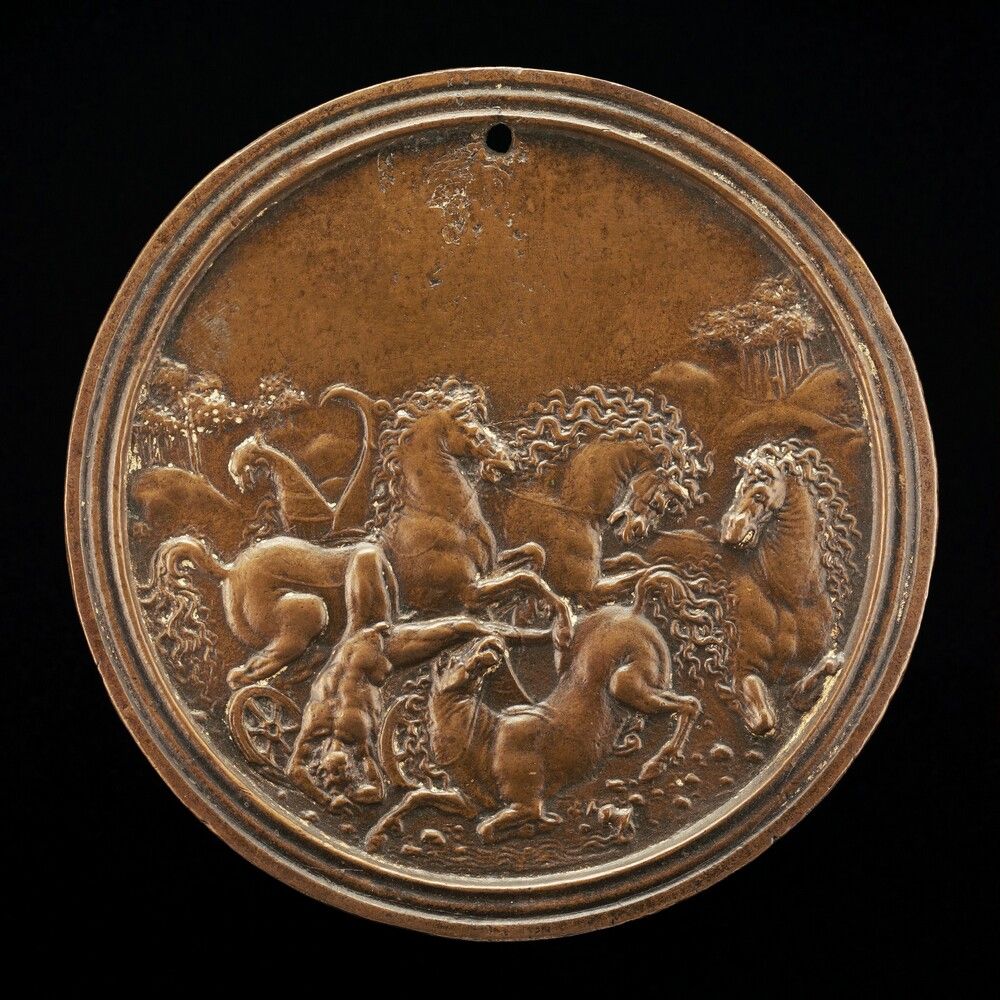
Death of Hippolytus - Moderno, late 15th - early 16th century, bronze//Dark brown patina
National Gallery of Art, Washington, DC, 1957.14.313. CC0
Lineage
See the full family tree1 recorded relation, each with the ancient line behind it.

Also Connected
5 recorded connections, each with the ancient line behind it.
Enemies
-

Aphrodite plans his ruin for scorning her.
-

Rejected by him, she accused him falsely to Theseus.
Connected
-

He honours Artemis alone, and she clears his name as he dies.
-

The author of the Naupactica says Asclepius raised him from the dead.
-

Theseus's curse, granted by Poseidon, sends the bull from the sea that wrecks his chariot.
Where Accounts Differ
- his Amazon mother: Antiope or Hippolyte
- his fate after death: hero cult, revival by Asclepius, or Virbius
- how Phaedra made her accusation
- Euripides's two Hippolytus plays
- His mother's name differs by source. Euripides calls her only the Amazon. Apollodorus's Epitome says most writers named Theseus's Amazon bride Antiope, some Melanippe, and that Simonides called her Hippolyte. Plutarch's Life of Theseus names his mother Antiope and reports that Pindar called her son Demophon rather than Hippolytus.
- What happened after his death is told three ways. Euripides and the Troezen cult described by Pausanias make him a hero honored with hair offerings, though the Troezenians denied that the horses killed him and linked him to the constellation of the Charioteer. Apollodorus's Library, citing the Naupactica, and the Aricians quoted by Pausanias say Asclepius raised him. Ovid and Virgil add that Diana hid him at Aricia under the name Virbius.
- Ovid makes Virbius the new name of the revived Hippolytus himself. Virgil gives the name both to Hippolytus in hiding and to his son by Aricia, who fights for the Latins in the Aeneid.
- The two sources on the accusation differ in staging. Euripides has Phaedra hang herself first and accuse him in a letter. Apollodorus's Epitome has her accuse him while alive, tearing her clothes, and hang herself only after her passion became known.
- Euripides wrote two plays on Hippolytus. The earlier one, known in modern scholarship as Hippolytus Veiled, is lost and is named here in prose only. Every Euripides citation on this page refers to the surviving play.
Read the full source verification →
Mythology
Referenced By
Sources
- Euripides, Hippolytus 10-20
- Euripides, Hippolytus 58-85
- Euripides, Hippolytus 601-616
- Euripides, Hippolytus 885-890
- Euripides, Hippolytus 1198-1243
- Euripides, Hippolytus 1416-1430
- Apollodorus, Epitome 1.16-1.17
- Apollodorus, Epitome 1.18-1.19
- Apollodorus, Library 3.10.3
- Pausanias, Description of Greece 1.22.1-1.22.2
- Pausanias, Description of Greece 2.27.4
- Pausanias, Description of Greece 2.32.1
- Pausanias, Description of Greece 2.32.3
- Plutarch, Life of Theseus 28
- Ovid, Metamorphoses 15.492-546
- Virgil, Aeneid 7.761-782
- Gilbert Murray, The Hippolytus of Euripides, translated into English rhyming verse with explanatory notes