Aegeus
Aegeus was a king of Athens and the mortal father of Theseus. Childless after two marriages, he received a riddling oracle at Delphi, fathered Theseus on Aethra at Troezen, and left a sword and sandals under a rock for the boy. When Theseus sailed home from Crete under the black sail by mistake, Aegeus believed him dead and threw himself to his death.
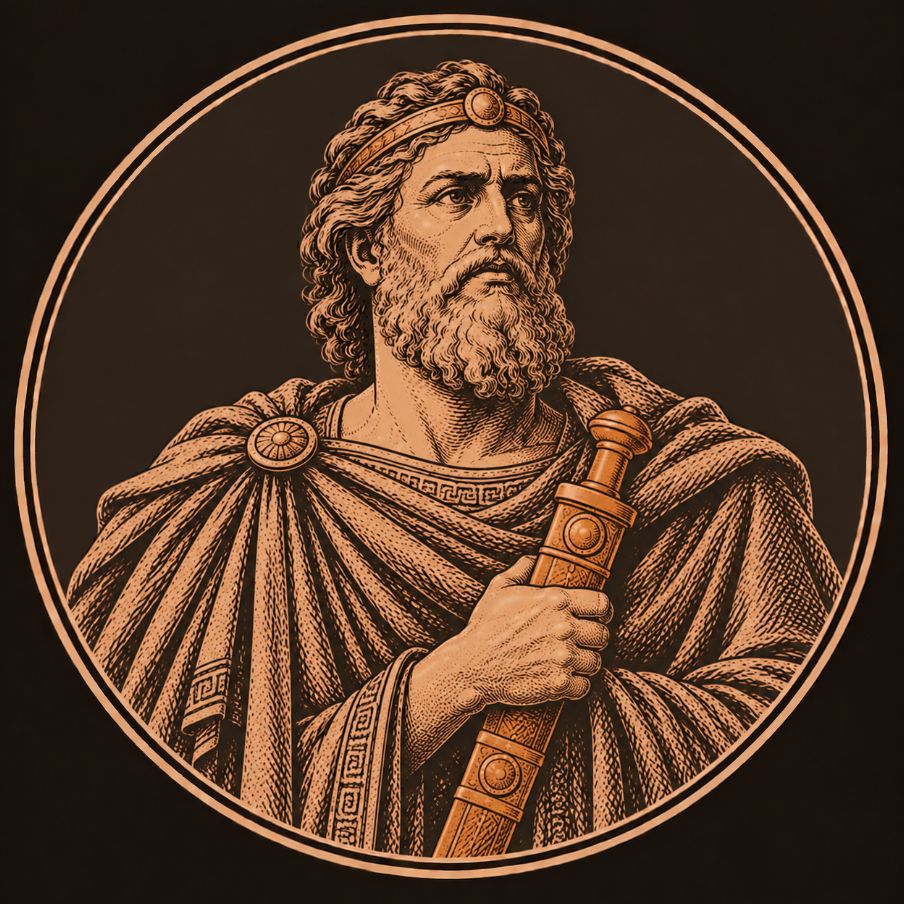
Aegeus, bronze medallion illustration
Generated by AI from this page's own facts, not an ancient image or evidence of anything. How this site uses generated images
Sections on this page
See Aegeus in the Greek family tree.
Core Myth
Apollodorus names Aegeus as one of four sons born to Pandion in exile at Megara, with Pallas, Nisus and Lycus. After Pandion died, the brothers drove the Metionids out of Athens and split the rule four ways, but Aegeus held the real power. He married twice, first Meta and then Chalciope, and had no child by either. Fearing his brothers, he went to consult the oracle at Delphi about children. The answer came as a riddle: he was not to loosen the mouth of the wineskin until he reached the height of Athens.
Puzzled, Aegeus travelled home by way of Troezen and told the oracle to its king, Pittheus. Apollodorus says Pittheus understood it, made Aegeus drunk and put him to bed with his daughter Aethra. Plutarch is less sure whether Pittheus persuaded him or tricked him. Before leaving, Aegeus hid a sword and a pair of sandals under a great rock. If Aethra bore a son strong enough to lift it, she was to send him to Athens with the tokens. Plutarch adds that the journey was to be secret, because the fifty sons of Pallas despised the childless king and plotted against him.
Back in Athens, Aegeus held the Panathenaic games, where Minos's son Androgeus beat every opponent. Apollodorus says Aegeus then sent Androgeus against the bull of Marathon, which killed him. The same account offers a second version, in which jealous rivals ambushed Androgeus on the road to Thebes. Either way, Minos made war on Athens. Famine and plague followed, and an oracle told the Athenians to give Minos whatever satisfaction he chose. He demanded seven youths and seven maidens as food for the Minotaur.
Years later, Theseus arrived in Athens carrying the tokens from the rock. By then Aegeus had married Medea, who recognised the stranger before her husband did. Apollodorus says she persuaded Aegeus to send the young man against the Marathonian bull, the Cretan Bull that Apollodorus elsewhere has roaming to Marathon after Heracles set it free. When Theseus survived, she gave Aegeus poison for him. Plutarch places the scene at a banquet: Theseus drew his sword as if to carve the meat, Aegeus knew it, and dashed the cup to the ground. He acknowledged his son before the citizens and drove Medea out.
When Theseus sailed with the third tribute, Aegeus told him to hoist white sails on the return if he lived, in place of the ship's black one. The voyage is told in full in Theseus and the Minotaur. Theseus killed the Minotaur, but on the way home, grieving for Ariadne in Apollodorus's telling, he forgot the signal. Aegeus saw the black sail from the Acropolis, took his son for dead, and threw himself down. Theseus succeeded him as king.
Why did King Aegeus believe his son was dead?
Because Theseus came home under the wrong sail. Before the voyage to Crete, Aegeus told his son to replace the ship's black sail with a white one if he returned alive. Apollodorus says Theseus, grieving for Ariadne, forgot the signal. Plutarch says the joy of the homecoming made both Theseus and his pilot forget. Seeing the black sail approach, Aegeus concluded that the Minotaur had killed his son. Plutarch also cites Simonides, for whom the signal of safety was a scarlet sail rather than a white one.
Apollodorus, Epitome 1.7-1.10
What did King Aegeus do?
Aegeus ruled Athens after he and his brothers expelled the Metionids, who had driven out their father Pandion. Childless, he consulted the Delphic oracle and fathered Theseus on Aethra at Troezen. Apollodorus holds him responsible for the death of Minos's son Androgeus, sent against the bull of Marathon, which led to Minos's war and the tribute of youths for the Minotaur. He later married Medea and almost poisoned Theseus before recognising him by his sword. He died believing Theseus had been killed in Crete.
Apollodorus, Library 3.15.6-3.15.7
Who was the father of Theseus?
The ancient sources give two fathers, and several keep both. Apollodorus says Aegeus lay with Aethra at Troezen and that Poseidon had her the same night. Hyginus adds that Poseidon gave up the child to Aegeus. In practice Aegeus is the father who counts on earth: he leaves the sword and sandals, recognises Theseus by the sword, and names him his heir. Poseidon's claim explains the divine favour Theseus enjoys at sea in other parts of his story.
Apollodorus, Library 3.15.7
What does an Aegeus do in Medea?
In Euripides's Medea, Aegeus arrives in Corinth on his way home from the oracle of Apollo at Delphi, where he asked how he might have children. Medea tells him Jason has abandoned her and that Creon is banishing her. She begs for refuge and promises that her drugs will end his childlessness. Aegeus agrees to shelter her if she reaches Athens on her own. At her insistence, he swears by Earth, the Sun and all the gods never to hand her over.
Euripides, Medea 663-756
Later Traditions
Where Aegeus fell is the sharpest disagreement about him. Apollodorus says he watched from the Acropolis and cast himself down. Pausanias, standing by the temple of Wingless Victory at the Acropolis gateway, reports the legend that Aegeus leapt from that very spot, from which the sea is visible. Plutarch says only that he threw himself from the rock. Catullus has him climb the citadel to watch and fling himself headlong from the height. Hyginus is the one who puts him into the sea itself, and says the Aegean was named after him. The popular explanation of the sea's name therefore rests on Hyginus, not on the older Greek accounts.
Even his fatherhood was contested. Apollodorus records that Poseidon lay with Aethra on the same night as Aegeus, and Hyginus says Poseidon yielded the child to Aegeus. His own descent was questioned too. Apollodorus notes a version in which Aegeus was really the son of one Scyrius, passed off by Pandion as his own. In Plutarch, the sons of Pallas call him only an adopted son of Pandion, with no blood tie to the old royal line of Erechtheus.
Euripides gives Aegeus his best-known scene outside the Theseus story. In the Medea, he passes through Corinth on his way home from Delphi and hears how Jason has abandoned Medea and Creon is banishing her. She promises to end his childlessness with her drugs. He agrees to shelter her if she reaches Athens on her own, and swears by Earth, the Sun and all the gods never to give her up. The oath secures her a refuge before she takes her revenge in Corinth.
Athens honoured him all the same. Pausanias lists Aegeus among the eponymous heroes whose statues stood in the city, and mentions a hero-shrine of Aegeus. Plutarch says the poison spilled where the Delphinium enclosure later stood, on the site of Aegeus's house. Plutarch also preserves a variant from the poet Simonides, in which the agreed signal of safety was not a white sail but a scarlet one.
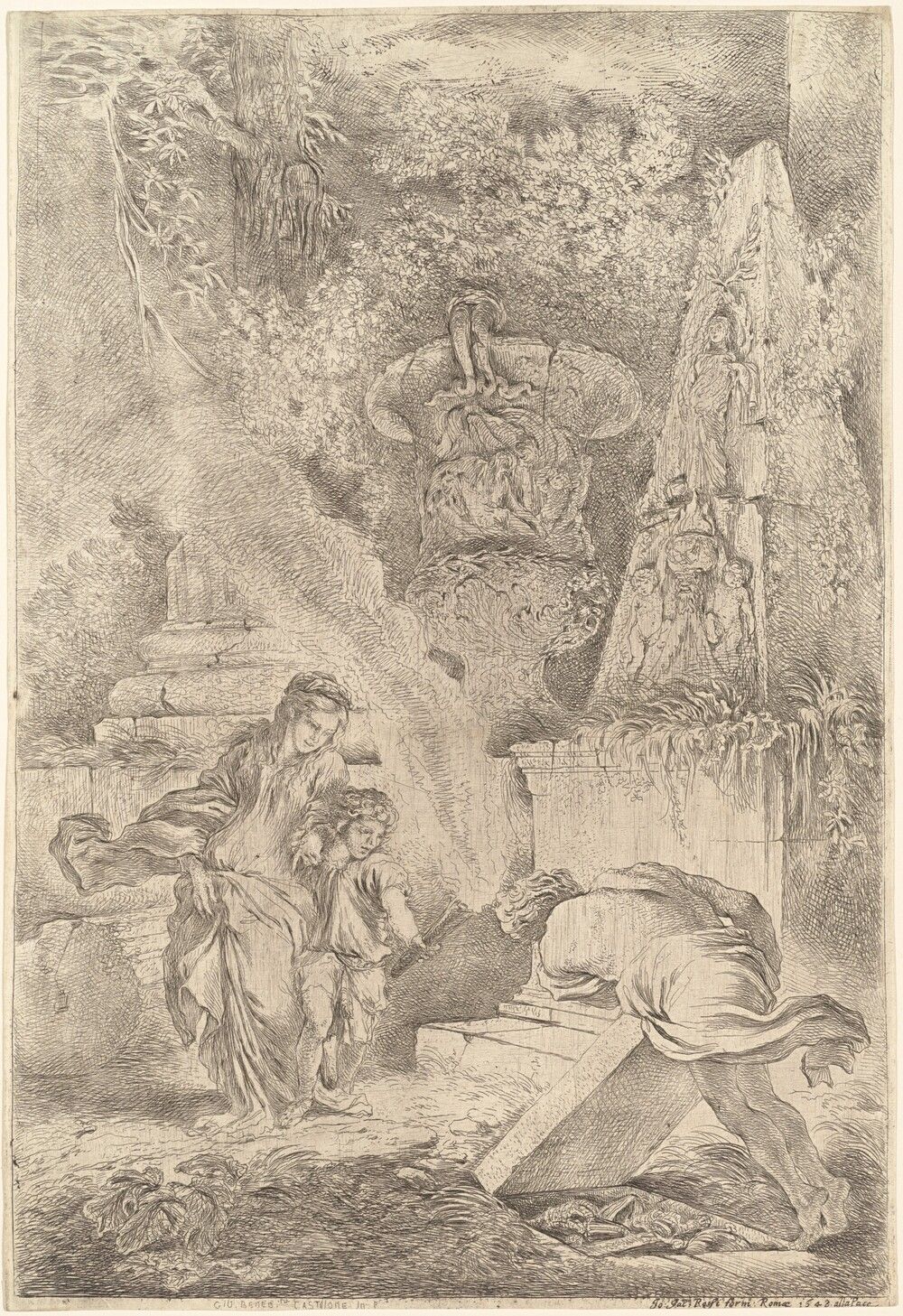
Theseus Finding Aegeus' Arms - Giovanni Benedetto Castiglione, c. 1645, etching on laid paper
National Gallery of Art, Washington, DC, 2018.113.27. CC0
Lineage
See the full family tree1 recorded relation, each with the ancient line behind it.
Children

Also Connected
2 recorded connections, each with the ancient line behind it.
Enemies
-
The death of Minos's son Androgeus led to his war on Athens and the tribute of youths and maidens.
Connected
-
Medea, living with Aegeus in Athens, tried to poison the returning Theseus.
Where Accounts Differ
- where Aegeus leapt to his death
- whether Aegeus or Poseidon fathered Theseus
- whether Aegeus was a true son of Pandion
- how Androgeus died
- the colour of the agreed sail
- How and where Aegeus died differs by source. Apollodorus (Epitome 1.10) has him watch from the Acropolis and cast himself down, Pausanias (1.22.4-1.22.5) places the leap beside the temple of Wingless Victory, Plutarch (Theseus 22) says he threw himself from the rock, and Catullus (64) has him fling himself from the citadel's height. Only Hyginus's Fabulae sends him into the sea and derives the name of the Aegean from him.
- Theseus's paternity is double. Apollodorus (Library 3.15.7) has Poseidon lie with Aethra on the same night as Aegeus, and Hyginus says Poseidon ceded the child to Aegeus. Apollodorus (Library 3.16.1) still calls Theseus the son Aethra bore to Aegeus.
- Aegeus's own descent is disputed. Apollodorus (Library 3.15.5) makes him a son of Pandion but records that some called him a son of Scyrius whom Pandion passed off as his own. In Plutarch (Theseus 13), the sons of Pallas call him only an adopted son of Pandion.
- Apollodorus (Library 3.15.7) gives two deaths for Androgeus: killed by the bull of Marathon after Aegeus sent him against it, or ambushed by jealous competitors on the way to games at Thebes. Only the first makes Aegeus responsible.
- Plutarch (Theseus 17) records that Simonides made the agreed signal of safety a scarlet sail, not a white one.
- Plutarch is cited from the Dryden-Clough translation held in the site's source library, with chapter numbers checked against Bernadotte Perrin's Loeb translation.
Read the full source verification →
Mythology
Appears In
Related Terms
Referenced By
Sources
- Apollodorus, Library 3.15.5
- Apollodorus, Library 3.15.6-3.15.7
- Apollodorus, Library 3.15.7
- Apollodorus, Library 3.15.7-3.15.8
- Apollodorus, Library 3.16.1
- Apollodorus, Library 2.5.7
- Apollodorus, Epitome 1.5-1.6
- Apollodorus, Epitome 1.7-1.10
- Euripides, Medea 663-756
- Plutarch, Life of Theseus 3
- Plutarch, Life of Theseus 12
- Plutarch, Life of Theseus 13
- Plutarch, Life of Theseus 17
- Plutarch, Life of Theseus 22
- Pausanias, Description of Greece 1.5.2-1.5.4
- Pausanias, Description of Greece 1.22.4-1.22.5
- Catullus, Carmina 64.212-245
- Hyginus, Fabulae