Minotaur
The Minotaur was a creature with the body of a man and the head of a bull, born from the unnatural union of Queen Pasiphaë of Crete and a divine bull. Imprisoned in the Labyrinth built by Daedalus, it was fed human tribute from Athens until slain by Theseus.

The Minotaur of the Cretan Labyrinth
Generated by AI from this page's own facts, not an ancient image or evidence of anything. How this site uses generated images
Sections on this page
See Minotaur in the Greek family tree.
Core Myth
Apollodorus traces the Minotaur's origin to a bargain King Minos broke. Minos himself was born a generation earlier from Zeus's abduction of Europa, carried to Crete in the shape of a gentle white bull - the same island where his own son would later be sealed away as a monster with a bull's head. Poseidon sent Minos a magnificent white bull to sacrifice in the god's honor, but Minos, admiring the animal, kept it and substituted a lesser bull instead. Poseidon punished the deception by making Minos's wife, Pasiphaë, fall in love with the bull itself. Unable to consummate the union on her own, Pasiphaë had the craftsman Daedalus build a hollow wooden cow she could hide inside, and from that union she bore the Minotaur - a creature with a man's body and a bull's head, named Asterion at birth but known ever after by the name that simply means "bull of Minos."
Minos did not kill the child, though every source treats it as a monster from birth. Instead he had Daedalus construct the Labyrinth beneath his palace at Knossos, a maze built specifically so that anyone who entered could not find their way back out, and confined the Minotaur inside it. After his son Androgeos died in Athens, Minos went to war and imposed a recurring tribute on the defeated city: seven youths and seven maidens sent to Crete at fixed intervals to be fed to the Minotaur in the Labyrinth. Plutarch adds a rationalizing detail some Greek writers preferred: the tribute may have been sent to a games or contest called Taurus rather than to the Minotaur literally, a version told to make the tale less monstrous, though it is not the mainstream account.
The tribute continued until Theseus, son of the Athenian king Aegeus, volunteered to go among the intended victims. Ariadne, Minos's daughter, fell in love with him and gave him a ball of thread to unwind as he entered the maze, so he could retrace his steps. Theseus killed the Minotaur, by most accounts with his bare hands or a sword smuggled in, and followed the thread back out, ending the tribute for good.
Why did Poseidon curse Pasiphaë instead of punishing Minos directly?
Apollodorus frames it as punishment through the family rather than the person: Minos had broken his bargain by keeping the sacrificial bull for himself, and Poseidon's revenge was to make Minos's own household bear a monstrous, permanent consequence, rather than to strike Minos down outright. The king survives; his wife and the child she bears do not get off so lightly.
Apollodorus, Library 3.1.3-3.1.4
How was the Minotaur actually conceived?
Pasiphaë could not approach the bull on her own terms, so she had the craftsman Daedalus build a hollow wooden cow covered in real hide, which she climbed inside so the bull would mount it believing it to be a real cow. The device is Daedalus's first recorded commission in the myth, well before he builds the Labyrinth that later imprisons the child born from it.
Apollodorus, Library 3.1.4
Why did Athens have to send tribute to Crete?
After Minos's son Androgeos died while visiting Athens, Minos went to war against the city and won. As part of the settlement, Athens was required to send seven young men and seven young women to Crete at fixed intervals to be given to the Minotaur in the Labyrinth, a punishment imposed for the son's death rather than any offense connected to the Minotaur itself.
Apollodorus, Epitome 1.7
How did Theseus find his way out of the Labyrinth after killing the Minotaur?
Ariadne, Minos's daughter, gave him a ball of thread before he entered and told him to tie one end at the entrance and unwind it as he went in, so that after killing the Minotaur he could follow the thread back to the door rather than getting lost in the maze meant to prevent exactly that.
Apollodorus, Epitome 1.9
Is there a version of the myth where the Minotaur isn't real?
Plutarch records one: some Greek writers held that Athenian youths were not fed to a monster at all, but sent to compete in or be awarded as prizes in games held in honor of a Cretan general named Taurus, and that the whole tribute was later misremembered as a monster story. Plutarch presents this as a possible rationalization circulating in his sources rather than the version most people told or believed.
Plutarch, Life of Theseus 15-16
Later Traditions
The Minotaur and the Labyrinth became enduring figures for confinement and for a monstrous problem that cannot simply be avoided, only entered and solved from within. Archaeological excavation of the Bronze Age palace complex at Knossos, with its genuinely maze-like floor plan and bull-related imagery, has long been proposed as a possible real-world seed for the myth, though the connection is suggestive rather than proven. The same excavations recovered double axes, the labrys, a Minoan cult object that no ancient telling of the Minotaur myth ever mentions.

Black-Figure Hydria (Water Vessel): Frontal Quadriga (Body); Theseus and Minotaur (Shoulder) - Greece, Attic, c. 520 BCE, ceramic
The Cleveland Museum of Art, Cleveland, OH, 1975.1. CC0
Lineage
See the full family tree1 recorded relation, each with the ancient line behind it.
Parents
-

Pasiphaë's union with this same bull, sent by Poseidon and later captured by Heracles as his seventh labor, produced the Minotaur.
Also Connected
2 recorded connections, each with the ancient line behind it.
Connected
-

Daedalus built both the wooden cow that let Pasiphaë conceive the Minotaur and the Labyrinth built afterward to contain it.
-
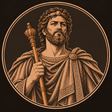
Minos shut the Minotaur, born to his wife Pasiphae, in the Labyrinth.
Where Accounts Differ
- rationalized games-contest version
- Plutarch preserves a rationalized alternate tradition in which the Athenian tribute went to a games contest rather than to a literal monster - evidence that even ancient authors treated the story's monstrous core as something later writers tried to explain away.
Read the full source verification →
Mythology
Appears In
Killed By
Related Terms
Referenced By
Sources
- Apollodorus, Library 3.1.3-3.1.4
- Apollodorus, Epitome 1.7-1.9
- Plutarch, Life of Theseus 15-19
- Timothy Gantz, Early Greek Myth (1993)