Monsters and Creatures of Greek Myth
This cluster covers Greek mythology's monstrous creatures. Medusa and the Gorgons, the Minotaur, the Hydra, Cerberus, the Chimera, the Sphinx, Typhon, Scylla, Charybdis, the Sirens, and the Cyclopes all belong here. Hesiod's Theogony makes Typhon and Echidna the parents of most of them. But ancient authors disagree sharply about the details: Medusa's origin, the Hydra's head count, and whether Homer's Cyclops matches Hesiod's Cyclopes.
Sections on this page
Overview
Most of Greek myth's monsters share one family tree. Hesiod's Theogony makes Typhon, the last and greatest challenger to Zeus's rule, and his mate Echidna the parents of nearly every creature in this cluster. Echidna bore three of them directly: the many-headed Hydra of Lerna, the flesh-eating Cerberus who guards the underworld's gate, and the fire-breathing Chimera. The Chimera is lion in front, serpent behind, and goat in the middle. A second union, with the hound Orthus, produced the riddling Sphinx who terrorized Thebes until her riddle was answered. Heracles faced two of Echidna's children directly in his labors: he killed the Hydra outright and dragged Cerberus up from the underworld alive.
Medusa, the only mortal of the three Gorgons, belongs to an older and separate lineage. Hesiod makes her and her sisters Stheno and Euryale daughters of the sea deities Phorcys and Ceto, not of Typhon and Echidna. Of the three, only Medusa is mortal. Perseus beheaded her while she slept, guided by Athena and looking only at her reflection in his shield. She was the one Gorgon a hero could actually kill. The Sirens, whose song lures sailors to their deaths, share the sea-adjacent setting but not the bloodline. Ancient sources give them no consistent parentage at all. No ancient text or artwork gives them a fish's tail, either.
Scylla and Charybdis menace Odysseus from opposite sides of the same strait in Homer's Odyssey. Scylla is a six-headed devourer who seizes sailors straight from the deck. Charybdis is a whirlpool that swallows the sea three times a day. The Cyclopes split into two traditions that ancient authors never reconcile. One is Hesiod's three named smiths, who forge Zeus's thunderbolt. The other is Homer's unnamed race of lawless, one-eyed pastoral giants, and Polyphemus, blinded by Odysseus, is one of them.
The Minotaur stands apart from this genealogy entirely. It was born of Queen Pasiphae's union with a bull, not descended from Typhon or the sea. It punishes a king's broken vow rather than embodying a primordial horror. Theseus, not Heracles or Perseus, ended it. What unites this cluster despite the different bloodlines is how little the ancient sources agree on. Medusa's own origin, the Hydra's head count, and whether Homer's Cyclops matches Hesiod's Cyclopes are all genuinely disputed. None of them are settled facts smoothed over by later retellings.
In This Topic (12)
-

Typhon Character
Typhon is the most fearsome monster in Greek mythology, born to challenge Zeus's rule and defeated only after an enormous battle.
-
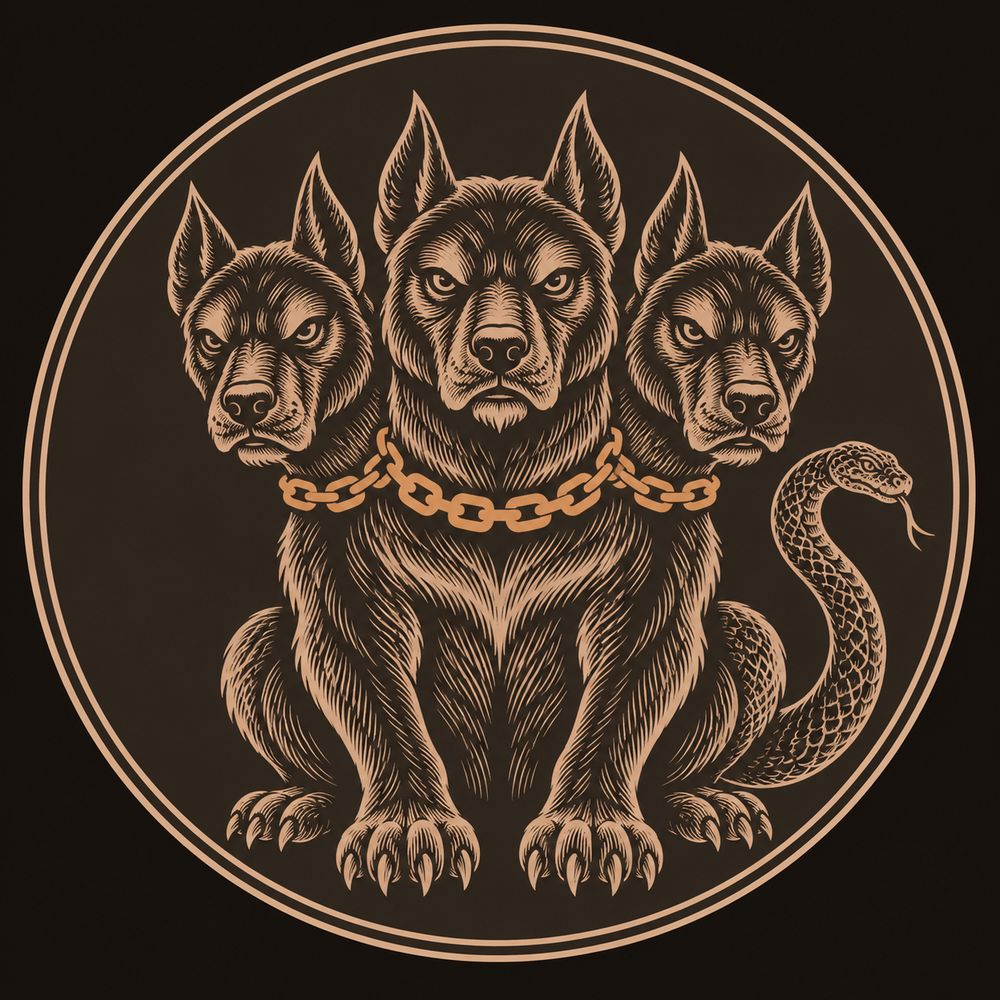
Cerberus Character
Cerberus is the monstrous three-headed dog that guards the entrance to the Greek underworld.
-

Hydra Character
The Hydra is a many-headed serpentine monster whose heads regenerated when cut off.
-

Chimera Character
The Chimera is a fire-breathing hybrid monster with the body of a lion, a goat's head rising from its back, and a serpent for a tail.
-

Sphinx Character
The Sphinx is the riddling monster with a woman's face, a lion's body, and wings, who terrorized Thebes until her riddle was solved.
-

Medusa Character
Medusa is the mortal Gorgon whose gaze turned anyone who looked upon her to stone.
-
The Gorgons Term
The Gorgons are three monstrous sisters in Greek mythology - Stheno, Euryale, and Medusa - whose direct gaze turns anyone who meets it to stone. Hesiod's Theogony names them daughters of the sea-god Phorcys and his sister Ceto, living beyond glorious Ocean at the western edge of the world, near the Hesperides and the realm of Night. The same lines name two more daughters of that pair, the Graeae, gray from their birth. Of the three Gorgons, only Medusa is mortal; Stheno and Euryale are ageless and cannot be killed at all. That single distinction is the reason Medusa, and not either of her sisters, is the Gorgon of myth: a hero sent after an immortal target would have no possible victory, so the entire Perseus story depends on the sisters not being identical. Hesiod's Theogony gives almost no individual description of Stheno and Euryale beyond their names and their immortality - they exist mainly to establish that there were three Gorgons, not one, and that Medusa's mortality set her apart. Later sources fill in the shared imagery associated with all three: snakes for hair, a gaze that petrifies on contact, and a monstrous, fanged, sometimes bronze-clawed appearance found across archaic Greek art long before it settles into the more human-faced Medusa familiar from later vase painting and sculpture. The most consequential episode involving the Gorgons is Perseus's killing of Medusa, already treated in full elsewhere in this reference; the fact that matters here is why the mission was possible in the first place. Apollodorus's fuller narrative of the beheading assumes exactly what Hesiod establishes: that Medusa, unlike her sisters, could die. Hesiod also records what Ovid's later account depends on - that Poseidon had already lain with Medusa before Perseus ever arrives, so that Pegasus and Chrysaor spring from her neck at the moment of death rather than being conceived afterward. A real and unresolved variant separates the Gorgons' oldest attested tradition from a much later Roman one. Hesiod treats Medusa as a Gorgon from birth, with no story of how she came to be one, and gives no account of Stheno and Euryale's origin beyond their shared parentage. Ovid, writing centuries later, tells a different story for Medusa alone: that she was once a beautiful mortal woman, admired above all for her hair, until Poseidon violated her in Athena's own temple and Athena, unable to punish a god, transformed Medusa's hair into snakes as punishment instead. Ovid's account never extends this backstory to Stheno or Euryale, who remain, in every source, monstrous without explanation. The two traditions are not reconciled anywhere in antiquity; they answer different questions about Medusa rather than contradicting a single settled account.
The Gorgons are three sisters, Stheno, Euryale and Medusa. Only Medusa, the mortal one, has her own page here, since she alone could be killed and so became the target of Perseus's quest.
-
Sirens Term
The Sirens are dangerous creatures in Greek mythology whose irresistible singing lures sailors to their deaths on the rocks of their island, most famously survived by Odysseus, who has his crew bind him to the mast so he can hear the song without steering the ship toward it. Every ancient text and every piece of ancient Greek art that depicts them agrees on their form: women with the bodies of birds, usually with a human head and torso set on a bird's wings, legs, and claws. No ancient source gives them a fish's tail. The familiar image of the Siren as a fish-tailed mermaid is a much later, medieval and post-classical development with no basis in the ancient Greek or Roman texts; the confusion arose long after antiquity, from a later blending of the bird-woman Siren with entirely separate mermaid folklore. Homer's Odyssey gives the fullest and earliest surviving account. The witch Circe warns Odysseus that the Sirens sit in a meadow surrounded by the bones of men they have already destroyed, and that anyone who hears their song and comes near never returns home to see his wife and children again. Following her instructions, Odysseus has his men plug their own ears with wax while he alone listens, lashed tightly to the ship's mast with orders not to be untied no matter how he begs; the ship passes safely while the Sirens' song fades behind it, and Odysseus survives an encounter the poem otherwise treats as fatal to anyone who hears it. Ancient sources do not agree on the Sirens' number or parentage. Homer never says how many there are, and later tradition varies between two and three, with different authors giving them different names and different parents. Apollodorus counts the river-god Achelous and a Muse among the parents given for them, tying the Sirens to a broader pattern in Greek myth of dangerous, alluring beings born from a union of a nature-god and a divine singer. Ovid supplies a different account of how they came to have bird bodies at all: he makes them companions of Persephone at the moment of her abduction, given wings by the gods afterward so that they could search for her over the sea without exhausting themselves - an origin story that has nothing to do with sailors or shipwreck and explains their bird form as a search-tool rather than a natural trait. The Sirens also appear in the story of the Argonauts, where Orpheus's music, rather than any physical restraint, is what saves the crew: his playing simply outcompetes the Sirens' song, so the Argonauts sail past without needing Odysseus's more desperate solution of ropes and wax.
-

Scylla Character
Scylla is the six-headed monster who devours sailors from a cliff in the strait opposite Charybdis.
-

Charybdis Character
Charybdis is the monstrous whirlpool that swallows and disgorges the sea three times a day opposite Scylla's cliff.
-
Cyclopes Term
The Cyclopes are one-eyed giants in Greek mythology, but the name actually covers two distinct and unrelated traditions that most readers blend together without realizing they come from different sources. Hesiod's Theogony describes the original three Cyclopes - Brontes, Steropes, and Arges, whose names mean Thunder, Lightning, and Bright - as primordial sons of Gaia and Ouranos, born alongside the Titans with a single round eye set in the middle of the forehead. Their father Ouranos hated and imprisoned them at birth, and Kronos kept them confined after seizing power in turn. Zeus freed them during the war against the Titans, and in gratitude they forged his thunderbolt, along with Hades's cap of invisibility and Poseidon's trident, the weapons that decided the war. Homer's Odyssey describes a completely different race under the same name, centuries of literary distance from Hesiod's smiths. His Cyclopes are lawless, one-eyed pastoral giants who live scattered across an island with no assemblies, no laws, and no agriculture, each family ruling itself with no regard for the others. Polyphemus, the giant blinded by Odysseus, is one of this race, a son of Poseidon rather than of Gaia and Ouranos, tending sheep in a cave rather than working at any forge. Homer gives no indication that his Cyclopes have any connection to weapon-making at all; they are herdsmen and cannibals, not craftsmen. These two traditions are genuinely distinct rather than one evolving into the other, and ancient authors never reconcile them into a single consistent population. Hesiod's three named Cyclopes are specific individuals tied to a specific act, the forging of Zeus's power, set in the primordial age before the Olympians ruled. Homer's Cyclopes are an entire unnamed race, living in ordinary story-time during Odysseus's return from Troy, defined by their isolation and savagery rather than by any craft. Apollodorus, writing after both, largely follows Hesiod for the smith-Cyclopes' origin and role in freeing Zeus, keeping the two strands separate rather than merging them; later authors such as Callimachus complicate the smith tradition further by placing the same Cyclopes at Hephaestus's forge rather than crediting them as independent makers, but that is a layering of Hesiod's tradition with itself, not a merger with Homer's pastoral giants.
This term covers two ancient traditions that are never merged into one population: Hesiod's primordial smith-Cyclopes who forge Zeus's thunderbolt, and Homer's separate, unnamed race of lawless pastoral giants.
-

Minotaur Character
The Minotaur is the half-man, half-bull monster imprisoned in the Labyrinth of Crete.
Unlike most of this cluster, the Minotaur is not descended from Typhon and Echidna. It is born from Queen Pasiphae's union with a bull, a punishment for her husband's broken vow rather than a primordial monster.
Was Medusa born a monster, or was she transformed into one?
Ancient sources give two incompatible answers. Hesiod's Theogony makes Medusa a Gorgon from birth, one of three daughters of the sea deities Phorcys and Ceto. She is mortal where her sisters Stheno and Euryale are not, and Hesiod gives no story of how she came to look as she did. Ovid's Metamorphoses, written centuries later in Rome, tells a different story for Medusa alone. She was once a beautiful woman, admired above all for her hair. Neptune assaulted her inside Minerva's own temple. Minerva could not punish a god, so she turned Medusa's hair to snakes instead. Ovid never extends this backstory to Medusa's sisters, who remain simply monstrous in every source. The two traditions are not reconciled anywhere in antiquity; they answer different questions about Medusa rather than contradicting one settled account.
Hesiod, Theogony 270-279; Ovid, Metamorphoses 4.706-803
How many heads did the Hydra have?
There is no single ancient answer. Hesiod's Theogony describes the Hydra only as a monster raised by Hera and killed by Heracles, with no head count given at all. Apollodorus's Library supplies the number most modern retellings treat as standard: nine heads, eight mortal and one immortal. That is why Heracles's nephew Iolaus had to cauterize each neck stump, to stop new heads from sprouting. Diodorus Siculus reports other ancient figures for the count, ranging both below and above nine. No single number was treated as canonical in antiquity.
Hesiod, Theogony 313-318; Apollodorus, Library 2.5.2; Diodorus Siculus, Bibliotheca Historica 4.11
Is Homer's Cyclops the same kind of being as Hesiod's Cyclopes?
No, and ancient authors never merge the two. Hesiod's Theogony names three specific Cyclopes, Brontes, Steropes and Arges, primordial sons of Gaia and Ouranos. They forge Zeus's thunderbolt as smiths during the war against the Titans. Homer's Odyssey describes an entirely different, much later race under the same name. It is an unnamed population of lawless, one-eyed pastoral giants, with no assemblies, laws or agriculture. Each family governs itself alone. Polyphemus, the cannibal shepherd blinded by Odysseus, belongs to Homer's race and is a son of Poseidon, with no connection to metalworking at all. Apollodorus, writing after both, keeps the two traditions separate rather than reconciling them.
Hesiod, Theogony 139-146; Homer, Odyssey 9.106-115
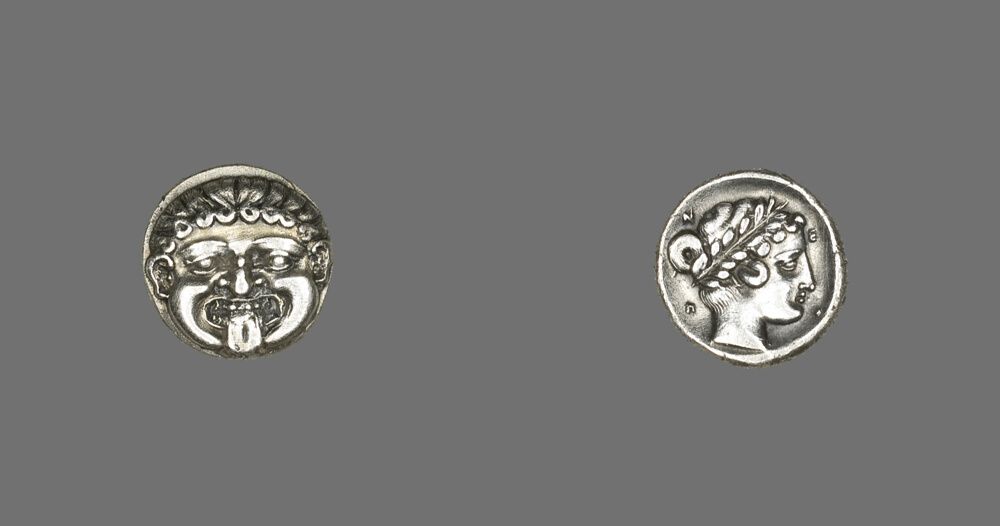
Drachm (Coin) Depicting the Gorgon Medusa - Kavála, 411-356 BCE, Silver
The Art Institute of Chicago, Chicago, IL, 1922.4922. CC0
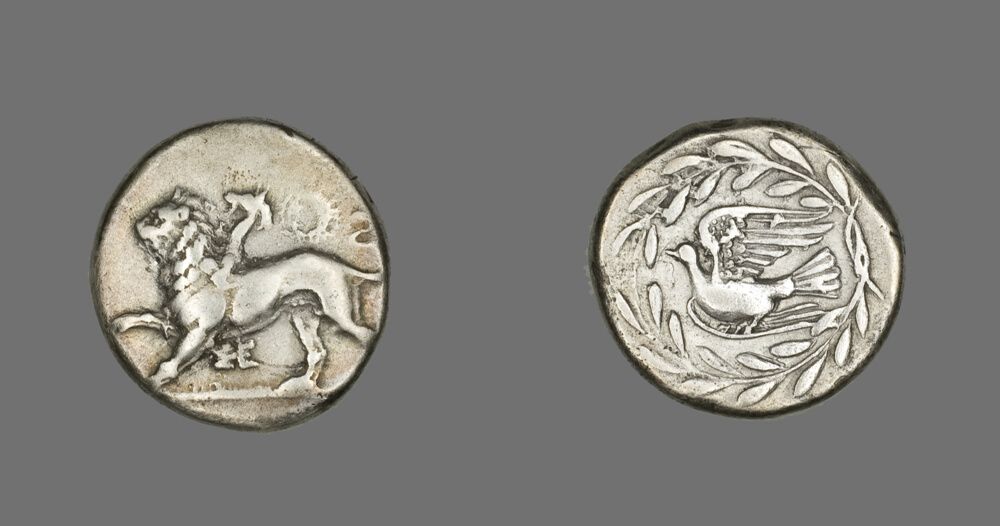
Aeginetic Stater (Coin) Depicting a Chimera - Sikión, 431-400 BCE, Silver
The Art Institute of Chicago, Chicago, IL, 1923.1164. CC0
Where Accounts Differ
- medusa-born-monster-vs-transformed
- hydra-head-count-varies
- homers-cyclops-vs-hesiods-cyclopes
- cerberus-head-count-varies
- sirens-bird-not-fish
- Cerberus's head count varies as sharply as the Hydra's. Hesiod's Theogony gives him fifty heads. The three-headed image that dominates later art and popular retelling has no ancient text that explicitly replaces the fifty-headed original.
- No ancient text or artwork gives the Sirens a fish's tail. Every Greek and Roman source shows them as bird-bodied: a woman's head and torso set on a bird's wings, legs and claws. The fish-tailed mermaid image is a later, medieval invention that blended the Siren with unrelated mermaid folklore.
- The Minotaur does not belong to the Typhon-and-Echidna lineage that produces most of this cluster. It is a punishment for King Minos's broken vow to Poseidon. It was born from Queen Pasiphae's union with a bull, not descended from any primordial monster pair.
Related Terms
Referenced By
Sources
- Hesiod, Theogony 270-279
- Hesiod, Theogony 306-332
- Hesiod, Theogony 139-146
- Apollodorus, Library 2.4.2
- Apollodorus, Library 2.5.2
- Apollodorus, Library 1.9.25
- Ovid, Metamorphoses 4.706-803
- Homer, Odyssey 9.106-115
- Homer, Odyssey 12.85-125
- Homer, Odyssey 12.101-110
- Diodorus Siculus, Bibliotheca Historica 4.11