Medusa
Medusa is the only mortal one of the three Gorgon sisters, monstrous beings with snakes for hair and a petrifying gaze. She was beheaded by the hero Perseus, and her severed head retained its power to turn onlookers to stone.

Medusa, the mortal Gorgon of Greek myth
Generated by AI from this page's own facts, not an ancient image or evidence of anything. How this site uses generated images
Sections on this page
What does the name "Medusa" mean? →
See Medusa in the Greek family tree. Looking for a name of your own? Try the mythological name generator.
Core Myth
Hesiod places Medusa as one of three daughters Ceto bore to Phorcys, the Gorgons, who live beyond the stream of Ocean. Her two sisters, Stheno and Euryale, are immortal and ageless; Medusa alone is mortal, and that single fact is what makes her killable and therefore what gives Perseus a quest instead of an impossible one. Hesiod adds a detail Ovid's later version depends on: Poseidon lay with her in a soft meadow among spring flowers, well before Perseus ever comes near her. Ovid's weaver also shows the god as a bird hovering round Medusa, in the tapestry of Arachne and Athena. Hesiod's sea is peopled by Nereids in human form, and the fish-tailed mermaid appears only in later writing (Theogony 240-264).
Apollodorus supplies the plot Hesiod does not: sent by King Polydectes to bring back her head, Perseus approaches the Gorgons' lair with a curved sword from Hermes, winged sandals, Hades's cap of invisibility, and a knapsack for the head. Because a direct look turns a man to stone, he watches Medusa's reflection in his bronze shield and cuts off her head without meeting her eyes. From her severed neck spring two children conceived with Poseidon: the winged horse Pegasus and the warrior Chrysaor, both born fully formed at the moment of her death, not before it. Hesiod adds that Chrysaor later fathered the three-headed Geryon with Callirhoe, a daughter of Ocean.
Ovid, writing centuries later, gives Medusa a backstory Hesiod never mentions: she was once a beautiful young woman, admired above all for her hair, until Poseidon violated her inside Athena's own temple. Athena, unable to punish a god, turned her anger on the victim instead and transformed Medusa's hair into snakes. The two accounts do not describe the same event so much as answer different questions - Hesiod explains what she is and how she dies; Ovid explains why.
Why was Medusa the only Gorgon who could be killed?
Hesiod is explicit that her two sisters, Stheno and Euryale, are immortal and ageless, while Medusa alone is mortal. That single distinction is what turns Perseus's task from impossible into merely dangerous: a hero sent after an immortal target would have no story to complete, so the entire quest depends on the Gorgons not being identical.
Hesiod, Theogony 270-283
How did Perseus manage to look at Medusa without being turned to stone?
He never looked at her directly. Apollodorus describes him watching her reflection in his polished bronze shield, a gift arranged with Athena's help, while he approached and struck. The gaze had to meet the viewer's own eyes to work, so a reflected image let Perseus see exactly where to strike without triggering the curse.
Apollodorus, Library 2.4.2
What was born from Medusa's severed neck?
The winged horse Pegasus and the warrior Chrysaor, both children of Poseidon conceived before her death, sprang out fully formed the instant Perseus cut off her head. Hesiod treats their birth as simultaneous with the beheading rather than something that happened earlier and was merely revealed by it.
Hesiod, Theogony 280-283
Was Medusa always a monster, or was she once human?
That depends which author you read. Hesiod never describes her as anything but a monstrous Gorgon from birth. Ovid, writing in Rome centuries later, tells a different story: Medusa was a beautiful mortal woman, admired for her hair, until Poseidon violated her inside Athena's temple and Athena punished her by turning her hair to snakes. The two versions are not contradictory drafts of one story so much as answers to different questions about her.
Ovid, Metamorphoses, Book 4
Why did Athena punish Medusa and not Poseidon?
In Ovid's telling, Athena could not act against a fellow god for what Poseidon did, so her anger fell on the one target within her power, the victim herself. The text does not present this as fair; it presents it as what a god without recourse against another god actually does, which is part of why the episode reads so differently to modern audiences than it likely did to Ovid's original readers.
Ovid, Metamorphoses, Book 4
Later Traditions
Medusa's severed head, the Gorgoneion, was mounted on Athena's aegis and became one of the most widely reproduced protective images in the Greek world, carved onto temple pediments, shields, and roof tiles to ward off evil by meeting a threat with a worse one. Roman writers inherited both the monster and the mortal-victim reading side by side without resolving the contradiction between them. Modern feminist scholarship has returned to Ovid's version specifically, reading Medusa as a victim punished for another's crime rather than as a monster in her own right.

Terracotta reilef roundel with head of Medusa - Greek, 2nd century BCE, Terracotta
Metropolitan Museum of Art, New York, NY, 98.8.30. CC0
Lineage
See the full family tree1 recorded relation, each with the ancient line behind it.
Children

Also Connected
1 recorded connection, each with the ancient line behind it.
Connected
-
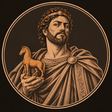
Polydectes held Perseus to his boast of bringing the Gorgon's head.
Where Accounts Differ
- origin variant
- Origin variant: Hesiod presents Medusa as a Gorgon from birth, with no backstory beyond her parentage and her death. Ovid's account of her as a violated mortal woman transformed as punishment is a later Roman addition, and the two are read for different purposes rather than reconciled.
Read the full source verification →
Mythology
Appears In
Killed By
Related Terms
Referenced By
Sources
- Hesiod, Theogony 270-283
- Apollodorus, Library 2.4.2
- Ovid, Metamorphoses, Book 4
- Hesiod, Theogony 287-294
- Ovid, Metamorphoses 6.87-145
- Stephen R. Wilk, Medusa: Solving the Mystery of the Gorgon (2000)
- Timothy Gantz, Early Greek Myth (1993)