Arachne and Athena
Arachne was a mortal weaver of Lydia who would not admit that Athena had taught her, and who challenged the goddess to a contest. In Ovid's telling, Athena wove a warning about presumption while Arachne wove the gods' seductions, and Athena could find no flaw in her rival's work. Enraged, Athena tore the tapestry, struck Arachne, and after Arachne tried to hang herself, turned her into the first spider.
Sections on this page
What Led To It
The only full ancient telling of Arachne's story that this page has verified is Ovid's, in Metamorphoses 6.1-145. Ovid was a Roman poet writing in Latin, so the goddess is Minerva and her rival gods are Jupiter, Neptune and Saturn. The setting and the characters are Greek: Lydia, Colophon, Mygdonia and Athena's contest with Poseidon over Athens. The Roman side of the goddess is on the Minerva page.
In Ovid the story follows a song of the Muses that Athena has just heard and approved. What Arachne does is what Greek thought calls hubris: a mortal treating herself as a god's equal. Ovid gives her a real gift and a real fault. She is the best weaver in Lydia, and she refuses to credit a teacher.
The Myth
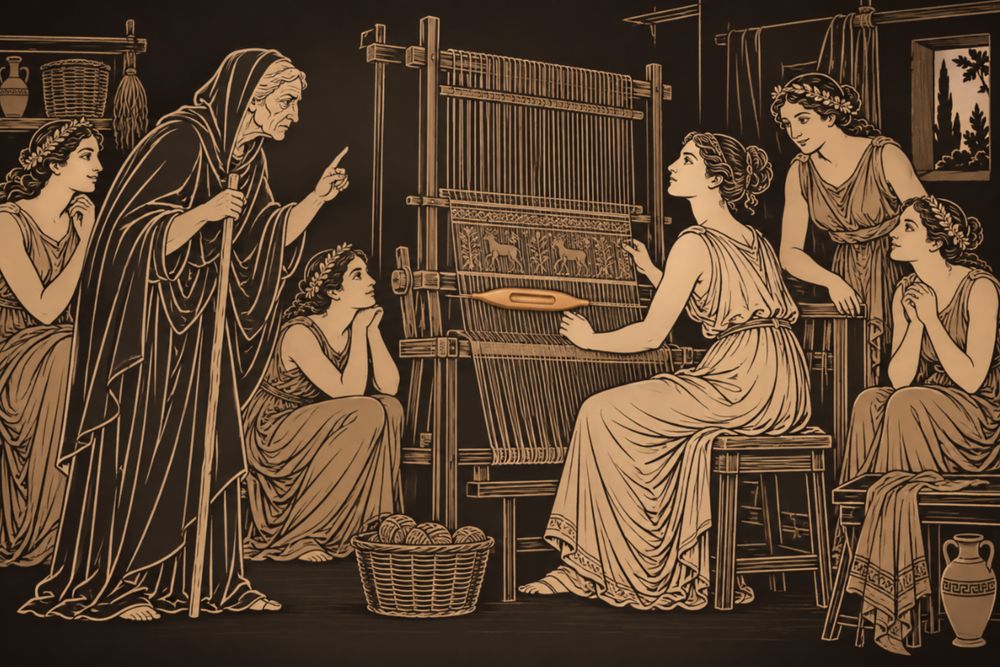
Athena warns Arachne in disguise
Generated by AI from this page's own facts, not an ancient image or evidence of anything. How this site uses generated images
Ovid ties the story to the scene just before it. Athena (Minerva in Ovid's Latin) has heard the Muses sing and approves their song and their anger, but she thinks it is easy to praise someone else. She resolves that no earthly creature should slight her majesty, and her thoughts turn to Arachne, a girl of Lydia famous for her skill at weaving wool and for nothing else. Her father dyed wool in Phocean purple in Colophon, her mother was of low birth and dead, and Arachne lived in a small town.
She was so good that nymphs left the vineyards of Tmolus and the streams of the Pactolus to watch her card, spin and embroider. Ovid says every motion showed how much Minerva had taught her, but Arachne always denied it. She said, "Let her contend in art with me; and if her skill prevails, I then will forfeit all!"
Athena took her at her word. She came to Arachne disguised as an old woman with long grey hair and a staff, and gave her a warning. It is no harm to want praise from mortals, she said, but Arachne should not deny Minerva's art and should ask the goddess's pardon. Arachne dropped her thread, scowled, and could barely keep her hand from striking. She called the old woman a witless fool and told her to advise her own goddess to come and not avoid the contest. "Minerva comes to you!" the goddess answered, and put off the disguise. The nymphs and the women of Mygdonia bowed. Arachne stood defiant, flushed, went pale, and blushed again.
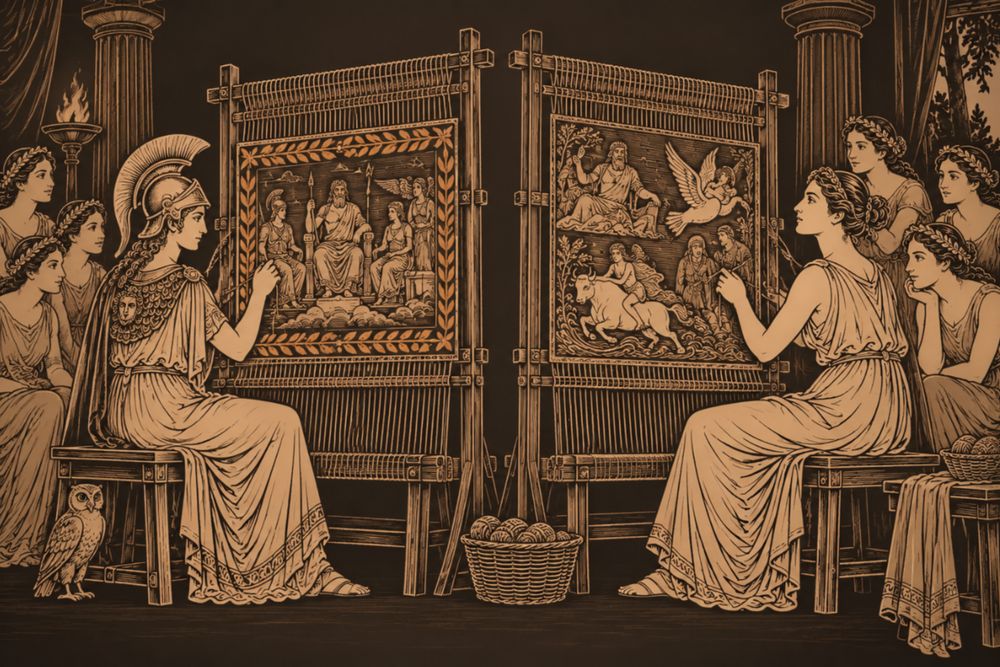
The weaving contest
Generated by AI from this page's own facts, not an ancient image or evidence of anything. How this site uses generated images
Both women set up looms at once and wove without a word more. Ovid's Athena wove the hill of Ares in Athens, where Cecrops built his citadel, and the old contest over the city's name. Twelve gods sit on high thrones around Zeus, each drawn so that he can be told apart. Poseidon strikes the rock with his trident and a horse springs out, and Athena, with shield, spear and aegis, makes an olive tree sprout from the earth. The gods judge that the olive is the better gift. This is the contest told in The Birth of Athena and her own page.
In the four corners she wove warnings, small and brightly coloured. Rhodope and Haemus were turned into mountains for aspiring to rival the high gods. A Pygmy queen was changed into a crane by Hera, because she thought herself the equal of the gods. Antigone, Laomedon's daughter, who compared herself to Hera, became a stork. And Cinyras wept on the steps of a temple that had once been his daughter's living limbs. Athena finished with a border of olive. Her whole web says one thing: this is what presumption earns.
Arachne wove the opposite. She wove the gods' seductions and deceptions, and Ovid lists them. Zeus comes as the bull that carries off Europa (The Rape of Europa), as an eagle to Asteria, as a swan to Leda, as a satyr to Antiope, as Amphitryon to Alcmena, as a shower of gold to Danae, as a flame to Aegina, as a shepherd to Mnemosyne, and as a spotted snake to Persephone. Poseidon appears as a bull, a river, a ram, a horse, a bird with Medusa, and a dolphin. Apollo shows up as a rustic, a hawk, a lion and a shepherd. Dionysus is a cluster of false grapes and Saturn a stallion. Arachne bordered the web with flowers and ivy. Ovid adds that all of it was woven true to life.
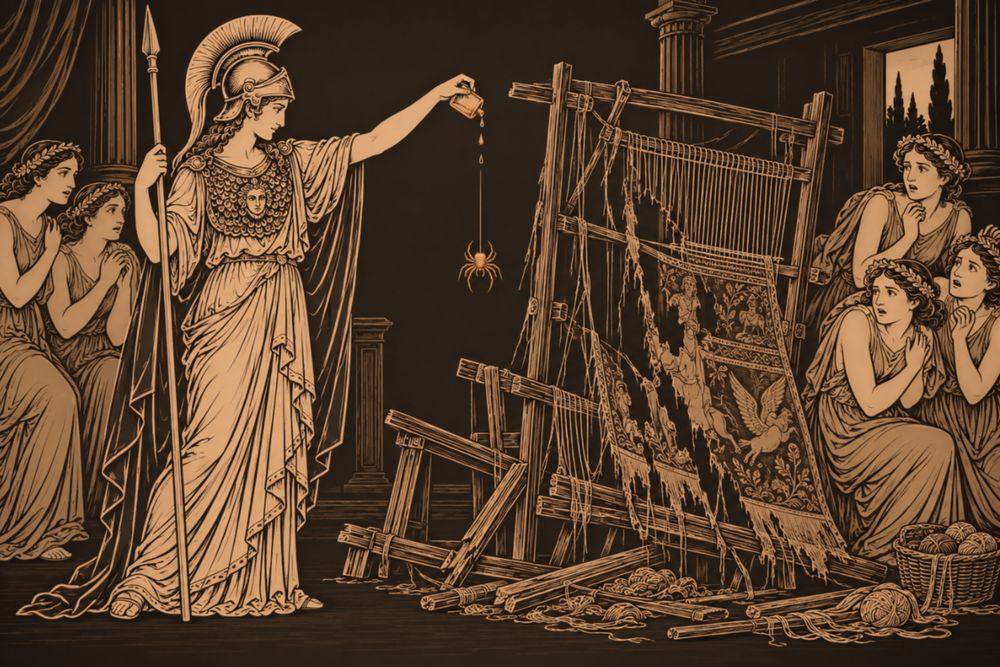
Athena turns Arachne into a spider
Generated by AI from this page's own facts, not an ancient image or evidence of anything. How this site uses generated images
Athena could find no flaw. Ovid says even Envy cannot censure perfect art, and she was enraged because Arachne had such skill. She tore the web to pieces, ruining the scenes of the gods' wicked actions, and struck Arachne on the head with her boxwood shuttle, sharply three times and then once more. Arachne would not bear the insult. She tied a cord around her neck and hung herself.
Athena pitied her at the sight, held her up and saved her from that death, but was angry still. She pronounced a different doom, given in the passage below. Then, before withdrawing, she sprinkled Arachne with a juice made from herbs of Hecate. At once Arachne's hair fell off, and her nose and ears with it. Her head shrank, and so did her whole body. Her slender fingers gathered to her sides as long thin legs, the rest of her was absorbed into her belly, and from it she drew a fine thread. Ovid ends: "ever since, Arachne, as a spider, weaves her web."
Although I grant you life, most wicked one, your fate shall be to dangle on a cord, and your posterity forever shall take your example, that your punishment may last forever!
What Followed
Ovid ends with the transformation, and gives it no later scene. What survives is the spider itself. Virgil, in Georgics 4.246-247, lists among the dangers to a beehive a spider that hangs its web across the doorway and calls it the victim of Minerva's spite. He does not name Arachne, but the line shows Latin readers already linked the spider to Minerva's anger.
The word carried on. Greek arakhne means spider and spider's web, and in 1815 the French naturalist Lamarck named the class Arachnida from it, the group that holds spiders, scorpions and mites.
Afterlife and Modern Influence
Velazquez's The Spinners, or the Fable of Arachne, now in the Prado in Madrid, shows a tapestry workshop in the foreground and, in the background, a woven scene of the rape of Europa, one of the panels Ovid gives to Arachne. Art historian Diego Angulo argued that the workshop scene is really Ovid's contest, and that reading is now generally accepted. Sources I checked disagree on the year Angulo proposed it, so it is left out here.
Why was Arachne changed into a spider?
Because Athena, enraged that she could find no flaw in Arachne's tapestry, punished her. In Ovid, Athena tore the web and struck Arachne, who then hung herself. Athena saved her from that death but sentenced her to dangle on a cord forever, and sprinkled her with a juice from Hecate's herbs that shrank her into a spider.
Ovid, Metamorphoses 6.88-145
How is Arachne related to spiders?
In Ovid's myth she is the first spider: her body shrinks, her fingers become legs and she spins thread from her belly, and Athena says her descendants will follow her example. Arachne is the Greek word for spider, and the class Arachnida, holding spiders, scorpions and mites, takes its name from it.
Ovid, Metamorphoses 6.88-145
Is Arachne Greek or Roman mythology?
Both, in a way. The only full ancient telling is by Ovid, a Roman poet writing in Latin, so the goddess is called Minerva. But the setting and figures are Greek: Arachne lives in Lydia, and Minerva stands for Athena. Virgil, also a Roman poet, mentions the spider as the victim of Minerva's spite. No earlier Greek telling is cited here.
Ovid, Metamorphoses 6.1-87; Virgil, Georgics 4.246-247
Was Arachne a better weaver than Athena?
Ovid says her work had no flaw. Athena looked for a fleck and could not find one, and her rage came because Arachne had such skill. Ovid names no judge and gives no verdict. Athena ends the contest by tearing the web, and the story never says the goddess lost or won on merit.
Ovid, Metamorphoses 6.88-145
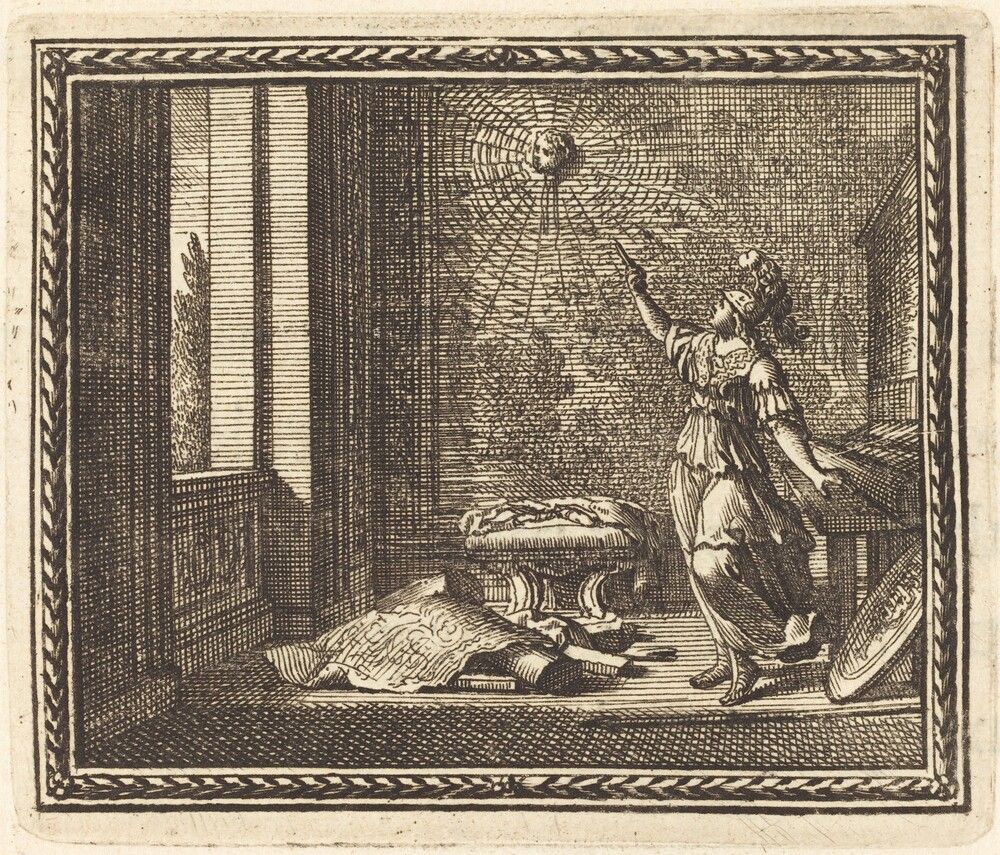
Minerva Changing Arachne into a Spider - Jean Lepautre, published 1676, etching and engraving on laid paper
National Gallery of Art, Washington, DC, 1988.49.2. CC0
Where Accounts Differ
- ovid-only-full-telling
- roman-names-greek-setting
- tapestry-contents
- who-won-the-contest
- Only one full ancient telling is cited. Ovid, Metamorphoses 6.1-145, is the whole narrative. Virgil, Georgics 4.246-247, mentions the spider as the victim of Minerva's spite without naming Arachne. No Greek source for Arachne is cited on this page, because none was verified.
- Ovid writes Roman names: Minerva, Jupiter, Neptune, Bacchus and Saturn. This page uses Athena, Zeus, Poseidon and Dionysus in its own voice and says so where it quotes.
- Ovid reports Arachne's own denial of Athena as her teacher but does not say whether it is true: the narrator says every motion showed how much Minerva had taught her, and that Arachne would deny it.
- The tapestries are Ovid's own device. Athena's four corner scenes and Arachne's list of divine deceptions appear in Metamorphoses 6.1-145 and are not confirmed by any other source here, so they are not an independent tradition.
- The Antigone in Athena's third corner is Laomedon's daughter of Troy, changed into a stork, not the daughter of Oedipus, so the page does not link her to the Theban Antigone.
Read the full source verification →
Mythology
Figures In This Myth
Also Connected
Related Terms
Referenced By
Sources
- Ovid, Metamorphoses 6.1-87
- Ovid, Metamorphoses 6.88-145
- Virgil, Georgics 4.246-247
- Online Etymology Dictionary, entry for arachnid
- Museo Nacional del Prado, The Spinners, or the Fable of Arachne (Velazquez)