Danaë
Danaë is the daughter of King Acrisius of Argos. Warned by an oracle that a son of hers would kill him, Acrisius locked her in an underground bronze chamber, but Zeus reached her as a shower of gold. She bore Perseus, and when Acrisius discovered the child he set mother and son adrift at sea in a wooden chest, which washed ashore on Seriphos.

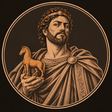
Danae, mortal mother of the hero Perseus
Generated by AI from this page's own facts, not an ancient image or evidence of anything. How this site uses generated images
Sections on this page
See Danaë in the Greek family tree.
Core Myth
Apollodorus opens the story with the oracle: Acrisius, king of Argos, asks how he might have sons, and the god answers that a son born to his daughter Danaë will kill him. Apollodorus does not say which oracle he consulted. To prevent any child at all, he builds a chamber of bronze underground and shuts her in it. Zeus reaches her anyway, coming down through the roof as a shower of gold, and she conceives Perseus.
When Acrisius learns of the birth he does not believe Zeus is responsible. He has mother and infant sealed into a wooden chest and cast into the sea, unwilling to kill his own daughter outright but content to let the sea do it for him. The chest drifts to the island of Seriphos, where a fisherman named Diktys draws it in with his net and raises Perseus as his own. Diktys's brother, King Polydectes, later wishes to marry Danaë against her will and sends the grown Perseus after the Gorgon Medusa specifically to be rid of him.
The oracle is fulfilled at the end of the story rather than during it: years later, an adult Perseus accidentally kills Acrisius with a discus at funeral games, without recognizing him, at a city far from Argos.
Why did Acrisius lock Danaë in a bronze chamber?
An oracle told him that a son born to Danaë would kill him. Acrisius had no son of his own, so he tried to remove the possibility of a grandson entirely by building an underground chamber of bronze and shutting her inside it, sealed away from any man. Zeus was not stopped by the walls, since a god does not need a door.
Apollodorus, Library 2.4.1
How did Zeus reach Danaë in the bronze chamber?
He came down through the roof of the chamber as a shower of gold, and she conceived Perseus by him. The image became one of the most repeated in Greek and later Roman art precisely because it makes visible what no lock can stop: a god's approach leaves no broken door and no witness, so Acrisius cannot even prove how it happened.
Apollodorus, Library 2.4.1
Why did Acrisius set Danaë and Perseus adrift instead of killing them?
Apollodorus does not give a single stated reason, but the act itself is a common pattern in Greek myth for a king unwilling to kill family directly: casting mother and child into the sea in a sealed chest lets the sea take the blame instead of the king's own hand. Acrisius did not believe Zeus was the father and treated the birth as proof of a human affair, which he punished this way rather than with outright execution.
Apollodorus, Library 2.4.1
Where did Danaë and Perseus land after being cast to sea?
Their chest washed ashore on the island of Seriphos, where a fisherman named Diktys found it in his net and raised Perseus. Diktys's brother, King Polydectes, ruled the island and later wanted to marry Danaë; it is Polydectes who sends the grown Perseus after Medusa's head, hoping the quest will kill him and leave Danaë free to marry.
Apollodorus, Library 2.4.1
Did the oracle about Acrisius come true?
Yes, though neither man intended it. Years after Perseus and Danaë settled on Seriphos, an adult Perseus competed at funeral games in a distant city where Acrisius happened to be present, and a discus Perseus threw struck and killed him by accident. Perseus did not know his grandfather was in the crowd, which is the detail later authors return to: the oracle is fulfilled exactly, and avoided by no wall or exile.
Apollodorus, Library 2.4.4
Later Traditions
Sophocles wrote a tragedy, now lost, on Danaë's imprisonment, and the myth is a common subject on Roman sarcophagi and in later European painting, where the shower of gold is usually read as an image of Zeus's power to enter any enclosure. In Ovid's contest of Arachne and Athena, the weaver's tapestry shows Zeus courting Danaë as a gleaming shower of gold. Horace treats the bronze tower as proof that no wall keeps out gold, turning the story into a comment on bribery rather than divine desire.

Lineage
See the full family tree2 recorded relations, each with the ancient line behind it.
Parents
-

Her mother, in Apollodorus, is Eurydice, a daughter of Lacedaemon.
Children

Also Connected
2 recorded connections, each with the ancient line behind it.
Enemies
-
Danae and Dictys fled to the altars from his violence; Hyginus instead has him marry her.
Connected
-

Zeus reached her inside her sealed bronze chamber as a shower of gold, the single event her entire recorded myth turns on.
Where Accounts Differ
- how she reached Seriphos
- Apollodorus gives the fullest connected account of the chamber, the chest, and the landing at Seriphos; later Roman sources (sarcophagi, Horace) treat the shower of gold mainly as an image rather than retelling the surrounding plot.
Read the full source verification →
Mythology
Appears In
Related Terms
Referenced By
Sources
- Apollodorus, Library 2.4.1
- Apollodorus, Library 2.4.4
- Pindar, Pythian Ode 12
- Ovid, Metamorphoses 6.87-145
- Timothy Gantz, Early Greek Myth (1993)