Perseus
Perseus is a demigod son of Zeus and the mortal Danaë, sent by King Polydectes to fetch the head of the Gorgon Medusa on what was meant to be a fatal errand. With divine aid from Athena, Hermes, and the nymphs, he beheaded Medusa using a mirrored shield, then used her petrifying head to rescue the princess Andromeda and found the Mycenaean dynasty.

Perseus, the hero who slew Medusa
Generated by AI from this page's own facts, not an ancient image or evidence of anything. How this site uses generated images
Sections on this page
What does the name "Perseus" mean? →
See Perseus in the Greek family tree. Looking for a name of your own? Try the mythological name generator.
Core Myth
Perseus was the son of Zeus and Danaë, conceived when Zeus visited her as a shower of gold. King Polydectes of Seriphos sent Perseus on what he believed was a suicide mission: to bring back the head of Medusa, the only mortal Gorgon, whose gaze turned anyone to stone. With help from Athena and Hermes, Perseus obtained winged sandals, a cap of invisibility, and a magic satchel. Apollodorus says nymphs held this gear, and the Graeae showed Perseus the way only after he seized their single eye and tooth. He found the Gorgons asleep, approached Medusa using his polished shield as a mirror, and beheaded her. On his return journey, he used Medusa's head to rescue the princess Andromeda from a sea monster and to petrify Polydectes. Perseus became the legendary ancestor of the Perseid dynasty of Mycenae.
How did Perseus kill Medusa without being turned to stone?
He never looked at her directly. Athena and Hermes equipped him with a polished bronze shield, and Perseus approached the sleeping Gorgon watching her reflection in it, guiding the killing blow by sight of the mirror image rather than the creature itself. He also had a cap of invisibility and winged sandals from the nymphs to escape her two immortal Gorgon sisters afterward.
Apollodorus, Library 2.4.2-2.4.3
Why could Medusa be killed if the other Gorgons were immortal?
Apollodorus specifies that of the three Gorgon sisters, only Medusa was mortal; Stheno and Euryale could not be killed at all. This is why Perseus's mission specifically targeted Medusa rather than any Gorgon, and why her sisters could pursue him afterward but never stop him.
Apollodorus, Library 2.4.2
What came out of Medusa's body when she was beheaded?
Ovid and Apollodorus both record that the winged horse Pegasus and the warrior Chrysaor sprang from her neck at the moment of decapitation, born from her union with Poseidon before her death. Perseus later gave Pegasus no further role in his own story; the horse passes into other myths, most famously Bellerophon's.
Ovid, Metamorphoses 4.604-5.249
How did Perseus rescue Andromeda?
On his way back from Medusa, Perseus found Andromeda chained to a rock on the coast of Aethiopia, offered as a sacrifice to a sea monster sent to punish her mother Cassiopeia's boast of being more beautiful than the Nereids. In Ovid he killed the monster with his sword, not with Medusa's head, and claimed Andromeda as his wife; the petrifying head comes out only afterward, against Phineus and his men.
Ovid, Metamorphoses 4.604-5.249
Did Perseus really kill his grandfather Acrisius?
Yes, though by accident and without recognizing him. Years after settling on Seriphos, Perseus competed at funeral games in a foreign city where Acrisius happened to be a spectator; a discus Perseus threw went astray and struck the old man, killing him. This fulfilled the original oracle without either man intending it.
Apollodorus, Library 2.4.4
What is Perseus's connection to the invention of the aulos?
Pindar's twelfth Pythian ode credits Athena with inventing the aulos, a double reed pipe, specifically to imitate the mourning wail of Medusa's Gorgon sisters after Perseus killed her, then gave the instrument to mortals. The ode treats Perseus's feat as the indirect origin of a real musical tradition rather than only a monster-slaying story.
Pindar, Pythian Ode 12
Later Traditions
Perseus remained one of the most celebrated heroes in both Greek and Roman tradition. His constellation and that of Andromeda were placed among the stars, making them permanent features of the night sky. Pindar's Pythian 12 treats his slaying of Medusa as the origin of a specific cultural artifact: the goddess Athena is said to have invented the aulos, a reed instrument, to imitate the mourning cry of Medusa's surviving Gorgon sisters. Herodotus later records that the Persians claimed descent from Perseus, an example of Greek myth being reused to explain a foreign people's own origins.

Coin Depicting the Hero Perseus - Greece, 178-168 BCE, Bronze
The Art Institute of Chicago, Chicago, IL, 1923.1224. CC0
Lineage
See the full family tree2 recorded relations, each with the ancient line behind it.


Also Connected
1 recorded connection, each with the ancient line behind it.
Connected
-
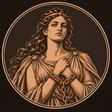
Perseus killed the sea monster, freed her from the rock and married her.
Read the full source verification →
Mythology
Appears In
Related Terms
Referenced By
Sources
- Apollodorus, Library 2.4.2-2.4.4
- Ovid, Metamorphoses 4.604-5.249
- Pindar, Pythian Ode 12
- Timothy Gantz, Early Greek Myth (1993)